Khyber Pakhtunkhwa (KP) Terrorism Watch

Tablighi Jamaats need regulation and supervision. There was a rumor in early 2000s, they were registering people for suicide bombings while moving around for "Tabligh".
 

Death toll from suicide bombing near police station in Swat rises to 19

Fazal Khaliq
August 3, 2026

1785758888380.png

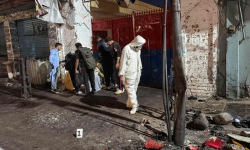
Police officials inspect the site following a suicide bombing during a protest in Swat district on August 2. — AFP

SWAT: The death toll from Sunday’s suicide bombing near a police station in Swat rose to 19 on Monday, with police saying that four more victims had succumbed to their injuries.

The suicide bombing had taken place near the Kabal Police Station while a protest against lawlessness was under way at the adjoining public square. Police said that the suicide bomber had detonated his explosives after police personnel attempted to stop and search him at the entrance to the police station.

The bombing had claimed the lives of 15 people, including police officials, and left 18 injured.

“However, four more victims succumbed to their injuries during treatment, raising the death toll to 19,” Swat police spokesperson Nasir Iqbal Karimi said in a statement.

The statement added that a large-scale rescue operation was launched immediately after the attack, in which more than 50 Rescue 1122 personnel participated.

“Rescue teams provided first aid at the scene before shifting the injured to various hospitals for further treatment. Authorities are continuing relief efforts as investigations into the suicide attack remain under way,” it said.

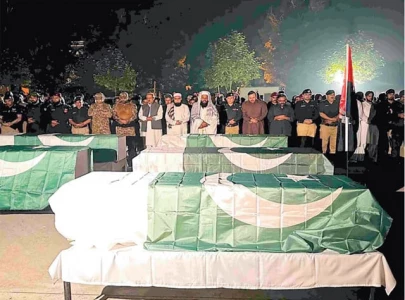
In a separate statement, Swat police said the funeral prayers of two policemen martyred in the suicide attack were held at Javed Iqbal Shaheed Police Lines on Monday.

A smartly turned-out police contingent presented a guard of honour to Constable Mukarram Khan and Constable Hussain Khan, and floral wreaths were laid on their coffins.

The ceremony was attended by Malakand Regional Police Officer Syed Fida Hassan Shah, Swat District Police Officer Muhammad Umar Khan, Superintendent of Police (operations) Ghulam Sadiq Khan, Superintendent of Police (headquarters) Ataullah, and other senior police officers.
 

Cleric killed after explosion at supermarket in South Waziristan's Wana

AK Wazir
August 3, 2026

LOWER SOUTH WAZIRISTAN: A cleric was killed following an explosion, suspected to have been caused by a pressure bomb, at a supermarket in Lower South Waziristan’s Wana on Monday, police said.

Wana Circle Deputy Superintendent of Police (DSP) Asghar Ali Shah told Dawn that the explosion occurred on the ground floor of a supermarket located in Rustam Bazaar.

He said Mufti Jana Mir Masti Khel sustained critical injuries in the explosion and was immediately shifted to Wana district headquarters hospital, where he succumbed to his injuries.

The DSP added that he and Wana City Police Station House Officer Usman Wazir, along with a large contingent of police, reached the site of the incident after the explosion, and the area was cordoned off while investigators collected forensic evidence.

DSP Shah said initial investigation suggested the bomb was planted to target the cleric.

He said police had filed an initial complaint and further investigation was under way to identify the perpetrators and determine the motive behind the attack.

The incident comes just three days after unidentified gunmen shot dead Maulana Ismail, a cleric affiliated with Jamiat Ulema-i-Islam-Fazl (JUI-F), in Azam Warsak Bazaar of Lower South Waziristan’s Birmal tehsil.

On July 28, a local cleric was killed and two other people were injured in a suspected quadcopter attack near a mosque in the Landi Doag area of Birmal.

In January, JUI-F leader Maulana Sultan Muhammad Wazir was critically injured in a bomb blast near a madressah in South Waziristan’s Wana Bazaar area and later succumbed to his injuries.
 
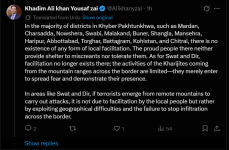
" To compare Punjab and Khyber Pakhtunkhwa on the matter of security, peace, and border management, it is essential to understand a few key and fundamental facts. The biggest secret behind Punjab's secure situation is that no foreign or local terrorist group there receives logistic support, safe havens, or assistance from the local population for accommodation or reconnaissance. In Punjab, at both urban and rural levels, if any suspicious person arrives and stays, they immediately fall into the grip of the law due to biometric registration, tenancy forms, and a robust local intelligence system. The common citizen or landowner there does not shelter explosives or terrorists in their area for the sake of a few thousand rupees or political and religious influence.

In contrast, the local facilitation occurring at every level in certain specific areas of Khyber Pakhtunkhwa—particularly in North and South Waziristan, the outskirts villages of Bannu, the two tehsils of Bajaur, Loe Mamund and Ude Mamund, and the Tirah Valley in Khyber—is a naked truth. Until an internal facilitator shows the way, conducts reconnaissance, and opens the door of their own home, no miscreant coming from across the border can so easily infiltrate the local population and carry out operations. You must listen to the interview of senior journalist Fakhr Kaka Khel; the point he highlighted is a matter of historical record. If one examines the list of central and regional commanders of Tehrik-e-Taliban Pakistan and other banned organizations, their affiliations trace back to precisely these specific areas, where they not only received manpower locally for operations against security forces but were also provided every kind of protection. Mullah Fazlullah, Maulvi Faqir Muhammad, Umer Khalid Khorasani, Tariq Afridi, Mangal Bagh, Baitullah Mehsud, Abdullah Mehsud, Khan Said Sajna, Hakimullah Mehsud, the current emir Mufti Noor Wali Mehsud, Adnan Rashid, Hafiz Gul Bahadur, and Shehryar Mehsud are included. All these faces emerged from our Khyber Pakhtunkhwa; they poisoned the minds of their own people's children and maintained their training camps and facilitators in precisely these areas.

Punjab's peace is no accidental miracle or divine gift from the unseen. When attacks occurred in various cities of Punjab, they carried out revolutionary work on their security infrastructure. Punjab freed the Counter-Terrorism Department, or CTD, from the influence of traditional police and molded it into a modern, technology-equipped, and autonomous intelligence agency. They completely neutralized all sleeper cells of old sectarian and banned organization networks. All major cities were linked with Safe City projects, night-vision cameras, and integrated command centers, making the movement of explosives or weapons impossible. In comparison, within Khyber Pakhtunkhwa, policing—and especially law enforcement agencies in border and tribal districts—were neither equipped with technology in this manner nor was a permanent, empowered CTD system free from political and local interference established.

The threat on the eastern border comes from India's regular army, where the forces of two organized states stand face-to-face along the international border with regular fencing, lighting, and checkpoints, and guerrilla-style infiltration by non-state elements from across the border is not possible there. In contrast, the western border consists of a 2,600-kilometer-long, extremely rugged mountain range, on the other side of which lies Afghanistan, plagued by decades of instability where TTP has established safe havens. In this rugged environment, as long as black sheep providing facilitation from within for a few coins remain present, completely eliminating this menace will remain a major challenge for the security forces. Punjab's proud youth is also the son of this same country, offering the sacrifice of their lives on the front lines against both the Fitna al-Hindustan and the Khawarij. Peace is not established merely through emotional speeches or narratives of victimhood; rather, it is established by identifying internal facilitators, modernizing and empowering the police and CTD in the Punjab mold, and conducting impartial operations against internal sleeper cells." Khadim Ali khan Yousaf zai
To view this content we will need your consent to set third party cookies.
For more detailed information, see our cookies page.


pashtuns always ask why there is peace in punjab, implying army conspiracy. here is another pashtun telling them why.
1785759255181.png
 
Random bombing would be pointless

They've already removed millions of Afghans from the country
And they will remove millions more

The border closures cause Afghanistan major economic pain

And as civil war ramps up inside Afghanistan, the aim will be to keep Afghans busy inside Afghanistan
So in other words, the conventional military strategy failed and now strategy changed to economic coercion and militant activity?
 
So in other words, the conventional military strategy failed and now strategy changed to economic coercion and militant activity?

maybe it finally gave groups inside Afghanistan opportunity to rise up knowing taliban will not find any place to hide in Pakistan this time. That Taliban utterly failed to defend themselves from attacks and protect Afghanistan sovereignty. Pakistan bombing Afghan taliban is behind rise of resistance groups.
 
So in other words, the conventional military strategy failed and now strategy changed to economic coercion and militant activity?

Not quite

The fall of the Afghan Republic was vital for Pakistani strategic interests

The Afghan Republic was a legitimate accepted government, that could link up with the U.S, India etc etc get funds, support for it's military

So destroying the Afghan Republic, getting the U.S, NATO and India out of Afghanistan after decades of investment was vital

Because the Taliban are isolated, even at the best of times foreign states only have a limited leeway due to the chaos and ability of Pakistan to strike enemies there


The hope was the Afghans would calm down and see sense in trade and good relations
But the ethnocentric extremism is INCREDIBLE and very difficult to deal with, as a result over time they kept supporting TTP

Now this is bad, but it's not the same level as major strategic threat the Afghan Republic and U.S bases in Afghanistan posed


Their is simply no military policy for a state like Afghanistan, they have been fighting since forever, so more fighting doesn't phase them

But giving consequences to Afghans does

So for the sake of a suicide bombing often in the middle of nowhere, against other pashtun police or civilians

The Afghans have now had millions of Afghans kicked out of Pakistan
And millions more will follow
They have lost port access and trade and market access

Endlessly attacking Afghanistan is not a plan, Afghanistan is no small country and it diverts resources away from our real enemy, the Hindus


So this policy is in place to limit any Afghan terrorism and slowly turn the screws and cause serious pain to the Afghans over time

Now Afghanistan is seeing major military operations by opposition forces, and that will be used to keep the Afghans busy inside Afghanistan

The world is changing and Pakistan understands the wider implications, and it can't endlessly waste time on afghans or BLA Baloch

So the idea is let the police and FC deal with them and as long as the terrorism is kept to obscure backwards tribal areas, everyone else can get on with business
 
Not quite

The fall of the Afghan Republic was vital for Pakistani strategic interests

The Afghan Republic was a legitimate accepted government, that could link up with the U.S, India etc etc get funds, support for it's military

So destroying the Afghan Republic, getting the U.S, NATO and India out of Afghanistan after decades of investment was vital

Because the Taliban are isolated, even at the best of times foreign states only have a limited leeway due to the chaos and ability of Pakistan to strike enemies there


The hope was the Afghans would calm down and see sense in trade and good relations
But the ethnocentric extremism is INCREDIBLE and very difficult to deal with, as a result over time they kept supporting TTP

Now this is bad, but it's not the same level as major strategic threat the Afghan Republic and U.S bases in Afghanistan posed


Their is simply no military policy for a state like Afghanistan, they have been fighting since forever, so more fighting doesn't phase them

But giving consequences to Afghans does

So for the sake of a suicide bombing often in the middle of nowhere, against other pashtun police or civilians

The Afghans have now had millions of Afghans kicked out of Pakistan
And millions more will follow
They have lost port access and trade and market access

Endlessly attacking Afghanistan is not a plan, Afghanistan is no small country and it diverts resources away from our real enemy, the Hindus


So this policy is in place to limit any Afghan terrorism and slowly turn the screws and cause serious pain to the Afghans over time

Now Afghanistan is seeing major military operations by opposition forces, and that will be used to keep the Afghans busy inside Afghanistan

The world is changing and Pakistan understands the wider implications, and it can't endlessly waste time on afghans or BLA Baloch

So the idea is let the police and FC deal with them and as long as the terrorism is kept to obscure backwards tribal areas, everyone else can get on with business

I acknowledge your position but I disagree to an extent. Strategically the Afghans are not a threat - that is true. They are a tactical issue. Killing police here and there (soft targets) will not collapse the Pakistani state. But we have failed to inflict sufficient damage as to deter them. Kabul and Kandahar should be in ruins - all infrastructure destroyed. They should have to pay a huge material coat for any attack in Pakistan.

We need another full fledged op, but this time creating a 10km buffer zone we make a no mans land.

Too many of Pashtuns in Pakistan are disloyal. This is the other side of the coin. They find support in the local population. FATA needs to be taught a lesson they shall never forget.

PTI and their ilk are enemies of the state of Pakistan. They support these morons simply out of ethnonationalism.
 

Users who are viewing this thread

Back
Top