Lebanese president says Saudi Arabia to be 1st destination for foreign visits
Saudi crown prince conveyed congratulations on Aoun's election as president of Lebanon in phone call
Stephanie Rady |
11.01.2025 - Update : 13.01.2025
Lebanese President Joseph Aoun
BEIRUT
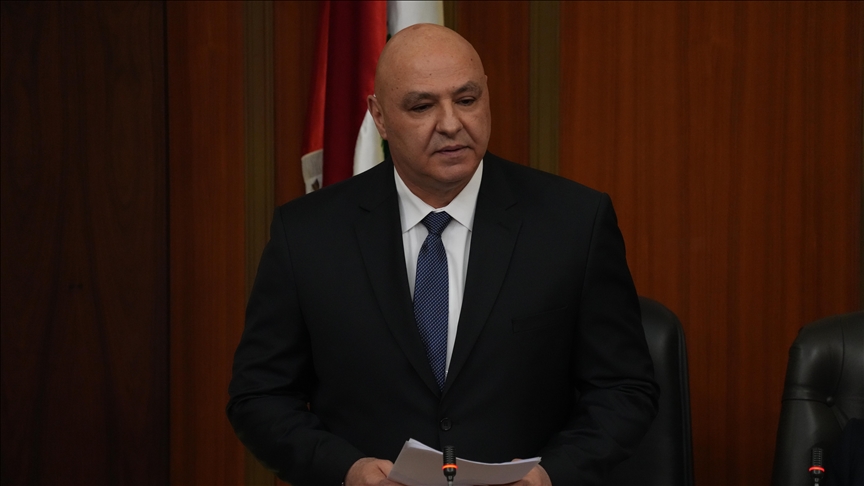
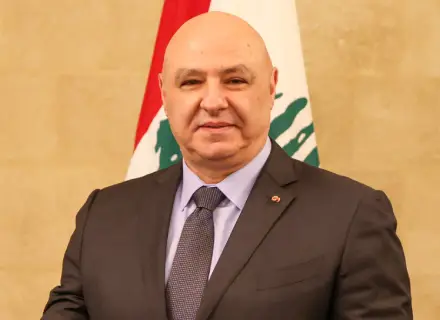
Lebanese President Joseph Aoun said on Saturday that Saudi Arabia will be his "first destination" for foreign visits after assuming office on Thursday.
In a statement, the Lebanese presidential palace confirmed that President Aoun had received a phone call from Saudi Crown Prince Mohammed bin Salman.
During the call, the crown prince conveyed the congratulations of King Salman bin Abdulaziz on Aoun's election as the president of Lebanon and extended an invitation for him to visit Saudi Arabia.
In response, Aoun confirmed that Saudi Arabia would be his first foreign visit, emphasizing the country's “historical role in supporting Lebanon” and the importance of Lebanon's Arab identity in shaping its regional relations.
The two leaders discussed "the latest developments and ways to strengthen the unique and historical relationship between Saudi Arabia and Lebanon," according to the statement.
Separately, President Aoun expressed his hope to form a Lebanese government "as soon as possible" to set the country on the right path and begin building bridges of trust with the international community.
During his first meeting with Lebanon’s Grand Mufti Sheikh Abdul Latif Derian at the Baabda Palace, Aoun reiterated that he is committed to building a state based on justice and equality for all of Lebanon's components.
On Friday, Aoun announced that parliamentary consultations to select a prime minister for the new government would begin on Monday.
Aoun was elected by the Lebanese parliament on Thursday, ending over two years of political vacuum since President Michel Aoun left office in October 2022.
*Writing by Ikram Kouachi in Ankara
Saudi crown prince conveyed congratulations on Aoun's election as president of Lebanon in phone call - Anadolu Ajansı

www.aa.com.tr
Saudi Foreign Minister meets President Joseph Aoun in historic visit to Lebanon
February 5, 2025
During the meeting, Prince Faisal and President Joseph Aoun discussed the latest developments in Lebanon
International Finance Business Desk
< 1 Min Read
Saudi Foreign Minister Prince Faisal bin Farhan visited Lebanon, where he was hosted by Lebanese President Joseph Aoun at Baabda Palace in Beirut. This marks the first visit by a senior Saudi official to Lebanon in over 15 years.
During their meeting, Prince Faisal and President Joseph Aoun discussed the latest developments in Lebanon and the region. The Saudi Foreign Minister reaffirmed Saudi Arabia’s ongoing support for Lebanon and its people. He conveyed greetings from King Salman, the Custodian of the Two Holy Mosques, and Crown Prince Mohammed bin Salman, wishing President Aoun, the government, and the Lebanese people further prosperity and development.
The meeting was attended by Saudi Ambassador to Lebanon Walid Bukhari, Assistant Director General of the Minister’s Office Walid Al-Samaeel, and Prince Yazid bin Mohammed bin Fahd Al-Farhan, the Foreign Minister’s advisor on Lebanese Affairs.
In a subsequent press briefing, Prince Faisal reiterated Saudi Arabia’s commitment to Lebanon, stressing the importance of reforms in boosting international trust in the country.
He also discussed the significance of adhering to the ceasefire agreement, expressing confidence in President Joseph Aoun and his prime minister’s ability to restore stability in Lebanon.
“We trust their ability to stabilise the country,” he said.
President Aoun welcomed the visit, interpreting it as a sign of hope and expressing his gratitude to Saudi Arabia for its support, particularly in helping to fill the gap left by the presidential void. He also expressed his hope that Saudi Arabia would send more visits to Lebanon in the future.
Aoun noted that five nations, including Saudi Arabia, played a crucial role in resolving Lebanon’s presidential crisis and supporting his election as president.
Saudi Foreign Minister Prince Faisal bin Farhan visited Lebanon, where he was hosted by Lebanese President Joseph Aoun at Baabda Palace in Beirut.

internationalfinance.com
Hariri returns to politics, backs PM Salam, calls for unity
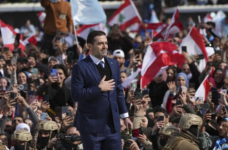
Former Lebanese Prime Minister Saad Hariri greets his supporters after he paid his respects at the grave of his father, former Prime Minister Rafik Hariri, on the 20th anniversary of his assassination in Beirut, Feb. 14, 2025. (AP)
BEIRUT: Former Lebanese Prime Minister Saad Hariri announced on Friday, the 20th anniversary of the assassination of his father Rafic Hariri, also a former PM, the “return of the Future Movement to political activity in all upcoming milestones and events.” This comes after a three-year...

arab.news
NAJIA HOUSSARI
February 14, 2025 18:40
- This comes after a three-year suspension of his political engagement and that of his party
- Hariri affirmed that the party, founded by his late father, “will continue, rooted in adherence to the Taif Constitution, state-building, reconstruction, and institutional development”
BEIRUT: Former Lebanese Prime Minister Saad Hariri announced on Friday, the 20th anniversary of the assassination of his father Rafic Hariri, also a former PM, the “return of the Future Movement to political activity in all upcoming milestones and events.”
This comes after a three-year suspension of his political engagement and that of his party.
Hariri affirmed that the party, founded by his late father, “will continue, rooted in adherence to the
Taif Constitution, state-building, reconstruction, and institutional development. We ask for nothing but a normal state where no weapons exist outside the authority of the state.”
Speaking before crowds that had gathered since the morning from Beirut, Bekaa, and the north, waving Lebanese flags in Martyrs’ Square in downtown Beirut and chanting his name, Hariri stated: “The supporters of Rafic Hariri remain here, and your voices will be heard in every upcoming national milestone. Everything comes in its own time.”
In what politicians have described as a “responsible, non-provocative, and unifying speech,” Hariri emphasized: “We now have a president, a government, and new hope, which was expressed in the inaugural speech and the statement of Prime Minister Nawaf Salam. This is a golden opportunity, and our decision is to support it and reject any attempt to circumvent it.”
Addressing the residents of the south, Bekaa, and Beirut’s southern suburbs — who suffered the brunt of the Israeli war against Hezbollah — Hariri said: “You are partners in this opportunity, and without you, it cannot be realized. You must break the previous impression that you are a force of obstruction, domination, and arms.
You are partners in building bridges with Arab brothers and in reconstruction. You are key partners in restoring the legitimacy of the state, which alone — through its army, security forces, and institutions — can protect all Lebanese citizens.”
Hariri added: “
Demanding a normal state means a state where weapons are exclusively in the hands of the national army and legitimate security forces, where the economy is free, productive, and provides jobs and a dignified life for all Lebanese. It means a state where the judiciary is independent, laws are upheld, freedoms are protected, and justice is served for the martyrs, the wounded, and those affected by the Beirut port explosion.”
He praised citizens who opened their homes to those forced to flee their communities.
“From the south to the Bekaa, from Beirut to its southern suburbs, we honor all those we have lost. The same unity that carried us through conflict must now heal the unified Lebanese body and drive our reconstruction,” he said, calling for a coordinated effort to rebuild affected areas.
“We fully back the presidency and government in their efforts to build a functioning state,” Hariri said,
emphasizing the importance of restoring Lebanon’s regional role and maintaining healthy relationships with both Arab nations and the international community.
Hariri expressed strong support for state institutions and the Lebanese army, particularly in their efforts to implement UN Resolution 1701 and ensure complete Israeli withdrawal from occupied villages.
“Twenty years ago, you demanded justice and, through your determination, removed Bashar Assad’s criminal regime from Lebanon. Now after 20 years, and before that, 30 years of sectarian rule, suffering, injustice, murder, imprisonment, torture, and brutality, the heroic Syrian people have risen and expelled this criminal from Syria. Perhaps this marks not just the beginning of justice, but its ultimate triumph.”
Hariri stressed:
“We stand firmly with the Syrian people’s aspirations and their right to self-determination. Our vision is clear: a stable, rebuilt Syria engaging with Lebanon as an equal partner, where both nations’ sovereignty and independence are fully respected.”
Addressing regional issues, Hariri reaffirmed his commitment to Palestinian rights and the two-state solution.
He criticized Israeli Prime Minister Netanyahu’s approach saying that “the problem with Netanyahu is his evasion of responsibility and peace in favor of war.”
He warned against attempts to resolve the conflict at the expense of neighboring Arab states including Egypt, Jordan, and Saudi Arabia.
President Joseph Aoun paid tribute to Rafic Hariri, calling him “a statesman par excellence.” He highlighted that “his political stance played a crucial role in strengthening national unity, safeguarding civil peace, and implementing the National Reconciliation Document endorsed by the Taif Conference.”
The ceremony, held near Hariri’s tomb, drew tens of thousands of Lebanese, including supporters of the Future Movement.
The event coincided with Israeli warplanes flying over Beirut and its southern suburbs.
Meanwhile, the Lebanese and Iranian foreign ministries worked to facilitate the return of Lebanese passengers from Tehran after Lebanese authorities denied a plane from the Iranian capital permission to land at Beirut airport under Israeli pressure.
Youssef Rajji, Lebanon’s foreign minister, said on Friday that “the Lebanese and Iranian ministries are in communication through the Lebanese ambassador in Tehran to ensure the return of the Lebanese citizens to Beirut.”
On the same day, all roads leading to Beirut airport were reopened following the army’s intervention, ending hours of protests on Thursday night.
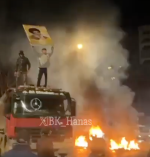
Hundreds of Hezbollah supporters had taken to the streets, setting tires ablaze in protest and accusing “the Lebanese state of yielding to Israeli and American demands.”
Avichai Adraee, spokesperson for the Israeli army, posted a claim alleging that “the Quds Force and Hezbollah are using Beirut airport to smuggle funds intended for arming Hezbollah on civilian planes.”
Following a directive from the Ministry of Transport and Public Works, the Directorate General of Civil Aviation at Beirut airport informed Tehran airport that it would temporarily refrain from receiving the Iranian aircraft.
In a statement, the directorate explained that additional security measures would be implemented to ensure the safety of Beirut airport, Lebanese airspace, and passengers, in coordination with airport security authorities.
These measures align with international aviation standards, but their full implementation would require additional time for certain airlines to comply.
Consequently, flight schedules — including those from Iran — have been temporarily adjusted until Feb. 18.
A political source linked the incident to intelligence suggesting that the plane was carrying funds for Hezbollah, raising security concerns.
Given the airport’s heightened surveillance, authorities have taken precautionary measures to mitigate any potential risks.
Hezbollah, through its deputy Ibrahim Al-Moussawi, accused Israel of repeatedly violating Lebanese sovereignty with US complicity.
He urged the state to stand firm against Israeli threats, regardless of the circumstances.
On Jan. 3, an Iranian plane was searched after an Iranian diplomat on board refused to comply with security procedures.
However, the Iranian Embassy later clarified that the funds in the diplomat’s possession were intended for the embassy’s operational expenses.
BEIRUT: Former Lebanese Prime Minister Saad Hariri announced on Friday, the 20th anniversary of the assassination of his father Rafic Hariri, also a former PM, the “return of the Future Movement to political activity in all upcoming milestones and events.” This comes after a three-year...
www.arabnews.com
The son of King Fahd is back.