
F-22Raptor
Elite Member

Liberator has emerged from the U.S. Navy’s budget as a high-end standoff capability for uncrewed undersea vehicles (UUVs), enabling the deployment of heavyweight torpedoes on the seafloor.
In 2025, the U.S. Navy quietly unveiled its Liberator program as an effort focused on developing, testing, and fielding a containerized heavyweight torpedo for expeditionary and contested environments. Well-hidden in its 5,000-page research and development budgets released in June 2025, the service curtly described its Liberator effort as a tool to develop “an alternative delivery system for torpedoes or similar devices” with no additional information.
This year, new details regarding Liberator’s purpose and capabilities have emerged, still well-hidden, going far beyond what was previously known or speculated about the system’s intended use or deployment platform.
Liberator is an “innovative approach” to torpedo and mine warfare that will deploy as a “stationary system placed on the seabed to launch various payloads”. Development has been underway for several years and FY2026 funding was allocated to move the system along in its prototyping phase for design and fabrication of a full-scale test asset.
The system is intended to serve as an extension of the U.S. Navy’s Orca Extra Large Uncrewed Undersea Vehicle (XLUUV) submarine as a stealthy, covert insertion tool for further employment of the service’s Mark 48 Advanced Capability (ADCAP) heavyweight torpedo. The deployable system, with its containerized (and encapsulated) ADCAP, appears to be designed around the Orca’s 10-meter-long multi-purpose payload module based on an attached requirement for Hunter — a known Orca payload delivery system — which, according to the budget documents, depends on Liberator’s development and testing to be tested and fielded.
“The acquisition strategy for Hunter program will be developed by Q1FY28 in alignment with the Liberator program timeline,” the U.S. Navy’s FY2027 research and development budget reads.
Naval News previously covered the Orca’s first payload module installation in 2024 where at least one large vertically-opening mission bay was visible. That mission bay could deploy a subsystem like Liberator given its size; previous renderings of the mission bay showed at least twelve mounted heavyweight torpedo tube launchers. Unlike the renderings, Liberator gives Orca XLUUVs the ability to deploy autonomous leave-behind seafloor launchers for ADCAPs that keep the uncrewed submarines away from direct combat.
In operational environments, Liberator could covertly be deployed from Orcas or other platforms to the seafloor of contested or denied waters some time in advance to patiently await high-value adversary submarines and surface ships. Those targets include ones “in hard-to-reach places”, according to the U.S. Navy’s budget documents. Orcas and other XLUUVs could drop dozens of Liberator payloads in maritime chokepoints or hostile waters — all wielding ship-killing heavyweight torpedoes that have long been used as the final death blow during SINKEX ship-sinking test events.
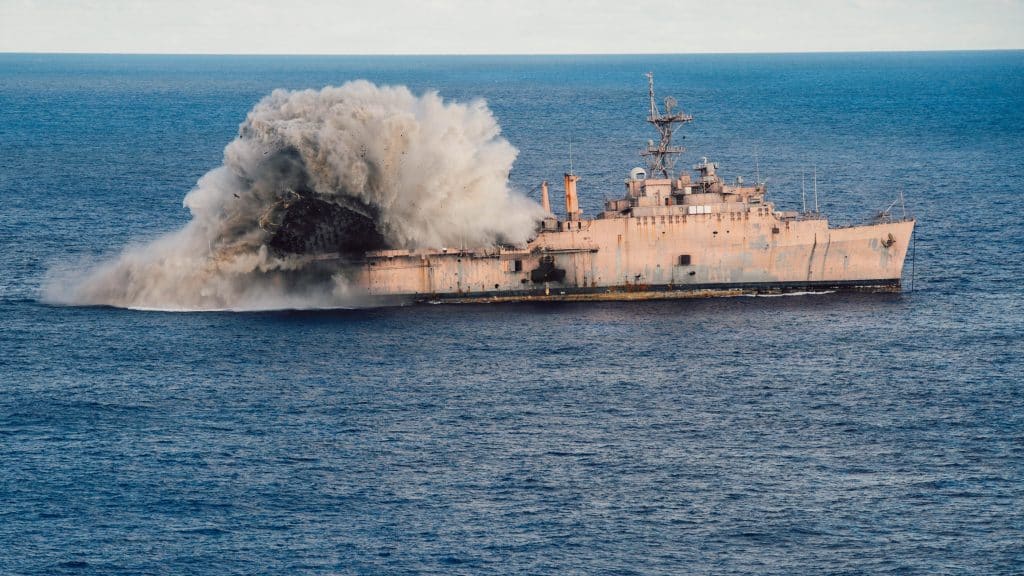
Naval News has already identified pathways for the Liberator’s future deployment of Mark 48 ADCAP heavyweight torpedoes and Mark 54 lightweight torpedoes (LWTs). Additional payloads could also be incorporated into the system as previously mentioned, like one-way attack uncrewed undersea vehicles (UUVs) developed through the Defense Innovation Unit (DIU) or new torpedoes currently in development for the fleet like the Mark 54 Compact Rapid Attack Weapon that aim to pack multiple torpedoes into the same dimensions as an ADCAP.
A seabed platform like Liberator with stowed heavyweight torpedoes represents the latest in a series of mine warfare torpedo effectors, building off the service’s Cold War Mark 60 CAPTOR and more recent Hammerhead Encapsulated Effectors, the latter of which already uses Mark 54 LWTs for anti-submarine warfare. Encapsulated ADCAPs would give the U.S. Navy tremendous range increases over both with an added capability against large surface combatants, with publicly known range estimates for the heavyweight torpedo exceeding 12-21 nautical miles.
An encapsulated ADCAP would also provide dramatically enhanced lethality compared to Hammerhead, with ADCAP wielding a 650lb (295kg) warhead designed to detonate directly under a ship’s hull for maximum damage compared to the Hammerhead’s 100lb (44kg) warhead designed to destroy submarines.
A warhead that large is capable of severely damaging nearly any type or class of ship in combat operations, from small corvettes to hundred-thousand-ton aircraft carriers.
Deployed to a place like the Taiwan or Luzon Straits, adversary submarines and high value targets like carriers, amphibious assault ships, and replenishment vessels could all be held at risk with Liberator systems. Mounted to the seafloor, the systems would be extremely difficult to disable, locking adversary ships and submarines inside the Pacific’s First Island Chain.
Naval News was first to cover the Liberator program and its objectives in July 2025, noting its unique application for uncrewed platforms like uncrewed surface vessels (USVs) and XLUUVs that seek to leverage containerized payloads for launched effects. A classified industry day event held in October of the same year briefed industry partners on the demands of both Liberator and Hunter signifying their shared requirements and capabilities. U.S. Navy officials declined to comment on Liberator’s specifics at the time.
“Program Executive Office, Unmanned and Small Combatants (PEO USC) is leading the effort and will deliver a 3.5 hour presentation about Liberator and a related unmanned undersea vehicle (UUV) payload, Hunter, to industry partners next week. Hunter is a lethality enhancement payload designed for Boeing’s Orca XLUUV joint emergent operational need (JEON),” Naval News wrote in 2025, speculating over Liberator’s purpose as a program closely tied to Orca’s previously-known Hunter payload module. “It is unclear if Hunter will integrate ADCAP torpedoes for Orca as well, but the combination of both suggest it is a possibility.”
The U.S. Navy expects to award a competitive Other Transaction Authority contract to several competitors in this fiscal quarter of 2026 for prototypes, which will in turn inform the service decisions for production contracts that are expected to follow in FY2027. A maintenance and operational test plan will be finalized in 2027 alongside initial training for fleet sailors ahead of an at-sea demo late in that year that will test Liberator’s end-to-end capabilities.


