Light News, Event from or about Indonesia

Status
Not open for further replies.

‘The Javan tiger still exists’: DNA find may herald an extinct species’ comeback​


Christopel Paino, Rahmadi Rahmad
4 Apr 2024 Indonesia

1767147242017.png

  • A 2019 sighting by five witnesses indicates that the long-extinct Javan tiger may still be alive, a new study suggests.
  • A single strand of hair recovered from that encounter is a close genetic match to hair from a Javan tiger pelt from 1930 kept at a museum, the study shows.
  • “Through this research, we have determined that the Javan tiger still exists in the wild,” says Wirdateti, a government researcher and lead author of the study.
  • The Javan tiger was believed to have gone extinct in the 1980s but only officially declared as such in 2008, along with the Bali tiger; a third Indonesian subspecies, the Sumatran tiger, is also edging closer to extinction.
 

Free Meals Program Reaches 55 Million, Creates 900,000 Jobs in First Year​


Erfan Maruf
January 8, 2026 | 2:40 pm

1767863052934.png
Workers clean and load metal food trays into a large drying oven at the SPPG Sukamantri in Bogor, where the equipment is used to sanitize and prepare containers for daily meal production. (Photo Courtesy of BGN)


Jakarta. President Prabowo Subianto's flagship Free Nutritious Meals (MBG) program has far exceeded its first-year target, reaching more than 55 million beneficiaries nationwide, according to the National Nutrition Agency (BGN).


BGN Deputy Head Nanik S. Deyang said the program was initially designed to serve just 6 million people in 2025 but has grown nearly tenfold within its first year of implementation.


“The original target for 2025 was only 6 million beneficiaries. As of today, the number of people we serve has reached 55.1 million,” Nanik said during a visit to SMK Negeri 1 Jakarta High School on Thursday.


She attributed the sharp increase largely to strong participation from the public and private partners in building and operating community-based nutrition kitchens (SPPG). Without such partnerships, she said, the fiscal burden on the state would have been significantly heavier.

“If all the kitchens were built solely by the government, the investment would run into tens of trillions of rupiah,” Nanik said. “If we calculate 20,000 kitchens at around Rp 2 billion each ($119,000) that would amount to Rp40 trillion. That investment has effectively been made by our partners.”


Read More:​

Prabowo Hails First Year of Free Nutritious Meals Program as Major Success


As of early January 2026, a total of 19,188 SPPG units are operating across Indonesia. Beyond expanding access to nutritious meals, the program has also become a major source of job creation.


Nanik said around 902,000 workers are directly involved in SPPG kitchens, with about 789,318 currently active. The employment impact extends further through indirect jobs linked to supply chains and supporting industries.


“The MBG program has significantly opened new employment opportunities, especially in the nutritious food service sector,” she said.


Micro, small and medium enterprises (MSMEs), cooperatives, village-owned enterprises (BUMDes), joint village enterprises (BUMDesma), Kopdes Merah Putih, and a wide range of suppliers are involved in providing raw materials. BGN data show that 46,955 suppliers are currently participating in the program.


According to Nanik, the number of indirect workers linked to MBG has reached around 1.5 million people, bringing total employment connected to the program to roughly 2.5 million nationwide.


“Overall, about 2.5 million people are now working and involved in the MBG program,” she said.


Sri Mulyani Appointed to the Bill Gates Foundation Board


By Irawati

1768295339001.png

Key Points

  • Sri Mulyani Indrawati was officially appointed as a member of the Gates Foundation Governing Board on January 12, 2026.
  • Her experience and leadership are considered strategic in supporting the governance and mission of the Gates Foundation.
  • The appointment aligns with the Gates Foundation’s long-term commitment to eradicating poverty, reducing maternal and infant mortality, and combating infectious diseases.


Jakarta – Former Finance Minister Sri Mulyani Indrawati has officially been appointed as a member of the governing board of the Gates Foundation, the philanthropic organization founded by Microsoft co-founder Bill Gates, on January 12, 2026.

“The Gates Foundation announced the appointment of Dr. Sri Mulyani Indrawati—one of Indonesia’s first and longest-serving female finance ministers, and a former Managing Director and Chief Operating Officer of the World Bank—to its governing board, which was established in 2022,” the Gates Foundation said in a press release on Tuesday, January 13, 2026.

Mark Suzman, CEO and member of the Gates Foundation Governing Board, stated that as a globally respected economist, Sri Mulyani has led major reforms across financial institutions and championed policies that promote resilience and inclusive economic growth.

According to him, her extensive experience in economic and development policy will bring valuable perspectives to the foundation’s governance and mission.

“Sri Mulyani brings deep experience in shaping equitable economic outcomes—expertise that is critically important to achieving the foundation’s long-term goals,” said Mark Suzman.
Read also: Retiring as Finance Minister, Sri Mulyani to Become a Lecturer for Future Global Leaders at Oxford

Suzman added that Sri Mulyani’s leadership will help ensure that the Gates Foundation’s resources continue to be used to expand opportunities, foster inclusive economic growth, and improve outcomes for communities around the world.

He noted that Sri Mulyani’s appointment to the Gates Foundation board represents a highly significant moment in the foundation’s history.

Last year, the Chair of the Bill Gates Foundation made a historic commitment to spend the foundation’s endowment over the next two decades, focusing on three key goals: ending preventable maternal and infant deaths, ensuring that the next generation grows up free from deadly infectious diseases, and lifting millions of people out of poverty and onto a path toward prosperity.

Sri Mulyani also said she felt honored to join the Gates Foundation’s governing board to help deliver tangible impact for those most in need.

“With 20 years to make the greatest possible impact on the lives of those who need it most, I am honored to join the Gates Foundation’s governing board and contribute during this critical moment filled with both challenges and opportunities,” she said.
Read also: A Look at the Size of Sri Mulyani’s Pension After Stepping Down as Finance Minister

She added that her collaboration with the Gates Foundation began nearly a decade ago through work exploring how new technologies can expand opportunities and advance inclusive and sustainable development.

“I am highly motivated to bring my experience in global finance, economic policy, and good governance into these vital efforts to save lives and improve living standards,” Sri Mulyani said.
Sri Mulyani will serve alongside other board members, including Ashish Dhawan, Dr. Helene Gayle, Strive Masiyiwa, Thomas J. Tierney, Mark Suzman, and Bill Gates. (*)

Editor: Galih Pratama


Indonesia Ranked #1 for Happiest Workers in Asia-Pacific, Beating Singapore and Australia

Editorial Team – Kompas.com
To view this content we will need your consent to set third party cookies.
For more detailed information, see our cookies page.


KOMPAS.com – Indonesia has ranked first as the country with the happiest workers in the Asia-Pacific region.

This achievement is based on the latest exclusive report from the Workplace Happiness Index, released by Jobstreet by SEEK.

The report was compiled based on an online survey conducted by the research institution Nature in October–November 2025, involving around 1,000 respondents in Indonesia’s labor market, aged 18 to 64.

The results showed that 82% of respondents in Indonesia said they felt fairly happy to very happy at work.

This figure far exceeded other countries in the region, such as Hong Kong (47%), Singapore (56%), and Australia (57%).

In addition, 86% of Indonesian workers reported feeling appreciated in the workplace, while 75% said their work provides personal fulfillment or feels meaningful.


Jobstreet Survey: Supportive Colleagues Are the Main Driver of Workplace Happiness

Although a higher salary remains the main goal for 54% of workers, the report shows that the biggest drivers of workplace happiness actually come from work-life balance and a sense of purpose.

Specific factors contributing most to Indonesian workers’ happiness include:

  • Relationships with colleagues or teams (77%)
  • Workplace location (76%)
  • Feeling that the job is meaningful (75%)
However, the report also highlights several challenges.

Citing Kompas.com on Tuesday (February 3, 2026), 44% of workers still experience stress, while 56% feel burdened by job demands.

Senior leadership was identified as the third largest factor contributing to workplace unhappiness, reaching 64%.

The Acting Managing Director of Jobstreet by SEEK Indonesia, Wisnu Dharmawan, explained that competitive salaries remain important for attracting candidates. However, long-term happiness is more likely to be achieved when employees feel their work is meaningful and when they have room to enjoy life outside of work.

“Company leaders play a crucial role in bridging this gap by building open communication and transparently recognizing each individual’s achievements,” he said, as quoted by Kontan on Tuesday (February 3, 2026).

Gen X and Millennials Are the Happiest at Work

The Workplace Happiness Index report also reveals that workplace happiness in Indonesia is not uniform, but varies based on life stage and location.

Based on the survey:

  • Generation X is the most satisfied group, with 85% workplace happiness
  • Millennials follow closely at 84%
For these older generations, happiness is largely driven by strong team relationships and work rhythms they have already mastered.

In contrast, Generation Z, which is just beginning their careers, recorded the lowest happiness level at 76%.

They tend to feel less appreciated and struggle to connect daily tasks with a larger purpose—creating a challenge for companies to better engage younger talent.

Workplace happiness also varies across industries and geographic regions.

The technology sector recorded the highest happiness level at 93%, driven by pride in the workplace and clarity of purpose.


Jabodetabek Has the Happiest Workers

In terms of region, Jabodetabek (Greater Jakarta) recorded the happiest workers, with a happiness level of 87%.

This contrasts with western Indonesia, which recorded the lowest level at 75%.

These differences are influenced by income factors and better access to workplace facilities in the capital region.


AI Anxiety and Burnout Remain Major Concerns

Despite the high happiness ranking, technological developments—especially the rise of Artificial Intelligence (AI)—remain a source of concern.

Around 42% of workers feel that AI could threaten their job security, particularly in the technology sector.

Additionally, 43% of workers reported experiencing mental exhaustion or burnout.

Even more notably, 40% of workers who said they are happy still admitted to experiencing burnout.

Wisnu emphasized that Indonesia’s position as the happiest workforce in Asia-Pacific reflects strong optimism and a positive work culture. However, he warned companies not to become complacent.

“The 43% burnout figure and concerns over AI are alarms for employers to act more proactively. Sustainable happiness can only be achieved if business targets are balanced with employees’ mental well-being,” he said.
Through the report, Jobstreet by SEEK encourages companies to focus on three main strategies:

  1. Building a sense of purpose at every employee level
  2. Supporting personal-life boundaries through flexibility
  3. Listening to different needs across generations
Meanwhile, the Asia-Pacific countries with the highest workplace happiness index after Indonesia are:

  • Philippines (77%)
  • Malaysia (70%)
  • Thailand (67%)
  • New Zealand (65%)

Key Points / Important Takeaways

  • 🥇 Indonesia ranks #1 for happiest workers in Asia-Pacific (82% happy).
  • 🇭🇰🇸🇬🇦🇺 Indonesia outperforms Hong Kong (47%), Singapore (56%), and Australia (57%).
  • 🙌 86% feel appreciated at work; 75% find their work meaningful.
  • 🤝 The strongest happiness factor is supportive colleagues (77%).
  • 💰 Salary is still the top desire for 54%, but work-life balance and purpose matter more for happiness.
  • 😰 Stress remains significant: 44% stressed, 56% burdened by workload.
  • 👔 Senior leadership is a major unhappiness factor (64%).
  • 👨‍💼 Gen X (85%) and Millennials (84%) are happiest; Gen Z lowest (76%).
  • 💻 Tech sector has the highest happiness rate (93%).
  • 📍 Jabodetabek leads regionally with 87% workplace happiness.
  • 🤖 AI is a job-security concern for 42% of workers.
  • 🧠 Burnout affects 43% of workers, including many who still claim to be happy.
 
To view this content we will need your consent to set third party cookies.
For more detailed information, see our cookies page.


Bali Fashion Not Appropriate in Java!​


To view this content we will need your consent to set third party cookies.
For more detailed information, see our cookies page.


Indonesia's REAL Economic Engine = Micro Businesses!​


60.7 % of Indonesian GDP is generated by its medium, small, and micro enterprises/businesses.
Chinese New Year celebrated in Jakarta

To view this content we will need your consent to set third party cookies.
For more detailed information, see our cookies page.
 

US-Israel Strike on Iran Disrupts Travel for 59,000 Indonesian Umrah Pilgrims​


Salman Mardira
February 28, 2026 | 11:22 pm


To view this content we will need your consent to set third party cookies.
For more detailed information, see our cookies page.


Jakarta. The Hajj and Umrah Ministry has urged families of Indonesian pilgrims to remain calm as tensions escalate in the Middle East following large-scale Israeli and US military strikes on Iran.


Flights to and from Saudi Arabia have been affected by the deteriorating security situation in the region. Several airlines have rerouted or delayed services as a precaution, disrupting the departure and return schedules of Indonesian umrah pilgrims.


The impact is being felt both by pilgrims currently in Saudi Arabia and by those still in Indonesia awaiting departure.


According to data from the government’s Umrah and Special Hajj Management Computerized System (Siskopatuh), about 58,873 Indonesian umrah pilgrims are currently in Saudi Arabia.

Puji Raharjo, director general for hajj and umrah management at the ministry, said the government — through the ministry, Indonesian representatives abroad and relevant authorities — is closely monitoring developments and coordinating efforts to ensure pilgrims remain safe and properly served.

Read More:​

Bali Airport Reports Canceled Middle East Flights After War Erupts in Iran


“We urge all umrah pilgrims not to panic. Remain calm and continue coordinating with your respective licensed umrah travel operators to obtain official and up-to-date information,” Puji said in Jakarta on Saturday.


He stressed that the state is present to provide protection and assistance in accordance with applicable regulations and that families should not be swayed by unverified information circulating online.


Pilgrims and their families are advised to maintain communication through their registered Umrah Travel Organizers (PPIU) to ensure that updates come from official and accountable sources.


The ministry said it continues to coordinate with agencies at home and in Saudi Arabia to ensure the safety and security of Indonesian pilgrims remain the top priority.


Authorities also urged the public not to spread unverified information that could trigger panic. The government is committed to providing maximum protection and ensuring any policy adjustments prioritize the safety, security, and comfort of pilgrims, the ministry said.


The advisory comes after Israel and the United States launched major airstrikes on several Iranian cities on Saturday, reportedly killing dozens and damaging key facilities. Iran retaliated by targeting US military assets in several Gulf countries, with missiles reportedly striking sites in Bahrain, Qatar, Kuwait, and the United Arab Emirates.

 
Japan Welcomes Indonesian Muslim Migrant Workers, Praised for Diligence and Honesty


04 Mar 2026 03:17PM


To view this content we will need your consent to set third party cookies.
For more detailed information, see our cookies page.

Tokyo


JAKARTA
— The number of Indonesian Migrant Workers (PMI) in Japan has surpassed 180,000 people, making it the fastest-growing group compared to workers from other countries. The Japanese government says its society is now increasingly accepting Muslim workers, including those from Indonesia.

The Chargé d’Affaires ad interim of Japan in Indonesia, Myochin Mitsuru, said the rising number of Indonesian workers in Japan reflects a shift in public attitudes toward foreign Muslim workers.

“The number of Indonesian workers has now reached 180,000 in Japan. This proves that Japanese society no longer has doubts about accepting Muslim workers, including those from Indonesia,” he said during an iftar gathering hosted by the Japanese Embassy with Indonesian Islamic leaders in Jakarta, as reported by Antara on Wednesday (March 4).
He acknowledged that historically Japan did not have a deep understanding of Muslim communities. However, this situation has changed as interaction and the presence of foreign workers from various countries — including Indonesia — have increased.

According to Myochin, even people in rural areas, which are often considered conservative, are now more open to Indonesian workers because they are viewed as hardworking and honest.

“So that is why, as you can imagine, people in Japan — especially in rural areas, very traditional and conservative regions — are accepting many Indonesians. This shows that Japanese people now have no hesitation in accepting Muslims, including Indonesians,” he explained.
“People in rural Japan eventually realized that Indonesian workers are diligent, honest, and kind. That is why acceptance of them has grown significantly,” he added.

Indonesians in Japan Reach 230,000​

Data from Japan’s Ministry of Justice through the Immigration Services Agency, published by the Instagram account @kbritokyo, recorded that the number of Indonesian citizens in Japan reached 230,689 as of June 2025.

This figure represents a 37.2% increase compared to the previous year, placing Indonesia among the six largest foreign communities in Japan.

The surge reflects not only increased labor mobility but also strengthening bilateral relations through education, culture, and youth exchanges.

“People-to-people contact is very important. We must get to know each other, understand each other’s backgrounds, and respect one another,” Myochin said.
He also expressed admiration for Ramadan culture in Indonesia. Quoting a Japanese proverb, “Hunger is the best seasoning,” he explained that the phrase means hunger makes food taste better. According to him, the experience of breaking the fast illustrates the happiness that comes after practicing restraint throughout the day.

Since 2004, the Japanese government has invited more than 190 Islamic boarding school (pesantren) leaders through the Japan-East Asia Network of Exchange for Students and Youths (JENESYS) program.

This year, eight young participants from Nahdlatul Ulama (NU), Muhammadiyah, Istiqlal Mosque, and UIN were invited to Tokyo and Nagasaki to strengthen cross-cultural understanding between the two countries.


To view this content we will need your consent to set third party cookies.
For more detailed information, see our cookies page.
 

The Most Moral Countries Worldwide​


Canada and Indonesia lead among surveyed countries, with 92% of respondents in both countries generally believing in their fellow citizens’ morality.


Canada edges slightly ahead, with 7% of respondents saying their compatriots are immoral, compared to 8% in Indonesia.


--------------

To view this content we will need your consent to set third party cookies.
For more detailed information, see our cookies page.
 

1.7 Million Vehicles Return to Greater Jakarta as Eid Traffic Builds​


Antara, Endang Mulyani
March 25, 2026 | 11:43 am


To view this content we will need your consent to set third party cookies.
For more detailed information, see our cookies page.


Jakarta. State toll road operator Jasa Marga (IDX: JSMR) recorded 1,702,500 vehicles returning to the Greater Jakarta area, covering the Eid al-Fitr holiday period from March 11 to March 23.


The figure represents about 50% of the projected 3.39 million vehicles expected to return by the end of the post-holiday travel period on March 29. The total reflects cumulative traffic from four main toll gates: Cikampek Utama, Kalihurip Utama, Cikupa, and Ciawi.


Traffic was dominated by vehicles from the east (Trans-Java and Bandung), accounting for 696,748 vehicles, or 40.9%. This was followed by traffic from the west (Merak) at 568,159 vehicles, or 33.4%, and from the south (Puncak) at 437,593 vehicles, or 25.7%.

On the second day after Eid, 225,293 vehicles returned to Greater Jakarta, marking a 73.7% increase compared with the normal daily volume of 129,695 vehicles.

A sharp spike was recorded at the Cikampek Utama toll gate, where traffic reached 75,837 vehicles, up 197.7% from normal levels.


“Traffic volume is expected to continue rising, particularly during the peak return period on March 24, 28, and 29,” said President Director Rivan A. Purwantono.


To avoid congestion between March 25 and 27, road users are advised to adjust their travel schedules and take advantage of the Work From Anywhere (WFA) policy.


Jasa Marga is also offering a 30% toll discount on nine toll road sections from March 26 to 27 to help ease traffic density.


The company has enhanced services along major toll roads by maximizing toll gate operations, deploying road service fleets, and implementing traffic management measures in coordination with police. Functional lanes have also been prepared to support traffic distribution, with personnel on standby 24 hours a day.


Sanggabuana Forest One Step Closer to Becoming a Conservation Area​


DETIK.COM (March 31, 2026)

To view this content we will need your consent to set third party cookies.
For more detailed information, see our cookies page.

Sanggabuana forest, West Java


A long wait since 2021 has finally yielded results. The Sanggabuana Mountain forest area in West Java is now one step closer to gaining conservation status, after officially being approved for processing into a protected area.

Stretching across four regencies—Karawang, Bogor, Cianjur, and Purwakarta—the Sanggabuana Mountains are known as one of the regions with rich biodiversity. The government plans to convert this area into a Grand Forest Park (Tahura) as part of a more comprehensive conservation effort.


Toward Conservation Status​

The Executive Director of the Sanggabuana Conservation Foundation (SCF), Annisa Sutarno, explained that Tahura is part of a Nature Conservation Area (KPA).

This refers to Law No. 32 of 2024, which amends Law No. 5 of 1990, covering:

  • National Parks
  • Grand Forest Parks (Tahura)
  • Nature Tourism Parks
“The proposal to change the function of this forest area will reportedly be processed partially. The plan to designate the Sanggabuana Mountains as a conservation area has also been confirmed by SCF,” said Annisa when confirmed by detikJabar, Tuesday (March 31, 2026).

Government Action Begins​

Concrete steps are now being prepared. The Indonesian Ministry of Forestry has formed an Integrated Team to conduct an in-depth study of the proposed change.

The team is scheduled to begin fieldwork on April 1, 2026.

“This Integrated Team will start fieldwork on April 1, 2026, based on the study proposal for changing the function of the Sanggabuana forest area into a conservation area, prepared by SCF,” Annisa added.

Multi-Stakeholder Coordination​

The process involves extensive coordination across multiple stakeholders, including:

  • West Java Forestry Agency
  • Perum Perhutani
  • Local governments (Karawang, Purwakarta, Bogor, Cianjur)
  • Sub-district heads and village leaders
The field research will cover an area of approximately 11,743 hectares.


To view this content we will need your consent to set third party cookies.
For more detailed information, see our cookies page.


Jatiluhur Reservoir, West Java

Long Journey Since 2021​

The effort to establish conservation status began several years ago.

In 2021, during a working meeting between Commission IV of the Indonesian House of Representatives and the Ministry of Environment and Forestry, the Sanggabuana Mountains were initially proposed to become a National Park.

However, evolving field conditions led the government to consider a more suitable designation.

“Based on developments and field conditions, the most ideal status for the Sanggabuana Mountains is a Grand Forest Park (Tahura) or preservation area,” said Annisa.

Final Decision Pending​

The final decision remains in the hands of the Minister of Forestry. For SCF, the main priority is ensuring maximum protection through a conservation forest scheme.

“We aim for a conservation forest model because it ensures stronger protection and preservation efforts by the government,” she added.

Rich Biodiversity​

Data collected by SCF highlights the ecological importance of the area:

  • 482 wildlife species recorded
  • 50 protected species (based on Ministerial Regulation No. 106/2018)
  • 292 species listed on the IUCN Red List
  • 43 species included in CITES Appendix
Rare species identified include:

  • 311 Javan gibbons (Hylobates moloch) across 103 groups
  • 20 Javan leopards (Panthera pardus melas)

Critical Water Resource Role​

The Sanggabuana Mountains also play a vital role in water resource management:

  • 339 water springs / river sources
  • Spread across four regencies
  • Supply water to:
    • Jatiluhur Reservoir
    • Citarum River Basin (DAS Citarum)
“Nearly half of these water sources flow into rivers supplying Jatiluhur Reservoir, while the rest flow into the Citarum watershed,” Annisa explained.

To view this content we will need your consent to set third party cookies.
For more detailed information, see our cookies page.


Jatiluhur Reservoir, West Java, which is very important to Greater Jakarta pipe water source, along with the new Karian Dam in Banten province.

A Milestone for Conservation Efforts​

For Annisa and her team, this approval marks a significant milestone.

After more than five years of scientific exploration and conservation efforts, in collaboration with universities, conservation institutions, and the Indonesian Army (TNI AD), the long-awaited results are finally becoming visible.

“After more than five years of scientific exploration and conservation efforts with various partners, we are deeply grateful that these efforts are finally bearing fruit,” she concluded.


LSI Survey: 74.9% of Respondents Willing to Fight to Defend the Country​


Baharudin Al Farisi
12 April 2026,


To view this content we will need your consent to set third party cookies.
For more detailed information, see our cookies page.


JAKARTA, KOMPAS.com — The majority of respondents in a survey conducted by the Indonesian Survey Institute (LSI) stated that they would be willing to go to war to defend Indonesia in the event of a conflict with another country.

This patriotism-related question was part of the survey titled “Public Evaluation and Commitment to Pancasila,” presented by LSI Executive Director Djayadi Hanan in Cikini, Central Jakarta, on Sunday (April 12, 2026).

1776046004922.png


🇮🇩 Willingness to Defend the Country​

Respondents were asked:

If Indonesia were to go to war against another country, how willing would you be to participate in defending the nation?
Results:

  • 26.4% → Very willing
  • 48.5% → Willing
👉 Total: 74.9% willing or very willing

“The majority (74.9%) stated that they are willing or very willing to take part in defending the Unitary State of the Republic of Indonesia,” LSI stated.

❗ Those Not Willing​

  • 17.4% → Not willing
  • 4.4% → Strongly not willing
  • 3.2% → Don’t know / no answer

⚠️ Concern Over Foreign Threats​

Respondents were also asked about their concerns regarding potential foreign attacks:

  • 46.9% → Very concerned
  • 43.2% → Concerned
👉 Total: 90.1% express concern

“The majority (90.1%) are concerned about potential threats or attacks from other countries,” LSI reported.

📊 Survey Methodology​

  • Sample size: 2,020 respondents
  • Population: Indonesian citizens aged 17+ or married
  • Method: Multistage random sampling
  • Margin of error: ±2.2%
  • Confidence level: 95%
  • Data collection: Face-to-face interviews
Quality control:

  • 20% of samples rechecked (spot check)
  • No significant errors found
Survey period: March 4 – March 12, 2026


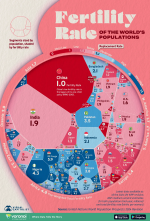
The Fertility Rate of Every Country in the World​


Published on May 17, 2026

1779162218637.png


Indonesia Ranked Asia’s Earliest-Rising Nation, According to Sleep Cycle Data​


Fergi Nadira

To view this content we will need your consent to set third party cookies.
For more detailed information, see our cookies page.


JAKARTA — Indonesia has been ranked as the earliest-rising country in Asia, according to data from Sleep Cycle, as cited by Seasia Stats.

The study found that Indonesians wake up at an average time of 6:55 a.m., making Indonesia the earliest-rising nation among the 15 Asian countries included in the ranking.

Indonesia outperformed Japan, which ranked second with an average wake-up time of 7:09 a.m., followed by Thailand in third place at 7:24 a.m.
The Philippines and Qatar completed the top five, with average wake-up times of 7:28 a.m. and 7:32 a.m., respectively.

The data suggests that work schedules, daily routines, cultural habits, and lifestyle patterns all play a role in shaping sleep and wake-up behavior across Asia.

In East Asia, South Korea ranked seventh with an average wake-up time of 7:38 a.m., matching Singapore, which recorded the same average.
Meanwhile, Malaysia and China posted slightly later averages of 7:41 a.m. and 7:42 a.m., respectively.

Top 15 Asian Countries by Earliest Average Wake-Up Time​

RankCountryAverage Wake-Up Time
1Indonesia6:55 a.m.
2Japan7:09 a.m.
3Thailand7:24 a.m.
4Philippines7:28 a.m.
5Qatar7:32 a.m.
6India7:36 a.m.
7South Korea7:38 a.m.
8Singapore7:38 a.m.
9Malaysia7:41 a.m.
10China7:42 a.m.
11United Arab Emirates7:43 a.m.
12Taiwan7:56 a.m.
13Hong Kong7:57 a.m.
14Kuwait8:01 a.m.
15Saudi Arabia8:27 a.m.
At the other end of the ranking, Saudi Arabia recorded the latest average wake-up time among the surveyed countries at 8:27 a.m.

The findings highlight how differences in culture, work patterns, climate, and daily routines contribute to varying sleep schedules across Asia.

However, health experts caution that waking up earlier does not necessarily indicate better sleep quality. The U.S. Centers for Disease Control and Prevention (CDC) emphasizes that obtaining sufficient, high-quality sleep remains one of the most important factors for maintaining both physical and mental health.

Source: CNBC Indonesia, citing Sleep Cycle data as compiled by Seasia Stats.
 
Independence Day Commemoration, 17 August 2026

To view this content we will need your consent to set third party cookies.
For more detailed information, see our cookies page.


To view this content we will need your consent to set third party cookies.
For more detailed information, see our cookies page.
 
Status
Not open for further replies.

Users who are viewing this thread

Back
Top