Makkah Joint Defense Agreement: Turkey, Saudi Arabia, and Pakistan, news & updates

This defense agreement between the three countries ought to be seen in a much larger picture. An evil alliance, having a core that consists of Israel, India, and UAE, was already working for quite some time on occupying, or at least gaining a controlling access or leverage, strategic points in Asia and Africa. The first phase of the plan was to defeat and humiliate Pakistan in a limited war (May 2025) and then attacking Iran immediately after that to destroy it's military power and collapse of its regime. In the meantime, they kept working on creating and supporting militias in Yemen, Sudan, Somalia, and Libya for occupying places full of natural resources or controlling sea lanes in at least the Red Sea. Both attacks, on Pakistan and Iran, failed to achieve the objectives. So, the second attack on Iran was launched with the plans for igniting a devastating war between Shia Iran and Sunni Arabs to fully destroy each other. That plan also met a failure. However, these attacks left so many unanswered questions for the regional countries.

The stupid way the Iranian terrorists of IRGC have acted through out this period raises strong suspicions that Zionists have deep rooted influence among the goons of Iranian IRGC. The IRGC goons killed at least tens (and possible hundreds) of thousands of Irani protesters. They also sidelined the elected Irani government while publicly humiliating the elected leaders multiple times. Then these goons have launched missile/drone attacks on almost all Arab countries apparently against the directions from the officials of elected government.
 
You allowed IDF to enter and Syria to be destroyed by Turkish backed CIA rebels (Operation Timber Sycamore), cutting links between Iran and Hezbollah,

Iran , ASSAD Regime and Hezbol allowed Israel to take 1/3 of Syria via Israeli proxy PKK-YPG terrorists

on the other hand , Turkiye blocked Israeli plan in Syria and cleaned Syria from terrorists ( PKK-YPG , ISIS , Hezbol , etc )

Turkiye saved Syria's territorial integrity


Yemeni warriors will destroy any outsider who would be foolish enough to enter the Yemeni death trap. Ask Sudanese, Moroccans, Emiratis, Egyptians and Colombians who were fooled Epsteins friend MBS.

soon whole world will see what will happen with so-called Yemeni warriors ( Houtsis ) as like loser PKK-YPG , ISIS , SAA , IRGC , Hezbol , LNA , WAGNER , RSF

Iran backed Houtsis are in Yemen as an illegitimate actor disrupting order against the legitimate government and threatening the country's territorial integrity

enough is enough with Iran and Israel who creates chaos in sunni muslim Countries
 
This defense agreement between the three countries ought to be seen in a much larger picture. An evil alliance, having a core that consists of Israel, India, and UAE, was already working for quite some time on occupying, or at least gaining a controlling access or leverage, strategic points in Asia and Africa. The first phase of the plan was to defeat and humiliate Pakistan in a limited war (May 2025) and then attacking Iran immediately after that to destroy it's military power and collapse of its regime. In the meantime, they kept working on creating and supporting militias in Yemen, Sudan, Somalia, and Libya for occupying places full of natural resources or controlling sea lanes in at least the Red Sea. Both attacks, on Pakistan and Iran, failed to achieve the objectives. So, the second attack on Iran was launched with the plans for igniting a devastating war between Shia Iran and Sunni Arabs to fully destroy each other. That plan also met a failure. However, these attacks left so many unanswered questions for the regional countries.

The stupid way the Iranian terrorists of IRGC have acted through out this period raises strong suspicions that Zionists have deep rooted influence among the goons of Iranian IRGC. The IRGC goons killed at least tens (and possible hundreds) of thousands of Irani protesters. They also sidelined the elected Irani government while publicly humiliating the elected leaders multiple times. Then these goons have launched missile/drone attacks on almost all Arab countries apparently against the directions from the officials of elected government.

In all this scenario, no good can be expected neither from Israel nor Iran. Both are evils. Countries like Pakistan, Tukiye, KSA, and small Gulf states have to chart a new course to safeguard their sovereignty and territorial integrity. Before dealing with these monstrous evils, their deep rooted proxies must be smashed. This defense agreement is the first step in that direction. Both evils, Iranians and Zionists, must learn to respect the sovereignty of other states.

It will be wrong to say that Americans have been defeated by Iran. Strategic games are much deeper. Destroying Shia Iran completely is not in the strategic interest of Israel and the West. In fact, they already desperately need a credible Shia threat posed to Arabs for their strategic interests in the region.
 
Brother, the regime itself is advertising itself as a "net security provider", peddling their services like all tajirs do.
No they are not. They are actually threatening other countries, so called Sunni axis of resistance'.
 
Not Turkiye and not Jolani
but your lovely Iran and Russia killed hundreds of thousand of sunni muslims in Syria to protect radical dictatorial and criminal regime of ASSAD Family


now Iraq and Syria are free from Iran backed terrorists
soon InsaALLAH Yemen
Why do Jolani/al Nusra and his Turkish handlers escape accountability for the Syria war ? They proved the most efficient killers, hence they won and now rule the place.

Opportunistic, amoral and ruthless Turks now spot a new opportunity to serve the West in this American defeat and retrenchment to Jordan/Israel, against Iran and allies.

But the old problem remains , you will never be accepted as Europeans.
 
Iran , ASSAD Regime and Hezbol allowed Israel to take 1/3 of Syria via Israeli proxy PKK-YPG terrorists

on the other hand , Turkiye blocked Israeli plan in Syria and cleaned Syria from terrorists ( PKK-YPG , ISIS , Hezbol , etc )

Turkiye saved Syria's territorial integrity


soon whole world will see what will happen with so-called Yemeni warriors ( Houtsis ) as like loser PKK-YPG , ISIS , SAA , IRGC , Hezbol , LNA , WAGNER , RSF

Iran backed Houtsis are in Yemen as an illegitimate actor disrupting order against the legitimate government and threatening the country's territorial integrity

enough is enough with Iran and Israel who creates chaos in sunni muslim Countries
Take a look in the mirror. It is your daddy, America , which attacks one Muslim country after another , with your full cooperation and assistance. Same sad story with the Gulfies. Same with Pakistan.

All a bunch of satraps who obtain some bling and toys and start to delude themselves into thinking they are some sort of "powers", when all they have ever done is execute a script written many oceans away.
 
Last edited:
ok, business world doesn't live on ifs and buts ,Indians are penetrated inside Saudi system.
When few years ago Pakistan was making defence pack with Turkey, Saudi threat Pak to kick out the labor.
There is nothing like 'Indians are penetrated inside Saudi system'. I have lived in that country for years and years. The defense pact that you are talking about was deemed as an attempt of creating a Muslim block as a rival to KSA and gulfies. That impression was created due to the foolish way IK government embarked upon that project. In short, that effort and the current agreement have very different ground realities and goals.
 
Why do Jolani/al Nusra and his Turkish handlers escape accountability for the Syria war ? They proved the most efficient killers, hence they won and now rule the place.

Opportunistic, amoral and ruthless Turks now spot a new opportunity to serve the West in this American defeat and retrenchment to Jordan/Israel, against Iran and allies.

But the old problem remaina , you will never be accepted as European.

Jolani is Syria
Iran , Russia , Hezbol and other Iran backed terrorists are not Syria who killed hundreds of thousand of sunni muslims in Syria

You can keep crying .. now Syria is free

Not Israel and not Iran but the TURKS ruled Syria in the last 900 years
 
Take a look in the mirror. It is your daddy, America , which attacks one Muslim country after another , with your full cooperation and assistance. Same sad story with the Gulfies. You are all mere satraps.

USA destroyed SADDAM and allowed Iran to enter Iraq
Iran helped USA in Afghanistan

Iran invited Russia to kill hundreds of thousand of sunni muslims in Syria

Take a look in the mirror
 
Various analysis of this pact come to the same conclusion. It is a reaction to the US defeat in this war , perceptions of a strengthened Iranian hand in the region and concerns about a weakened or absent America in the post-war.

Saudi Arabia, Turkey and Pakistan Sign Defense Pact​

Agreement highlights the scramble for new security arrangements in the wake of the Iran war​


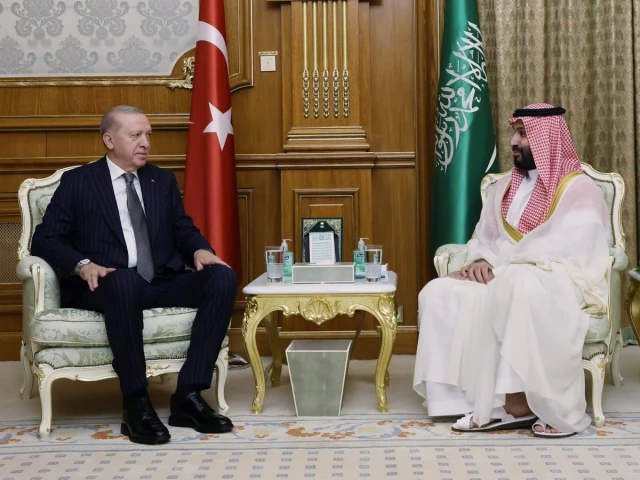
Turkish President Tayyip Erdogan meets Saudi Crown Prince Mohammed bin Salman.
Turkish President Recep Tayyip Erdoğan meets Saudi Crown Prince Mohammed bin Salman in Mecca, Saudi Arabia. Saudi Press Agency/Handout/Reuters

ISTANBUL—The leaders of Turkey, Saudi Arabia and Pakistan signed a mutual defense agreement on Friday, laying the foundation for closer military ties among three U.S. allies looking for new ways to shore up their security after years of upheaval in the Middle East.
The agreement comes as the U.S. and Israeli war against Iran has created new risks for the region while raising new uncertainties about the American security umbrella.

President Trump
, having launched the war against the advice of his Arab Gulf allies, is now looking for an exit that many countries in the region fear could leave them exposed to an angered and emboldened Iran.

Israel’s demonstration of powerful military and intelligence capabilities and its willingness to use them across the region since the deadly Hamas attack on Oct. 7, 2023, has also raised new security considerations for other Middle East powers.
The agreement brings together Pakistan, a nuclear-armed nation, with Saudi Arabia, a wealthy oil producer, and Turkey, a NATO member with a large and growing defense industrial base.

It builds on an existing defense arrangement between Saudi Arabia and Pakistan. A Turkish official said the pact includes a collective defense clause and is purely defensive, not aimed at any specific actor. Other countries are welcome to join the agreement, the official said.

“The Agreement is intended to strengthen collective deterrence against any act of aggression, and stipulates that any armed attack against any one of the three States shall be regarded as an attack against them all,” Pakistan’s Foreign Ministry said.

The joint defense accord underscores how regional powers are taking a hard look at their security arrangements in the wake of the war in Iran. Tehran built its defense largely on retaliatory strikes across the Persian Gulf, which exceeded its attacks on Israel and hit economic and cultural targets as well as U.S. bases and embassies. Iran also launched missiles at Turkey, a NATO member that hosts an important base for U.S. forces.

Israel, meanwhile, is bumping up against Turkey in Syria and launched a missile attack on Hamas leaders in Qatar last year that alarmed Gulf states that got little warning and assumed their relationship with the U.S. would prevent such strikes.

Saudi Arabia also faces a growing threat in neighboring Yemen, where the Iran-backed Houthi militia has begun attacking opposing military forces backed by the kingdom and shooting at Saudi tankers transiting the Red Sea. The kingdom said a Houthi attack Thursday injured 11 people in a Saudi border town.

“It’s a response to both of these destabilizing factors, because all three countries view the overall destabilization of the region with a similar lens, tracing it both to Israel and to Iran,” said Sinan Ülgen, a former Turkish diplomat and the director of EDAM, a think tank in Istanbul.

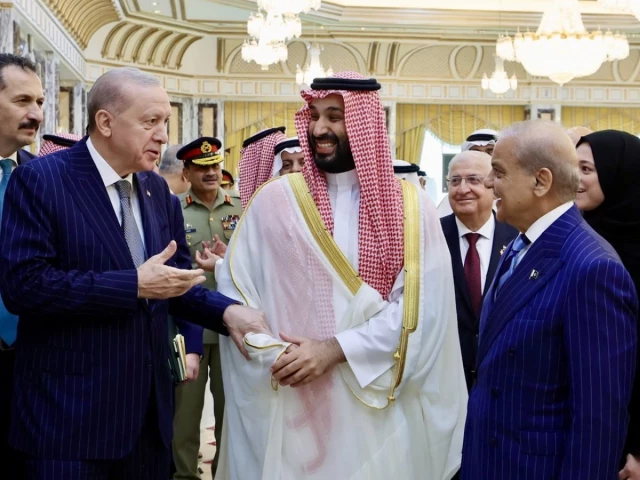
The leaders of the three majority Sunni Muslim nations signed the agreement at a ceremony in Mecca, home to the holiest site in Islam. Turkish President Recep Tayyip Erdoğan signed the agreement along with Saudi Arabian Crown Prince Mohammed bin Salman and Pakistani Prime Minister Shehbaz Sharif.

The three governments didn’t say what, if any, practical steps they would take if any of them were to be attacked. Pakistan and Saudi Arabia signed a similar bilateral agreement last year, months before the kingdom came under attack from Iranian missiles and drones during the current conflict. Pakistan dispatched a fleet of warplanes to the Gulf country in April after several weeks of war.

NATO air defenses shot down the ballistic missiles Iran fired at Turkey during its barrage of strikes earlier this year. Pakistan, which didn’t come under attack in the war but briefly exchanged fire with Iran in 2024, emerged as the leading mediator between Washington and Tehran early in the conflict.

The new defense agreement could be seen as an effort to build up a bulwark against future Iranian attacks, analysts said.

“This gives a message to Iran that it cannot just simply dictate its way under the new realities which we see are now emerging, which have considerably strengthened Iran’s hand in the Gulf region
,” said Umer Karim, an associate fellow with the King Faisal Center for Research and Islamic Studies, a think tank in Riyadh, Saudi Arabia.

The agreement also points to the dilemmas facing regional powers in the Middle East, Europe and Asia. These countries may want to diversify their security arrangements following the war in Iran, but remain broadly dependent on the U.S. for key military supplies and support.

“I think that all the three countries are structurally in a bind with the U.S. with regards to their security or politics. Although they do try to pragmatically wade around it for their national interest,” Karim said.
 
Iran , ASSAD Regime and Hezbol allowed Israel to take 1/3 of Syria via Israeli proxy PKK-YPG terrorists

on the other hand , Turkiye blocked Israeli plan in Syria and cleaned Syria from terrorists ( PKK-YPG , ISIS , Hezbol , etc )

Turkiye saved Syria's territorial integrity


soon whole world will see what will happen with so-called Yemeni warriors ( Houtsis ) as like loser PKK-YPG , ISIS , SAA , IRGC , Hezbol , LNA , WAGNER , RSF

Iran backed Houtsis are in Yemen as an illegitimate actor disrupting order against the legitimate government and threatening the country's territorial integrity

enough is enough with Iran and Israel who creates chaos in sunni muslim Countries
No.. YPG-PYD and US forces entered north east Syria thanks to the weakening of central authorities, caused by CIA and Turkey backed rebels and the civil war.

Turkey did nothing when Israel safely entered and occupied Syrian territories and when Israel destroyed all the Syrian military equipment.

Turkey is a NATO country so it has at least partial common interests with Israel and zionism, weakening of Iran, occupation of Syrian lands and weakening any anti-imperialist force (Houthis, Hezbollah, even Hamas by encouraging disarmament initiatives).

Turkey literally never delivered 1 single bullet to Hamas or Islamic Jihad.

Turkey DID deliver fuel to Israel during the genocide.
 

This article also mentions that the pact is primarily against Iran, but with the additional nugget that it will be operationalized by action against the Houthis.

Saudi Arabia, Turkey and Pakistan sign defence pact in Mecca​

Three allies seek to deepen regional security co-operation to deal with wars and instability

Saudi Arabia, Turkey and Pakistan signed a defence pact in Mecca on Friday as the allies seek to deepen regional security co-operation after the turmoil triggered by the US-Israeli war against Iran.

The agreement between the three Muslim-majority countries comes as Riyadh faces a growing threat from Iranian-backed Houthi rebels in Yemen, who have reignited a decade-long conflict with Saudi Arabia, attacking oil tankers in the Red Sea and targeting the kingdom’s energy infrastructure with missiles and drones.

The military alliance “reflects a recognition that American deterrence has been significantly weakened and that the Iranian threat will increasingly need to be managed by regional powers”, said Ali Shihabi, a Saudi commentator close to the royal court.

Pakistan’s foreign ministry said the agreement reflected the three states’ “commitment to further strengthening their collective security and to promoting peace, security and stability in the region and beyond”.“The agreement is intended to strengthen collective deterrence against any act of aggression, and stipulates that any armed attack against any one of the three states shall be regarded as an attack against them all,” the ministry said in a statement.

Saudi Arabia said the pact was not “an effort to establish a military axis or a sectarian bloc. Nor is it linked to any nuclear ambitions or arms race.” A Turkish official said the pact was “purely defensive in nature” and not focused on any “specific actor”. He said it would be open for other regional states to join in the future.

The deal was signed by Saudi Crown Prince Mohammed bin Salman, Turkish President Recep Tayyip Erdoğan and Pakistani Prime Minister Shehbaz Sharif. Pakistan’s powerful military chief Field Marshal Asim Munir was also at the meeting.

Two people briefed on the agreement said it was similar to a mutual defence pact Saudi Arabia and nuclear-armed Pakistan agreed last September. In April, Pakistan deployed a squadron of fighter jets and crew, as well as a Chinese-made HQ-9 air-defence system, to a Saudi air base to help the kingdom defend against Iranian attacks as part of that deal.

Riyadh and Islamabad have for months been holding talks with Nato-member Turkey on the possible expansion of their agreement, which appears to have been accelerated by the escalating conflict between the Houthis and Saudi Arabia.

“It’s a prelude to more Saudi military action against the Houthis. Turkey has naval assets and I think they will be expected to participate, as will the Pakistanis,” one of those briefed on the deal said.

“It reflects Turkish willingness to get involved, which is a very interesting development.”A Pakistani official said Munir and Erdoğan discussed forming a “new regional security architecture” and collaborating to respond to Houthi strikes on Saudi Arabia and Red Sea shipping during talks in Ankara last month.


Ankara is seeking to increase defence exports to the Gulf, and the tripartite alliance could marry Riyadh’s petrodollars with Ankara and Islamabad’s battle-hardened armies and defence production capabilities.

Turkey and Pakistan are already co-operating on drone development, while Saudi Arabia has signed major drone procurement and training deals with Turkish defence company Baykar.The defence deal also “fits the broader US preference for greater regional burden-sharing”, Burcu Ozcelik, a senior fellow at the Royal United Services Institute think-tank in London, said. “At the same time, it aligns with the ‘regional solutions to regional problems’ approach long advocated by Ankara.

”Saudi Arabia, Turkey, Pakistan and Egypt have been deepening their ties over the past year as regional states seek to manage the fallout from almost three years of conflict in the Middle East between Iran and its proxies and Israel.

As well as the threat posed by Iran, the allies are also increasingly concerned about Israel’s military operations across the region.All four have sought to de-escalate the US’s war with Iran, during which Tehran has launched barrages of missiles and drones at Gulf states and closed the Strait of Hormuz.

The conflict has injected a mood of urgency among regional states about their need to diversify defence partnerships as the months-long war has reinforced the view that they cannot rely solely on the US as a security partner.

“The US can’t do the job, so it helps to fill the gap and there is a need for a new security architecture in the region,” one of the people briefed on the talks said.


That has become more pressing for Riyadh as the Houthis last month resumed their war against the kingdom, shattering a four-year truce by launching missiles and drones at Saudi Arabia and announcing a blockade of Saudi ports.They have also threatened to close the Bab al-Mandab Strait, which connects the Red Sea to the Gulf of Aden.

The waterway has become a vital route for Saudi Arabia to export its oil to Asia since Iran closed the Strait of Hormuz.In a sign that the conflict was escalating, the Saudi military said Houthi attacks on the kingdom’s southern province of Najran wounded 11 civilians, including a four-year-old child, on Thursday.

Separately, the Houthis claimed responsibility for attacks that killed dozens of forces aligned to the Saudi-backed Yemeni government.Saudi Arabia has responded to Houthi attacks in recent weeks by launching air strikes against the rebels in Yemen.

The kingdom intervened in Yemen’s civil war in 2015 to lead an Arab coalition against the Houthis after the rebels seized Sana’a and ousted the internationally recognised government. The parties reached a ceasefire in April 2022, but the October 7 Hamas attack on Israel and the Houthis’ assaults on shipping upended a diplomatic push to end the war.

The truce, however, had largely held before last month’s flare-up.Saudi Arabia has also faced missile and drone attacks from Iranian-backed militias in Iraq, and last month joined the US in launching strikes against those militants.The Saudi-owned Al Arabiya media outlet quoted an official on Thursday saying there was “credible intelligence” that suggested Iranian-backed proxies and Iran’s Revolutionary Guards were preparing to attack the kingdom.

Yasmine Farouk, at Crisis Group think-tank, said in a recent note that the deepening alliance between Saudi Arabia and its allies has “the potential to reshape the regional order, if incrementally, with the first test being whether it can help bring about a stable outcome to the US-Israeli war with Iran”.
 
Various analysis of this pact come to the same conclusion. It is a reaction to the US defeat in this war , perceptions of a strengthened Iranian hand in the region and concerns about a weakened or absent America in the post-war.

what a joke
 

Turkish president says Makkah Joint Defence Agreement targets no country, open to other friendly nations​

Says the agreement reaffirms the right to self-defence as defined under Article 51 of the UN Charter


Anadolu AgencyAugust 07, 20264 min read
facebook twitter whatsup linkded email

turkish president recep tayyip erdogan and saudi arabia s king salman bin abdulaziz meet to sign a joint defence agreement in makkah saudi arabia on aug 7 2026 saudi press agency

Turkish President Recep Tayyip Erdogan and Saudi Arabia's King Salman bin Abdulaziz meet to sign a joint defence agreement in Makkah, Saudi Arabia, on Aug 7, 2026. — SAUDI PRESS AGENCY


Turkish President Recep Tayyip Erdogan on Friday said that the Makkah Joint Defence Agreement signed earlier in the day between Türkiye, Saudi Arabia and Pakistan targeted no country and remained open to the participation of other friendly nations seeking peace, prosperity and stability in the region.

In a post on the Turkish social platform NSosyal, Erdogan said the agreement, based on the principle of collective deterrence, would strengthen security and defence cooperation, support joint defence industry projects and contribute to counterterrorism efforts.

He said the agreement also reaffirms the right to self-defence as defined under Article 51 of the UN Charter.

"The agreement does not target any country and is open to the participation of all brotherly countries seeking peace, prosperity and stability in our region," Erdogan said.


Türkiye, he added, would firmly maintain its principled stance in favour of resolving conflicts and crises through dialogue and diplomacy, based on respect for international law and in line with its vision of regional ownership.

Erdogan said he travelled to Makkah earlier Friday at the invitation of Saudi Crown Prince and Prime Minister Mohammed bin Salman, where he met with the Saudi crown prince and PM Shehbaz Sharif.

"On this occasion, as the three countries, we signed a Joint Defence Agreement," he said.

READ: What the Pakistan-Saudi Arabia-Turkiye defence pact is — and what it isn't

Erdogan expressed hope that the visit, consultations and agreement would benefit the entire region.

Meanwhile, the Turkish Vice President Cevdet Yilmaz also described the pact as a “historic step” that would strengthen the region’s security architecture.

Yilmaz said it would reinforce cooperation in collective security, deterrence, the defence industry and regional stability, while advancing Türkiye’s peace-oriented foreign policy vision and multidimensional strategic partnerships.


He stressed that the agreement was “not directed against any country”.

Yilmaz also expressed hope that the strategic cooperation established in the security field would expand into economic areas.

“We expect the spirit of strategic cooperation established in the field of security through this agreement to also accelerate economic cooperation, particularly in connectivity, trade, finance and investment,” he said.

He said regional partnerships were becoming increasingly important at a time when global institutions and rules were weakening.

“These forms of cooperation could also lay the groundwork for a fairer global order in the future,” he added.

READ MORE: Pakistan-Saudi-Turkiye defence deal in pipeline, defence production minister says

Yilmaz said he hoped the agreement, built on a shared history, brotherhood and solidarity, would bring positive outcomes for the region, the Islamic world and global peace.

In addition, Turkish Communications Director Burhanettin Duran described the agreement as "a historic step" that strengthened the countries' shared history, deep-rooted fraternal ties and strong spirit of solidarity on a strategic basis.

Duran said on the Turkish social media platform NSosyal that Türkiye, under the leadership of President Erdogan, remains committed to contributing to regional and global peace, security and stability through strategic cooperation with friendly and brotherly countries in an increasingly complex global security environment.

"The Makkah Joint Defence Agreement signed between Türkiye, Saudi Arabia and Pakistan is a historic step in further strengthening our shared history, deep-rooted brotherly ties and strong spirit of solidarity on a strategic basis," he said.


Duran said the agreement did not target any country and would strengthen the three nations' common security and collective deterrence while advancing defence industry cooperation and military interoperability, contributing significantly to preserving peace and stability in the region.

He added that the agreement reflected the determination of the three countries to uphold their shared values and build the future security architecture through solidarity.

He further expressed hope that the agreement would bring benefits to the three brotherly countries and further strengthen the deep-rooted brotherhood and strategic cooperation among Türkiye, Saudi Arabia and Pakistan.
 

What the Pakistan-Saudi Arabia-Turkiye defence pact is — and what it isn't​

It builds on decades of strategic ties, without targeting any country, while rejecting comparisons with military blocs


Web DeskAugust 07, 20263 min read
facebook twitter whatsup linkded email

turkish president recep tayyip erdo an saudi crown prince mohammed bin salman and prime minister shehbaz sharif in makkah saudi arabia on august 7 2026 photo x

Turkish President Recep Tayyip Erdoğan, Saudi Crown Prince Mohammed bin Salman, and Prime Minister Shehbaz Sharif in Makkah, Saudi Arabia on August 7, 2026. Photo: X


Pakistan, Saudi Arabia and Turkiye have formalised their longstanding strategic relationship through the newly signed "Makkah Joint Defence Agreement", a trilateral security framework that its proponents describe as a defensive arrangement aimed at strengthening collective deterrence, enhancing military cooperation and promoting regional stability.

The agreement, signed during the Makkah Al-Mukarramah Summit for Joint Defence, has prompted comparisons with military alliances such as NATO. However, according to security analysts, the pact is intended to formalise decades of existing strategic cooperation rather than create a new military bloc or offensive alliance.

A formal framework for existing ties

According to security analysts, the agreement represents the natural progression of longstanding political, military and strategic relations among the three countries.

They note that Pakistan's ties with Turkiye date back to the Khilafat Movement, while Pakistan and Saudi Arabia have maintained decades of defence, political, economic and diplomatic cooperation based on what they describe as mutual trust and shared strategic interests.

Rather than establishing an entirely new partnership, analysts say the agreement provides a formal institutional framework for cooperation that has evolved over many years.

Why now?

Security analysts argue that the agreement reflects a rapidly changing regional security environment.

They point to regional conflicts, evolving security threats and changes in the character of modern warfare as factors driving closer strategic coordination among countries that share common security interests.

According to them, the trilateral framework is intended to preserve regional stability by strengthening collective security mechanisms instead of relying on ad hoc bilateral cooperation.

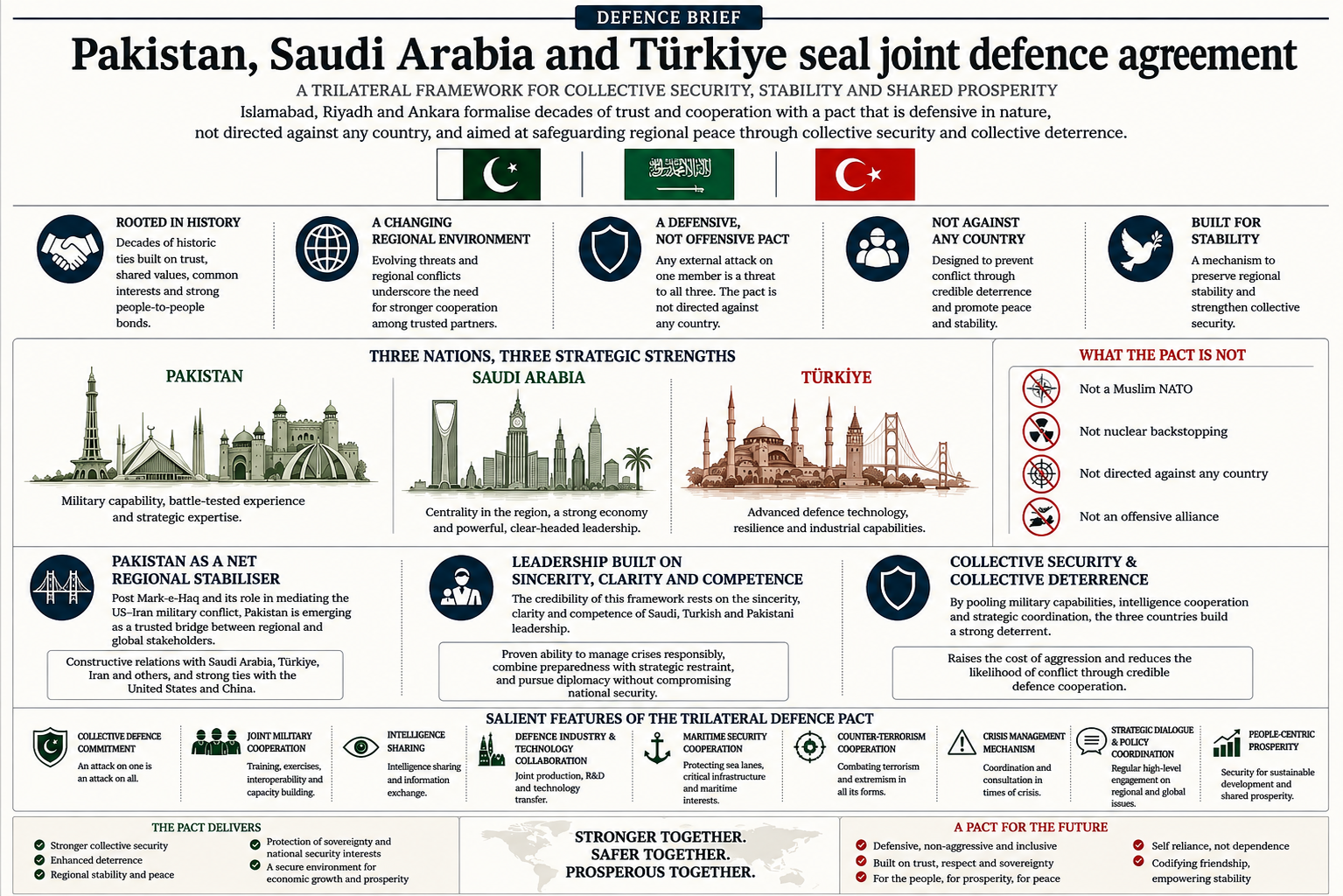
chatgpt-image-aug-7-2026-08-01-21-pm1786114997-0.png


What the agreement does

At its core, the agreement establishes a framework based on the principles of collective security and collective deterrence.

Security analysts say its central premise is that aggression against one member would be regarded as a threat to all three, thereby increasing the potential cost of military action and discouraging conflict through credible deterrence.

The framework also envisages expanded defence cooperation, including closer military coordination, intelligence sharing, strategic consultations, defence planning and broader institutional cooperation between the three countries.

According to analysts, pooling military capabilities and strategic coordination is intended to improve preparedness while reducing the likelihood of regional conflict.

The complementary roles of the three countries

The agreement draws on what security analysts describe as the complementary strengths of each participant.

Pakistan contributes experienced armed forces, operational expertise and strategic planning capabilities developed through decades of counterterrorism operations and conventional military preparedness.

Saudi Arabia brings economic strength, regional influence and political leadership, while Turkiye contributes an advanced defence industry, military technology and industrial capacity.

Together, analysts say, these capabilities form a balanced security architecture capable of responding to emerging regional security challenges.

Pakistan's evolving diplomatic role

Security analysts also argue that Pakistan has increasingly emerged as a regional stabiliser through its diplomatic engagement in recent regional crises.

They cite Pakistan's mediation efforts during the recent US-Iran conflict, alongside its diplomatic relations with Saudi Arabia, Turkiye, Iran, China and the United States, as evidence that Islamabad is well positioned to serve as a bridge between regional and global stakeholders.

They say that this broader diplomatic role complements Pakistan's contribution to the trilateral framework.

What the agreement is not

While comparisons have been drawn with existing military alliances, security analysts reject several common characterisations of the pact.

They emphasise that the agreement is not:

  • an offensive military alliance;
  • directed against any specific country;
  • a "Muslim NATO";
  • a nuclear security arrangement or extended nuclear deterrence agreement; or
  • a religion-based political or military bloc.
Instead, they describe it as a defensive security framework designed to deter aggression, strengthen military cooperation and enhance regional stability without targeting any state.

According to the analysts, the agreement is intended to reinforce self-reliance among the three partners while codifying an existing strategic relationship through a formal institutional mechanism.

A collective deterrence model

Security analysts say the credibility of the framework ultimately depends on continued political coordination among the three governments.

They argue that the leadership of Pakistan, Saudi Arabia and Turkiye has consistently combined military preparedness with diplomatic engagement and strategic restraint, making the agreement a mechanism for crisis management as much as defence cooperation.

According to them, the objective is to reduce the likelihood of conflict through credible deterrence while providing a structured platform for long-term security cooperation among the three countries.

Although the agreement significantly deepens trilateral defence coordination, analysts maintain that its stated purpose is not to create a new geopolitical bloc but to institutionalise an existing strategic partnership centred on collective security, stability and regional cooperation.
 

Users who are viewing this thread

Pakistan Defence Latest

Back
Top