Navigation
Install the app
How to install the app on iOS
Follow along with the video below to see how to install our site as a web app on your home screen.
Note: This feature may not be available in some browsers.
More options
Style variation
You are using an out of date browser. It may not display this or other websites correctly.
You should upgrade or use an alternative browser.
You should upgrade or use an alternative browser.
Mirage III / V of Pakistan Air Force
- Thread starter ghazi52
- Start date
More options
Who Replied?




Fatman17
THINK TANK: CONSULTANT
PAKISTAN DAY PARADE 2017
- Aviation Features
- Pakistan Day Parade 2017
By Waseem Abbas 15th June 2017
FEATURE

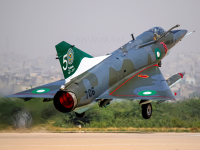
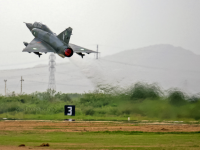
Mirage VEF serial 748 en route to the Shakarparian Parade Ground in Pakistan’s capital city Islamabad.
Waseem Abbas
THE ARMED forces of Pakistan held a Joint Services Parade on March 23 to commemorate the 77th anniversary of the passing of the Pakistan Resolution on the same date in 1940.
The event, held at Shakarparian Parade Ground in Islamabad, featured 66 aircraft of 17 different types from all three branches of the armed forces. There were 17 formation flights and four solo displays.
The majority of the jets took off from their home bases. Meanwhile, Qasim Army Aviation Base (AAB) at Dhamial Rawalpindi, home to the 101 Army Aviation Group, hosted the bulk of the helicopters including assets from the Pakistan Navy (PN).
Chief of the Air Staff (CAS) Air Chief Marshal Sohail Aman led the flypast in an F-16 Block 52. Fighters from different Pakistan Air Force (PAF) squadrons then appeared in fourship diamonds. Pairs of F-16As and F-16Bs were followed by JF-17s, F-7PG Skybolts and another four-ship of F-7Ps.
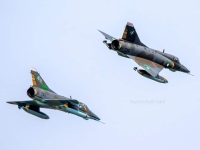
Mirages upgraded to Retrofit of Strike Element (ROSE) standard represented the strike element of the PAF and also marked 50 years of service. Seven Mirages took part in two groups. Mirage VEF serial 748 with special Pakistan Day markings led the first diamond. The second formation of three jets was led by Mirage VEF serial 706.
Also participating was a ZDK-03 Karakoram Eagle airborne early warning and control (AEW&C) aircraft flanked by two Saab 2000 Erieyes.
Making its debut was an Il-78 tanker flanked by two C-130s.
A pair of P-3Cs from Karachi-based 28 Squadron represented PN Aviation. Unmanned aerial vehicles (UAVs) were shown on flatbed military trucks. Examples included the Burraq armed with two Burq missiles, as well as the Scout, Huma and Uqab. The indigenous Ra’ad air-launched cruise missile was also included on a flatbed carrier.
The second half of the display involved 19 helicopters from the Pakistan Army (PA) and PN Aviation. The majority of these were from 101 Army Aviation Group, while a group of AH-1s joined in from the 404 Army Aviation Group based at Multan. The helicopters were led by a three-ship of AH-1s. The Cobras were followed by three-ships of AS550C3 Fennecs, Bell 412EPs, IAR- 330SM Pumas, Mi-17s and PN Aviation Z-9ECs from 222 Squadron ‘Stingrays’.
This was followed by two formations of jet trainers from the PAF Academy Asghar Khan. The first was from the Academy’s Aerobatics Team ‘The Sherdils’ in four T-37s. They were followed by nine K-8s.
A JF-17 from 14 Squadron ‘Tail Choppers’ based at PAF Base Minhas, Kamra, performed an aerobatics display. The Thunder was followed by an F-16 from PAF Base Mushaf at Sargodha.

Mirage VEF serial 706 in 50th anniversary markings. It is operated by 27 Squadron ‘Zarrars’ stationed at PAF Base Rafiqui.
Alan Warnes

Originally published in AirForces Monthly Magazine
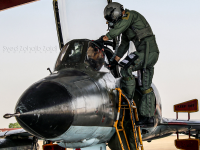
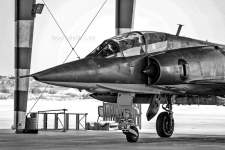
Ice-Le0pard
Registered Member

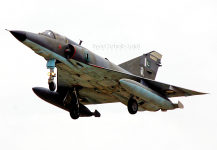
Are Mirage 5 ROSE IIs and IIIs capable of carrying targeting pods? I found this image and despite carrying several glide bombs and LGBs I don't actually see any targeting pods of any sort. The exception is the grey and black communications pod for the H-4 SOW/Raptor II.
Furthermore, I looked over some threads on SWIFT RETORT and it seems that the Mirage 5s relied on data-link with Mirage IIIDAs for targeting.
Could someone clarify if our Mirage 5s carry targeting pods and, if so, what the payload options are as I only know the following:
-REK Glide Bombs 500-2000lbs
-Al-Battar LGBs
-AIM-9P4s
-H-4 SOW/Denel Raptor II
-Hijara (500 or 250lbs, not sure) Cluster Bombs
-Dumb Bombs 500-2000lbs
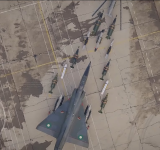
Furthermore, I looked over some threads on SWIFT RETORT and it seems that the Mirage 5s relied on data-link with Mirage IIIDAs for targeting.
Could someone clarify if our Mirage 5s carry targeting pods and, if so, what the payload options are as I only know the following:
-REK Glide Bombs 500-2000lbs
-Al-Battar LGBs
-AIM-9P4s
-H-4 SOW/Denel Raptor II
-Hijara (500 or 250lbs, not sure) Cluster Bombs
-Dumb Bombs 500-2000lbs
Fatman17
THINK TANK: CONSULTANT
AIRCRAFT PROFILE: DASSAULT MIRAGE III
- Aviation Features
- Aircraft profile: Dassault Mirage III
By Malcolm V Lowe 1st October 2020
FEATURE
Mirage III series single-seaters were significant members of the world-famous line of delta-winged warplanes produced in France by Dassault. Malcolm V Lowe tells their story
The celebrated French aviation company Avions Marcel Dassault is one of the most prolific producers of jet-powered combat aircraft. Created following World War Two as a successor to the prewar Avions Marcel Bloch, Dassault owed its existence to French aviation pioneer Marcel Bloch, whose surname change following the war to Dassault coincided with the establishment of one of the world’s most famous aircraft designers and manufacturers.
Carrying a large AS 37 Martel anti-radar missile beneath its fuselage, a Phimat chaff dispenser on its outer starboard wing pylon, and a Barax ECM pod far to port, this Mirage IIIE No 624/3-JG was operated by EC 2/3 ‘Champagne’
DASSAULT AVIATION
Dassault’s company was eager to embrace the new technology of high-performance jet-powered combat aircraft, which created and produced the famous line of Mirage warplanes for French and export service – including the Mirage III family.

Where it all began: the original, small ‘Delta Mystère’ that first flew in June 1955 DASSAULT AVIATION
Pioneering designs
In the post-war era, Dassault successfully exploited jet engine technology and duly built a series of aircraft for service with France’s re-established air force, the Armée de l’Air – starting with the austere straight-winged Ouragan of 1949. This was followed by the swept-wing Mystère IIC, which entered service with the Armée de l’Air’s 10th Escadre de Chasse (EC 10 – fighter wing) in 1954, the Mystère IVA operational the next year, and the Super Mystère B.2, which joined the front line during 1958. Research into delta-wing technology was taking place at this time in several countries, including France, and in response to a 1953 official requirement
Dassault introduced the delta into its product line. The 1953 specification was for a high-performance fighter to intercept high-flying Soviet bombers. Several French manufacturers responded, each one using rocket power wholly or partially to give maximum performance. Dassault suggested a small delta-winged interceptor with mixed jet engine and rocket propulsion, which first flew in June 1955 as the ‘Delta Mystère’. However, the aircraft was too small to carry a worthwhile armament load and interception radar, and the project therefore progressed through several revisions and actual prototypes while Dassault perfected the design – and adopted a new name, ‘Mirage’. At one stage the French government cancelled the whole programme, but Dassault pressed on regardless and was ultimately rewarded with a contract for a batch of development aircraft. They were known as Mirage IIIAs, serial numbers 01 to 10, the first (A 01) flying in May 1958. These machines were a great success and their development transformed the basic Mirage delta design into a viable warplane. On October 24, 1958, A 01 achieved Mach 2, the first European fighter to attain this performance milestone.
By then, an order had already been placed for 100 Mirage IIIAs in September 1957, but this was modified during October 1958 into 100 of the intended single-seat Mirage IIIC production model, fitted with a CSF Cyrano air-to-air radar. Eventually 95 production Mirage IIICs were built, serial numbers 1 to 95, with the additional five to make up the 100 intended for development purposes.
The first production example flew in October 1960. Powered by a SNECMA Atar 9B-series turbojet of some 13,404lb st with afterburner, the Mirage IIIC had a moveable shock cone within each fuselage air intake, plus an ‘eyelet’ style variable exhaust, and could be fitted with an additional SEPR 841 rocket motor beneath the rear fuselage. The latter, however, was rarely used. This was because the likelihood of high-level Soviet bombers requiring a zoom-to-altitude interception diminished during the type’s service career. Introducing the classic Mirage delta wingspan of marginally less than 27ft, the IIIC was armed with two 30mm DEFA 552 cannon in the lower forward fuselage fitted to a removable ‘pack’, and could carry various weapons and external fuel tanks on three (later five) lower wing/fuselage stores stations, including a single Matra R.530 air-to-air missile (AAM) on the centreline and two Matra Magic or AIM-9 Sidewinder short-range AAMs, one under each wing. Secondary air-to-ground missions could also be flown.

In completely ‘clean’ configuration, Mirage IIIC No 60/10-RG of EC 2/10 ‘Seine’ displays the distinctive delta-wing design of the Mirage family, and the large nose radome carrying equipment for the onboard Cyrano radar
SHAA

Mirage IIIC No 28, coded 2-EG of EC 1/2 ‘Cigognes’ and with a SEPR 841 rocket motor beneath its rear fuselage, illustrates an alternative weapons combination of a Matra R.511 air-to-air missile on its centreline pylon
DASSAULT AVIATION

Ten Mirage IIIA airframes were built as development aircraft for the Mirage III programme. The more pointed nose of the type is exemplified here by the fourth aircraft, A 04, in natural metal finish
Fatman17
THINK TANK: CONSULTANT
DASSAULT AVIATION

Elegant and advanced, the delta-winged Mirage was an important Western warplane during the Cold War. This R.530-armed Mirage IIIC No 62/10-RJ, belonged to EC 2/10 ‘Seine’ based at Creil
SHAA

A major flaw in the early production MiG-21’s equipment layout included a fuselage fuel tank located near to an oxygen supply. Well-placed cannon fire could result in a spectacular explosion, and this image is believed to show cannon strikes from an Israeli Mirage IIICJ
KEY COLLECTION

Illustrating the original bare-metal finish of the French Mirage IIIC fleet, this example from EC 2/10 ‘Seine’ at Creil, No. 9/10-RS, proudly wore the ‘Cercle de Chasse de Paris’ badge on its vertical tail. A chief role for EC 10 was the air defence of the French capital
DASSAULT AVIATION

The first squadron of the Armée de l’Air operational on the Mirage IIIE was Escadron de Chasse 2/13 ‘Alpes’. One of its aircraft, No 417, wears the original code letter/ number on its mid-fuselage, rather than the later forward fuselage location
MALCOLM V LOWE COLLECTION
In the Armée de l’Air, the Mirage IIIC entered service initially with the 2nd Escadre de Chasse at Dijon-Longvic during 1961 – that unit’s famous ‘stork’ squadron, EC 1/2 ‘Cigognes’, receiving its first example in July that year. Teething problems with the new aircraft, especially its complex radar, were encountered early on, but the type matured into a significant fighter type for the Armée de l’Air during the Cold War years. In total, four French Air Force fighter Escadres de Chasse eventually operated the Mirage IIIC, these being the 2nd Escadre at Dijon-Longvic, the 5th at Orange-Caritat, 10th at Creil, and the 13th at Colmar-Meyenheim.
In parallel with the single-seat Mirage IIIC, a two-seat conversion/operational trainer was also developed. In all, 27 production examples of the Mirage IIIB were delivered to the Armée de l’Air, the first flying on July 19, 1962. They were followed by five Mirage IIIB1 airframes specifically for trials work. In service, the Mirage IIIB was allocated in small numbers to each operational Mirage IIIC squadron and were eventually concentrated specifically in the 2nd Escadre’s EC 2/2 ‘Côted’Or’ squadron, which was subsequently re-designated as a specialised training unit, ECT 2/2.

Mirage IIIE, No 539/3-XO, EC 3/3 ‘Ardennes’, French Armée de l’Air, 1993. This aircraft was repainted in the air defence scheme worn by Mirage 2000Cs (and received special decorations) as the last example of its kind to be serviced by the maintenance unit GERMAS 15.003, then co-located at the aircraft’s home base of Nancy. It previously wore standard green and grey camouflage in keeping with its ground-attack role
Elegant and advanced, the delta-winged Mirage was an important Western warplane during the Cold War. This R.530-armed Mirage IIIC No 62/10-RJ, belonged to EC 2/10 ‘Seine’ based at Creil
SHAA
A major flaw in the early production MiG-21’s equipment layout included a fuselage fuel tank located near to an oxygen supply. Well-placed cannon fire could result in a spectacular explosion, and this image is believed to show cannon strikes from an Israeli Mirage IIICJ
KEY COLLECTION
Illustrating the original bare-metal finish of the French Mirage IIIC fleet, this example from EC 2/10 ‘Seine’ at Creil, No. 9/10-RS, proudly wore the ‘Cercle de Chasse de Paris’ badge on its vertical tail. A chief role for EC 10 was the air defence of the French capital
DASSAULT AVIATION
The first squadron of the Armée de l’Air operational on the Mirage IIIE was Escadron de Chasse 2/13 ‘Alpes’. One of its aircraft, No 417, wears the original code letter/ number on its mid-fuselage, rather than the later forward fuselage location
MALCOLM V LOWE COLLECTION
In the Armée de l’Air, the Mirage IIIC entered service initially with the 2nd Escadre de Chasse at Dijon-Longvic during 1961 – that unit’s famous ‘stork’ squadron, EC 1/2 ‘Cigognes’, receiving its first example in July that year. Teething problems with the new aircraft, especially its complex radar, were encountered early on, but the type matured into a significant fighter type for the Armée de l’Air during the Cold War years. In total, four French Air Force fighter Escadres de Chasse eventually operated the Mirage IIIC, these being the 2nd Escadre at Dijon-Longvic, the 5th at Orange-Caritat, 10th at Creil, and the 13th at Colmar-Meyenheim.
In parallel with the single-seat Mirage IIIC, a two-seat conversion/operational trainer was also developed. In all, 27 production examples of the Mirage IIIB were delivered to the Armée de l’Air, the first flying on July 19, 1962. They were followed by five Mirage IIIB1 airframes specifically for trials work. In service, the Mirage IIIB was allocated in small numbers to each operational Mirage IIIC squadron and were eventually concentrated specifically in the 2nd Escadre’s EC 2/2 ‘Côted’Or’ squadron, which was subsequently re-designated as a specialised training unit, ECT 2/2.
Mirage IIIE, No 539/3-XO, EC 3/3 ‘Ardennes’, French Armée de l’Air, 1993. This aircraft was repainted in the air defence scheme worn by Mirage 2000Cs (and received special decorations) as the last example of its kind to be serviced by the maintenance unit GERMAS 15.003, then co-located at the aircraft’s home base of Nancy. It previously wore standard green and grey camouflage in keeping with its ground-attack role
Fatman17
THINK TANK: CONSULTANT
ALL ANDY HAY-FLYING ART

Mirage IIIC, No 75/13PE, EC 2/13 ‘Alpes’, French Armée de l’Air, Colmar, 1964. The two shades of blue on the tail motif reflect this unit’s dual role of operating day and night

Mirage IIIO, A3-4, 2 Operational Conversion Unit, RAAF, Williamtown, Australia, 1967. The red intake markings eventually changed to yellow with black trim

Mirage IIICJ, ‘176’, ‘The First Jet Squadron’, Israeli Air Force, 1974. Black and yellow ID triangles were added to all Israeli Mirages during the Yom Kippur War, in October 1973. Its ‘kill’ markings are for enemy aircraft shot down during this and the previous War of Attrition

Mirage IIIEA, I-018, Grupo 8, VIII Brigada Aérea, Argentinian Air Force, Río Gallegos, May-June 1982

Mirage IIIS, ‘J-2306’, Cp.Av.3, Swiss Air Force, 1996. Swiss Mirages began to receive low-visibility camouflage from 1987, having previously been in bare metal
The first Mirage IIICJ airframes were delivered to Israel during April 1962, the initial operational unit on the type being 101 Squadron, with 117 and 119 Squadrons subsequently also operating the type. The first ‘kill’ by an Israeli Mirage was achieved on July 14, 1966, over a Syrian-operated MiG-21 during the then-current Water War.

Showing to advantage the prominent and distinctive radar bulge beneath its nose, Mirage IIIE No 519/3-XC of EC 3/3 ‘Ardennes’ displays the potent grace of this French masterpiece
Mirage IIIC, No 75/13PE, EC 2/13 ‘Alpes’, French Armée de l’Air, Colmar, 1964. The two shades of blue on the tail motif reflect this unit’s dual role of operating day and night
Mirage IIIO, A3-4, 2 Operational Conversion Unit, RAAF, Williamtown, Australia, 1967. The red intake markings eventually changed to yellow with black trim
Mirage IIICJ, ‘176’, ‘The First Jet Squadron’, Israeli Air Force, 1974. Black and yellow ID triangles were added to all Israeli Mirages during the Yom Kippur War, in October 1973. Its ‘kill’ markings are for enemy aircraft shot down during this and the previous War of Attrition
Mirage IIIEA, I-018, Grupo 8, VIII Brigada Aérea, Argentinian Air Force, Río Gallegos, May-June 1982
Mirage IIIS, ‘J-2306’, Cp.Av.3, Swiss Air Force, 1996. Swiss Mirages began to receive low-visibility camouflage from 1987, having previously been in bare metal
Overseas success
The Mirage IIIC gained a comparatively modest number of sales on the foreign defence market. Nevertheless, its success – especially in combat – was a significant basis for the enormous export achievements of later models in the Mirage line. The most high-profile export deal featured the 72 examples sold to Israel in the early 1960s as the Mirage IIICJ. Known locally as the Shahak (loosely translated as ‘Skyblazer’), these aircraft became vitally important to the Israelis in subsequent wars and skirmishes across the Middle East. They proved highly successful in aerial combat, even against the very capable MiG-21.The first Mirage IIICJ airframes were delivered to Israel during April 1962, the initial operational unit on the type being 101 Squadron, with 117 and 119 Squadrons subsequently also operating the type. The first ‘kill’ by an Israeli Mirage was achieved on July 14, 1966, over a Syrian-operated MiG-21 during the then-current Water War.
Showing to advantage the prominent and distinctive radar bulge beneath its nose, Mirage IIIE No 519/3-XC of EC 3/3 ‘Ardennes’ displays the potent grace of this French masterpiece
Fatman17
THINK TANK: CONSULTANT
DASSAULT AVIATION

A Mirage IIIE from EC 2/4 ‘Lafayette’ carries a CEN 52 training round beneath its belly, emulating the most potent weapon carried by French-operated Mirages, the AN 52 free-fall tactical nuclear bomb
DASSAULT AVIATION

The Mirage IIIE equipped several Escadres de Chasse (fighter wings) of France’s Armée de l’Air, including EC 2, one of whose aircraft, No 451/2-LT of EC 3/2 ‘Alsace’, is seen here displaying its clean supersonic-capable lines
DASSAULT AVIATION
June the following year was marked by the internationally important Six-Day War. This pitted Israel against Egypt (United Arab Republic), Jordan and Syria, during which the Mirages played a major part in the successful Israeli operations, being used as fighters, fighter-bombers and armed recce platforms. The Israeli Mirages were armed with locally produced Rafael Shafrir 1 AAMs (one beneath each wing) in addition to the onboard 30mm cannon, plus some examples of the bulky Matra R.530 AAM (the latter comprising just one missile, on the lower fuselage centreline pylon).
The ending of this conflict did not mean the cessation of aerial warfare in the region, and various air battles in later years, culminating in the Yom Kippur War of October 1973, allowed the Israeli Shahaks to record further aerial victories. Shahak 59 was the highest-scoring Mirage, Israeli sources quoting 13 air-to-air victories for this airframe when flown by different pilots. Some of the Shahak fleet survived long enough to be considerably modernised, later serving with 253 and 263 Squadrons alongside newer equipment.
Another Mirage IIIC export customer was South Africa, which ordered 16 examples as the Mirage IIICZ, principally for operation by the famous 2 Squadron ‘Flying Cheetahs’ of the South African Air Force. Delivered from 1963, the IIICZ was successfully flown in combat, especially over Angola, again proving victorious in the air-to-air realm.
A single Mirage IIIC was supplied to Switzerland, which intended licence production but eventually opted for later marks of the Mirage; instead the single IIIC (sometimes referred to as a Mirage IIICS) was used for development work, including weapons trials. From late 1982 onwards, Israel supplied around 19 surplus Mirage IIICJs to Argentina to help replace overall Argentine losses during the Falklands War earlier that year.
In addition to French service, the two-seat Mirage IIIB was exported in small numbers to several countries including South Africa, Israel, Lebanon and Switzerland.
Officially formed on the last day of 1978 at Djibouti-Ambouli airfield, EC 3/10 was tasked with air defence for the Republic of Djibouti (a former French colony/ territory) which is situated in the strategically important area of the Horn of Africa. In this role, ‘Vexin’ took over from the Djibouti-based North American F-100D Super Sabre fighters of EC 4/11 ‘Jura’.
The Mirages – sometimes referred to as Mirage IIIC (DJ) – performed admirably in the skies of Djibouti for a decade, armed when necessary with Matra Magic AAMs for their defensive duties, until the summer of 1988 when they were relieved by the Mirage F1C fighters of what became on paper a new ‘Vexin’ unit, EC 4/30.

Illustrating how effective the type’s later camouflage could be, Mirage IIIE No 434/13-QK of EC 1/13 ‘Artois’ exhibits a worn finish in this low-level image
SHAA
Further development of the Mirage line by Dassault led to multiple new models and spinoffs. Significant among these was a direct derivative of the Mirage IIIC, the more powerful and very long-lived Mirage IIIE.
Essentially the IIIC was primarily a fighter, but during its development it was obvious to Dassault’s designers that the basic ‘C’ airframe and layout had considerable growth potential, and that its principal fighter role could also be expanded to include dedicated air-to-ground operations. The subsequent development work carried out by Dassault turned the basic delta Mirage IIIC fighter layout into a true multi-role tactical strike aircraft, with onboard electronics that allowed air-to-ground operations, in addition to keeping intact the original Mirage role of fighter.

The second prototype Mirage IIIE, 02, is seen in this ‘family group’ image at the test base of Istres-Le Tubé in Southern France, with test pilot Henri Suisse third from the right
DASSAULT AVIATION
The new Mirage IIIE was very similar to the earlier ‘C’ but noticeably it had a small fuselage extension behind the cockpit to facilitate additional electronics (including Marconi navigation equipment), placing the rear edge of the opening section of the cockpit canopy in line with the air intake’s leading edge. The ‘E’ was also designed for greater internal fuel capacity, a shortcoming of the Mirage IIIC being its comparatively limited endurance – although like the ‘C’, the Mirage IIIE could carry various underwing external fuel tanks to increase range. Five pylons/stores stations were mounted underneath the ‘E’, one on the fuselage centreline and two beneath each wing.
Apart from the straight-fin leading edge of the ‘E’ compared with that of the Mirage IIIC, the most obvious external difference between the two was a bulge beneath the forward fuselage, containing a downward-looking antenna associated with the Marconi Doppler radar configured as part of a new avionics suite intended primarily for air-to-ground operations. In the forward fuselage and large nose radome was equipment for the onboard CSF Cyrano II multifunction radar (later Thomson-CSF Cyrano II/IIbis), a relative of the earlier Cyrano radar in the Mirage IIIC.
Specifications for the Armée de l’Air IIIE are detailed in the accompanying table. Overall, the ‘E’ was larger, heavier, and more powerful than the Mirage IIIC and could carry more ordnance on its five weapons pylons. Like the ‘C’, the Mirage IIIE was similarly armed with two 30mm DEFA 552 cannon in the lower forward fuselage, mounted in a removable ‘pack’ with 125 rounds each.
Successful testing led to orders for Armée de l’Air service, which eventually resulted in 183 examples of the Mirage IIIE being contracted – although this total differs to figures of 192 or even the 186 sometimes quoted, but a count back of airframes identified by the manufacturer suggests that 183 is correct. Serial numbers began at 401 and randomly continued to 625. The first production example, Mirage IIIE No 401, flew during January 1964.

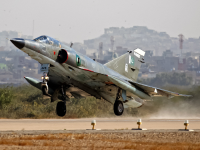
Pakistan has continued to be a major user of Mirages and has flown them in combat. This Sidewinder-armed example, ‘535’, was built for the RAAF as A3-35 and obtained from Australia in 1990
KEY COLLECTION
The initial squadron of this wing to become fully combat ready was EC 2/13 ‘Alpes’, officially receiving its first example in the opening months of 1965. It was a former Mirage IIIC operator and was followed by EC 1/13 ‘Artois’ later in 1965. This squadron had also flown the IIIC, and duly acted temporarily as a training and transition unit for personnel of other squadrons set to be equipped with the IIIE, and for pilots of foreign countries that had purchased the ‘E’ as export customers. In total, four Armée de l’Air Escadres de Chasse eventually operated the IIIE. Numerically these were EC 2 at Dijon-Longvic; EC 3 at Lahr in West Germany, later Nancy-Ochey in France; EC 4 at Luxeuil Saint-Sauveur, and EC 13 at Colmar-Meyenheim. The type became an important element in the Armée de l’Air’s tactical command, the Force Aérienne Tactique (FATac). Besides the single-seat Mirage IIIE, 20 of the related twoseat Mirage IIIBE trainers were ordered in 1970. With a lengthened fuselage but similar power to the ‘E’, in service the IIIBE was intended for operational Mirage IIIE units, but many eventually flew specifically with the 2nd Escadre’s ECT 2/2 ‘Côte-d’Or’ specialised training squadron.

An RAAF Mirage IIIO from 2 Operational Conversion Unit photographed during a combined US-Australian exercise, Pacific Consort, in 1980. Serialled A3-11, it was among the ‘Aussie’ Mirages supplied to Pakistan during 1990
A Mirage IIIE from EC 2/4 ‘Lafayette’ carries a CEN 52 training round beneath its belly, emulating the most potent weapon carried by French-operated Mirages, the AN 52 free-fall tactical nuclear bomb
DASSAULT AVIATION
The Mirage IIIE equipped several Escadres de Chasse (fighter wings) of France’s Armée de l’Air, including EC 2, one of whose aircraft, No 451/2-LT of EC 3/2 ‘Alsace’, is seen here displaying its clean supersonic-capable lines
DASSAULT AVIATION
June the following year was marked by the internationally important Six-Day War. This pitted Israel against Egypt (United Arab Republic), Jordan and Syria, during which the Mirages played a major part in the successful Israeli operations, being used as fighters, fighter-bombers and armed recce platforms. The Israeli Mirages were armed with locally produced Rafael Shafrir 1 AAMs (one beneath each wing) in addition to the onboard 30mm cannon, plus some examples of the bulky Matra R.530 AAM (the latter comprising just one missile, on the lower fuselage centreline pylon).
The ending of this conflict did not mean the cessation of aerial warfare in the region, and various air battles in later years, culminating in the Yom Kippur War of October 1973, allowed the Israeli Shahaks to record further aerial victories. Shahak 59 was the highest-scoring Mirage, Israeli sources quoting 13 air-to-air victories for this airframe when flown by different pilots. Some of the Shahak fleet survived long enough to be considerably modernised, later serving with 253 and 263 Squadrons alongside newer equipment.
Another Mirage IIIC export customer was South Africa, which ordered 16 examples as the Mirage IIICZ, principally for operation by the famous 2 Squadron ‘Flying Cheetahs’ of the South African Air Force. Delivered from 1963, the IIICZ was successfully flown in combat, especially over Angola, again proving victorious in the air-to-air realm.
A single Mirage IIIC was supplied to Switzerland, which intended licence production but eventually opted for later marks of the Mirage; instead the single IIIC (sometimes referred to as a Mirage IIICS) was used for development work, including weapons trials. From late 1982 onwards, Israel supplied around 19 surplus Mirage IIICJs to Argentina to help replace overall Argentine losses during the Falklands War earlier that year.
In addition to French service, the two-seat Mirage IIIB was exported in small numbers to several countries including South Africa, Israel, Lebanon and Switzerland.
Prolonged career
The longest-surviving frontline Mirage IIIC airframes in the Armée de l’Air were the examples assigned to EC 3/10 ‘Vexin’. This unit became independent of the 10th Escadre when the latter was disbanded (as the final Mirage IIIC fighter wing) in the mid-1980s.Officially formed on the last day of 1978 at Djibouti-Ambouli airfield, EC 3/10 was tasked with air defence for the Republic of Djibouti (a former French colony/ territory) which is situated in the strategically important area of the Horn of Africa. In this role, ‘Vexin’ took over from the Djibouti-based North American F-100D Super Sabre fighters of EC 4/11 ‘Jura’.
The Mirages – sometimes referred to as Mirage IIIC (DJ) – performed admirably in the skies of Djibouti for a decade, armed when necessary with Matra Magic AAMs for their defensive duties, until the summer of 1988 when they were relieved by the Mirage F1C fighters of what became on paper a new ‘Vexin’ unit, EC 4/30.
Illustrating how effective the type’s later camouflage could be, Mirage IIIE No 434/13-QK of EC 1/13 ‘Artois’ exhibits a worn finish in this low-level image
SHAA
Further development of the Mirage line by Dassault led to multiple new models and spinoffs. Significant among these was a direct derivative of the Mirage IIIC, the more powerful and very long-lived Mirage IIIE.
Essentially the IIIC was primarily a fighter, but during its development it was obvious to Dassault’s designers that the basic ‘C’ airframe and layout had considerable growth potential, and that its principal fighter role could also be expanded to include dedicated air-to-ground operations. The subsequent development work carried out by Dassault turned the basic delta Mirage IIIC fighter layout into a true multi-role tactical strike aircraft, with onboard electronics that allowed air-to-ground operations, in addition to keeping intact the original Mirage role of fighter.
The second prototype Mirage IIIE, 02, is seen in this ‘family group’ image at the test base of Istres-Le Tubé in Southern France, with test pilot Henri Suisse third from the right
DASSAULT AVIATION
Electronic follow-on
One of the five development Mirage IIIC aircraft was used as a proof-of-concept for the planned new multi-role derivative, and in the event three actual prototypes of what became the Mirage IIIE were built. Numbered Mirage IIIE 01 to 03, the first of these initially flew on April 5, 1961. The subsequent development work on the new layout was comparatively smooth, being based on the already established and successful IIIC design, leading to the straightforward adoption of the type for Armée de l’Air service.The new Mirage IIIE was very similar to the earlier ‘C’ but noticeably it had a small fuselage extension behind the cockpit to facilitate additional electronics (including Marconi navigation equipment), placing the rear edge of the opening section of the cockpit canopy in line with the air intake’s leading edge. The ‘E’ was also designed for greater internal fuel capacity, a shortcoming of the Mirage IIIC being its comparatively limited endurance – although like the ‘C’, the Mirage IIIE could carry various underwing external fuel tanks to increase range. Five pylons/stores stations were mounted underneath the ‘E’, one on the fuselage centreline and two beneath each wing.
Apart from the straight-fin leading edge of the ‘E’ compared with that of the Mirage IIIC, the most obvious external difference between the two was a bulge beneath the forward fuselage, containing a downward-looking antenna associated with the Marconi Doppler radar configured as part of a new avionics suite intended primarily for air-to-ground operations. In the forward fuselage and large nose radome was equipment for the onboard CSF Cyrano II multifunction radar (later Thomson-CSF Cyrano II/IIbis), a relative of the earlier Cyrano radar in the Mirage IIIC.
Bigger and better
This equipment enabled the Mirage IIIE to perform low-level air-to-ground penetration missions in (theoretically) all-weather conditions, but also gave it a secondary air-to-air capability, which was to mirror exactly the roles the type was subsequently to play for the Armée de l’Air. The ‘E’ in its designation appropriately stood for ‘Électronique’, although fortuitously it was also the next letter available in the alphabet following the Mirage IIID two-seater model.Specifications for the Armée de l’Air IIIE are detailed in the accompanying table. Overall, the ‘E’ was larger, heavier, and more powerful than the Mirage IIIC and could carry more ordnance on its five weapons pylons. Like the ‘C’, the Mirage IIIE was similarly armed with two 30mm DEFA 552 cannon in the lower forward fuselage, mounted in a removable ‘pack’ with 125 rounds each.
Successful testing led to orders for Armée de l’Air service, which eventually resulted in 183 examples of the Mirage IIIE being contracted – although this total differs to figures of 192 or even the 186 sometimes quoted, but a count back of airframes identified by the manufacturer suggests that 183 is correct. Serial numbers began at 401 and randomly continued to 625. The first production example, Mirage IIIE No 401, flew during January 1964.
Pakistan has continued to be a major user of Mirages and has flown them in combat. This Sidewinder-armed example, ‘535’, was built for the RAAF as A3-35 and obtained from Australia in 1990
KEY COLLECTION
Widespread service
The Mirage IIIE entered Armée de l’Air frontline service during 1965, and the first examples taken on charge the previous year were for test and work-up purposes. This included evaluation and initial conversion for pilots and groundcrew in the Centre d'Expériences Aériennes Militaires (CEAM) test establishment at Montde-Marsan. The first unit to operate the Mirage IIIE was the 13th Escadre de Chasse at Colmar-Meyenheim.The initial squadron of this wing to become fully combat ready was EC 2/13 ‘Alpes’, officially receiving its first example in the opening months of 1965. It was a former Mirage IIIC operator and was followed by EC 1/13 ‘Artois’ later in 1965. This squadron had also flown the IIIC, and duly acted temporarily as a training and transition unit for personnel of other squadrons set to be equipped with the IIIE, and for pilots of foreign countries that had purchased the ‘E’ as export customers. In total, four Armée de l’Air Escadres de Chasse eventually operated the IIIE. Numerically these were EC 2 at Dijon-Longvic; EC 3 at Lahr in West Germany, later Nancy-Ochey in France; EC 4 at Luxeuil Saint-Sauveur, and EC 13 at Colmar-Meyenheim. The type became an important element in the Armée de l’Air’s tactical command, the Force Aérienne Tactique (FATac). Besides the single-seat Mirage IIIE, 20 of the related twoseat Mirage IIIBE trainers were ordered in 1970. With a lengthened fuselage but similar power to the ‘E’, in service the IIIBE was intended for operational Mirage IIIE units, but many eventually flew specifically with the 2nd Escadre’s ECT 2/2 ‘Côte-d’Or’ specialised training squadron.
An RAAF Mirage IIIO from 2 Operational Conversion Unit photographed during a combined US-Australian exercise, Pacific Consort, in 1980. Serialled A3-11, it was among the ‘Aussie’ Mirages supplied to Pakistan during 1990
Fatman17
THINK TANK: CONSULTANT
USAF


Coded 118-AI, Mirage IIIE No 506 was assigned to the CEAM for trials work and here carries a Nord AS 30 air-to-ground guided missile
DASSAULT AVIATION

Various Mirages have featured special retirement or commemorative colour schemes. This example belonged to the 4th Escadre de Chasse at Luxeuil Saint-Sauveur which, in the French numbering system, is BA 116 (BA meaning Base Aérienne or military air base)
KEY COLLECTION

Spain was one of several export customers for the Mirage IIIE, and in Spanish service the type was known as the IIIEE. Dassault readily configured overseas orders to meet specific customers’ requirements, supported by a well-regarded after-sales service
KEY COLLECTION
The Armée de l’Air Mirage IIIE unit tasked with the nuclear role was EC 4. Already a Mirage IIIE operator as recounted earlier, that wing’s two squadrons (EC 1/4 ‘Dauphiné’ and EC 4/2 ‘Lafayette’, sometimes written as ‘La Fayette’) became nuclear-capable during the 1970s. The Mirages of these two units were charged with low-level penetration for their tactical nuclear attack profile should that ever have become necessary, but they also retained their existing conventional tactical strike and interception missions. The 4th Escadre de Chasse continued to operate the Mirage IIIE until 1988.
Eventually 100 single-seat examples designated Mirage IIIO (serials A3-1 to A3-100), and 16 two-seaters called Mirage IIID (A3-101 to A3-116) were built for Australia. Of the former, 48 were completed as Mirage IIIO(F) dedicated single-seat fighters and the remaining single-seaters as Mirage IIIO(A) attack aircraft, although finally all surviving examples of these types (except for a test airframe) appear to have been given over to the latter role. The first IIIO(F) assembled in Australia (A3-3) was completed in late 1963, but the last two-seat IIID (A3-116) was delivered as late as January 1974. The Australian Mirages survived into the 1980s when they were replaced by Australian-configured McDonnell Douglas Hornets.
Mirage IIIEs were also important to Switzerland, where the type was built as the IIIS. The Swiss eventually received 36 examples (the first completed in 1964), the initial two being built in France, the rest in Switzerland. An upgrade programme in the 1980s included the provision of distinctive canard fin units on the side of the air intakes of each aircraft.
Most overseas customers for the Mirage IIIE also flew two-seat export Mirage IIID derivatives alongside their single-seaters. In addition, occasioned by arms embargoes or necessity, several Mirage III operators locally modified surviving airframes or began related indigenous production, meaning that the basic Mirage III design concept lives on in several parts of the world.
Argentina also flew the Mirage IIIE as the IIIEA, some of these participating in 1982’s Falklands conflict for air defence duties – and as top cover for other Argentine air assets. Flown by Grupo 8 de Caza, two were lost in combat to British Sea Harriers.
In operational terms the Mirage IIIE was a considerable success, and some Armée de l’Air units persisted with the type well into the 1990s. A much-quoted final production total for overall Mirage IIIE manufacture, including those for France and all export customers, is 523 examples. The last French unit to officially fly the ‘E’ was EC 3/3 ‘Ardennes’ in 1994. The success of the IIIE, and current Mirage 2000 series developed from it, has allowed its manufacturer to thrive. Today the company is called Dassault Aviation, a title adopted in 1990.
Author’s acknowledgement: Grateful thanks to several colleagues associated with the Mirage family through military or manufacturing connections, including Bertrand Deleest, Christian Durand, Christophe Marie and Robin Powell.

Nuclear capability
The Mirage IIIE was included in an important nuclear weapons test and integration assignment during the early 1970s. Codenamed Operation Tamara, it involved the dropping of a French-developed AN 52 tactical nuclear bomb at a testing area in the Pacific Ocean. For this project, two Mirage IIIEs from EC 4 were shipped by sea from France all the way to the Pacific. The relevant experimental drop was made successfully by Mirage IIIE No 617 on August 28, 1973 within the well-known testing area near Mururoa Atoll. The AN 52 had by then already been trialled, but Operation Tamara’s success validated a proportion of the French Mirage IIIE fleet being equipped with the AN 52 as a part of France’s independent nuclear deterrent. The AN 52 was also carried by some French-operated SEPECAT Jaguar and Dassault Super Étendard aircraft, as well as early examples of Dassault’s Mirage 2000N.
Coded 118-AI, Mirage IIIE No 506 was assigned to the CEAM for trials work and here carries a Nord AS 30 air-to-ground guided missile
DASSAULT AVIATION
Various Mirages have featured special retirement or commemorative colour schemes. This example belonged to the 4th Escadre de Chasse at Luxeuil Saint-Sauveur which, in the French numbering system, is BA 116 (BA meaning Base Aérienne or military air base)
KEY COLLECTION
Spain was one of several export customers for the Mirage IIIE, and in Spanish service the type was known as the IIIEE. Dassault readily configured overseas orders to meet specific customers’ requirements, supported by a well-regarded after-sales service
KEY COLLECTION
The Armée de l’Air Mirage IIIE unit tasked with the nuclear role was EC 4. Already a Mirage IIIE operator as recounted earlier, that wing’s two squadrons (EC 1/4 ‘Dauphiné’ and EC 4/2 ‘Lafayette’, sometimes written as ‘La Fayette’) became nuclear-capable during the 1970s. The Mirages of these two units were charged with low-level penetration for their tactical nuclear attack profile should that ever have become necessary, but they also retained their existing conventional tactical strike and interception missions. The 4th Escadre de Chasse continued to operate the Mirage IIIE until 1988.
Major exports
The Mirage IIIE was highly lucrative as an export aircraft and achieved important sales in the foreign defence market. Arguably the most significant overseas success for the IIIE was Australia (for Royal Australian Air Force -RAAF) service, where the type was built under licence. Apart from initial aircraft, all Australian Mirage IIIEs were either assembled from French-made parts, or later completely manufactured in Australia.Eventually 100 single-seat examples designated Mirage IIIO (serials A3-1 to A3-100), and 16 two-seaters called Mirage IIID (A3-101 to A3-116) were built for Australia. Of the former, 48 were completed as Mirage IIIO(F) dedicated single-seat fighters and the remaining single-seaters as Mirage IIIO(A) attack aircraft, although finally all surviving examples of these types (except for a test airframe) appear to have been given over to the latter role. The first IIIO(F) assembled in Australia (A3-3) was completed in late 1963, but the last two-seat IIID (A3-116) was delivered as late as January 1974. The Australian Mirages survived into the 1980s when they were replaced by Australian-configured McDonnell Douglas Hornets.
Mirage IIIEs were also important to Switzerland, where the type was built as the IIIS. The Swiss eventually received 36 examples (the first completed in 1964), the initial two being built in France, the rest in Switzerland. An upgrade programme in the 1980s included the provision of distinctive canard fin units on the side of the air intakes of each aircraft.
Concept lives on
Other single-seat IIIE operators flew aircraft built by Dassault in France for the export market. Some of these differed markedly in equipment from the French-operated machines, which were arguably the best of all the IIIE series built. They are listed in the accompanying table of operators. Among them, Pakistan supplemented 18 French-built airframes (IIIEP) with 50 complete examples (including 42 single-seaters) and five incompletes obtained from Australia in 1990, sometime after the RAAF had retired its remaining frontline machines.Most overseas customers for the Mirage IIIE also flew two-seat export Mirage IIID derivatives alongside their single-seaters. In addition, occasioned by arms embargoes or necessity, several Mirage III operators locally modified surviving airframes or began related indigenous production, meaning that the basic Mirage III design concept lives on in several parts of the world.
Argentina also flew the Mirage IIIE as the IIIEA, some of these participating in 1982’s Falklands conflict for air defence duties – and as top cover for other Argentine air assets. Flown by Grupo 8 de Caza, two were lost in combat to British Sea Harriers.
In operational terms the Mirage IIIE was a considerable success, and some Armée de l’Air units persisted with the type well into the 1990s. A much-quoted final production total for overall Mirage IIIE manufacture, including those for France and all export customers, is 523 examples. The last French unit to officially fly the ‘E’ was EC 3/3 ‘Ardennes’ in 1994. The success of the IIIE, and current Mirage 2000 series developed from it, has allowed its manufacturer to thrive. Today the company is called Dassault Aviation, a title adopted in 1990.
Author’s acknowledgement: Grateful thanks to several colleagues associated with the Mirage family through military or manufacturing connections, including Bertrand Deleest, Christian Durand, Christophe Marie and Robin Powell.
Topics
Read more about
Originally published in FlyPast Magazine
Users who are viewing this thread
Total: 4 (members: 0, guests: 4)
Pakistan Defence Latest
-

-
 Federal cabinet gives nod to imposition of emergency in KP; summary sent to president (17 Viewers)
- Latest: Starlord
-

-

-

Country Watch Latest


Latest Posts
-
-
-
-

-
Federal cabinet gives nod to imposition of emergency in KP; summary sent to president (17 Viewers)
- Latest: Starlord