National Artificial Intelligence Policy 2025

ghazi52

THINK TANK: CONSULTANT
Joined
Mar 21, 2007
Messages
156,823
Reaction score
206,666
Reputation
8,687.1
Country of Origin
Country of Residence

Federal cabinet approves National AI Policy 2025


APP | Dawn.com
July 30, 2025
1753910499731.png

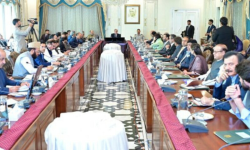
Prime Minister Shehbaz Sharif chairs the federal cabinet meeting in Islamabad on July 30. — APP

The federal cabinet on Wednesday marked major reforms after key decisions in strategic areas, including the approval of the National Artificial Intelligence (AI) Policy 2025.

Prime Minister Shehbaz Sharif chaired a meeting of the federal cabinet today, which unanimously approved the National AI Policy 2025, designed to create a complete AI ecosystem in the country. The policy aims to democratise access to artificial intelligence, enhance public services and open up new employment and innovation avenues.

“Our youth are Pakistan’s greatest asset. Providing them with education, skills, and equal opportunities in AI is a top priority,” PM Shehbaz said.

The AI policy outlined training a million AI professionals by 2030, establishing an AI Innovation Fund and AI Venture Fund to boost private sector involvement, creating 50,000 AI-driven civic projects and 1,000 local AI products in the next five years.

It also called for the distribution of 3,000 annual AI scholarships and facilitation of 1,000 research projects, inclusion of women and individuals with disabilities through accessible education and financing, strengthening cybersecurity and national data security protocols, promoting global partnerships and compliance with international AI regulations.

An AI Council and a comprehensive master plan and action matrix will oversee the policy’s implementation.

The prime minister applauded the Ministry of IT and allied institutions for their timely efforts, saying, “AI will not only modernise our economy but also enhance productivity across agriculture, public services, and governance.”

The cabinet also ratified decisions made in earlier sessions of the Cabinet Committee on Privatisation and the Committee on Legislative Business held on July 8, 17, and 25, respectively.

Earlier in the month, Pakistani AI platform SOCByte launched the country’s first AI-powered cybersecurity programme designed to provide critical information to professionals.
 
• Research shows top 10 chatbots often repeat falsehoods and create fake answers when unsure • Experts warn AI responses can be deliberately biased or altered through programming

WASHINGTON: As misinformation exploded during India’s four-day conflict with Pakistan, social media users turned to an AI chatbot for verification— only to encounter more falsehoods, underscoring its unreliability as a fact-checking tool.

With tech platforms reducing human fact-checkers, users are increasingly relying on AI-powered chatbots — including xAI’s Grok, OpenAI’s ChatGPT, and Google’s Gemini — in search of reliable information.

“Hey @Grok, is this true?” has become a common query on Elon Musk’s platform X, where the AI assistant is built in, reflecting the growing trend of seeking instant debunks on social media.

But the responses are often themselves riddled with misinformation.

Grok — now under renewed scrutiny for inserting “white genocide,” a far-right conspiracy theory, into unrelated queries — wrongly identified old video footage from Sudan’s Khartoum airport as a missile strike on Pakistan’s Nur Khan airbase during the country’s recent conflict with India.

Unrelated footage of a building on fire in Nepal was misidentified as “likely” showing Pakistan’s military response to Indian strikes.

“The growing reliance on Grok as a fact-checker comes as X and other major tech companies have scaled back investments in human fact-checkers,” McKenzie Sadeghi, a researcher with the disinformation watchdog NewsGuard, told AFP.

“Our research has repeatedly found that AI chatbots are not reliable sources for news and information, particularly when it comes to breaking news,” she warned.

‘Fabricated’

NewsGuard’s research found that 10 leading chatbots were prone to repeating falsehoods, including Russian disinformation narratives and false or misleading claims related to the recent Australian election.

In a recent study of eight AI search tools, the Tow Centre for Digital Journalism at Columbia University found that chatbots were “generally bad at declining to answer questions they couldn’t answer accurately, offering incorrect or speculative answers instead”.
 
Media experts at a forum held recently in Singapore emphasised the importance of journalists gaining a thorough understanding of artificial intelligence, highlighting that it was crucial for them to learn how to responsibly integrate AI into their journalistic practices.

Under the title “Artificial intelligence and its impacts on journalists”, the experts stressed that journalists should learn how to use AI in their practices to make their work more creative and dynamic.

Professor Charlie Beckett, director of Polis and the LSE Journalism and AI Project at the London School of Economics and Political Science, said that AI must be used for positive change, as it had made things easier for everyone.

“To effectively leverage AI, it’s essential to understand the technology thoroughly. While AI itself does not make mistakes, errors can occur due to human input or oversight.

Therefore, it’s important to recognise that these mistakes are human, not AI errors,“ he said, adding that today, innovative individuals were creatively using AI to condense lengthy news formats into shorter, more digestible pieces.

He advised using AI responsibly, as it was a conscious choice that shaped the future of journalism. “Despite the risks associated with AI, it is essential for good journalists to utilise it in a responsible manner,” he added.

August Nguyen, news partnership manager for Southeast Asia at Google, stated that Google was heavily investing in products across various sectors, including news.

She emphasised that AI was being developed to enhance creativity and productivity, solve complex problems and deepen knowledge and understanding.
 

AI policy can revolutionize Pakistan’s economy, say experts


'We must act decisively, cut red tape, and deliver early wins that demonstrate credibility,' said one expert

Gohar Ali Khan

1754160786034.png

IT sector experts and stakeholders hailed the government’s comprehensive National Artificial Intelligence (AI) Policy, terming it a milestone towards revolutionizing economic development in the country within next few years through collaboration and implementation in true letter and spirit.

They said the policy will open a new era of opportunities for Pakistan, as it can not only attract local and foreign investments, but could also increase exports of high-tech services and products.

Prime Minister Shehbaz Sharif approved the National AI Policy 2025 in a cabinet meeting recently which aims to create a complete AI ecosystem in Pakistan and democratize access to AI, enhance public services, as well as open up new employment and innovation avenues.
 
AI education

According to Mehwish Salman Ali, Member AI committee at Pakistan IT industry association, P@SHA, Pakistan needs to collaborate with local and foreign universities and training institutions to prepare human resources for AI, including 10,000 trainers and 1 million IT graduates in the next two years, which requires joint efforts and a uniform structure.

In this regard, top IT companies along with universities should not only launch relevant degree programs but also establish innovation centers in major cities to provide platforms to professionals for working on new ideas along with upskilling and capacity-building, she added.

She also suggested that the government should build state-level relationship with advanced countries and emerging economies such as Gulf countries for collaborations on various AI projects for mutual benefits and trade ties.

The National AI policy outlines training 1 million AI professionals by 2030, establishing an AI Innovation Fund and AI Venture Fund to boost private sector involvement, creation of 50,000 AI-driven civic projects and 1,000 local AI products in the next five years, distribution of 3,000 annual AI scholarships and facilitation of 1,000 research projects, inclusion of women and differently-abled individuals through accessible education and financing, strengthening cybersecurity and national data security protocols, promoting global partnerships and compliance with international AI regulations.

Further, an AI Council and a comprehensive master plan and action matrix will oversee the policy’s implementation under the policy.
 
$10 billion IT exports

Senior Vice Chairman P@SHA Muhammad Umair Nizam said the policy will prove as a roadmap for achieving major milestones on business, technology and economic fronts in Pakistan.

This policy may play a pivotal role in achieving the target of $10 billion IT exports by FY29 , and open windows of opportunities for investments in IT and allied companies, he said.

However, the government should provide basic infrastructure for reaping the benefits of this policy, including fast internet, affordable devices, electricity, and workstations in different cities, he added.

The government should also launch awareness campaigns nationwide because the country not only need professionals and developers of AI but also ethical and productive users of this technologies, he further said.

P@SHA said it will extend its full support in the ambitious goal of the government through its members.

Meanwhile Dr Noman Said, an IT exporter and CEO SI Global Solution said “Pakistan’s draft National Artificial Intelligence Policy is an encouraging and much-needed step toward creating a future-ready digital economy, but it is not short of vision as Pakistan’s history with tech policies is riddled with delays and diluted impact.”

“To make this count, we must act decisively, cut red tape, and deliver early wins that demonstrate credibility. The real challenge isn’t crafting a policy, it’s turning it into progress.”

The policy sets goals stretching to 2028, while AI globally is evolving every 6–12 months, hence, the country must move at the speed of innovation, not bureaucracy, he suggested.

While the creation of different institutions is proposed, success will depend on whether these institutions are led by technocrats and industry experts or bogged down by administrative hurdles, Dr Noman said.

The private sector, particularly startups and SMEs, must be incentivized with regulatory sandboxes, tax breaks, and access to public datasets to drive adoption and innovation from the ground up.

He pointed out that the policy mentions international collaboration but must act fast to align with global AI alliances.

“ If we don’t integrate now, we risk becoming data consumers, not contributors.“
 
To view this content we will need your consent to set third party cookies.
For more detailed information, see our cookies page.
 

Users who are viewing this thread

Pakistan Defence Latest

Country Watch Latest

Back
Top