National strategic policies, planning & reforms: Discussions

Bro people are available who can discuss and draft policy papers. Eg Rabia Akhtar and Ejaz Haider as 2 examples. There are many more. Government MNAs l agree are not capable. Let them present their opinions to the military and the parliament for actualization. There are people in the military who are capable to construct such policies but my only objection is that it is not the military’s sole domain as it exists today.
Agreed, shouldn't be solely the military's domain alone.

I am of the personal opinion we need a transitional reformist administration with strong civil-military inputs which can set out to carry sweeping structural reforms across the country, by this I mean extremely radical ones. Because things today are just not working.

— Education: entire educational ecosystem will be completely revamped, foreign experts will be contracted to develop an updated competitive system, and GDP allocation will be raised to at least 5%.

— Governance: entire bureaucracy and CSS system should be completely revamped and modernised, if needed with foreign expert assistance, it's an extremely outdated British colonial derived system and even the testing is subpar. Should be more technocratic in nature, with domain qualified experts in important ministries. More digitisation and performance based promotions with longer posts, not shifting around rapidly.

Land reforms against feudal elites. Make key cities as federal territories (Karachi, Gwadar, Lahore).

The goal is to have an efficient sized government that is effective. As well as a population that contains strong human capital. This requires revamping of education and beuracracy, you'll see things improve across the board after this including the economy and overall national competency.
 
Agreed, shouldn't be solely the military's domain alone.

I am of the personal opinion we need a transitional reformist administration with strong civil-military inputs which can set out to carry sweeping structural reforms across the country, by this I mean extremely radical ones. Because things today are just not working.

— Education: entire educational ecosystem will be completely revamped, foreign experts will be contracted to develop an updated competitive system, and GDP allocation will be raised to at least 5%.

— Governance: entire bureaucracy and CSS system should be completely revamped and modernised, if needed with foreign expert assistance, it's an extremely outdated British colonial derived system and even the testing is subpar. Should be more technocratic in nature, with domain qualified experts in important ministries. More digitisation and performance based promotions with longer posts, not shifting around rapidly.

Land reforms against feudal elites. Make key cities as federal territories (Karachi, Gwadar, Lahore).

The goal is to have an efficient sized government that is effective. As well as a population that contains strong human capital. This requires revamping of education and beuracracy, you'll see things improve across the board after this including the economy and overall national competency.
Huge ask
 
The situation is unlikely to meaningfully improve then.

If Pakistan seeks to be a competent regional power then these deep reforms are a must or it will continue to drag its feet trying to survive till tomorrow, till implosion.
 
In All honesty after "Bajwa Doctrine" bullshiat , no more Doctrine

Sub Se Bara Rupaiya

Bring down this Debt !!!

National Yearly GDP : 346,000,000,000 USD (346 Billion USD)
Debt internal/external : 222,000,000,000 USD (222 Billion USD)

GDP to Debt Ratio : 69%, bring it down to 20%

Simple Principle


a) All Provinces must register "Surplus"
b) No new Luxury cars for Politicians
c) Politicians Ride in Red Bus with Civilians
d) Reduce Import of Luxury items from Overseas
e) Reduce Perks for Judges
f) Reduce Perks for Gas/ Electricity for all Federal workers

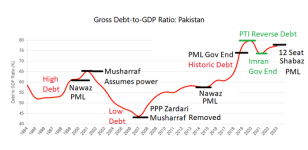
Musharraf had a fantastic 7 year run , reduced debt to GDP figures from 65% to 43%

It improved the Rupee Strength

If this graph will rise , Poverty will rise in Pakistan , and Cost to live will rise

Fix this Graph , with quick down payment on Debt
1752537094597.png


Nawaz Doctrine came 3 times all 3 times it failed , historic Debt
PPP Doctrine came 2 times , both times Debt rose less then PML era but big rise

Bajwa Doctrine increased debt ratio from 72% to 75% so it was a failure


Only Musharraf Doctrine was successful and Imran Khan Doctrine when debt figures went down
 
Last edited:
In All honesty after "Bajwa Doctrine" bullshiat , no more Doctrine

Sub Se Bara Rupaiya

Bring down this Debt !!!

National Yearly GDP : 346,000,000,000 USD (346 Billion USD)
Debt internal/external : 222,000,000,000 USD (222 Billion USD)

GDP to Debt Ratio : 69%, bring it down to 20%

Simple Principle


a) All Provinces must register "Surplus"
b) No new Luxury cars for Politicians
c) Politicians Ride in Red Bus with Civilians
d) Reduce Import of Luxury items from Overseas
e) Reduce Perks for Judges
f) Reduce Perks for Gas/ Electricity for all Federal workers

Musharraf had a fantastic 7 year run , reduced debt to GDP figures from 65% to 43%

It improved the Rupee Strength

If this graph will rise , Poverty will rise in Pakistan , and Cost to live will rise

Fix this Graph , with quick down payment on Debt
View attachment 134743


Nawaz Doctrine came 3 times all 3 times it failed , historic Debt
PPP Doctrine came 2 times , both times Debt rose less then PML era but big rise

Bajwa Doctrine increased debt ratio from 72% to 75% so it was a failure


Only Musharraf Doctrine was successful and Imran Khan Doctrine when debt figures went down
This is good for a few minor suggestions here and there but it ignores the larger persistent issue in why the entire state is in a condition of constant paralysis of incompetency, it doesn't address the root fix of why all institutions are underperforming, low quality, lack luster.

If you can fix this fundamental issue, you can see mass improvement across all domains, and I believe it starts with a comprehensive educational revamp and restructuring beuracratic recruitment process with a focus on modernising it and technocratic examinations, CSS is outdated and filled with nepotism.
 
An article by an American who surprisingly has a decent understanding of things.

Points out the extremely poor economic performance of Pakistan and how it relies purely on hand outs from others. It's state dysfunctionality, poor education, and low quality institutions, and in turn everything else being extremely poor.


Government today came out randomly and informed the world that around 40 thousand Pakistanis are missing and thought to be in Iran, Iraq or Syria.

40 thousand Pakistanis are wandering around desserts of the middle east or singing gypsy songs along the Euphrates or by the Babylonian gardens. Nobody knows.
 
Interesting read on the history of Pakistan's industry:

Private Sector Did Not Lead Pakistan’s Early Industrialisation (1950s-1960s). The State Made 22 Families. The Families Did Not Build The Industry

Yousuf Nazar

In the two decades following independence, Pakistan’s industrial landscape was shaped not by spontaneous private ventures but by a deliberate, state‑led campaign under the Pakistan Industrial Development Corporation (PIDC). Born of the Ministry of Industries’conviction that some ventures—by virtue of scale, complexity, or long gestation—lay beyond the reach of private capital, PIDC became the government’s instrument for pioneering capital‑intensive, technology‑heavy industries. Its mission was at once catalytic and transitional: to conceive, finance, build, and operate foundational plants; to train the skilled workforce that would sustain them; and finally to transfer each enterprise into capable private hands once it achieved operational viability.

From its formal inauguration in early 1952, PIDC moved swiftly to translate broad economic plans into steel, concrete, and machinery. Its work unfolded in five mutually reinforcing thrusts: energy and basic materials, fertilizers and petrochemicals, textiles and jute, heavy engineering, and consumer‑goods manufacturing. At every stage, the corporation combined licensing foreign technology, assembling international finance, and building on‑site training institutes. The factory gates in Karachi, Taxila, Hyderabad, Dhaka, and Jamrud would stand, by the mid‑1960s, as monuments to a state‑led “big push” that reconfigured Pakistan’s production landscape.

1. Energy and Basic Materials:

Nothing powers modern industry like a reliable energy supply and a steady stream of raw materials. PIDC’s first flagship project, the Sui–Karachi gas pipeline, was commissioned in October 1954. Stretching some 814 kilometres from the newly discovered Sui gas field in Balochistan to Karachi’s bustling port and industrial zone, the pipeline included six compressor stations and state‑of‑the‑art monitoring equipment supplied by Bechtel of the United States. Before its completion, Karachi’s factories depended on imported coal or fuel oil; afterward, low‑cost natural gas fuelled not only PIDC’s own fertilizer and petrochemical plants but also spurred private investments in glassworks, ceramics kilns, and textile dyeing.

Alongside energy, PIDC tackled essential raw materials. The Pakistan Glass Tube & Bottle Factory, established in Hyderabad in 1956, harnessed locally sourced silica sand and incorporated a pioneering cullet‑recycling program. With an annual capacity of 15 million bottles across diverse sizes, it captured over 80 percent of the domestic beverage‑bottle market by 1962. Investment in DDT and insecticide production at Dhaka in 1959—supplying 2,500 tons of technical‑grade DDT plus smaller volumes of malathion and parathion—underscored the corporation’s role in both public health campaigns and agricultural modernization.

2. Fertilizers and Petrochemicals:

With energy secured, PIDC turned to fertilizers—the lifeblood of agricultural productivity. In 1955, it brought on stream the Drigh Road Fertilizer Plant in Karachi. Built with licensing agreements from Germany’s BASF and process design by M.W. Kellogg of the United States, the plant’s initial annual output of 60,000 tons of ammonium sulphate was subsequently augmented by sulfuric‑acid based phosphatic fertilizers. By 1958, this facility alone supplied nearly 30 percent of Pakistan’s fertilizer needs, enabling the wheat‑area expansions that undergirded national food‑security objectives.

Although a full‑scale petrochemical complex would not emerge until later decades, PIDC’s engineers in 1963–65 carried out exhaustive feasibility and pilot‑plant studies for styrene‑butadiene and gasoline‑cracking operations. Working in Karachi and Dhaka laboratories, they adapted Soviet processes to Pakistan’s natural‑gas feedstocks and trained a cadre of young petro‑chemists. Though the Khalifa Point plant would only come online in the 1980s, PIDC’s early work laid both technical and organizational groundwork.

3. Jute and Textiles: Weaving Export Earnings

Textiles and jute products were Pakistan’s first manufactured export earners, and PIDC moved decisively to develop both sectors. In Narayanganj (East Pakistan) the Adamjee Jute Mills opened in 1952 as the largest jute mill in Asia, boasting 100,000 spindles and German‑made looms from Platt Brothers. PIDC retained 51 percent equity, with the Adamjee Group holding the balance. By 1960, this single mill was exporting over 75,000 tons of hessian, sacking, and carpet‑backing annually, accounting for nearly half of the country’s manufactured export revenues.

Back in Karachi, the Malir Textile Mill (commissioned in 1958) specialized in woollen and worsted yarns, spinning on 25,000 spindles under British licensing. Its on‑site dyeing and processing school—affiliated with the nascent National Textile Institute—soon became a training centre supplying instructors and supervisors to private mills across West Pakistan. These initiatives underscored PIDC’s broader model: build the plant, then build the people.

4. Heavy Engineering: Building the Backbone

The Second Five‑Year Plan (1960–65) marked PIDC’s greatest foray into heavy engineering and capital‑goods production—sectors deemed critical to reduce import dependence and foster technological self‑reliance. In 1957, the Karachi Shipyard & Engineering Works (KSEW) rolled out its first material‑handling cranes (200‑ton capacity) and sugar‑mill equipment, within a yard featuring a 100‑meter berth, two 80‑ton cranes, machine shops, and a molten‑steel foundry. Over 500 welders and metalworkers were trained under rigorous four‑year apprenticeships, many later supervising private shipyards.

Subsequent projects included the Pakistan Machine Tool Factory (1960) in Karachi, which produced up to 2,000 lathes, milling machines, and drill presses annually under Japanese and American license agreements. Its output supplied over 40 percent of private workshops’ tooling needs by 1965. The Heavy Mechanical Complex (HMC) at Taxila, inaugurated in 1963 on a sprawling 1,500‑acre site, housed forging presses up to 500 tons, fabrication shops, and pattern‑making units. It churned out road rollers (100 units per month), sugar‑mill boilers, railway wheelsets, and more—simultaneously spawning ancillary small‑scale enterprises that turned Taxila into a vibrant industrial district.

By 1967, the Heavy Electrical Complex (HEC) at Jamrud (near Peshawar) added power‑transformer winding and core‑assembly shops through Chinese technical collaboration. Producing transformers up to 132 kV with an annual 300 MVA capacity, HEC soon began exporting transformer kits to Iran and Turkey. Together, these complexes forged Pakistan’s capacity to engineer, cast, and assemble capital goods once entirely imported—a profound shift in industrial capability.

5. Skills, Infrastructure, and Regional Development

Across every project, PIDC wove into the factory blueprint a dedicated training wing: welding schools adjacent to the shipyard, electrical‑workshop programs alongside HEC, and chemical‑analysis laboratories at the fertilizer plant. These institutes, augmented by study attachments abroad, created a reservoir of skilled technicians, engineers, and managers. In parallel, PIDC’s deliberate choice of locations—often in underdeveloped districts—spurred road construction, 11 kV power substations, and water‑supply networks. Small businesses—fabricators, transport operators, housing contractors—sprang up around the plants, broadening local commerce and urban growth.

6. The Turnover Process: State Pioneer to Private Steward

PIDC never sought to be a permanent entrepreneur. As each plant approached 60–70 percent of its designed capacity—typically within eight to ten years of commissioning—the corporation opened the door to private investment. Major divestments unfolded in the early‑to mid‑1960s: Adamjee, Amin, and Karim jute mills passed fully into private hands; sugar and textile units in West Pakistan found new owners in the Dawood, Saigol, and Ispahani groups; the Drigh Road Fertilizer Plant was sold in 1967 to an Esso‑Searles consortium.

Yet even after these handovers, the state remained the industrial architect. The Protective Duties Act of 1950 and the import‑licensing regime continued to shield nascent industries; the Export Bonus Scheme of 1958 rewarded manufactured exports; specialized finance institutions—PICIC and IDBP—underwrote private industrial credit. Thus, the private sector inherited not only assets but a web of government policies that guided investment toward national priorities.

7. Outcomes: A ‘Big Push’ Realized

By 1969, large‑scale manufacturing in Pakistan was growing at over 9 percent per annum—outpacing many Asian peers. The once‑modest jute mills and textile workshops had become export engines; the newly minted shipyard and machine‑tool factory signalled self‑reliance in capital equipment; and the regional clusters around Taxila and Jamrud stood as proof that deliberate siting policies could foster balanced development. Manufactured exports had surpassed those of Malaysia, Indonesia, Thailand, and the Philippines, vindicating the state‑led import‑substitution and big‑push strategies. Unfortunately, Pakistan could not transition into the next phase - an export led growth.

The Enduring Legacy of PIDC

When critics later noted that two dozen industrial families controlled two‑thirds of industrial capital, they were right in identifying the contours of private concentration—but they owed their positions to PIDC’s pioneering work. Without the corporation’s financial risks, technology licenses, and skill‑training programs, Pakistan’s entrepreneurial class would have lacked platforms from which to launch their empires.

Today, long after nationalizations, liberalizations, and privatizations have reshaped the economy, the factories, the human capital, and the regional infrastructures that PIDC forged in the 1950s and 1960s remain integral to Pakistan’s industrial fabric. Its story is a testament to what a determined state can achieve when it chooses to carry the “big push” itself—building industries that, once mature, empower a private sector to flourish on firmer foundations.
 
Interesting read on the history of Pakistan's industry:

Private Sector Did Not Lead Pakistan’s Early Industrialisation (1950s-1960s). The State Made 22 Families. The Families Did Not Build The Industry

Yousuf Nazar

In the two decades following independence, Pakistan’s industrial landscape was shaped not by spontaneous private ventures but by a deliberate, state‑led campaign under the Pakistan Industrial Development Corporation (PIDC). Born of the Ministry of Industries’conviction that some ventures—by virtue of scale, complexity, or long gestation—lay beyond the reach of private capital, PIDC became the government’s instrument for pioneering capital‑intensive, technology‑heavy industries. Its mission was at once catalytic and transitional: to conceive, finance, build, and operate foundational plants; to train the skilled workforce that would sustain them; and finally to transfer each enterprise into capable private hands once it achieved operational viability.

From its formal inauguration in early 1952, PIDC moved swiftly to translate broad economic plans into steel, concrete, and machinery. Its work unfolded in five mutually reinforcing thrusts: energy and basic materials, fertilizers and petrochemicals, textiles and jute, heavy engineering, and consumer‑goods manufacturing. At every stage, the corporation combined licensing foreign technology, assembling international finance, and building on‑site training institutes. The factory gates in Karachi, Taxila, Hyderabad, Dhaka, and Jamrud would stand, by the mid‑1960s, as monuments to a state‑led “big push” that reconfigured Pakistan’s production landscape.

1. Energy and Basic Materials:

Nothing powers modern industry like a reliable energy supply and a steady stream of raw materials. PIDC’s first flagship project, the Sui–Karachi gas pipeline, was commissioned in October 1954. Stretching some 814 kilometres from the newly discovered Sui gas field in Balochistan to Karachi’s bustling port and industrial zone, the pipeline included six compressor stations and state‑of‑the‑art monitoring equipment supplied by Bechtel of the United States. Before its completion, Karachi’s factories depended on imported coal or fuel oil; afterward, low‑cost natural gas fuelled not only PIDC’s own fertilizer and petrochemical plants but also spurred private investments in glassworks, ceramics kilns, and textile dyeing.

Alongside energy, PIDC tackled essential raw materials. The Pakistan Glass Tube & Bottle Factory, established in Hyderabad in 1956, harnessed locally sourced silica sand and incorporated a pioneering cullet‑recycling program. With an annual capacity of 15 million bottles across diverse sizes, it captured over 80 percent of the domestic beverage‑bottle market by 1962. Investment in DDT and insecticide production at Dhaka in 1959—supplying 2,500 tons of technical‑grade DDT plus smaller volumes of malathion and parathion—underscored the corporation’s role in both public health campaigns and agricultural modernization.

2. Fertilizers and Petrochemicals:

With energy secured, PIDC turned to fertilizers—the lifeblood of agricultural productivity. In 1955, it brought on stream the Drigh Road Fertilizer Plant in Karachi. Built with licensing agreements from Germany’s BASF and process design by M.W. Kellogg of the United States, the plant’s initial annual output of 60,000 tons of ammonium sulphate was subsequently augmented by sulfuric‑acid based phosphatic fertilizers. By 1958, this facility alone supplied nearly 30 percent of Pakistan’s fertilizer needs, enabling the wheat‑area expansions that undergirded national food‑security objectives.

Although a full‑scale petrochemical complex would not emerge until later decades, PIDC’s engineers in 1963–65 carried out exhaustive feasibility and pilot‑plant studies for styrene‑butadiene and gasoline‑cracking operations. Working in Karachi and Dhaka laboratories, they adapted Soviet processes to Pakistan’s natural‑gas feedstocks and trained a cadre of young petro‑chemists. Though the Khalifa Point plant would only come online in the 1980s, PIDC’s early work laid both technical and organizational groundwork.

3. Jute and Textiles: Weaving Export Earnings

Textiles and jute products were Pakistan’s first manufactured export earners, and PIDC moved decisively to develop both sectors. In Narayanganj (East Pakistan) the Adamjee Jute Mills opened in 1952 as the largest jute mill in Asia, boasting 100,000 spindles and German‑made looms from Platt Brothers. PIDC retained 51 percent equity, with the Adamjee Group holding the balance. By 1960, this single mill was exporting over 75,000 tons of hessian, sacking, and carpet‑backing annually, accounting for nearly half of the country’s manufactured export revenues.

Back in Karachi, the Malir Textile Mill (commissioned in 1958) specialized in woollen and worsted yarns, spinning on 25,000 spindles under British licensing. Its on‑site dyeing and processing school—affiliated with the nascent National Textile Institute—soon became a training centre supplying instructors and supervisors to private mills across West Pakistan. These initiatives underscored PIDC’s broader model: build the plant, then build the people.

4. Heavy Engineering: Building the Backbone

The Second Five‑Year Plan (1960–65) marked PIDC’s greatest foray into heavy engineering and capital‑goods production—sectors deemed critical to reduce import dependence and foster technological self‑reliance. In 1957, the Karachi Shipyard & Engineering Works (KSEW) rolled out its first material‑handling cranes (200‑ton capacity) and sugar‑mill equipment, within a yard featuring a 100‑meter berth, two 80‑ton cranes, machine shops, and a molten‑steel foundry. Over 500 welders and metalworkers were trained under rigorous four‑year apprenticeships, many later supervising private shipyards.

Subsequent projects included the Pakistan Machine Tool Factory (1960) in Karachi, which produced up to 2,000 lathes, milling machines, and drill presses annually under Japanese and American license agreements. Its output supplied over 40 percent of private workshops’ tooling needs by 1965. The Heavy Mechanical Complex (HMC) at Taxila, inaugurated in 1963 on a sprawling 1,500‑acre site, housed forging presses up to 500 tons, fabrication shops, and pattern‑making units. It churned out road rollers (100 units per month), sugar‑mill boilers, railway wheelsets, and more—simultaneously spawning ancillary small‑scale enterprises that turned Taxila into a vibrant industrial district.

By 1967, the Heavy Electrical Complex (HEC) at Jamrud (near Peshawar) added power‑transformer winding and core‑assembly shops through Chinese technical collaboration. Producing transformers up to 132 kV with an annual 300 MVA capacity, HEC soon began exporting transformer kits to Iran and Turkey. Together, these complexes forged Pakistan’s capacity to engineer, cast, and assemble capital goods once entirely imported—a profound shift in industrial capability.

5. Skills, Infrastructure, and Regional Development

Across every project, PIDC wove into the factory blueprint a dedicated training wing: welding schools adjacent to the shipyard, electrical‑workshop programs alongside HEC, and chemical‑analysis laboratories at the fertilizer plant. These institutes, augmented by study attachments abroad, created a reservoir of skilled technicians, engineers, and managers. In parallel, PIDC’s deliberate choice of locations—often in underdeveloped districts—spurred road construction, 11 kV power substations, and water‑supply networks. Small businesses—fabricators, transport operators, housing contractors—sprang up around the plants, broadening local commerce and urban growth.

6. The Turnover Process: State Pioneer to Private Steward

PIDC never sought to be a permanent entrepreneur. As each plant approached 60–70 percent of its designed capacity—typically within eight to ten years of commissioning—the corporation opened the door to private investment. Major divestments unfolded in the early‑to mid‑1960s: Adamjee, Amin, and Karim jute mills passed fully into private hands; sugar and textile units in West Pakistan found new owners in the Dawood, Saigol, and Ispahani groups; the Drigh Road Fertilizer Plant was sold in 1967 to an Esso‑Searles consortium.

Yet even after these handovers, the state remained the industrial architect. The Protective Duties Act of 1950 and the import‑licensing regime continued to shield nascent industries; the Export Bonus Scheme of 1958 rewarded manufactured exports; specialized finance institutions—PICIC and IDBP—underwrote private industrial credit. Thus, the private sector inherited not only assets but a web of government policies that guided investment toward national priorities.

7. Outcomes: A ‘Big Push’ Realized

By 1969, large‑scale manufacturing in Pakistan was growing at over 9 percent per annum—outpacing many Asian peers. The once‑modest jute mills and textile workshops had become export engines; the newly minted shipyard and machine‑tool factory signalled self‑reliance in capital equipment; and the regional clusters around Taxila and Jamrud stood as proof that deliberate siting policies could foster balanced development. Manufactured exports had surpassed those of Malaysia, Indonesia, Thailand, and the Philippines, vindicating the state‑led import‑substitution and big‑push strategies. Unfortunately, Pakistan could not transition into the next phase - an export led growth.

The Enduring Legacy of PIDC

When critics later noted that two dozen industrial families controlled two‑thirds of industrial capital, they were right in identifying the contours of private concentration—but they owed their positions to PIDC’s pioneering work. Without the corporation’s financial risks, technology licenses, and skill‑training programs, Pakistan’s entrepreneurial class would have lacked platforms from which to launch their empires.

Today, long after nationalizations, liberalizations, and privatizations have reshaped the economy, the factories, the human capital, and the regional infrastructures that PIDC forged in the 1950s and 1960s remain integral to Pakistan’s industrial fabric. Its story is a testament to what a determined state can achieve when it chooses to carry the “big push” itself—building industries that, once mature, empower a private sector to flourish on firmer foundations.
The difference between the those days and today was back then there was goal, a Vision, long term planning, while today its drifting aimlessly no long term goals nothing.
 
The difference between the those days and today was back then there was goal, a Vision, long term planning, while today its drifting aimlessly no long term goals nothing.
There was hope and motivation back then to build something out of the country, and most importantly there was a greater educated pool to draw from left behind by the British educated.

Today, people are confused, they don't have a vision, they are demotivated, and they also lack the knowledge to execute any sort of plan towards a vision. It is mostly feudal/mafia interest groups that dominate today.

As much as I dislike PTI for different reasons, they did give hope. It's a shame they and the establishment had such a falling out instead of coming to an understanding. It was extremely petty.
 
Interesting read on the history of Pakistan's industry:

Private Sector Did Not Lead Pakistan’s Early Industrialisation (1950s-1960s). The State Made 22 Families. The Families Did Not Build The Industry

Yousuf Nazar

In the two decades following independence, Pakistan’s industrial landscape was shaped not by spontaneous private ventures but by a deliberate, state‑led campaign under the Pakistan Industrial Development Corporation (PIDC). Born of the Ministry of Industries’conviction that some ventures—by virtue of scale, complexity, or long gestation—lay beyond the reach of private capital, PIDC became the government’s instrument for pioneering capital‑intensive, technology‑heavy industries. Its mission was at once catalytic and transitional: to conceive, finance, build, and operate foundational plants; to train the skilled workforce that would sustain them; and finally to transfer each enterprise into capable private hands once it achieved operational viability.

From its formal inauguration in early 1952, PIDC moved swiftly to translate broad economic plans into steel, concrete, and machinery. Its work unfolded in five mutually reinforcing thrusts: energy and basic materials, fertilizers and petrochemicals, textiles and jute, heavy engineering, and consumer‑goods manufacturing. At every stage, the corporation combined licensing foreign technology, assembling international finance, and building on‑site training institutes. The factory gates in Karachi, Taxila, Hyderabad, Dhaka, and Jamrud would stand, by the mid‑1960s, as monuments to a state‑led “big push” that reconfigured Pakistan’s production landscape.

1. Energy and Basic Materials:

Nothing powers modern industry like a reliable energy supply and a steady stream of raw materials. PIDC’s first flagship project, the Sui–Karachi gas pipeline, was commissioned in October 1954. Stretching some 814 kilometres from the newly discovered Sui gas field in Balochistan to Karachi’s bustling port and industrial zone, the pipeline included six compressor stations and state‑of‑the‑art monitoring equipment supplied by Bechtel of the United States. Before its completion, Karachi’s factories depended on imported coal or fuel oil; afterward, low‑cost natural gas fuelled not only PIDC’s own fertilizer and petrochemical plants but also spurred private investments in glassworks, ceramics kilns, and textile dyeing.

Alongside energy, PIDC tackled essential raw materials. The Pakistan Glass Tube & Bottle Factory, established in Hyderabad in 1956, harnessed locally sourced silica sand and incorporated a pioneering cullet‑recycling program. With an annual capacity of 15 million bottles across diverse sizes, it captured over 80 percent of the domestic beverage‑bottle market by 1962. Investment in DDT and insecticide production at Dhaka in 1959—supplying 2,500 tons of technical‑grade DDT plus smaller volumes of malathion and parathion—underscored the corporation’s role in both public health campaigns and agricultural modernization.

2. Fertilizers and Petrochemicals:

With energy secured, PIDC turned to fertilizers—the lifeblood of agricultural productivity. In 1955, it brought on stream the Drigh Road Fertilizer Plant in Karachi. Built with licensing agreements from Germany’s BASF and process design by M.W. Kellogg of the United States, the plant’s initial annual output of 60,000 tons of ammonium sulphate was subsequently augmented by sulfuric‑acid based phosphatic fertilizers. By 1958, this facility alone supplied nearly 30 percent of Pakistan’s fertilizer needs, enabling the wheat‑area expansions that undergirded national food‑security objectives.

Although a full‑scale petrochemical complex would not emerge until later decades, PIDC’s engineers in 1963–65 carried out exhaustive feasibility and pilot‑plant studies for styrene‑butadiene and gasoline‑cracking operations. Working in Karachi and Dhaka laboratories, they adapted Soviet processes to Pakistan’s natural‑gas feedstocks and trained a cadre of young petro‑chemists. Though the Khalifa Point plant would only come online in the 1980s, PIDC’s early work laid both technical and organizational groundwork.

3. Jute and Textiles: Weaving Export Earnings

Textiles and jute products were Pakistan’s first manufactured export earners, and PIDC moved decisively to develop both sectors. In Narayanganj (East Pakistan) the Adamjee Jute Mills opened in 1952 as the largest jute mill in Asia, boasting 100,000 spindles and German‑made looms from Platt Brothers. PIDC retained 51 percent equity, with the Adamjee Group holding the balance. By 1960, this single mill was exporting over 75,000 tons of hessian, sacking, and carpet‑backing annually, accounting for nearly half of the country’s manufactured export revenues.

Back in Karachi, the Malir Textile Mill (commissioned in 1958) specialized in woollen and worsted yarns, spinning on 25,000 spindles under British licensing. Its on‑site dyeing and processing school—affiliated with the nascent National Textile Institute—soon became a training centre supplying instructors and supervisors to private mills across West Pakistan. These initiatives underscored PIDC’s broader model: build the plant, then build the people.

4. Heavy Engineering: Building the Backbone

The Second Five‑Year Plan (1960–65) marked PIDC’s greatest foray into heavy engineering and capital‑goods production—sectors deemed critical to reduce import dependence and foster technological self‑reliance. In 1957, the Karachi Shipyard & Engineering Works (KSEW) rolled out its first material‑handling cranes (200‑ton capacity) and sugar‑mill equipment, within a yard featuring a 100‑meter berth, two 80‑ton cranes, machine shops, and a molten‑steel foundry. Over 500 welders and metalworkers were trained under rigorous four‑year apprenticeships, many later supervising private shipyards.

Subsequent projects included the Pakistan Machine Tool Factory (1960) in Karachi, which produced up to 2,000 lathes, milling machines, and drill presses annually under Japanese and American license agreements. Its output supplied over 40 percent of private workshops’ tooling needs by 1965. The Heavy Mechanical Complex (HMC) at Taxila, inaugurated in 1963 on a sprawling 1,500‑acre site, housed forging presses up to 500 tons, fabrication shops, and pattern‑making units. It churned out road rollers (100 units per month), sugar‑mill boilers, railway wheelsets, and more—simultaneously spawning ancillary small‑scale enterprises that turned Taxila into a vibrant industrial district.

By 1967, the Heavy Electrical Complex (HEC) at Jamrud (near Peshawar) added power‑transformer winding and core‑assembly shops through Chinese technical collaboration. Producing transformers up to 132 kV with an annual 300 MVA capacity, HEC soon began exporting transformer kits to Iran and Turkey. Together, these complexes forged Pakistan’s capacity to engineer, cast, and assemble capital goods once entirely imported—a profound shift in industrial capability.

5. Skills, Infrastructure, and Regional Development

Across every project, PIDC wove into the factory blueprint a dedicated training wing: welding schools adjacent to the shipyard, electrical‑workshop programs alongside HEC, and chemical‑analysis laboratories at the fertilizer plant. These institutes, augmented by study attachments abroad, created a reservoir of skilled technicians, engineers, and managers. In parallel, PIDC’s deliberate choice of locations—often in underdeveloped districts—spurred road construction, 11 kV power substations, and water‑supply networks. Small businesses—fabricators, transport operators, housing contractors—sprang up around the plants, broadening local commerce and urban growth.

6. The Turnover Process: State Pioneer to Private Steward

PIDC never sought to be a permanent entrepreneur. As each plant approached 60–70 percent of its designed capacity—typically within eight to ten years of commissioning—the corporation opened the door to private investment. Major divestments unfolded in the early‑to mid‑1960s: Adamjee, Amin, and Karim jute mills passed fully into private hands; sugar and textile units in West Pakistan found new owners in the Dawood, Saigol, and Ispahani groups; the Drigh Road Fertilizer Plant was sold in 1967 to an Esso‑Searles consortium.

Yet even after these handovers, the state remained the industrial architect. The Protective Duties Act of 1950 and the import‑licensing regime continued to shield nascent industries; the Export Bonus Scheme of 1958 rewarded manufactured exports; specialized finance institutions—PICIC and IDBP—underwrote private industrial credit. Thus, the private sector inherited not only assets but a web of government policies that guided investment toward national priorities.

7. Outcomes: A ‘Big Push’ Realized

By 1969, large‑scale manufacturing in Pakistan was growing at over 9 percent per annum—outpacing many Asian peers. The once‑modest jute mills and textile workshops had become export engines; the newly minted shipyard and machine‑tool factory signalled self‑reliance in capital equipment; and the regional clusters around Taxila and Jamrud stood as proof that deliberate siting policies could foster balanced development. Manufactured exports had surpassed those of Malaysia, Indonesia, Thailand, and the Philippines, vindicating the state‑led import‑substitution and big‑push strategies. Unfortunately, Pakistan could not transition into the next phase - an export led growth.

The Enduring Legacy of PIDC

When critics later noted that two dozen industrial families controlled two‑thirds of industrial capital, they were right in identifying the contours of private concentration—but they owed their positions to PIDC’s pioneering work. Without the corporation’s financial risks, technology licenses, and skill‑training programs, Pakistan’s entrepreneurial class would have lacked platforms from which to launch their empires.

Today, long after nationalizations, liberalizations, and privatizations have reshaped the economy, the factories, the human capital, and the regional infrastructures that PIDC forged in the 1950s and 1960s remain integral to Pakistan’s industrial fabric. Its story is a testament to what a determined state can achieve when it chooses to carry the “big push” itself—building industries that, once mature, empower a private sector to flourish on firmer foundations.
All the East Asian tigers succeeded through smart state-led planning from the top-down. They recognised agrarian societies with uneducated masses largely cannot make strategic policy decisions themselves, essentially planning has to be from the top-educated down to the bottom. This later however opened the door to an educated society with greater democratic input.

The recipe is already there, tried and tested:

— Land reforms
— Huge educational overhaul focusing on modernisation, quality and mass accessibility.
— state institutional capacity building prioritising merit & competency
— state-led industrialisation and infrastructure projects via exports. Both public and private co-operation.
— Modern training institutions to create context-tailored bureaucracy that understood the country's needs in different domains, from foreign policy, to industrial, economic, sociocultural policies.

CPC arguably created the most efficient ecosystem for this.

The blueprint exists. Though individual interest groups and lack of motivation or vision dominate Pakistan as major obstacles.
 

Users who are viewing this thread

Back
Top