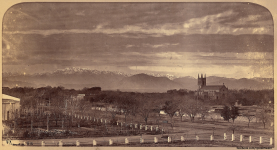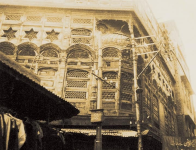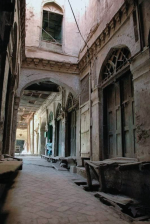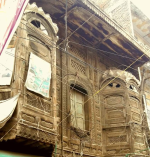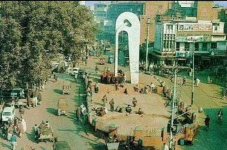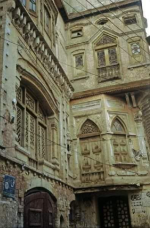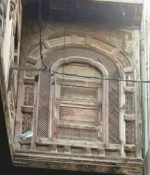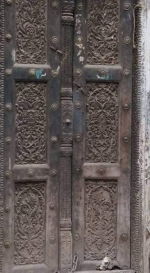
Old Peshawar

1772731378384.png

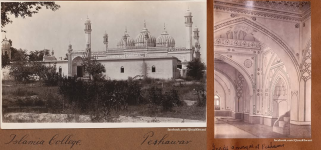
Mosque of the Islamia College Peshawar built in 1913

(Excerpted from 'History of the Islamia College Peshawar' Vol - 1 (1913-1953) by Dr Lal Baha) "But the masterpiece of the College buildings is that of the white mosque. Its entire cost was met by Khan Bahadur Haji Karim Bakhsh Sethi of the Peshawar City.

Being big merchant and a great philanthropist, Haji Karim Bakhsh was orthodox and religious minded pious man who took great pleasure and satisfaction in donating generously for charitable and religious purposes.

For a long time, he was the Mutawalli of the famous Mahabat Khan Mosque of the Peshawar City. While so, he effected considerable repairing in its domes and built its Muazzan Khana. When his friend, Sahibzada A.Q. approached him for College subscriptions, Haji promised to build a Mosque in the College compound. He engaged his own architects.

According to Haji Hafiz Allah Bakhsh and Haji Mohammad Ayub, the sons of the Late Haji Karim Bakhsh, the designer and supervisor of the College Mosque was late Mian Haji Mistari of Gunj, Peshawar. This man, they also credited with the construction of their beautiful triple storeys' houses in Muhallah Sethian, Peshawar. Haji Sahib ordered for special mats from Agra for the Mosque floor.

The pay of the Imam was also paid by him. It was discontinued in the Thirties as the family could no longer afford it. The actual cost of the Mosque is shown as Rs. 1,91,455.71

In contrast to the brick-red colour of the College main building, the Mosque of the Darul-Ulum with its white-plastered colour symbolises the simplicity and purity of Islam. It is designed in the usual orthodox style, having an open quadrangle on the east and the main prayer chamber on the west.

The whole of the sacred place is enclosed by a wall having three main entrances on three sides-north, south and east. The eastern end of this enclosure wall possesses Chhatris on the top. The main prayers chamber is rectangular in plan with four towers rising above the parapet at the four corners.

The prayer chamber is composed of a rectangular hall and a gallery on its east. It can be entered by five arched doorways from the courtyard. The interior hall of the prayer-chamber is divided into five bays. Three of them are covered by fluted domes.

The interior of this hall is highly embellished with colourful decoration consisting of geometric patterns interwoven with Arabic calligraphy and a few floral designs."

'History of the Islamia College Peshawar' Vol - 1 (1913-1953) by Dr Lal Baha
(Photos c.1923 : W H C Pulling of RAF via his grandson David Green)
 
1772731760734.png

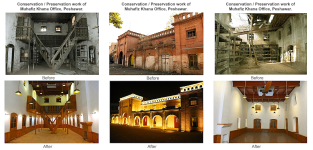
Historical Background of the Muhafiz Khana, Peshawar

The Muhafiz Khana (or Record Room) is a late nineteenth century public building, constructed in the later half of the 1800s, most likely around 1860-70, during the early British period in Peshawar. Situated on the North Circular Road, now known as Khyber Road, it formed part of the colonial administrative landscape that developed after the annexation of the frontier region.

Function and Historical Importance
The building served as a record room for the district administration. It housed revenue records, court documents, land settlements, stamp papers and judicial verdicts relating to civil, criminal and revenue cases from Peshawar and surrounding districts such as Charsadda and Nowshera.

Many of the documents preserved inside bore Persian script, indicating continuity from the pre British administrative system and suggesting that some records dated from the mid nineteenth century or earlier. These papers were not merely bureaucratic files but constituted a unique archival record of local law, land ownership, governance, and customary practices of the local society.

Within these very walls, administrators like Col Hastings are believed to have bent over desks under dim light, assembling the gazetteers and official records that still inform our understanding of the province’s past.

Architecturally, the Muhafiz Khana reflected colonial civic design, featuring high ceilings, sky windows for ventilation, wooden balconies, verandahs, and characteristic drainage spouts or gargoyles fashioned in animal head forms. Old banyan trees shade the front of the building (They were unfortunately subjected to extensive trimming in recent years reportedly due to security concerns) Together, these elements made it both a functional and culturally significant structure.

Neglect and Threat of Demolition

By the 1990s, the building had fallen into serious neglect. No major repair work was undertaken after 1990 and the situation worsened after the Devolution Plan of 2001, which dismantled the earlier bureaucratic system responsible for its upkeep. Staff was reduced drastically, maintenance ceased and seepage and humidity threatened both the structure and the records it housed.

In June 2003, the then Chief Justice of the Peshawar High Court ordered the suspension of record keeping in the Muhafiz Khana due to its unsafe condition.

The provincial government later took a decision to demolish the building and replace it with a modern structure. During this period, a nearby historic treasury building was demolished, underscoring the real danger faced by the Muhafiz Khana.

Civil Society Resistance and Legal Intervention
The proposed demolition triggered strong resistance from civil society, conservationists, historians and concerned citizens.

A leading role was played by the Sarhad Conservation Network (SCN), represented by Zahoor Durrani (late) and the Hindukush Conservation Association UK and Kalash Environmental Protection Society (KEPS) led by Maureen P. Lines (late). Their efforts were supported by conservation professionals, writers, journalists, and international heritage advocates.

From 2004 onwards, campaigns were launched highlighting the building’s historical value, the criminal neglect of its records, and the irreversible loss Peshawar would suffer if it were demolished. Media reports in Daily Times, The News, Dawn, and BBC Urdu amplified public concern.

(BBC Urdu Report Oct 2006)

(DAWN, Nov 2006)

In October 2006, Sarhad Conservation Network and its partners filed a public interest petition. On 4 November 2006, a two member bench of the Peshawar High Court, comprising Justice Qaim Jan Khan and Justice Ijaz Afzal, issued a stay order restraining the provincial and district governments from demolishing the Muhafiz Khana.

The petition argued that demolition would violate Articles 9, 14 and 28 of the Constitution of Pakistan, linking heritage preservation to dignity of life, cultural rights, and historical continuity. Senior Advocate Qazi Muhammad Jamil represented the petitioners pro bono.

The courts recognised the building as a structure of public and historical importance and demolition was halted.

Recognition of Those Who Saved the Building
The survival of the Muhafiz Khana is the result of collective civic action, particularly the sustained efforts of:

Sarhad Conservation Network (SCN)

Zahoor Durrani (late), conservationist and heritage advocate

Maureen P. Lines (late), environmentalist and founder of KEPS

Hindukush Conservation Association UK

Kalash Environmental Protection Society

Journalists and writers including Haroon Rashid of BBC Urdu & Imran Rasheed Imran (late)

Concerned citizens, lawyers, and heritage professionals in Pakistan and abroad
Their intervention ensured that this last surviving colonial era record building on Khyber Road was not lost to indiscriminate development.

Conservation and Legacy

In 2026, the conservation of the historic Muhafiz Khana in Peshawar was completed as part of the Peshawar Uplift Programme Phase II, an initiative by the Directorate of Archaeology & Museums KP and the Commissioner Peshawar, backed by the provincial government, marking the culmination of a struggle that began more than two decades earlier.

Its conservation stands not only as the preservation of a building but as a reminder that heritage survives when citizens intervene, when memory is valued and when history is treated as a public trust.

With its conservation now complete, the Muhafiz Khana also offers an opportunity for adaptive and repurposed use that serves the public while respecting its historical character. Rather than remaining a closed or purely administrative structure, the building could function as a public heritage space, such as a small archival display, resource centre, reading room or literary, art and cultural venue that tells the story of Peshawar’s administrative, cultural and social history.
 
1772731884504.png

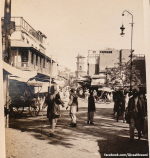
This view captures Peshawar City in 1923, seen from Chowk Yadgar (Remembrance Square), looking toward the Clocktower and the busy stretch near where the road forks toward Bazaar-e-Kalaan (Main Bazaar) and Karimpura Bazaar.

Wooden balconies overlook rows of mud plastered buildings. Tongas and pedestrians are moving through the street, while a tall streetlamp rises on the right.

In the distance stands the Clocktower, built in memory of Queen Victoria’s 1897 Diamond Jubilee and completed in 1900. It was a gift from Balmukand Ahooja, a contractor and banker, serving as both a physical and symbolic focal point of the city.

In the left foreground, an elderly Sikh gentleman walks toward the camera

(Photo: W H C Pulling of RAF via his grandson David Green)
 
1772731997176.png

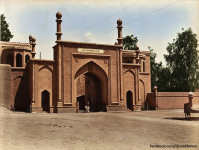
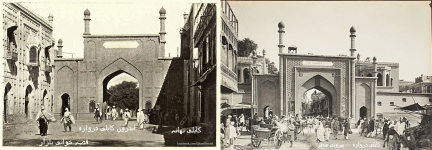
A 1905 View of the Kabuli Gate, Peshawar

Photograph by R B Holmes | Colourised from the original

This image captures the Kabuli Gate of Peshawar's walled city as it stood in 1905. The gate derived its original name from its orientation toward Kabul, marking the historic route that linked Peshawar to Central Asia and beyond.

During the British period, the earlier mud-built structure was reconstructed into the grand form seen here and was renamed the Edwardes Gate. With its elegant arches, slender minarets, refined stucco work, delicately adorned with lotus flower patterns reflecting a blend of local aesthetics and architectural sensibilities of that period, it became one of the most iconic entrances to the city.

Inside the gate lay the legendary Qissa Khwani Bazaar, or the "Bazaar of Storytellers", the converging place for traders and caravans from distant lands and perhaps the only marketplace in the world named for the tales once exchanged there.

Kabuli Gate was the principal point of entry for visitors arriving from the cantonment and was widely regarded as the most graceful of the sixteen original gates of the Walled City of Peshawar. More than a passageway, it stood as an elegant symbol of the city’s cosmopolitan past. QK
 
1772732059580.png

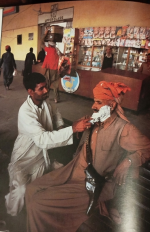
Capturing the easy pace of station life - Peshawar Cantonment Station 1985: A man enjoying a leisurely shave beside a magazine stall, while a red jacketed coolie passes by carrying a pair of luggage cases balanced on his head.

"The people were always dressed like this, - and always armed..." Time for a leisurely shave at Peshawar

(Source: 'The Imperial Way: By Rail From Peshawar to Chittagong', with text by travel writer Paul Theroux and photographs by Steve McCurry. Published 1985)
 
1772732156793.png


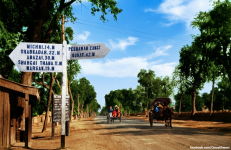
This colourised version of an original 1920s photograph portrays North Circular Road, known today as Khyber Road, one of Peshawar’s most important routes.


The road is notably tree lined, with light traffic reflecting the quieter pace of the period. In the distance, tongas and bicycles largely move eastwards toward the old city of Peshawar, though one tonga is seen approaching the photographer.

Prominently visible are direction signs. To the left, pointing toward what is now Warsak Road, are destinations including Michni, Shabkadar, Abazai, Shagai Thana and Warsak. To the right, pointing toward what is now Michni Road, the sign directs traffic toward Peshawar Cantonment and Kohat.

An octroi post sign is also visible, instructing carriers to stop for inspection and payment of octroi, a municipal tax levied on goods entering the city. Adjacent to this, parts of a wooden shed can be seen, likely serving as an octroi post or waiting area for passengers or carriers undergoing inspection. Nearby stands a telegraph post with overhead telegraph wires.

The photograph was taken near present day St Mary’s High School. On the left, the address 3 North Circular Road served as the kennel of the Peshawar Vale Hunt, on whose grounds St Mary’s School was later constructed in the early 1960s.

The view is oriented eastwards, looking toward Peshawar city. On the right side of the image and slightly elevated above the road lie open lawns that once formed part of the cantonment landscape. These grounds were situated in front of the quarter guard of a British infantry regiment and served as the regiment’s parade ground.
 
1772732288317.png

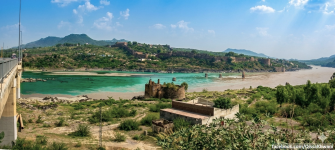
For the older generation, this scene needs no introduction. A once familiar sight on the Grand Trunk Road at Khairabad, Attock.

The Khairabad bridge, the confluence of the rivers below, the Attock Fort commanding a hill and the sense of arrival and departure all at once. When the M1 motorway arrived, journeys became faster and smoother and this familiar landmark slipped out of daily life. - QK

"About sixty miles from Islamabad, I found myself on a bridge, on the Grand Trunk Road to Peshawar.

Downstream was the Attock Fort, a spectacular structure with crenellated ochre walls, built in 1581 by the Moghuls, India's Muslim dynasty, to fortify the Afghan frontier. Upstream was a confluence of two great rivers: the Kabul, which had travelled some two hundred and fifty miles from its source, in the mountains west of the Afghan capital; and the Indus, one of the legendary rivers of Asia, which begins high in the Tibetan Himalayas.

The two rivers grudgingly accommodated each other. The Kabul was a sludgy burnt-sugar colour, the Indus a brilliant blue-green, like a child's painting of a mountain stream.

Below the confluence, the two colours remained clearly visible, one river with two distinct streams, as though geography as well as history wished to make a point about this place and the boundary that it marks—between the land of the Pashtun and the Punjab, the heartland of Pakistan." (Isabel Hilton - 'The New Yorker' Jan 2002)
 
1772732486057.png

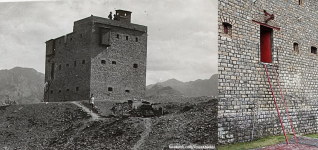
Blockhouses - Hallmarks of Frontier Warfare: On the North West Frontier, blockhouses (mini fortresses) or hilltop pickets in the 19th century and early 20th century were a practical response to rugged terrain and a form of warfare based on ambush, sniping, and defence against sudden raids rather than set battles. Built by the British, the blockhouses formed visual chains. From them, reflecting mirrors or heliographs, flags, lamps, or later telegraph lines could pass messages rapidly across vast and inaccessible terrain.

This network allowed small garrisons to summon help quickly and kept higher command informed.

These small strongly built posts were placed on commanding ridges, passes and along key routes to control movement of convoys, protect supply lines and provide observation over wide areas. Rather than occupying tribal territory in depth, the British used blockhouses to dominate critical ground and maintain lines of communication with a relatively small number of troops.

They appear in countless accounts and literature about operations in Khyber, Tirah, Waziristan, Malakand and the Mohmand country, where terrain and tribal resistance made conventional occupation impossible.

The ladder and pulley system was a key defensive feature. Entrances were raised above ground so that ladders could be hauled up during the night or in times of danger, denying attackers easy access.

The pulley also allowed rations, ammunition, water and even wounded men to be raised or lowered without opening a vulnerable ground level door. This design reflected the constant risk of surprise attacks and the need for a handful of soldiers to hold out until relief arrived.

Blockhouses became a hallmark of Frontier warfare because they embodied the British approach to control on the Frontier: economy of force, defensive dominance rather than permanent occupation and psychological presence. A small fortress on a hilltop could watch routes, signal to neighbouring pickets and project authority far beyond its size, making these structures as much instruments of policy as of military defence.

Today, many of these blockhouses lie abandoned and in varying states of ruin and their purpose largely forgotten. Preserving and conserving these structures is important not only to safeguard their historical value but also to recognise their considerable tourist appeal.

Such sites if properly preserved can help interpret the story of the North West Frontier while also contributing to heritage tourism in regions where such authentic historical assets are increasingly rare. - QK
 
1772732800671.png

(A colourised AI rendition of the original Baker & Burke photograph of Peshawar Cantonment, contributed by Mr Shahzad Zameer for QK)

The Early Cantonment at Peshawar Under Winter Skies, 1878–79: This iconic photograph of Peshawar was taken from above the 3rd Bengal Cavalry Mess. This mess once stood approximately at the location where the PIA Building now occupies the corner of Arbab Road and The Mall. From this elevated vantage point, the camera captures a sweeping view of Peshawar Cantonment in its earliest decades.

In the distance, St John’s Church is clearly visible, with the snow covered Khyber hills forming a dramatic backdrop. The season is unmistakably winter. The trees are leafless, the light subdued and the sky overcast suggesting the photograph was taken shortly after a spell of winter rain. Pools of collected water can be seen in the foreground, in an area that later housed the Grindlay's Bank. The clouds appear to be clearing, lending the image a quiet reflective atmosphere.

The Mall Road is visible as a broad, tree lined avenue, with trees planted in an orderly fashion. This reflects the cantonment’s original planning, which followed a grid plan layout, a standard urban planning approach of the period. Since the cantonment was established in the 1850s, the trees appear relatively young, most likely sheesham and peepal varieties, planted to shape what would later become the green character of Saddar. A narrow road (present Arbab Road) can also be traced leading toward Saddar Bazaar.

Several important buildings anchor the composition. From L-R: What was previously mistakenly identified as Masonic Lodge is in fact the original white building of St Michael’s Catholic Church. (Masonic Lodge next to the church is not visible in this view) In the middle stands the original single-hall Peshawar Club building and St John’s Church nearby, illustrating the early institutional landscape of the cantonment. A small but telling detail is a signboard reading “W. Doyle,” likely belonging to a watch repairer, a trade supported by documentary records from that era.

Signed “Baker & Burke” at the bottom this image often appears with the original caption “General View from Above the 3rd B C Mess Looking Towards the Church,” and has been variously dated to 1862, 1870 and 1878. Based on stylistic and contextual evidence, the late 1870s dating is the most plausible. It was perhaps taken in the winter of 1878–79 by the pioneering photographers John Burke and William Baker, who operated under the name Baker & Burke.

Burke maintained a photographic practice in Peshawar Cantonment in the nineteenth century, and the partnership also ran a studio in Murree. Their work has been comprehensively documented by Omar Khan in his book 'From Kashmir to Kabul', which traces their extraordinary photographic record of the north western frontier and adjoining regions.

The photograph stands as both a historical document and a work of art. It records the formative years of Peshawar Cantonment with precision, while its careful composition, atmospheric light, and depth transform it into a contemplative image of a city in the making. It reflects a time when the cantonment was still new, the city beyond it was only beginning to grow, and the skies over Peshawar were clear.

(Image Source: The British Library collection. Original photo by Baker & Burke) Colorised by Shahzad Zameer for QK

1772732860623.png

The Early Cantonment at Peshawar Under Winter Skies, 1878–79

The iconic photograph of Peshawar was taken from above the 3rd Bengal Cavalry Mess. This mess once stood approximately at the location where the PIA Building now occupies the corner of Arbab Road and The Mall. From this elevated vantage point, the camera captures a sweeping view of Peshawar Cantonment in its earliest decades.
 
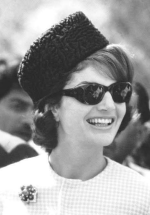
1962

First lady USA in Peshawar with Topi

1772743281357.png
 
1772797683886.png

Kabuli gate ke Ander afgghanistN ka sifarat khan ki khubsurat building hai is wajah se ye nam para aage qissa khani bazar dhakki naalbandi hamara abaae gher jo ab bik chuka hai yahaan ab hospital hai
 

Users who are viewing this thread

Back
Top