Old pictures of Pakistani Cities

Bolan Pass (after Railway was made), Circa 1880.

The pass is approximately 60 miles long (100 km) and is at an altitude of 5,880 feet (1,792 metres). Due to its strategic location, the pass has traditionally been used as a gateway to India by traders, invaders and nomadic tribes. The railroad cuts through the pass en route to the Afghanistan frontier.

Photograph of the Bolan Pass from the Macnabb Collection (Col James Henry Erskine Reid): Album of Miscellaneous views, taken in the 1880's. The Bolan Pass is a gap in the central Brahui Mountain Range, Pakistan.


1609445136086.png
 
1960s: Lahore - Quetta of the NWR - Nannar Nala bridge at the beginning of the Bolan Pass - P.S.A. Berridge, coll. Olga Berridge


1610570042791.png
 
Arrival of Train At Bannu Railway Station, Circa 1936.

The Railroad At Bannu Station Allowed For More Efficient Movement Of Men And Supplies, This Is a Narrow Gauge Railtrack.


1610648863178.png
 
Lahore, The Capital Of Punjab Province, Is Considered The Cultural Centre Of Pakistan.

Islam Came Here After The Advent Of Mahmud Of Ghazni In 1021 AD, And It Was Subsequently Ruled By A Succession Of Dynasties Of The Delhi Sultanate, Followed By The Mughals, The Sikhs And The British.

It Reached Its Apogee Under The Mughals, Known As The Garden City And With Enough Architecture To Rank It With Other Great Mughal Centres Like Delhi, Agra And Fatehpur Sikri.

The British Took Control Of Lahore From The Sikhs In 1849, And Transformed Its Landscape With Railways, Factories And Roads. They Continued The Tradition Of Embellishing It With Architecture, Constructing Some Of The Finer Examples Of Colonial Buildings In The Indo-Islamic-Gothic-Victorian Style Here.

Taken By George Craddock In The 1880's, Part Of The Bellew Collection Of Architectural Views.

© George Craddock / British Library


1610649252510.png


The Railway Station At Lahore, Circa 1880.
 
1921: Train at Kachh Railway Station .....
Kach station ( Ziarat ) bordering Harnai and Pishin...
Balochistan


1600305439380.png
 
Khyber Railway Station Landikotal, Circa 1928


1608158839530.png


.


Photograph Of A Railway Engine Stopped At Jamrud Station, At Khyber Pass Circa 1920's.

Tracks Connecting The Jamrud Junction Railway Station To Landi Kotal Via The Khyber Pass Were Completed In November 1925. The Tracks Have Since Fallen Into Disuse.


1608158919842.png
 
Karachi to Kotri - The first railways in Pakistan
By Owais Mughal.

The first railway line was laid in the in the areas that now comprise Pakistan in the year 1858 in Karachi. The following is the story of this historical event as well as the construction of first railway section of Pakistan which was opened between Karachi City and Kotri in 1861.

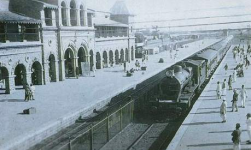
The following photo is kind of jumping the gun in our story but it is the earliest photo of railways that I could research for Karachi-Kotri section. The photo is circa 1900 and shows the 5:30am passenger train reaching Frere Road Station (now called Karachi Cantonment) from Kotri.
1740613490985.png

Passenger arriving at Karachi from Kotri, 1900

The origin of Railways in Pakistan is quite unusual. The railway here was not built for commercial passenger service but more for the reason of cutting transport time for cargo bound for East. The first line from Karachi to Kotri was constructed primarily to reduce the journey time on the final stage of long haul from Britain to Delhi and Calcutta. Many of the later lines were built for Military purposes.

The Early Planning
The Railway planning in the areas that comprise Pakistan got an official status when Lord Dalhousie, Governer General of India, gave his approval for laying a 108 miles (173km) long railway line between Karachi and Kotri in December, 1853 .

Scinde Railway (SR) Company
The next significant event in the history of Karachi-Kotri section occured in 1855 when Scinde Railway Company was formed in London. In January 1856, a contract was signed between East India Company and Scinde Railway Company to build Karachi-Kotri Railway Line. In 1857, Scinde Railway Company's scope was increased to laying a railway track between Karachi and Kotri and also between Multan and Amritsar via Lahore.

Ground Breaking of the First Railway Project
Sir Bartle Frere, who was the then Commissioner of Scinde (Sindh) did the ground breaking of the project on April 29, 1858. The ceremony included him pushing a wheel-barrow full of construction material at the site of a railway embankment in Karachi.

I can say for sure that first Railway Track in Pakistan was thus laid somewhere between April, 1858 and December, 1859. This is a 16 month long time period but I am unable to research the exact date or a time window any shorter than this.

In 1859, two small stretches of Railway Line were opened in Karachi. One of this track section still exists while the other one has been uprooted.

The First Operational Railway Track
The First section, which exists to date, ran from the then Karachi port of Kimari to Railway Workshops which were located near the present daykala pul just north of Karachi Cantonment Station.

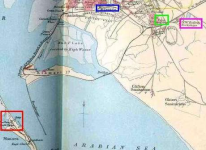
See the map of Karachi from 1893. Find Kimari here which was an island in 1893. From Kimari follow the solid black line towards the 'green rectangle' (now Karachi Cantonment Station) and onwards to violet rectangle (which was once the Railway Workshop). The precise location of this Railway Workshop, which is not present today is unknown to me. There are two routes shown between Kimari and Karachi Cantonment. I will request you to consider the lower one, the one which bypasses the blue rectangle. This was the first ever piece of railway track built in Karachi (and Pakistan).
1740613553125.png

Map of Karachi area, 1893
 
The Second Operational Railway Track
The Second Track which became operational in Karachi started from the Railways Workshop near present-day 'kala pul' and went east-wards to Gizri bandar (harbor) located in Gizri Creek.

This track and the Railway Workshop is not present anymore but my strong guess is the track ran parallel to present-day Korangi Road until it reached Gizri Creek (near Present Day Marina Club in Defense Housing Society). Any confirmation here from our learned readers will be highly appreciated.

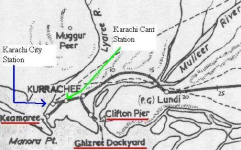
This following map shows the location of these very first stretches of Railway Lines which were built in Pakistan. Note the location of present day Kimari, Karachi City Station, Karachi Cantonment Station and Ghizree (Gizri) Creek marked on the map. Also note how the English spellings of these places have evolved over time.

1740613641226.png

Early railway lines in the Karachi area
The following is the satellite image of present day Karachi with superimposed colored lines to show the two sections which became operational in 1859. While the 'green' track is still operational, the history that I have researched so far is silent on when was the 'yellow' track uprooted and what was its exact route.


Satellite map showing Karachi area railway lines in 1859

When Karachites saw the First Railway Locomotive

Of the whole of what is now Pakistan, people of Karachi were the first to see a steam locomotive in action and many could not believe what were they seeing.

1740613689484.png

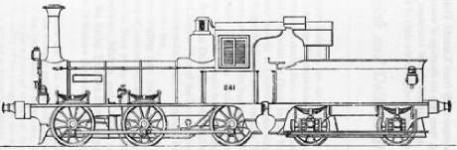
Diagram of 0-6-0 Scindhia class locomotive

The locomotive diagram shown above is of a 0-6-0 Scindhia Class which was among the first few used on railways in present day Pakistan

As an inaugural run of Railways in Karachi, John Brunton the Chief Engineer of Karachi-Kotri Railway Project, drove in a steam locomotive with Sir Bartle Frere, the Commissioner of Sindh to Kiamari in a railway train. Once again I don't have the exact date of this travel but it was most likely between 1859 and 1861.

John Brunton wrote the following anecdote on this occasion and it sounds so strange today:

The natives of Scinde had never seen a locomotive engine, they had heard of them as dragging great loads on the lines by some hidden power they could not understand, therefore they feared them, supposing that they moved by some diabolical agency, they called them shaitan. When I got out my locomotive for trial the Karachi natives were astounded. I drove the engine myself of course at a slow speed - the natives thronging all round, I was fearful of some accident. At last I thought I should frighten them away, so I blew the engine steam whistle loudly. Instantly they all rushed back from the "Demon" falling over one another much to our amusement.

This completes our capturing of the history of first railway tracks in the city limits of Karachi (and Pakistan). Now let us review the history of Railways North-eastwards of Karachi to Kotri.
 

Users who are viewing this thread

Pakistan Defence Latest

Back
Top