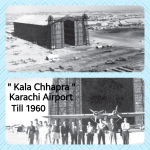
Construction of the Kala Chapra (Black Hangar) began in 1927 and was completed in 1929. At 260 meters long, 50 meters wide and towering, the Black Hangar was the largest steel structure built during the British era. Designed and constructed in 1927 as part of the British government's Royal Air Force Plan, it was an aircraft station.
In which aircraft would rest after long flights before departing on their next journey. The Kala Chapra -Black Hangar was built by the British government in collaboration with the Air Ministry and other companies. The hangar was originally built as a base for the famous airship of the time. An airship was a special type of aircraft that flew with the help of gas balloons.
It was a flying platform that flew to a destination with the help of high-speed wings powered by jets. The boundaries of the British Empire that In the past, it used to extend from England to Australia. In those days, airships also flew between these countries, carrying passengers in their cots. This high hangar was built within the boundaries of Karachi Airport to anchor the airship. This ship used to fly from Britain to Australia, stopping in Karachi in between.
At 6 pm on October 4, 1930, this airship took off from Cardington, England, with its 54 passengers, but unfortunately, it crashed within the borders of France due to a technical failure just eight hours later.
Meanwhile, in Karachi, this ship was being awaited with great excitement, which was supposed to land on the black sand. The residents of Karachi were anxious to see the sight of its landing, but they were devastated to hear of its destruction. After this incident, this hangar waited for another ship for the next four decades, but no ship was to come here, nor When the hangar turned rusty and black, the residents of Karachi named it "Kala Chapra".
For those traveling to Karachi from Hyderabad and Thatta on the National Highway and for train passengers, Kala Chapra was a landmark. Due to its height, it began to be visible long before the city limits began. Especially train passengers would sit quietly until they saw Kala Chapra. They would start packing their belongings as soon as they first saw the chapra.
In the 60s, during the Ayub regime, this giant iron structure was traded with a large junkyard in Karachi. The workers of this junkyard kept cutting and ripping the structure apart for many days. Finally, one day this symbol of Karachi disappeared from the horizon of Karachi, but the Kala Chapra stop remained in place for the next 20 years, and then it too was lost in the pages of history.
In the time when we I started traveling in buses, at that time Kala Chapra used to be a well-known stop. As soon as the buses moved beyond Natha Khan Goth, the conductor would start shouting Kala Chapra Kala Chapra to warn the passengers getting down there.
Syed Zameer Jafri has also not only mentioned Kala Chapra in his book “Zamiriyat”, but has also written an elegy for it. In 1960, Colonel Maqbool Elahi Darvesh auctioned it as per the decision of the Ministry of Defense. In the days when the iron skin of this chapra was getting worn out, Rakim Al-Haruf used to live under its shadow in Drug Road Cantonment.


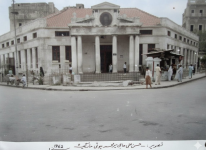
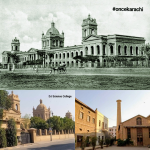
 1887 – Founded as Sindh Arts College, later named Dayaram Jethmal (D.J.) Science College.