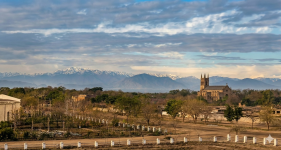
(A colourised AI rendition of the original Baker & Burke photograph of Peshawar Cantonment, contributed by Mr Shahzad Zameer for QK)
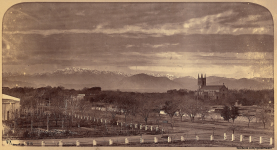
The Early Cantonment at Peshawar Under Winter Skies, 1878–79: This iconic photograph of Peshawar was taken from above the 3rd Bengal Cavalry Mess. This mess once stood approximately at the location where the PIA Building now occupies the corner of Arbab Road and The Mall. From this elevated vantage point, the camera captures a sweeping view of Peshawar Cantonment in its earliest decades.
In the distance, St John’s Church is clearly visible, with the snow covered Khyber hills forming a dramatic backdrop. The season is unmistakably winter. The trees are leafless, the light subdued and the sky overcast suggesting the photograph was taken shortly after a spell of winter rain. Pools of collected water can be seen in the foreground, in an area that later housed the Grindlay's Bank. The clouds appear to be clearing, lending the image a quiet reflective atmosphere.
The Mall Road is visible as a broad, tree lined avenue, with trees planted in an orderly fashion. This reflects the cantonment’s original planning, which followed a grid plan layout, a standard urban planning approach of the period. Since the cantonment was established in the 1850s, the trees appear relatively young, most likely sheesham and peepal varieties, planted to shape what would later become the green character of Saddar. A narrow road (present Arbab Road) can also be traced leading toward Saddar Bazaar.
Several important buildings anchor the composition. From L-R: What was previously mistakenly identified as Masonic Lodge is in fact the original white building of St Michael’s Catholic Church. (Masonic Lodge next to the church is not visible in this view) In the middle stands the original single-hall Peshawar Club building and St John’s Church nearby, illustrating the early institutional landscape of the cantonment. A small but telling detail is a signboard reading “W. Doyle,” likely belonging to a watch repairer, a trade supported by documentary records from that era.
Signed “Baker & Burke” at the bottom this image often appears with the original caption “General View from Above the 3rd B C Mess Looking Towards the Church,” and has been variously dated to 1862, 1870 and 1878. Based on stylistic and contextual evidence, the late 1870s dating is the most plausible. It was perhaps taken in the winter of 1878–79 by the pioneering photographers John Burke and William Baker, who operated under the name Baker & Burke. Burke maintained a photographic practice in Peshawar Cantonment in the nineteenth century, and the partnership also ran a studio in Murree. Their work has been comprehensively documented by Omar Khan in his book 'From Kashmir to Kabul', which traces their extraordinary photographic record of the north western frontier and adjoining regions.
The photograph stands as both a historical document and a work of art. It records the formative years of Peshawar Cantonment with precision, while its careful composition, atmospheric light, and depth transform it into a contemplative image of a city in the making. It reflects a time when the cantonment was still new, the city beyond it was only beginning to grow, and the skies over Peshawar were clear.
(Image Source: The British Library collection. Original photo by Baker & Burke) Colorised by Shahzad Zameer for QK