Old pictures of Pakistani Cities

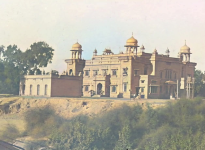
Peshawar Museum, 1922

1767218564063.png
 
1948, Karachi Port

1767218734819.png
 
1767219212930.png

Karachi
 
Last edited:
Pakistan Chowk, Karachi

1767279208756.png
 
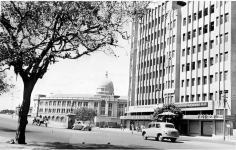
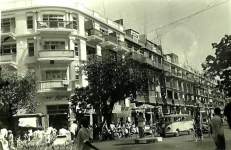
1950's... Burns Road, Karachi.

1767282150542.png

1767282270256.png
 
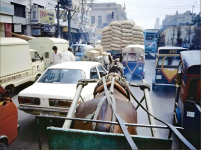
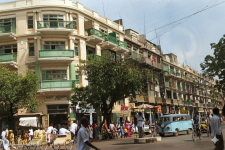
1990's, Karachi
Shahr e Faisa,l Malir say Nursery than Saddar and so on.

1767282419866.png
 
1767304148932.png

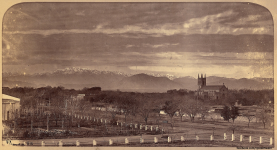
The Early Cantonment at Peshawar Under Winter Skies, 1878–79

The iconic photograph of Peshawar was taken from above the 3rd Bengal Cavalry Mess. This mess once stood approximately at the location where the PIA Building now occupies the corner of Arbab Road and The Mall.

From this elevated vantage point, the camera captures a sweeping view of Peshawar Cantonment in its earliest decades.

In the distance, St John’s Church is clearly visible, with the snow covered Khyber hills forming a dramatic backdrop. The season is unmistakably winter.

The trees are leafless, the light subdued and the sky overcast suggesting the photograph was taken shortly after a spell of winter rain. Pools of collected water can be seen in the foreground, in an area that later housed the Grindlay's Bank. The clouds appear to be clearing, lending the image a quiet reflective atmosphere.

The Mall Road is visible as a broad, tree lined avenue, with trees planted in an orderly fashion. This reflects the cantonment’s original planning, which followed a grid plan layout, a standard urban planning approach of the period.

Since the cantonment was established in the 1850s, the trees appear relatively young, most likely sheesham and peepal varieties, planted to shape what would later become the green character of Saddar. A narrow road (present Arbab Road) can also be traced leading toward Saddar Bazaar.

Several important buildings anchor the composition. From L-R: What was previously mistakenly identified as Masonic Lodge is in fact the original white building of St Michael’s Catholic Church. (Masonic Lodge next to the church is not visible in this view) In the middle stands the original single-hall Peshawar Club building and St John’s Church nearby, underscoring the early institutional landscape of the cantonment.

A small but telling detail is a signboard reading “W. Doyle,” likely belonging to a watch repairer, a trade supported by documentary records from that era.

Signed “Baker & Burke” at the bottom this image often appears with the original caption “General View from Above the 3rd B C Mess Looking Towards the Church,” and has been variously dated to 1862, 1870 and 1878. Based on stylistic and contextual evidence, the late 1870s dating is the most plausible. It was taken in the winter of 1878–79 by the pioneering photographers John Burke and William Baker, who operated under the name Baker & Burke. Burke maintained a photographic practice in Peshawar Cantonment in the nineteenth century, and the partnership also ran a studio in Murree. Their work has been comprehensively documented by Omar Khan in his book 'From Kabul to Kashmir', which traces their extraordinary photographic record of the north western frontier and adjoining regions.

The photograph stands as both a historical document and a work of art. It records the formative years of Peshawar Cantonment with precision, while its careful composition, atmospheric light, and depth transform it into a contemplative image of a city in the making. It reflects a time when the cantonment was still new, the city beyond it was only beginning to grow, and the skies over Peshawar were clear.

(Image Source: The British Library collection by Baker & Burke)
 
1767304391927.png

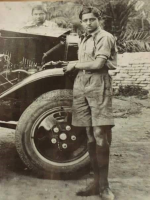
Photo courtesy of Mr Azmat Iqbal: "My father's name Fazal Rehman. He worked in Ford Co and also worked at Maira Bros. This is his 1928 pic in Peshawar City.

In those days this site was known as 'Charsada Stand' on the road in front of Firdos Cinema GT Road near to graveyard & tree of dates. After 1942 the Ford Co was owned by Bahi Jhamal Singh & relocated to Saddar Road.

its cost was 2700/ hundred with 4 tyre.

The place is when one is coming from Chowk Yadgaar side to Ashraf Road don't turn. On left side a Tikka shop is on street when u go in this street there is a grave yard there now."
 
1767304654567.png

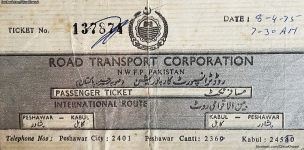
When the road from Peshawar to Kabul was a routine journey. A surviving bus ticket from 1975. An era of open roads and regional travel.
Courtesy: Mark Tesoriero

GTS- Govt Transport Bus Peshawar to Kabul daily service Night coach 8 0,clock departure from Peshawar Saddar Opp Dean's , hotel good old memories travelled to Kabul
 
1767305497727.png

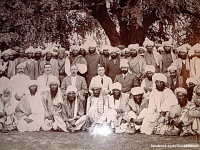
A rare 1914 photo of the frontiersmen who shaped the early North West Frontier including Sir George Roos Keppel (Chief Commissioner NWFP), George Cunningham, Moghal Baz Khan and Sahibzada Abdul Qayum (seated left) with local tribesmen and elders.
 
1767306207525.png

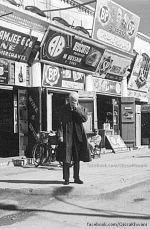
Arnold J. Toynbee on Saddar Road, Peshawar, during his visit to the city in 1960. He stayed here for a month as visiting professor at the University of Peshawar.

Arnold J. Toynbee (1889–1975) was a renowned British historian, philosopher of history, and diplomat, best known for his monumental 12-volume work 'A Study of History', in which he analyzed the rise and fall of civilizations through a comparative lens.

Toynbee’s writing combined scholarship with moral reflection, exploring how spiritual and cultural factors shape the fate of societies. His later travels, including his 1960 journey between the Oxus and Jumna rivers, reflected his deep interest in the meeting of Eastern and Western civilizations.

In his 1960 journey described in 'Between Oxus and Jumna', Toynbee visited several locations in Pakistan. He mentions stopping at Peshawar (as a visiting professor at the University of Peshawar for a month) and in the course of his overland travel he saw Multan, Dir, Swat and parts of the tribal areas of Pakistan. In the preface he has thanked the following Enver Qureshi of the Ministry of Information and his colleague Mr Qayyani while traveling in the tribal areas. In addition he writes: "At Peshawar I met with unceasing kindness and hospitality both at the University and in the City.

The friends that I have made there as a result, include the Vice Chancellor Colonel Afridi, the Registrar, Mr Hashim; The head of the History Department. Prof Munawwar Khan; the Director of the Pashtun Academy, Maulana Abd-al-Qadir; the Commissioner Agha Abdul Hamid; the Deputy Commissioner, Ruedad Khan; the G.O.C, Major-General "Atiq" Abdurrahman." (Between Oxus and Jumna - 1961)
 

Users who are viewing this thread

Latest Posts

Back
Top