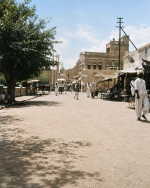
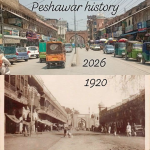
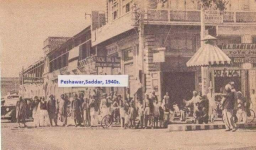
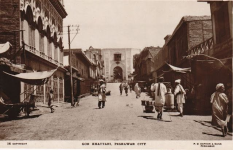
𝐏𝐞𝐬𝐡𝐚𝐰𝐚𝐫, 𝟏𝟗𝟑𝟖: 𝐓𝐡𝐞 𝐒𝐭𝐫𝐞𝐞𝐭 𝐨𝐟 𝐆𝐨𝐥𝐝𝐬𝐦𝐢𝐭𝐡𝐬 𝐀𝐧𝐝𝐞𝐫 𝐒𝐡𝐞𝐡𝐫: A view of 𝐴𝑛𝑑𝑒𝑟 𝑆ℎ𝑒ℎ𝑟 street from Chowk Yadgaar, leading towards the 𝐀𝐬𝐚𝐦𝐚𝐢 𝐆𝐚𝐭𝐞 named after the nearby Asamai Hindu temple.
In the distance is the tall minaret of the17th century Mughal 𝐌𝐚𝐡𝐚𝐛𝐚𝐭 𝐊𝐡𝐚𝐧 𝐌𝐨𝐬𝐪𝐮𝐞 with a 𝐒𝐢𝐤𝐡 𝐠𝐮𝐫𝐝𝐰𝐚𝐫𝐚 nearby. This was the street of the 𝑠𝑎𝑟𝑎𝑓𝑠, or gold dealers, where some of Peshawar’s wealthiest merchants lived and traded.
The location was no accident. In earlier times, Peshawar’s gold market was considered vulnerable to armed raids by robbers. With the formidable Balahisar Fort nearby and a substantial force stationed there, the merchants and their precious trade found some measure of protection.
The gold dealers were predominantly Hindus and Sikhs, reflecting the remarkably diverse commercial life of old Peshawar, where communities, places of worship and thriving businesses existed side by side within the walled city.
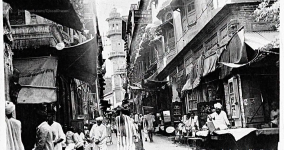
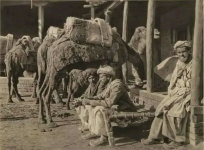
In a Caravansary, Peshawar, India (now in Pakistan). Photograph year 1927, by Martin Hurlimann.
Caravanserais were strategically located along trade routes to provide a safe haven for merchants and their valuable goods. They were often fortified with thick walls, watchtowers, and guarded entrances to protect against bandits, thieves, and other threats.
Tarikh-i Hind تاریخِ ھند #TarikhiHind#Peshawar
In a Caravansary, Peshawar, India (now in Pakistan). Photograph year 1927, by Martin Hurlimann.
This site uses cookies to help personalise content, tailor your experience and to keep you logged in if you register.
By continuing to use this site, you are consenting to our use of cookies.