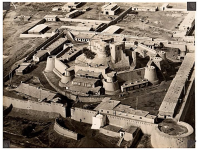
Jamrud Fort ("Fatehgarh") is constructed on a mound located at the mouth of the Khyber Pass (Historic route between Afghanistan and the subcontinent.
One end of the pass faces Peshawar, and the other opens into Afghanistan. The pass itself is a long winding route through mountains and is 33 miles long) It is a natural strategic location and we can assume why General Hari Singh Nalwa chose this spot for his fort:
1. It is a good observation point for many miles due to its height
2. Its north eastern side is mountainous, hence impassable for armies
3. On its western side is a river ("Rud") - another natural barrier. During monsoon rain ("Jam") it fills up as a torrent, hence the name Jamrud.
4. It is located on the main route to Afghanistan so every type of traffic can be observed for miles.
Khyber Pass is an ancient pass and its romance and history is timeless. It is possible the fort was built in 1836 on the ruins of a much older structure - Buddhist-era temple ruin or older fort perhaps.
The Sikhs used mud brick which was the hallmark of their construction, strengthened with stone. With its three layers of defence, the fort resembles a ship anchored in the sand when viewed from a distance. This striking image earned it the nickname 'HMS Jamrud' among the British. There is a mud outer wall, inside is a moat-like space.
An entranceway leads inside the inner wall. Yet another stairway leads to the innermost and top most core which also has the famous Hari Singh room where his body was kept in the final hours when he was mortally wounded in 1837. To conceal his death and maintain the morale of his troops, his body was propped up at a window of the room to deceive the Afghans into believing that Nalwa still lived and watched over the fort. Within the fort lies his samadhi (memorial).
The British made significant additions to the fort, including brickwork, new barracks, and facilities such as a regimental office and mess. It also features an old open-air racquets (squash) court.
At the fort's base, some of the stones used in construction are kanjoor stones, the same type of dressed stone commonly used in Buddhist Gandharan monasteries and stupas. This suggests that material from an older, possibly ancient, structure may have been repurposed during the fort’s construction.
Not far from here stands the massive Ishpola Stupa, dating to the 1st–2nd century CE, while the nearby Ali Masjid area also contains remnants of ancient Buddhist stupas perched on surrounding hilltops.
The fort has been remarkably maintained and preserved by the military, especially considering it is now nearly 190 years old. In 2023, custody of the fort was formally handed over to the Directorate of Archaeology & Museums, Govt of KP, marking a new chapter in its history. It is currently undergoing conservation and restoration works under a World Bank-funded program aimed at safeguarding heritage sites in the region. Nearby is the century-old Jamrud Railway Station, which also holds great appeal for tourists.
Khyber Pakhtunkhwa or “KP” (formerly North West Frontier) has a rich Sikh military history. It is dotted with a number of Sikh-era forts that are fascinating from Sikh heritage perspective. Besides Fatehgarh (Jamrud), other Sikh-era forts are Balahisar (Sameergarh), Shabqadar (Shankargarh), Bara Fort (Kishangarh), Mackeson, Michni etc etc. Hazara and Haripur part of KP is yet another area steeped in Sikh history. - (AJ)



 Federal cabinet gives nod to imposition of emergency in KP; summary sent to president (58 Viewers)


 Iran - Israel/US War: Israel-US declare war on Iran, Iran responds (129 Viewers)


