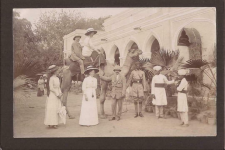
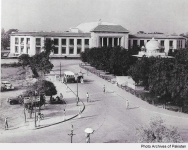
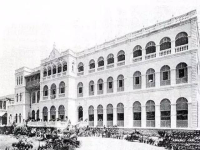
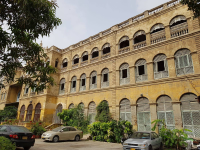
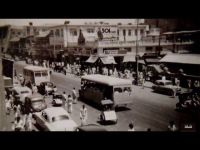
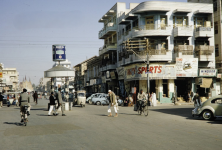
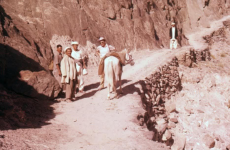
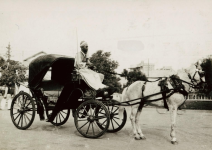
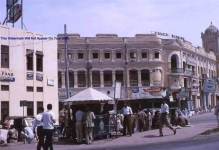
The Tower of Silence, Karachi - 1860.
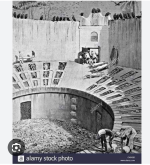
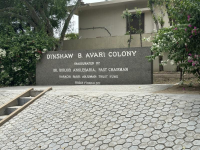
The Minar Khumushan or the Tower of Silence, known as 'Dakhma' in Persian, built about 164 years ago in Dansha Bi Awari Colony, a residential l area of local Persians located in Mahmoodabad, Karachi, is one of the few places in the world, where Zartishti (Parsi) religion is still practiced today. Who keep the dead.
The plaque just inside the main gate . Dated 1860s By the order of Deputy Governor General of India
Dinshaw Awari was a rich parsi owner of Awari tower .
Awari Colony is the rich parsi residential area within Parsi Colony. Few families lives there total population around 300 .
The burial traditions of the Persian community are particularly different from other religions. They have a particular theory of death and corpse, based on the concept of "Purity" and "Pollution".
According to the Zartishti belief, immediately after death, "droj-e-nasu" (spirit of impurity) enters the corpse.
That is why the corpse is not kept near earth, water and fire so that these elements are not impure, because these four (fire, water, earth, air) are considered sacred in the earthly religion.
The corpse is given a bath.
White clothes are worn, called "Sadra" and "Kusti".
Or the silent minars are traditionally placed in "Dakhma" or "Bridge of Silence" instead of burning the Persian corpse.
It is a round high building, with bodies kept on the roof.
Vultures and birds eat meat and bones dry up by the sun and wind.
After a while, the bones are sold and gathered in the well.
Many Persians in India and Pakistan now opt for burial or cremation (burning) in cemeteries instead of "dakhma", especially where vultures have vanished and tradition has become difficult to follow.
Lamps are lit at the time of death, because fire symbolizes purity.
"Modab" (pastor) recites specific prayers.
Family members don't touch dead bodies much, only specific people "nasu salar" (body caretakers) perform this duty.
Collective prayers are performed for the dead body on the third day, tenth day and then month or year in the agricultural community.