One chart that shows how China seized the lead in the robotaxi wars

Beijingwalker

VIP Member
Joined
Nov 4, 2011
Messages
92,955
Reaction score
113,476
Reputation
2,138.3
Country of Origin
Country of Residence

One chart that shows how China seized the lead in the robotaxi wars

TOM CARTER
Updated Mon, April 28, 2025 at 9:48 PM GMT+9

The BYD Sealion 7 was unveiled at the Paris Auto show

BYD's Sealion 7 is one of the Chinese EV giant's marquee models.Business Insider
  • China has snatched the lead in the global race to build self-driving cars, new data suggests.
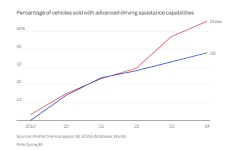
  • Over half the cars sold in China last year had advanced assisted driving tech, compared to under 40% in the US.
  • Chinese carmakers like BYD are leaving Tesla in the dust by offering self-driving tech for free.
Tesla and Waymo are locked in a race to build self-driving cars, but their Chinese rivals may be leaving them in the dust.

More than half of the cars sold in China last year were equipped with advanced driver assistance tech, compared to less than 40% in the US, according to data compiled by consulting firm AlixPartners.

The figures suggest China has built a sizable lead in the global race to deploy self-driving technology, with the gap appearing to widen over the past few years.

In 2021, around 24% of the cars sold in both the US and China were equipped with tech that allowed them to steer, accelerate, and brake autonomously, per AlixPartners analysis.
微信图片_20250428230536.png

While Western firms like Tesla and Google-backed Waymo are expanding aggressively in the US, they face fierce competition from Chinese companies that have made major technological strides in recent years.

Last month, Tesla rival BYD announced it would install its 'God's Eye' driver assistance tech for free across nearly its entire range of electric and hybrid cars, including the $7,800 Seagull hatchback.

That move quickly turned self-driving technology into the latest battlefront in China's brutally competitive car market, with several automakers rushing to follow BYD's lead by offering driver assist systems for free.

The self-driving scramble has left Tesla, which began rolling out its own advanced driver assist software to Chinese customers who had paid an extra $8,800 in February, at a competitive disadvantage in its second-largest market.

"Complimentary intelligent-driving features are emerging as a key competitive tool, further distinguishing China-brand offerings from overseas offerings," said Yvette Zhang, a Partner in the Automotive and Industrial Practice at AlixPartners.

One key reason that China has been able to roll out self-driving technology quicker than the US is the former's massive tech talent pool.

Chinese tech giants such as Xiaomi and Huawei have branched out into the electric vehicle business in recent years, and a survey of 400 auto industry executives in the US, China, and the EU conducted by AlixPartners pinpointed the availability of AI and machine-learning talent in China as a key advantage, alongside proximity to microchip hubs and more efficient data processing.

"Chinese brands are leveraging unique advantages to pursue faster and cheaper intelligent-driving solutions that are 'good enough' to bring to market," said Stephen Dyer, Asia Leader of the Automotive and Industrial Practice at AlixPartners.

Dyer added that some global automakers were attempting to learn from Chinese firms by striking strategic partnerships with their rivals.

Last year, Volkswagen struck a deal with Chinese EV upstart Xpeng to collaborate on technology for future products, including assisted driving.

China's self-driving revolution has not been without its speed bumps.

Last month, an SU7 electric vehicle built by smartphone giant Xiaomi was involved in a fatal crash on a Chinese highway. Xiaomi confirmed at the time that Navigate on Autopilot, the company's intelligent driving system, was engaged before the incident took place, with the human driver taking over seconds before the crash.

Weeks after the accident, Chinese authorities tightened regulations governing autonomous driving technology, banning automakers from exaggerating the capabilities of assisted driving features and reportedly telling companies to avoid describing them as "self-driving" entirely.
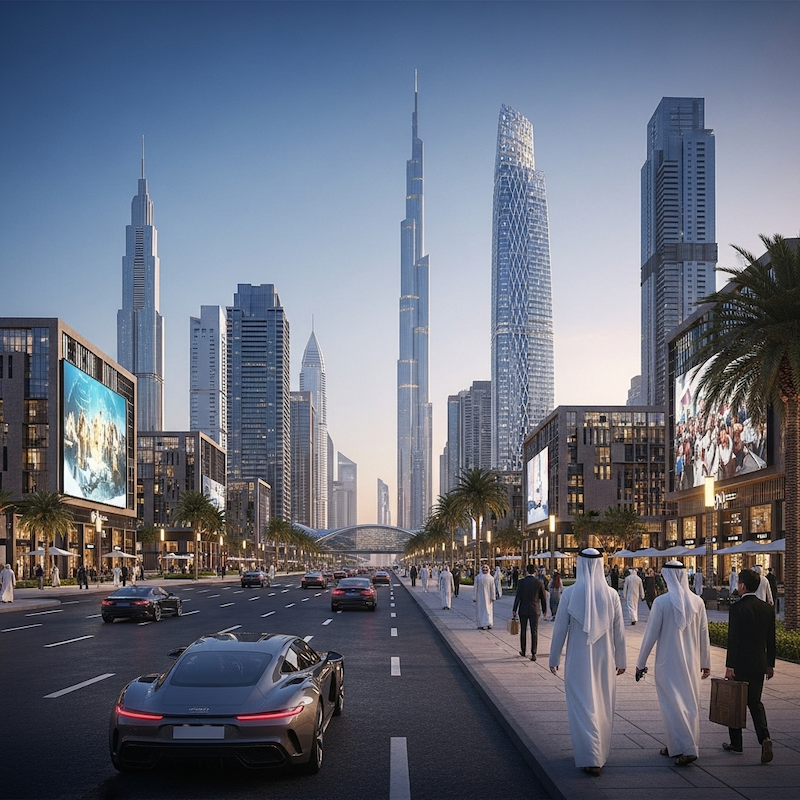
 
Chinese people are increasingly driving better, technologically more advanced cars than the drivers in the rest of the world.
 

China racing ahead in autonomous car adoption, says new report​

August 12, 2026 by David Edwards

China is the country most prepared for self-driving cars, according to a new report.

The new study by the B2B car company eCarsTrade analyzed robotaxi deployment, road infrastructure, legal frameworks, and public sentiment across 15 countries to see which nations are actually putting driverless vehicles on the road.

Driven by massive robotaxi deployment, nearuniversal 5G coverage, and advanced regulations that allow fully driverless commercial service, China ranks first.

The United States follows, with Waymo completing about 500,000 paid rides weekly.

New Zealand and Canada lag behind, with limited testing and less developed legal frameworks.

The study looked at four key areas, reflecting the self-driving environment. Adoption measured how many robotaxis are actually carrying paying passengers today, not just announcements or pilot programs. Infrastructure assessed road quality, 5G coverage and EV charging networks.

Legal frameworks captured whether countries have passed laws allowing commercial driverless operations, and public sentiment was drawn from surveys and Reddit analysis across 76 threads. Driver‐assist systems like Tesla Autopilot were excluded because they still require a human driver behind the wheel.

China​

  • Robotaxi status: Yes for Apollo Go, Pony.ai, WeRide
  • Safety driver: Not used for Apollo Go
  • Road quality: 4.8 out of 7
  • 5G coverage: 96 percent
  • Electric vehicle chargers: 3 million+
  • Legal category: Advanced
China is the world leader in self‐driving readiness, with more than 17 million robotaxi rides recorded. Apollo Go operates fully driverless vehicles without anyone behind the steering wheel, and 5G covers 96 percent of the population, giving autonomous vehicles the low‐latency connections they need.

Road quality is average, scoring 4.8 out of 7, but the sheer scale of deployment outweighs infrastructure limits. Plus, China has more than 3 million EV chargers, making it easier for electric robotaxi fleets to operate.

United States​

The United States ranks second, with Waymo completing about 500,000 paid rides every week. That is roughly 26 million rides per year, making it the largest commercial robotaxi service outside China.

Waymo operates fully driverless vehicles with no safety driver, and road quality scores are high at 5.6 out of 7.

The US has nearly 200,000 EV chargers and advanced federal and state laws that allow autonomous vehicles to operate commercially.

Public sentiment is more mixed than in China or Singapore, with Reddit threads showing strong concerns about blocked roads, emergency response, and the distinction between remote assistance and true autonomy.

Singapore​

Singapore takes third place, with the highest road quality score in the study at 6.7, meaning its streets are in excellent condition for autonomous vehicles.

5G coverage reaches 95 percent of the population, and the legal framework is fully advanced. Robotaxi deployment is more limited than in China or the US, with most services using shuttles or smaller vehicles that often still require a safety driver.

Singapore’s approach is methodical, as it’s building world‐class infrastructure and letting the technology catch up.

Germany​

Germany ranks fourth, as the first country in the world to legally permit Level 4 autonomous vehicles on public roads. Roads are easy to navigate, with good pavement (scoring 5.9 out of 7), and 5G covers 90 percent of the population. The country has 130,000 EV chargers, a solid base for electric autonomous fleets.

However, large‐scale robotaxi deployment has not yet arrived. The law is in place, but the fleets are still coming.

United Arab Emirates​

The UAE rounds out the top five, with Abu Dhabi operating fully driverless commercial robotaxis through a partnership between WeRide and Uber.

Road quality is excellent at 6.4 out of 7, and 5G covers 99 percent of the population, the highest in the top five. The legal framework is advanced, and public acceptance is strong.

The UAE has fewer than 2,000 EV chargers, which is a fraction of what China or the US has, but the country is small and densely populated, so scaling charging infrastructure is easier.

A real gear-shift​

An auto expert from eCarsTrade commented on the study: “The autonomous vehicle industry has spent years debating what is possible. The real shift happened when companies stopped talking and started picking up paying passengers.

“A robotaxi in a closed test track is a science project. A robotaxi carrying a real person across a busy city is a business.

“The technology improves faster when it faces real streets, real weather, and real impatient drivers. Simulation and controlled tests only take you so far. The rest comes from real rides, real mistakes, and real fixes.”
 

Users who are viewing this thread

Pakistan Defence Latest

Latest Posts

Back
Top