PAF F-16 | Discussions

@Falgrine

Would the parameters set for AI in combat Exs be the same for A/B and C/D considering the differences between A/B and C/D versions are mechanical rather than electronics ?
 
@Falgrine

Would the parameters set for AI in combat Exs be the same for A/B and C/D considering the differences between A/B and C/D versions are mechanical rather than electronics ?
@Signalian Sorry for the late reply. Was caught up with work, family. You know :)

Barring the enhanced EW suite and Digital FLCS for Blk 52s, they mostly bring the same capabilities to the battlefield as far as PAF is concerned.

But if you talk about using AI based decision making augmentation, then it would be based on the following characteristics:
  • Basic BFM performance
  • Threat reactions (ECM/ESM/ECCM)
  • Missile employment doctrine
  • Fuel management logic

The F-16A/B MLued and C/D would generally use very similar values. Though C/D is a heavier aircraft which limits is carefree employment as you would have for A/B. But having a digital FLCS is an advantage in energy management in general.

Now any AI augmentation would not rely on TDL data from F16s manning CAP stations/in the air alone. Instead any such digital aid would have the data access to the radar pictures from all different platforms, GCI radars, C2s airborne etc. Even drones flying far ahead of the formation doing emiiter localization and other EW activities would also chuck into the picture.

The task is to have low enough latency, high enough data rate for al different TDLs, fast enough translation before the data enters the deeply buried underground data fusion centers running the AI fusion, threat assesments and generating targeting/evasion cues, which are timely disseminated to all the blue guys.

If I were to list the challanges, those would be along these lines:

1. Data normalization
Every sensor speaks a different language. Link 16, Link 17, UAV links, GCI feeds, AWACS tracks, Passive radars etc. All data should be translated to a common tracking language. As the luck would have it, the sensor data fusion is my bread and butter though not in the Defence, so I know the challenges all too well.

2. Latency management
What use is the data from Mach 0.8/1.4 flying a/c if it is delayed. So the communication has to be real fast, reliable and secure and robust to the EW attacks

3. Actuall Tracking
So this is where the advanced multi object/target tracking (MOT) algorithms and Sensor data fusion comes into the picture. The issue is, different tracking systems onboard a/c etc. have their own implementations of the tracking algorithms. Then the data available at the output interface could be different for different systems. Its not like you get into the measurement update/association module inside the trackers and define your own signals to be put to the output interface. Instead you have to work with what you aleady have on the track interface. So we are taling about the Track to Track fusion (T2TF) instead of the detection level fusion which is information richer and much more controllable.

Then the correlation between different sensors is also unknown. Since we are talking about fusing tracked estimates and not raw data this becomes an important topic.

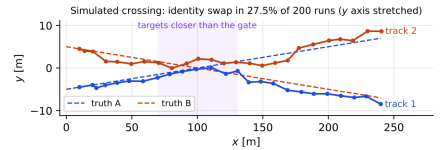
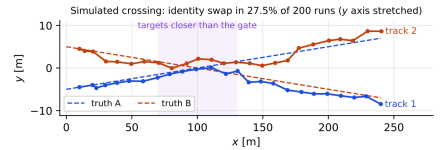
But most of all the real issue there could be associating data from different sensors for the same object. And there are many targets flying in teh close proximity e.g. in a furball. Tracking algorithms struggle here the most. This criss-crossing of the targets lead to tracking instability and new ids are constantly getting assigned to the new targets born thereof.

A way here is to use the radar returns (detections) from different radars, but that is not available.

Unless this ping-pong tracking issue is reliably solved, you cannot launch an interceptor in such a situation lest you have a heart for fratricide.

4. Pilots skill level and data presentation:
All the AI augmented targeting is use less if the operator is not well versed with type and quality of the incoming fused targeting data and how to use it. Likewise the way the data is presented to the shooters is also very important. A most likely AI based HUD cue should be more like: Hostile Rafale, 92% confidence, last updated 1.4 second ago, recommended shooter Falcon 3. There should be no confusion here.


Thats my take on the use of AI in exercises or in the live combat.

Happy to hear the feedback.
 
So an addition to the above:
May be AI augmented tracking could help solve this ping-pong tracking for T2TF.Thats is, instead of relying on the history based MTT algos e.g. MHT or RFS based methods like PMBM filters ( but those are detection level methods. If their T2T equivalents could be reliably implemented in the real time at all), DNNs could be trained specifically to use the track level signatures of the targets in exercises which could later be used in the real combat.

My two cents here.
 
So an addition to the above:
May be AI augmented tracking could help solve this ping-pong tracking for T2TF.Thats is, instead of relying on the history based MTT algos e.g. MHT or RFS based methods like PMBM filters ( but those are detection level methods. If their T2T equivalents could be reliably implemented in the real time at all), DNNs could be trained specifically to use the track level signatures of the targets in exercises which could later be used in the real combat.

My two cents here.
@Signalian
1794052191396.png
 

Attachments

  • 1794052176994.png
    1794052176994.png
    81 KB · Views: 0
@Signalian Sorry for the late reply. Was caught up with work, family. You know :)

Barring the enhanced EW suite and Digital FLCS for Blk 52s, they mostly bring the same capabilities to the battlefield as far as PAF is concerned.

But if you talk about using AI based decision making augmentation, then it would be based on the following characteristics:
  • Basic BFM performance
  • Threat reactions (ECM/ESM/ECCM)
  • Missile employment doctrine
  • Fuel management logic

The F-16A/B MLued and C/D would generally use very similar values. Though C/D is a heavier aircraft which limits is carefree employment as you would have for A/B. But having a digital FLCS is an advantage in energy management in general.

Now any AI augmentation would not rely on TDL data from F16s manning CAP stations/in the air alone. Instead any such digital aid would have the data access to the radar pictures from all different platforms, GCI radars, C2s airborne etc. Even drones flying far ahead of the formation doing emiiter localization and other EW activities would also chuck into the picture.

The task is to have low enough latency, high enough data rate for al different TDLs, fast enough translation before the data enters the deeply buried underground data fusion centers running the AI fusion, threat assesments and generating targeting/evasion cues, which are timely disseminated to all the blue guys.

If I were to list the challanges, those would be along these lines:

1. Data normalization
Every sensor speaks a different language. Link 16, Link 17, UAV links, GCI feeds, AWACS tracks, Passive radars etc. All data should be translated to a common tracking language. As the luck would have it, the sensor data fusion is my bread and butter though not in the Defence, so I know the challenges all too well.

2. Latency management
What use is the data from Mach 0.8/1.4 flying a/c if it is delayed. So the communication has to be real fast, reliable and secure and robust to the EW attacks

3. Actuall Tracking
So this is where the advanced multi object/target tracking (MOT) algorithms and Sensor data fusion comes into the picture. The issue is, different tracking systems onboard a/c etc. have their own implementations of the tracking algorithms. Then the data available at the output interface could be different for different systems. Its not like you get into the measurement update/association module inside the trackers and define your own signals to be put to the output interface. Instead you have to work with what you aleady have on the track interface. So we are taling about the Track to Track fusion (T2TF) instead of the detection level fusion which is information richer and much more controllable.

Then the correlation between different sensors is also unknown. Since we are talking about fusing tracked estimates and not raw data this becomes an important topic.

But most of all the real issue there could be associating data from different sensors for the same object. And there are many targets flying in teh close proximity e.g. in a furball. Tracking algorithms struggle here the most. This criss-crossing of the targets lead to tracking instability and new ids are constantly getting assigned to the new targets born thereof.

A way here is to use the radar returns (detections) from different radars, but that is not available.

Unless this ping-pong tracking issue is reliably solved, you cannot launch an interceptor in such a situation lest you have a heart for fratricide.

4. Pilots skill level and data presentation:
All the AI augmented targeting is use less if the operator is not well versed with type and quality of the incoming fused targeting data and how to use it. Likewise the way the data is presented to the shooters is also very important. A most likely AI based HUD cue should be more like: Hostile Rafale, 92% confidence, last updated 1.4 second ago, recommended shooter Falcon 3. There should be no confusion here.


Thats my take on the use of AI in exercises or in the live combat.

Happy to hear the feedback.
Looking at the 4 issues you highlighted:


1. Translating Link 16, Link 17, and various UAV feeds into a single common tracking language in real-time is a massive software hurdle. Since these data links could use different message formats and coordinate systems, so:

Q: How do you build a translation layer that doesn't introduce massive computational overhead or corrupt the precision of the kinematic data?

2. At Mach 1.5, a jet travels about half a Km every second, making network lag problematic. To process this in a deeply buried underground data center, the data has to travel down to the some DB, get fused by the AI, and travel back up to the cockpit.

Q: Do you think a centralized underground AI architecture is even viable for active dogfights, or will we be forced to push 'edge-computing' AI directly onto the AWACS and fighter jets to survive EW jamming?

3. This is another technical hurdle. Working strictly with the aircraft's output track interfaces instead of raw detections means we are trying to fuse someone else's mathematical assumptions. When multiple targets cross paths in a furball and IDs start ping-ponging, so:

Q: What specific algorithms or heuristics do you think would work best to calculate cross-correlation and stabilize track identities without causing a high risk of fratricide?

4. An AI is only as good as the pilot's willingness to trust it. If the HUD displays a slick cue like 'Hostile Rafale, 92% confidence', there is a massive risk of 'automation bias' where the pilot blindly fires.

Q: How should the AI communicate its own uncertainty or a sudden drop in track stability so the pilot knows exactly when to override the system?"
 

Users who are viewing this thread

Pakistan Defence Latest

Back
Top