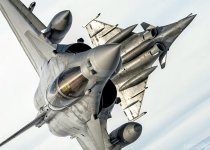
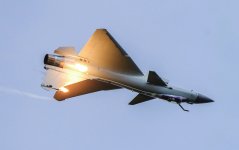
Why would Egypt buy J-10Cs shortly after purchasing Rafales? The deliveries are expected to begin this year.
To throw in the J-10C in arguments is like trying to cover up the fact that Egypt chose Rafales over J-10Cs.
The Egyptian Air Force is large and Egypt follows a policy of diversifying weapons sources so that it is not pressured by one of the suppliers.
The West supports Israel and will be against Egypt in the event of any war with it.
The diversity of fighters means the diversity of backward capabilities and ammunition.
Economically, Egypt cannot rely on 100 Rafale fighters in its air force. The cost of one plane is $150 million. It is ultimately a fourth-generation fighter and not all missions require a fighter like the Rafale.
One of the reasons is that the Russians were unable to develop the MIG-35 aircraft at the required level appropriate to Egyptian needs.
Suppliers cannot meet Egypt's full needs at the appropriate times due to the busy production lines.
There are many factors that led Egypt to turn to J-10C fighters. They represent a light aircraft for Egypt and represent the best price for performance, diversity, and low cost of its ammunition and diversity.
J-10C is developable.
UPGRADE Potential for J-10C:
certain modifications could reduce its radar cross-section (RCS). These might include:
Incorporating radar-absorbent materials (RAM) into critical areas like the engine intake, cockpit, and leading edges.
Redesigning some external features to minimize radar reflection.
The possibility of developing sensor fusion capabilities to provide higher capabilities
Enhancing the J-10C’s sensor fusion capabilities by integrating more sophisticated data processing algorithms and artificial intelligence (AI) to improve the pilot’s ability to interpret and act on sensor data quickly.
Upgrading the AESA radar to have greater range, resolution, and multi-function capabilities, including electronic attack modes.
Possibility of updating
IRST (Infrared Search and Track) systems, to provide passive detection capabilities that complement the radar and mitigate help the risk of being jammed or decoyed.
The software package includes PL-15 production
Continuing to refine and extend the range and performance of the PL-15 or developing even more advanced long-range missiles with enhanced seekers and counter-countermeasures (CCM).
Exploring hypersonic missile technologies
Availability of capabilities to improve performance
Electronic Warfare (EW) and Countermeasures
The ability to improve
Enhancing the J-10C’s ability to operate in an electromagnetic spectrum environment by improving its radar warning receivers (RWRs), electronic support measures (ESM), and electronic countermeasures (ECM).
Enhancing the J-10C’s datalink capabilities to allow for real-time information sharing with other friendly assets.
Developing secure communication channels and ensuring seamless interoperability with other platforms, such as unmanned aerial vehicles (UAVs) and command centers.
Implementing AI-driven decision support systems to help the pilot process and act on battlefield information quickly and accurately.
All this is being studied with the possibility of working with UAV and early warning aircraft.
At a cost of 1/3 of obtaining a fighter like the Rafale, it provides Egypt with financial resources by integrating fifth-generation fighters while maintaining the number of fighters for the theaters of operations facing Egypt, whether in the eastern Mediterranean, Libya, or the sources of the Nile. Also, Egypt does not depend on one camp, eastern or western.
Egypt will also turn to Chinese fifth-generation fighters. for secnd stage