Navigation
Install the app
How to install the app on iOS
Follow along with the video below to see how to install our site as a web app on your home screen.
Note: This feature may not be available in some browsers.
More options
Style variation
You are using an out of date browser. It may not display this or other websites correctly.
You should upgrade or use an alternative browser.
You should upgrade or use an alternative browser.
PAF J-10CE News, Updates and Discussion
- Thread starter amuqeetk
- Start date
- Status
- Not open for further replies.
More options
Who Replied?


Fatman17
THINK TANK: CONSULTANT
Promoted Content

Promoted Content
Flawless Kill Chain: Pakistan’s Networked Strike Took Down Indian Fighter, Says U.S. Analyst
Michael Dahm, Senior Fellow at the Mitchell Institute for Aerospace Studies, noted in an interview with Air & Space Forces Magazine that Pakistan's operational ability to establish a coherent “kill chain” under combat conditions has emerged as a defining feature of its air warfare doctrine.
ImageEnglishInternationalNews[COLOR=rgba(0, 0, 0, 0.44)]By adminhttps://defencesecurityasia.com/en/author/dsa-a/ [COLOR=rgba(0, 0, 0, 0.44)]Last updated Jun 20, 2025
[/COLOR]
Pakistan's AEWC aircraft ZDK-03
Share
(DEFENCE SECURITY ASIA) — In a dramatic shift that has reverberated through strategic circles in South Asia, a leading American aerospace analyst has highlighted Pakistan’s successful integration of its Chinese-supplied weapon systems and radar networks as a critical factor in its recent air superiority over India.
Michael Dahm, Senior Fellow at the Mitchell Institute for Aerospace Studies, noted in an interview with Air & Space Forces Magazine that Pakistan’s operational ability to establish a coherent “kill chain” under combat conditions has emerged as a defining feature of its air warfare doctrine.
According to Dahm, “Pakistan is capable of integrating ground-based radars with fighter jets and airborne early warning aircraft,” a statement that underscores the growing operational sophistication of the Pakistan Air Force (PAF).
He added, “The Pakistani Air Force deployed… ‘A’ launched by ‘B’ and guided by ‘C’, hitting its intended target,” referencing a detailed May 12 report by China Space News, a publication closely affiliated with China’s defence-industrial complex.
The success of this kill chain, Dahm explained, is less about platform-versus-platform comparisons and more about how well each element—from sensor to shooter—is fused into a networked, real-time engagement loop.
In modern high-velocity conflict environments, where milliseconds can determine mission success or failure, the concept of the kill chain—an end-to-end cycle of detection, identification, tracking, targeting, engagement, and battle damage assessment—has become the heartbeat of 21st-century military operations.
Each stage of the kill chain is now supported by a vast architecture of ISR (Intelligence, Surveillance, and Reconnaissance) assets, satellite links, high-speed data networks, and increasingly autonomous fire-control systems driven by artificial intelligence.
J-10C with PL-15
In the context of the Pakistan-India confrontation, Dahm believes the sequence likely began with a ground radar or air defence system detecting an Indian Air Force aircraft entering contested airspace.
The radar cue was then transmitted to a forward-operating J-10C, Pakistan’s newest 4.5-generation multirole fighter acquired from China, which promptly launched a long-range beyond-visual-range (BVR) missile toward the target.
Guidance during the missile’s midcourse phase was reportedly handled by an airborne early warning and control (AEW&C) platform—most likely the KJ-500—using encrypted datalinks to adjust missile trajectory for maximum probability of kill.
“It was a long-range, Beyond Visual Range shot, likely using the export variant PL-15E,” Dahm said, referring to one of China’s most formidable air-to-air missile systems, now fielded by both China and Pakistan.
According to Pakistani defence sources, one J-10C is believed to have successfully downed an Indian Air Force Rafale from a distance of 182 kilometers using a PL-15 missile—what some defence observers have called the longest recorded air-to-air kill in military aviation history.
While independent verification of the kill distance remains elusive, the PL-15 missile—developed by the China Airborne Missile Academy (CAMA)—has emerged as a strategic equalizer to Western analogues like the AIM-120D AMRAAM and the European Meteor.
With its dual-pulse motor and active radar seeker, the PL-15 is capable of engaging agile airborne targets well beyond 200 kilometers, placing it firmly in the elite category of long-range BVR munitions.
PL-15E Beyond Visual Range Air-to-Air Missile (BVRAAM)
Promoted Content
The kill chain demonstrated by Pakistan mirrors the U.S. military’s Combined Joint All-Domain Command and Control (CJADC2) doctrine, a next-generation warfare concept designed to unify land, air, sea, space, and cyber assets into a seamless decision-making web.
“If and when we learn more about the specific engagement details, it may reveal how well Pakistan has achieved systems integration—especially when compared to India’s fragmented approach,” Dahm said.
He also noted that Pakistan has likely converted some of its Chinese-supplied AEW&C aircraft into dedicated electronic warfare (EW) platforms, though it remains unclear whether electromagnetic manipulation played a role in the recent engagement.
Dahm cautioned against simplistic narratives that pit Chinese hardware directly against Western systems, stating, “What does this say about Chinese technology versus Western technology? Probably not a whole lot.”
“But it probably says a lot more about systems of systems, about training, about tactics … about all of those difficult-to-quantify things,” he emphasized, arguing that organisational cohesion and tactical doctrine often matter more than raw specifications.
Dahm also highlighted the structural disadvantage faced by the Indian Air Force (IAF), which, despite its numerical advantage, operates a fleet composed of disparate technologies sourced from France, Russia, Israel, and domestic programs—each with different data architectures, communication protocols, and EW systems.
Pakistan’s JF-17 with PL-15
India’s Platform Diversity: Strategic Asset or Tactical Liability?
The IAF’s frontline inventory includes French Rafales, Russian Su-30MKIs and MiG-29s, Anglo-French Jaguars, Indian-built Tejas fighters, and Mirage 2000s—all running incompatible avionics and fire-control suites.
This fragmentation complicates real-time data sharing, sensor fusion, and cross-platform targeting—a core requirement for any fully functional kill chain in modern air warfare.
Even basic tactical datalinks are non-standard, with Russian Su-30MKIs and French Rafales requiring third-party integration modules to communicate in real time, causing latency and vulnerability in time-sensitive operations.
The use of diverse missile ecosystems—AIM-132 ASRAAM, R-77, Meteor, Astra—further adds to the logistical and targeting complexity, requiring separate maintenance, storage, and command protocols.
This diversity, once viewed as a hedge against over-dependence, is increasingly becoming a structural liability in an era where speed, automation, and interoperability dominate the battlespace.
India’s air doctrine still lacks a fully digitized combat cloud architecture, making it harder to coordinate multi-platform, multi-domain operations with the same speed and precision as adversaries like Pakistan or China.
Pakistan’s Streamlined Airpower: A Template for Networked Warfare
Pakistan, in contrast, has adopted a more focused and integrated strategy, aligning its air combat doctrine around platforms sourced predominantly from China and the U.S., resulting in minimal compatibility friction.
The JF-17 Thunder and J-10C both employ Chinese-made AESA radars, EW systems, and datalinks that allow seamless information exchange with KJ-500 AEW&C platforms and ground-based radar networks.
This homogeneity allows Pakistan to operate a streamlined “sensor-to-shooter” loop with minimal latency—detection from radar, cueing by AEW&C, and immediate engagement by fighters—all linked within the same electronic warfare and data-sharing architecture.
Such a model enables not just faster reaction times, but also greater survivability and situational awareness for frontline pilots and commanders.
Saab 2000 Erieye AEWC
Chinese-designed systems like the PL-15 are fully integrated into this ecosystem, with data relays, midcourse guidance, and kill assessments occurring within a single sovereign digital domain—limiting vulnerability to spoofing, jamming, or inter-platform data loss.
Pakistan’s focus on a coherent kill chain doctrine was evident in the air battle now under scrutiny, which involved the orchestrated use of ground radars, AWACS, BVR missiles, and strategic targeting of high-value enemy assets at long range.
With China acting as both supplier and systems architect, Pakistan benefits from plug-and-play military packages where software, hardware, training, and tactical doctrine are delivered as an integrated suite.
This stands in stark contrast to India’s piecemeal defence procurement strategy, where platforms are often acquired first and integration solutions sought later—causing long delays, cost overruns, and operational incompatibilities.
In the age of fifth-generation warfare, where victory hinges on speed, automation, and data fusion, Pakistan’s kill chain-centric model offers a decisive edge in any future aerial confrontation in South Asia.
© 2025 - Defence Security Asia. All Rights Reserved.


Jinn Baba
Registered Member

Guidance during the missile’s midcourse phase was reportedly handled by an airborne early warning and control (AEW&C) platform—most likely the KJ-500—using encrypted datalinks to adjust missile trajectory for maximum probability of kill.
The JF-17 Thunder and J-10C both employ Chinese-made AESA radars, EW systems, and datalinks that allow seamless information exchange with KJ-500 AEW&C platforms and ground-based radar networks.
KJ500?
He also noted that Pakistan has likely converted some of its Chinese-supplied AEW&C aircraft into dedicated electronic warfare (EW) platforms, though it remains unclear whether electromagnetic manipulation played a role in the recent engagement.
ZDK-03 upgrades / change of use?
Fatman17
THINK TANK: CONSULTANT
I've heard about ZDK-03 new roles. It's confirmed nowKJ500?
ZDK-03 upgrades / change of use?

Is a another J-10C order on the cards? Because if PAF gets all the aircraft it has on order currently it would still leave 1 squadron flying legacy aircraft, also what's the plan for the Non MLU/52 F-16s?
RafaleSlayer
Registered Member
AlhamdulillahGo and check the website of Dassault, they show Rafale as "Combat Proven".......examples of combat proven, syria, libya all the bullshit countries.
The day rafale faced an equally tech enabled battlefield, all that FSO and Spectra EW bullshit bit the dust.
PAF can pretty much take on any European fighter at the moment.
Lahowla Wala Quwwata illa Billah
Attachments



Psyko70
Trusted Member
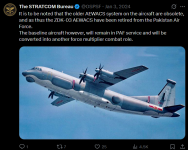
Hello sir, as soon as we ordered new Saab 2000, zdk 03 was to be shifted to Intelligence and EW role. it was discussed in older PDF.I've heard about ZDK-03 new roles. It's confirmed now
Why haven't there been photos of the changed ZDks?Hello sir, as soon as we ordered new Saab 2000, zdk 03 was to be shifted to Intelligence and EW role. it was discussed in older PDF.
Psyko70
Trusted Member
I dont know but I remember the complaints about performance of ZDK 03 to Saab 2000.Why haven't there been photos of the changed ZDks?
.
also in 2024 finally we shifted them to another role.
Attachments

Michael
VIP Member

Before the “5.7 Air Battle,” many Pakistanis may have supported the PAF continuing to purchase additional SAAB Erieye AEW&C systems.Hello sir, as soon as we ordered new Saab 2000, zdk 03 was to be shifted to Intelligence and EW role. it was discussed in older PDF.
After the “5.7 Air Battle,” if you still support the PAF purchasing additional SAAB Erieye AEW&C systems, then you need to learn more.
For the PAF, the biggest issue with the SAAB Erieye AEW&C is that it cannot guide any Chinese-produced missiles.

Tariq Habib Afridi
Registered Member

when are we getting the remaining 16 J-10CE?

iblini
Trusted Member

I think the Swedish and Chinese may have some back door cooperation to solved the issue, their Erieye did functioned with the Chinese jets.Before the “5.7 Air Battle,” many Pakistanis may have supported the PAF continuing to purchase additional SAAB Erieye AEW&C systems.
After the “5.7 Air Battle,” if you still support the PAF purchasing additional SAAB Erieye AEW&C systems, then you need to learn more.
For the PAF, the biggest issue with the SAAB Erieye AEW&C is that it cannot guide any Chinese-produced missiles.
Tariq Habib Afridi
Registered Member
yes because we didnt used ZDK-03 then the only awacs left with pakistan to use are SAAB and i guess we did guided the PL-15 using AWACSI think the Swedish and Chinese may have some back door cooperation to solved the issue, their Erieye did functioned with the Chinese jets.
The Erieyes were the ones guiding the PL-15s through the Pakistani datalinkBefore the “5.7 Air Battle,” many Pakistanis may have supported the PAF continuing to purchase additional SAAB Erieye AEW&C systems.
After the “5.7 Air Battle,” if you still support the PAF purchasing additional SAAB Erieye AEW&C systems, then you need to learn more.
For the PAF, the biggest issue with the SAAB Erieye AEW&C is that it cannot guide any Chinese-produced missiles.
- Status
- Not open for further replies.
Users who are viewing this thread
Total: 1 (members: 0, guests: 1)
Pakistan Defence Latest
-
 Federal cabinet gives nod to imposition of emergency in KP; summary sent to president (13 Viewers)
- Latest: prothought
-

-
-

-
Country Watch Latest
-
 Iran - Israel/US War: Israel-US declare war on Iran, Iran responds (154 Viewers)
- Latest: shapurzolaktaf
-

-

-

-
 China just proved it can cripple the US military in days Now Trump is furious (5 Viewers)
- Latest: HERO
Latest Posts
-
Iran - Israel/US War: Israel-US declare war on Iran, Iran responds (154 Viewers)
- Latest: shapurzolaktaf
-

-
-
-
