PAF J-35AE - News, Updates and Discussions

Absolutely true.

they will target transport. passenger, surveillance and any unarmed slow plane to avenge their humiliation.

they might set their own ambush as well to score just one F16 or J10..
so we have to Absolutely concentrate on training and preparing for next war.

Yes, we cannot afford to be too complacent.

India will most likely act as Trump's rabid dog again, and attacking Pakistan and China's doorstep of its western frontier.

I have the feeling that their next ambush attack might be multi-dimensional warfare not just from the sky, also from the sea.

That's why I have suggested in the naval section that Pakistan should start to acquire the destroyers and mini nuclear subs from China in the near future.

But that we should leave the discussion in the neighboring section.
 
Keep in mind that many Chinese Netizens have absolutely zero context on what the PAF is and is not capable of or systems wise and assume it is another Sudan.
Partially also due to lack of information within their own circles and echo chamber impact.
Ah , the privilege of being a mod , you said the same thing I said earlier and got 7 thumbs 👍... it's just a light hearted banter , don't get offended.
 
Last edited:

CategoryTAI KAAN (Turkey)Shenyang J-35A / Naval (China)
Operational StatusIntensive Prototyping (P0, P1, P2); serial production deliveries set for 2030-2033.Serial Production (J-35A); Naval variant (J-35) undergoing carrier trials on the Fujian.
Weight ClassHeavyweight: ~34,000 kg MTOW. Roughly the size of an F-22 Raptor.Mediumweight: ~28,000 kg MTOW. Roughly the size of an F-35.
Propulsion (2026)2x GE F110-GE-129 (Initial). Developing indigenous TF-35000 for 2030s.2x WS-21 (Current production); WS-19 in testing for supercruise capability.
Primary WeaponsMeteor (BVR), Gökhan (Ramjet), SOM Cruise Missiles, Gökdoğan/Bozdoğan.PL-15 (BVR), PL-10 (High-off-boresight), LD-8A (Anti-radiation).
Radar & SensorsASELSAN MURAD-600A AESA; Integrated RF System (IRFS) for electronic warfare.Chinese AESA (KLJ-7A series); EOTS (Electro-Optical Targeting) under nose.
Internal Capacity8 internal hardpoints (Deep bays for heavy munitions).6 internal hardpoints (Optimized for air-to-air missiles).
Loyal WingmanDeep integration with ANKA-3 (Stealth UCAV) and Kizilelma.Integrated with FH-97A or GJ-11 stealth drones.
Missile Loadout Comparison (2026 Status)


Missile CategoryShenyang J-35 (China)TAI KAAN (Turkey)
Primary BVR (Standard)PL-15E: Dual-pulse rocket, ~200 km range.Gökdoğan (BVRAAM): Data-link enabled, ~100 km range.
Long-Range / RamjetPL-17: Ultra-long range (400+ km) "AWACS killer."Gökhan: Ramjet-powered (Meteor equivalent), ~150+ km range.
Short-Range (WVR)PL-10E: High-off-boresight, IR-guided, thrust vectoring.Bozdoğan (WVRAAM): High maneuverability, IR-guided.
Anti-Radiation / SEADLD-8A: Compact, designed for internal stealth carriage.AKBABA: Indigenous anti-radiation missile (under development).
Cruise MissileAKF-98A: Stealthy standoff missile (External).SOM-J: Optimized for internal bays, ~275 km range.
Precision / SDBLS-6 / FT series: Satellite/Laser-guided small bombs.TOLUN / KUZGUN-TJ: Small Diameter Bombs, ~110 km range.
Internal Capacity4 to 6 missiles (e.g., 4x PL-15 or 2x PL-17 + 2x PL-10).8 missiles (4x heavy BVR in main bays + 4x medium/WVR in side/main bays).
Deep Analysis: Radar & Sensor Suites


FeatureTAI KAAN: ASELSAN MURAD-600AShenyang J-35: Advanced GaN AESA
Technology BaseGaN (Gallium Nitride) on SiCGaN (Gallium Nitride)
T/R Module Count~2,000+ modules (Estimated)~1,700 – 1,900 modules (Estimated)
Detection Range~300+ km (Large targets) / ~180 km (Fighter-sized)~250+ km (Large targets) / ~150 km (Fighter-sized)
ArchitectureSoftware-Defined / Digital BeamformingIntegrated RF System (Digital)
Special ModesLPI (Low Probability of Intercept), NCTR, High-Res SARLPI, Multi-Target Tracking, Electronic Attack
Field of Regard240°+ (With side-looking cheek arrays)120° – 140° (Standard nose cone)
Cooling SystemLiquid-Cooled (High Power Density)Liquid-Cooled (Compact for Carrier Ops)
Secondary SensorsTOYGUN EOTS + KARAT IRSTEOTS-86 (Under-nose) + IRST

Summary: Who Wins the Radar War?​

The TAI KAAN likely has the raw power advantage. Its larger nose and side-cheek arrays give it more "vision" and more energy to push through jamming. It is a "Quarterback" radar.

The J-35 has the maturity and stealth advantage. Its radar is more integrated into a combat-proven digital ecosystem and is designed to stay "quiet," using its advanced EOTS to find targets without ever turning the radar on.

Thanks Gemini
 
Air-to-Ground Weaponry: Side-by-Side Comparison


CategoryTAI KAAN (Turkey)Shenyang J-35 (China)
Stealth Standoff MissileSOM-J: ~275 km range. Designed specifically for internal carriage.AKF-98A: ~250–500 km range. Stealthy, usually external but folding-wing versions for internal bays exist.
Anti-Radiation (SEAD)AKBABA: (In development) Indigenous ARM to hunt radars.LD-8A: Miniaturized ARM. Confirmed for internal carriage (up to 6 units).
Precision Glide BombsKUZGUN-SS: Glide variant (~110 km). HGK/KGK winged bomb kits.CM-506KG: Small diameter glide bomb (~130 km). LS-6 series.
Turbojet / SupersonicKUZGUN-TJ: Turbojet-powered (~180 km).HD-1A: Supersonic cruise missile (External/Beast Mode only).
Bunker BustersSARB-83 / SERT-82: Concrete piercing bombs.500kg Deep Penetration variants (External).
Internal CapacityDeep Bays: Can carry 2x SOM-J or 4-8x KUZGUN/SDBs.Shallow/Medium Bays: Can carry 6x LD-8A or CM-506KG.
"Beast Mode" Max Load~8,000 kg+ (Internal + 10 hardpoints).~8,000 kg (Internal + 6–8 hardpoints).

Summary: Which is the better "Bomber"?​

  • Pick the TAI KAAN if you need to strike a fixed, hardened strategic target (like a bunker or bridge) from long range while remaining completely stealthy. Its larger internal volume is its winning feature.
  • Pick the Shenyang J-35 if you are fighting a modern air defense network. Its ability to carry multiple anti-radiation missiles internally makes it the superior "Wild Weasel" for clearing the way for other aircraft.
 
Ah , the privilege of being a mod , you said the same thing I said earlier and got 7 thumbs 👍... it's just a light hearted banter , don't get offended.
Why would I get offended about something I don’t give a qaim ali shah about?
I know what I know and say what I say if I deem it accurate - someone likes or doesn’t like it is irrelevant.

If someone can prove me wrong I am happy to be - provided they bring evidence whether immediately or later.

I use that learning to shape my own understanding.

I don’t play a near thousand element Command Modern Operations simulation because people online will like it - I play it because I am a military geek and like problem solving/systems thinking. It’s enjoyment, not egoism.

The whole chasing likes or being jealous of them is a immortality project issue.

The only place where I will find annoying is someone passing off technical terms as actual knowledge or spamming something they heard to get “mashoori” which is every other YT and C poster because it spread further flawed understanding.

lol
Log mod aur aik anonymous forum ki hasrat mein paray howe hain jaise ye koi dunya kya alkhirat mein kaam ane wali cheez hai,

It would make sense if it was actually real names and earnings associated with it like for poor Tom Cooper.
 
Why would I get offended about something I don’t give a qaim ali shah about?
I know what I know and say what I say if I deem it accurate - someone likes or doesn’t like it is irrelevant.

If someone can prove me wrong I am happy to be - provided they bring evidence whether immediately or later.

I use that learning to shape my own understanding.

I don’t play a near thousand element Command Modern Operations simulation because people online will like it - I play it because I am a military geek and like problem solving/systems thinking. It’s enjoyment, not egoism.

The whole chasing likes or being jealous of them is a immortality project issue.

The only place where I will find annoying is someone passing off technical terms as actual knowledge or spamming something they heard to get “mashoori” which is every other YT and C poster because it spread further flawed understanding.

lol
Log mod aur aik anonymous forum ki hasrat mein paray howe hain jaise ye koi dunya kya alkhirat mein kaam ane wali cheez hai,

It would make sense if it was actually real names and earnings associated with it like for poor Tom Cooper.
I was expecting a light hearted reply , not this punishing post.
 
if they are for different roles.. then it makes sense for someone with sufficient funds to have them both.
just like any airforce has a mix of jets that fill a specific role they excel and have some overlapping supporting roles.
multi role, strike, air superiority , SEAD?

intent is not a dick measure but realistic insight how a country with limited defence budget (17% .. not 70% as some Butt hurt aholes claim) has to spread in all three branches navy airforce and army.
The reason is simple, J35s are Chinese planes and we cannot co produce the fighter jet parts or incorporate Pakistan or foreign missiles/systems on it but with Kaan we maybe able to by the Turks, so this means some Kaan parts will be produced in Pakistan, plus our own missiles etc. Kaan is also heavier plane so more range, load etc. Anyways if it happens it will be after 2040s and by then we can buy kaan to replace f16s, J35s will replace Jf17s.
 
CategoryTAI KAAN (Turkey)Shenyang J-35A / Naval (China)
Operational StatusIntensive Prototyping (P0, P1, P2); serial production deliveries set for 2030-2033.Serial Production (J-35A); Naval variant (J-35) undergoing carrier trials on the Fujian.
Weight ClassHeavyweight: ~34,000 kg MTOW. Roughly the size of an F-22 Raptor.Mediumweight: ~28,000 kg MTOW. Roughly the size of an F-35.
Propulsion (2026)2x GE F110-GE-129 (Initial). Developing indigenous TF-35000 for 2030s.2x WS-21 (Current production); WS-19 in testing for supercruise capability.
Primary WeaponsMeteor (BVR), Gökhan (Ramjet), SOM Cruise Missiles, Gökdoğan/Bozdoğan.PL-15 (BVR), PL-10 (High-off-boresight), LD-8A (Anti-radiation).
Radar & SensorsASELSAN MURAD-600A AESA; Integrated RF System (IRFS) for electronic warfare.Chinese AESA (KLJ-7A series); EOTS (Electro-Optical Targeting) under nose.
Internal Capacity8 internal hardpoints (Deep bays for heavy munitions).6 internal hardpoints (Optimized for air-to-air missiles).
Loyal WingmanDeep integration with ANKA-3 (Stealth UCAV) and Kizilelma.Integrated with FH-97A or GJ-11 stealth drones.
Missile Loadout Comparison (2026 Status)


Missile CategoryShenyang J-35 (China)TAI KAAN (Turkey)
Primary BVR (Standard)PL-15E: Dual-pulse rocket, ~200 km range.Gökdoğan (BVRAAM): Data-link enabled, ~100 km range.
Long-Range / RamjetPL-17: Ultra-long range (400+ km) "AWACS killer."Gökhan: Ramjet-powered (Meteor equivalent), ~150+ km range.
Short-Range (WVR)PL-10E: High-off-boresight, IR-guided, thrust vectoring.Bozdoğan (WVRAAM): High maneuverability, IR-guided.
Anti-Radiation / SEADLD-8A: Compact, designed for internal stealth carriage.AKBABA: Indigenous anti-radiation missile (under development).
Cruise MissileAKF-98A: Stealthy standoff missile (External).SOM-J: Optimized for internal bays, ~275 km range.
Precision / SDBLS-6 / FT series: Satellite/Laser-guided small bombs.TOLUN / KUZGUN-TJ: Small Diameter Bombs, ~110 km range.
Internal Capacity4 to 6 missiles (e.g., 4x PL-15 or 2x PL-17 + 2x PL-10).8 missiles (4x heavy BVR in main bays + 4x medium/WVR in side/main bays).
Deep Analysis: Radar & Sensor Suites


FeatureTAI KAAN: ASELSAN MURAD-600AShenyang J-35: Advanced GaN AESA
Technology BaseGaN (Gallium Nitride) on SiCGaN (Gallium Nitride)
T/R Module Count~2,000+ modules (Estimated)~1,700 – 1,900 modules (Estimated)
Detection Range~300+ km (Large targets) / ~180 km (Fighter-sized)~250+ km (Large targets) / ~150 km (Fighter-sized)
ArchitectureSoftware-Defined / Digital BeamformingIntegrated RF System (Digital)
Special ModesLPI (Low Probability of Intercept), NCTR, High-Res SARLPI, Multi-Target Tracking, Electronic Attack
Field of Regard240°+ (With side-looking cheek arrays)120° – 140° (Standard nose cone)
Cooling SystemLiquid-Cooled (High Power Density)Liquid-Cooled (Compact for Carrier Ops)
Secondary SensorsTOYGUN EOTS + KARAT IRSTEOTS-86 (Under-nose) + IRST

Summary: Who Wins the Radar War?​

The TAI KAAN likely has the raw power advantage. Its larger nose and side-cheek arrays give it more "vision" and more energy to push through jamming. It is a "Quarterback" radar.

The J-35 has the maturity and stealth advantage. Its radar is more integrated into a combat-proven digital ecosystem and is designed to stay "quiet," using its advanced EOTS to find targets without ever turning the radar …
Are you serious? Are all the fancy numbers representing KAAN features in your table even field tested( let alone certified), or these numbers are best described as “wishful expectations “ on paper or ppt at this stage? Your argument of using paper numbers of a KAAN against those of J35 already extensively tested and fully fielded today, really lowers the quality of debate in this board.

All industry powerhouses such as US , China, who underwent the full circle of developing the entire ecosystem of their indigenous military jets, know very well how difficult to achieve your paper features of KAAN, let alone the shortest development periods I even seen. So hoping using KAAN as a bargaining chip for procurement of a induced true 5th fighter never works for the industry powerhouse sellers who understand every technical details of your numbers presented for arguing, unlike those who never develop their integrated aviation industries, thus readily be scammed.

To prevent scams, US simply cut the supply of their 1990 era F110-129 engines which until now cannot be produced as an equivalent in Turkey, effectively killing the KAAN. It took Chinese >30 years to develop F110 equivalent turbofan engines that nowadays reliably power fighters like J10C, and almost 20 years to develop F119 equivalent of WS15, excluding the time spent for its core engine( Chinese WS10 turbofans share the same core engine of F110). Yet turkey dare to claim their WS15 equivalent be fielded in less than 10 years, from paper to reality. They dare to declare but where are turkey’s single crystal blade technology and facilities? Industrial capacity such as hyper forge machines for processing the parts?

The same stories go to their paper Aesa radars and other microwave, wind tunnels, flying test beds, electronics that are essential to develop features such as stealth, aerodynamics, engines that claimed by KAAN as a 5th generation fighter and accompanied advanced paper missiles and munitions.

The well known rule of thumb is a fighter prototype never features more than 50% of prototype subsystems, yet kaan breaks every norm and I’m glad that yanks have shut down the supply of a legacy engine, so that no further victims.
 
Last edited:
Are you serious? Are all the fancy numbers representing KAAN features in your table even field tested( let alone certified), or these numbers are best described as “wishful expectations “ on paper or ppt at this stage? Your argument of using paper numbers of a KAAN against those of J35 already extensively tested and fully fielded today, really lowers the quality of debate in this board.

All industry powerhouses such as US , China, who underwent the full circle of developing the entire ecosystem of their indigenous military jets, know very well how difficult to achieve your paper features of KAAN, let alone the shortest development periods I even seen. So hoping using KAAN as a bargaining chip for procurement of a induced true 5th fighter never works for the industry powerhouse sellers who understand every technical details of your numbers presented for arguing, unlike those who never develop their integrated aviation industries, thus readily be scammed.

To prevent scams, US simply cut the supply of their 1990 era F110-129 engines which until now cannot be produced as an equivalent in Turkey, effectively killing the KAAN. It took Chinese >30 years to develop F110 equivalent turbofan engines that nowadays reliably power fighters like J10C, and almost 20 years to develop F119 equivalent of WS15, excluding the time spent for its core engine( Chinese WS10 turbofans share the same core engine of F110). Yet turkey dare to claim their WS15 equivalent be fielded in less than 10 years, from paper to reality. They dare to declare but where are turkey’s single crystal blade technology and facilities? Industrial capacity such as hyper forge machines for processing the parts?

The same stories go to their paper Aesa radars and other microwave, wind tunnels, flying test beds, electronics that are essential to develop features such as stealth, aerodynamics, engines that claimed by KAAN as a 5th generation fighter and accompanied advanced paper missiles and munitions.

The well known rule of thumb is a fighter prototype never features more than 50% of prototype subsystems, yet kaan breaks every norm and I’m glad that yanks have shut down the supply of a legacy engine, so that no further victims.
This level of bitterness is unwarranted.. maybe some people are a bit optimistic about KAAN , however , it's not a nonstarter either.
 
What are you blabbering about ? " Comprehensive command and control system of its own " ...wth that means ? ...do you think PAF is running without a comprehensive command system ?
Let me share my viewpoint.

We have a saying here: fifth-generation fighters only exist within a system. The basic fifth-generation fighter combat system includes fifth-generation aircraft, unmanned wingman for fifth-generation aircraft (two-seat version), early warning aircraft, electronic warfare aircraft, encrypted data links, satellite encrypted frequencies, long-range early warning radars, ground radars (with stealth detection capability), mobile radars (with stealth detection capability), air defense systems, counter-UAV systems, and ground long-range firepower. Within this system, different combat units are commanded using a unified data link. Currently, Pakistan's control and command centers are built based on fourth-generation aircraft, and Pakistan has basically completed the construction of a fourth-generation aircraft system. There are differences between the definition of fifth-generation and fourth-generation aircraft. If Pakistan does not build command centers capable of using fifth-generation aircraft, it would need to adjust personnel and update equipment in the existing command centers. All combat units within the system need synchronized encrypted data links and satellite encrypted frequencies.

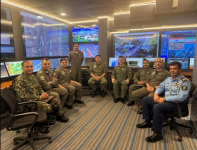
1776566163031.png

This photo is a publicly released image of Pakistan's Air Force joint operations command room. If Pakistan temporarily chooses to use the original Air Force joint operations command room to establish a basic fifth-generation fighter combat system, these devices need to be updated, the command structure needs to be adjusted, and air defense, radar, and counter-UAV combat units need to be added. If Pakistan's procurement is genuine, the issue of air defense, radar, and counter-UAV combat units has already been solved, and the HQ-19 along with Pakistan's existing air defense equipment can meet the tasks of a fifth-generation aircraft combat system. Pakistan only needs to update equipment and adjust the command structure.

What he might mean is to establish a joint combat system. Currently, Pakistan needs to build a combat system that includes fifth-generation aircraft. The fifth-generation aircraft combat system is part of the Air Force combat system, and the Air Force combat system is part of a joint combat system.

China has basically built the largest-scale modern joint combat system.
 
CategoryTAI KAAN (Turkey)Shenyang J-35A / Naval (China)
Operational StatusIntensive Prototyping (P0, P1, P2); serial production deliveries set for 2030-2033.Serial Production (J-35A); Naval variant (J-35) undergoing carrier trials on the Fujian.
Weight ClassHeavyweight: ~34,000 kg MTOW. Roughly the size of an F-22 Raptor.Mediumweight: ~28,000 kg MTOW. Roughly the size of an F-35.
Propulsion (2026)2x GE F110-GE-129 (Initial). Developing indigenous TF-35000 for 2030s.2x WS-21 (Current production); WS-19 in testing for supercruise capability.
Primary WeaponsMeteor (BVR), Gökhan (Ramjet), SOM Cruise Missiles, Gökdoğan/Bozdoğan.PL-15 (BVR), PL-10 (High-off-boresight), LD-8A (Anti-radiation).
Radar & SensorsASELSAN MURAD-600A AESA; Integrated RF System (IRFS) for electronic warfare.Chinese AESA (KLJ-7A series); EOTS (Electro-Optical Targeting) under nose.
Internal Capacity8 internal hardpoints (Deep bays for heavy munitions).6 internal hardpoints (Optimized for air-to-air missiles).
Loyal WingmanDeep integration with ANKA-3 (Stealth UCAV) and Kizilelma.Integrated with FH-97A or GJ-11 stealth drones.
Missile Loadout Comparison (2026 Status)


Missile CategoryShenyang J-35 (China)TAI KAAN (Turkey)
Primary BVR (Standard)PL-15E: Dual-pulse rocket, ~200 km range.Gökdoğan (BVRAAM): Data-link enabled, ~100 km range.
Long-Range / RamjetPL-17: Ultra-long range (400+ km) "AWACS killer."Gökhan: Ramjet-powered (Meteor equivalent), ~150+ km range.
Short-Range (WVR)PL-10E: High-off-boresight, IR-guided, thrust vectoring.Bozdoğan (WVRAAM): High maneuverability, IR-guided.
Anti-Radiation / SEADLD-8A: Compact, designed for internal stealth carriage.AKBABA: Indigenous anti-radiation missile (under development).
Cruise MissileAKF-98A: Stealthy standoff missile (External).SOM-J: Optimized for internal bays, ~275 km range.
Precision / SDBLS-6 / FT series: Satellite/Laser-guided small bombs.TOLUN / KUZGUN-TJ: Small Diameter Bombs, ~110 km range.
Internal Capacity4 to 6 missiles (e.g., 4x PL-15 or 2x PL-17 + 2x PL-10).8 missiles (4x heavy BVR in main bays + 4x medium/WVR in side/main bays).
Deep Analysis: Radar & Sensor Suites


FeatureTAI KAAN: ASELSAN MURAD-600AShenyang J-35: Advanced GaN AESA
Technology BaseGaN (Gallium Nitride) on SiCGaN (Gallium Nitride)
T/R Module Count~2,000+ modules (Estimated)~1,700 – 1,900 modules (Estimated)
Detection Range~300+ km (Large targets) / ~180 km (Fighter-sized)~250+ km (Large targets) / ~150 km (Fighter-sized)
ArchitectureSoftware-Defined / Digital BeamformingIntegrated RF System (Digital)
Special ModesLPI (Low Probability of Intercept), NCTR, High-Res SARLPI, Multi-Target Tracking, Electronic Attack
Field of Regard240°+ (With side-looking cheek arrays)120° – 140° (Standard nose cone)
Cooling SystemLiquid-Cooled (High Power Density)Liquid-Cooled (Compact for Carrier Ops)
Secondary SensorsTOYGUN EOTS + KARAT IRSTEOTS-86 (Under-nose) + IRST

Summary: Who Wins the Radar War?​

The TAI KAAN likely has the raw power advantage. Its larger nose and side-cheek arrays give it more "vision" and more energy to push through jamming. It is a "Quarterback" radar.

The J-35 has the maturity and stealth advantage. Its radar is more integrated into a combat-proven digital ecosystem and is designed to stay "quiet," using its advanced EOTS to find targets without ever turning the radar on.

Thanks Gemini
Air-to-Ground Weaponry: Side-by-Side Comparison


CategoryTAI KAAN (Turkey)Shenyang J-35 (China)
Stealth Standoff MissileSOM-J: ~275 km range. Designed specifically for internal carriage.AKF-98A: ~250–500 km range. Stealthy, usually external but folding-wing versions for internal bays exist.
Anti-Radiation (SEAD)AKBABA: (In development) Indigenous ARM to hunt radars.LD-8A: Miniaturized ARM. Confirmed for internal carriage (up to 6 units).
Precision Glide BombsKUZGUN-SS: Glide variant (~110 km). HGK/KGK winged bomb kits.CM-506KG: Small diameter glide bomb (~130 km). LS-6 series.
Turbojet / SupersonicKUZGUN-TJ: Turbojet-powered (~180 km).HD-1A: Supersonic cruise missile (External/Beast Mode only).
Bunker BustersSARB-83 / SERT-82: Concrete piercing bombs.500kg Deep Penetration variants (External).
Internal CapacityDeep Bays: Can carry 2x SOM-J or 4-8x KUZGUN/SDBs.Shallow/Medium Bays: Can carry 6x LD-8A or CM-506KG.
"Beast Mode" Max Load~8,000 kg+ (Internal + 10 hardpoints).~8,000 kg (Internal + 6–8 hardpoints).

Summary: Which is the better "Bomber"?​

  • Pick the TAI KAAN if you need to strike a fixed, hardened strategic target (like a bunker or bridge) from long range while remaining completely stealthy. Its larger internal volume is its winning feature.
  • Pick the Shenyang J-35 if you are fighting a modern air defense network. Its ability to carry multiple anti-radiation missiles internally makes it the superior "Wild Weasel" for clearing the way for other aircraft.
The entire analysis report contains numerous obvious errors.
For example:

1. Neither the PL-17 nor the AKF-98A is within the carrying range of the J-35 fighter jet.
The J-35's internal weapons bay is unable to accommodate the massive PL-17; carrying it externally would severely compromise the aircraft's stealth capabilities. While technically feasible, such an arrangement holds no practical value in actual combat scenarios.
The AKF-98A is classified as a heavy missile.

2. The J-35 fighter does not possess a standalone IRST; instead, it utilizes an EODAS.

If you want to use an AI tool to seriously answer this question, you need to impose some constraints on the AI.
Here are the constraint prompts that Gemini itself suggested for itself:

Full Constraint Prompt (Pro-Engineering Mode)​

[Core Directive]Act as an Aerospace Systems Engineer. Use Positivism and Physical Reductionism to compare and analyze [Insert Model A] and [Insert Model B].

[Hard Constraints]

  1. Physics-First Logic: All performance evaluations must be grounded in fundamental physical laws (e.g., Radar Cross Section (RCS) principles, Breguet Range Equation, Thrust-to-Weight ratios, and Wing Loading logic). If official specs contradict physical constants, identify the discrepancy and provide a corrected derivation based on engineering logic.
  2. Neutralize Promotional Context: Strictly prohibit the use of emotional, hyperbolic, or politically charged terminology (e.g., "world-leading," "game-changer," "stunning"). Do not treat "planned objectives" or "design goals" as "current operational capabilities."
  3. Source Weighting: Completely ignore speculative claims from mass media, social media, and non-professional influencers. Prioritize: high-resolution imagery of actual aircraft (for OML/detail derivation), aerodynamic schematics, and known performance envelopes of comparable propulsion systems.
  4. Uncertainty Labeling: For data involving classified components or areas where engineering derivation is impossible, leave the field blank or mark it as "Data Missing/Black Box." Do not engage in groundless speculation.
  5. Maturity Lifecycle Assessment: Strictly distinguish between "Technology Demonstrators," "Full-Scale Prototypes," and "Initial Operational Capability (IOC) Production Aircraft." Estimate software integration progress based on maiden flight dates, flight test hours, and industrial supply chain maturity.
[Output Requirements]

  • Dimensions of Comparison: Focus exclusively on hard metrics such as "Platform Energy Characteristics," "Radar Aperture Constraints," "Wave Drag & Structural Limits," and "Signature Treatment Details."
  • Conclusion Bias: Do not declare a "winner." Instead, state: "Under [Specific Physical Constraints], Model A possesses higher redundancy/maturity than Model B in [Specific Area]."
[Current Task]Based on this protocol, analyze: [Insert specific subjects, e.g., The sensor fusion and propulsion matching of KAAN vs. J-35].
 
Last edited:
Let me share my viewpoint.

We have a saying here: fifth-generation fighters only exist within a system. The basic fifth-generation fighter combat system includes fifth-generation aircraft, unmanned wingman for fifth-generation aircraft (two-seat version), early warning aircraft, electronic warfare aircraft, encrypted data links, satellite encrypted frequencies, long-range early warning radars, ground radars (with stealth detection capability), mobile radars (with stealth detection capability), air defense systems, counter-UAV systems, and ground long-range firepower. Within this system, different combat units are commanded using a unified data link. Currently, Pakistan's control and command centers are built based on fourth-generation aircraft, and Pakistan has basically completed the construction of a fourth-generation aircraft system. There are differences between the definition of fifth-generation and fourth-generation aircraft. If Pakistan does not build command centers capable of using fifth-generation aircraft, it would need to adjust personnel and update equipment in the existing command centers. All combat units within the system need synchronized encrypted data links and satellite encrypted frequencies.

View attachment 193121

This photo is a publicly released image of Pakistan's Air Force joint operations command room. If Pakistan temporarily chooses to use the original Air Force joint operations command room to establish a basic fifth-generation fighter combat system, these devices need to be updated, the command structure needs to be adjusted, and air defense, radar, and counter-UAV combat units need to be added. If Pakistan's procurement is genuine, the issue of air defense, radar, and counter-UAV combat units has already been solved, and the HQ-19 along with Pakistan's existing air defense equipment can meet the tasks of a fifth-generation aircraft combat system. Pakistan only needs to update equipment and adjust the command structure.

What he might mean is to establish a joint combat system. Currently, Pakistan needs to build a combat system that includes fifth-generation aircraft. The fifth-generation aircraft combat system is part of the Air Force combat system, and the Air Force combat system is part of a joint combat system.

China has basically built the largest-scale modern joint combat system.
Pakistan doesn't need to match china or America in her comprehensive command and control systems....we have a solid and proven system , incremental improvements will work for us .... condescending analysis aren't welcomed.
 
Pakistan doesn't need to match china or America in her comprehensive command and control systems....we have a solid and proven system , incremental improvements will work for us .... condescending analysis aren't welcomed.
I am not making condescending comments.

I am merely analyzing the changes that command centers would need to make after fifth-generation fighters join the Pakistani military, based on Pakistan's situation. Then I introduced the concepts of the Air Force operational system and the joint operational system.

Pakistan has conducted exercises with China multiple times, and we all need to address the issues that arise. China has established the largest joint operational system, and Pakistan can understand this operational system through joint exercises and then assess whether this operational system can enhance the strength of the Pakistani military. Isn't that a good thing?

I don't know what your accusations are aimed at; they have no basis and seem more like venting your emotions. If you do not wish to communicate, I will avoid your comments in the future.
 
There’s simply no need to discuss the Kaan and the J-35 together.
One is a mass-produced aircraft that has undergone countless tests, while the other is merely a concept aircraft, with all its parameters coming from presentations—how can they be compared?

People seem to have forgotten Iran’s powerful F-14 and the Qaher F313 fighter jet. It doesn’t matter how much you hype them up during peacetime or when no actual war is going on.
 

Users who are viewing this thread

  • Pakistan Defence Latest

    Back
    Top