RescueRanger
Meme Lord

Current snapshot October 11th 2025:
1. Violence along the Pakistan–Afghanistan frontier has escalated sharply in the past week, with multiple high-casualty attacks inside Pakistan (northwest/KPK) and reciprocal accusations of cross-border strikes between Islamabad and Kabul. [Source:https://apnews.com/article/pakistan...khan-taliban-d463f7d66b01979727e3edbd5969ecbf]
2. The Tehreek-e-Taliban Pakistan (TTP) has re-emerged as the main kinetic threat in Khyber Pakhtunkhwa and adjacent border districts; recent large-scale ambushes and a complex attack on a police training facility demonstrate improved operational capability.[Source: https://apnews.com/article/pakistan...khan-taliban-d463f7d66b01979727e3edbd5969ecbf]
3. Baloch separatist groups (BLA/BLF and splinter factions) continue high-impact operations in Balochistan, including temporary seizure of towns and strikes on infrastructure and Chinese-linked CPEC assets. [Source: https://ctc.westpoint.edu/the-baloc...on-tactics-and-regional-security-implications]
4. Islamabad has publicly justified kinetic actions across the border (air/strike claims) against militant targets in Afghanistan; Kabul’s Taliban administration has condemned such strikes — raising risk of wider interstate escalation. [Source:https://www.aljazeera.com/news/2025...abul-as-taliban-make-diplomatic-push-to-india]
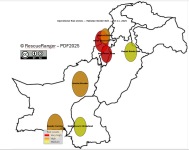
Recent incidents that shape risk (most relevant):
1. Complex attack on police training facility (Ratta Kulachi / Dera Ismail Khan area, KPK) — suicide truck + prolonged firefight; multiple police fatalities and attacker casualties. Demonstrates use of vehicle-borne IEDs and intent to hit large, symbolic training targets. (10 Oct 2025). [Source: https://apnews.com/article/pakistan...khan-taliban-d463f7d66b01979727e3edbd5969ecbf]
2. Ambushes and clashes in north-west / border districts — multiple security-force fatalities (including senior officers) reported in recent days; subsequent Pakistani raids reportedly killed dozens of militants. (9–10 Oct 2025).[Source:https://themedialine.org/headlines/...d-in-clash-with-terrorists-near-afghan-border]
3. Explosions in Kabul / accusations of Pakistani airstrikes — Afghan Taliban accused Pakistan of strikes on Kabul and eastern provinces; Pakistan links militants’ safe havens in Afghanistan to attacks inside Pakistan. This reciprocity raises diplomatic and kinetic escalation risks. (9–10 Oct 2025). [Source: https://www.aljazeera.com/news/2025...abul-as-taliban-make-diplomatic-push-to-india]
4. Sustained Baloch operations in 2025 — seizure of Zehri town (Jan 2025), train hijacking (Mar 2025) and credible documenting of attacks on CPEC projects through 2025 point to continued capability and intent in Balochistan. [Pakistan Institute of Peace Studies monitoring, STAP]
5. Data/incident trends: ACLED and other trackers show hundreds of attacks by TTP and affiliated groups in the past 12 months — an operational tempo well above baseline. [Source: https://acleddata.com/report/battle-borderlands-tehreek-i-taliban-pakistan-challenges-states-control]
Threat picture by area:
Scenarios — plausible short-term trajectories
Sources & further reading:
1. Violence along the Pakistan–Afghanistan frontier has escalated sharply in the past week, with multiple high-casualty attacks inside Pakistan (northwest/KPK) and reciprocal accusations of cross-border strikes between Islamabad and Kabul. [Source:https://apnews.com/article/pakistan...khan-taliban-d463f7d66b01979727e3edbd5969ecbf]
2. The Tehreek-e-Taliban Pakistan (TTP) has re-emerged as the main kinetic threat in Khyber Pakhtunkhwa and adjacent border districts; recent large-scale ambushes and a complex attack on a police training facility demonstrate improved operational capability.[Source: https://apnews.com/article/pakistan...khan-taliban-d463f7d66b01979727e3edbd5969ecbf]
3. Baloch separatist groups (BLA/BLF and splinter factions) continue high-impact operations in Balochistan, including temporary seizure of towns and strikes on infrastructure and Chinese-linked CPEC assets. [Source: https://ctc.westpoint.edu/the-baloc...on-tactics-and-regional-security-implications]
4. Islamabad has publicly justified kinetic actions across the border (air/strike claims) against militant targets in Afghanistan; Kabul’s Taliban administration has condemned such strikes — raising risk of wider interstate escalation. [Source:https://www.aljazeera.com/news/2025...abul-as-taliban-make-diplomatic-push-to-india]
Recent incidents that shape risk (most relevant):
1. Complex attack on police training facility (Ratta Kulachi / Dera Ismail Khan area, KPK) — suicide truck + prolonged firefight; multiple police fatalities and attacker casualties. Demonstrates use of vehicle-borne IEDs and intent to hit large, symbolic training targets. (10 Oct 2025). [Source: https://apnews.com/article/pakistan...khan-taliban-d463f7d66b01979727e3edbd5969ecbf]
2. Ambushes and clashes in north-west / border districts — multiple security-force fatalities (including senior officers) reported in recent days; subsequent Pakistani raids reportedly killed dozens of militants. (9–10 Oct 2025).[Source:https://themedialine.org/headlines/...d-in-clash-with-terrorists-near-afghan-border]
3. Explosions in Kabul / accusations of Pakistani airstrikes — Afghan Taliban accused Pakistan of strikes on Kabul and eastern provinces; Pakistan links militants’ safe havens in Afghanistan to attacks inside Pakistan. This reciprocity raises diplomatic and kinetic escalation risks. (9–10 Oct 2025). [Source: https://www.aljazeera.com/news/2025...abul-as-taliban-make-diplomatic-push-to-india]
4. Sustained Baloch operations in 2025 — seizure of Zehri town (Jan 2025), train hijacking (Mar 2025) and credible documenting of attacks on CPEC projects through 2025 point to continued capability and intent in Balochistan. [Pakistan Institute of Peace Studies monitoring, STAP]
5. Data/incident trends: ACLED and other trackers show hundreds of attacks by TTP and affiliated groups in the past 12 months — an operational tempo well above baseline. [Source: https://acleddata.com/report/battle-borderlands-tehreek-i-taliban-pakistan-challenges-states-control]
Threat picture by area:
A. Pakistan–Afghanistan border (general)
- Threat vectors: Infiltration by small armed units, cross-border fire/raids, movement of explosives/weapons, sanctuary and planning nodes across porous reaches of eastern and southern Afghan provinces.
- Drivers: Taliban-led Afghan administration’s ambiguous approach to Pakistani militants (denial vs differing priorities), rugged terrain and long uncontrolled stretches, political friction (recent diplomatic moves in region). [Source: https://www.reuters.com/world/asia-...ved-attack-that-killed-11-soldiers-2025-10-10]
B. Khyber Pakhtunkhwa (KPK) — highest near-border districts (e.g., North Waziristan, Dera Ismail Khan, Kurram, Orakzai)
- Current risk: Very High for complex attacks (suicide VBIEDs, coordinated assaults on security installations, ambushes on convoys). Recent high-casualty events confirm improved TTP capability and intent. [Source:https://apnews.com/article/pakistan...khan-taliban-d463f7d66b01979727e3edbd5969ecbf]
- Tactics observed: suicide vehicles, coordinated small unit assaults, IED ambushes, infiltration of recruits from Afghan sanctuaries. [Source: https://apnews.com/article/pakistan...khan-taliban-d463f7d66b01979727e3edbd5969ecbf]
C. Balochistan (Quetta hinterland, Khuzdar, Turbat, Gwadar approaches)
- Current risk: High to Very High in selected districts — insurgent groups continue asymmetric attacks on state targets, transport, and foreign nationals; they have demonstrated the ability to seize towns temporarily and carry out major attacks earlier in 2025. [Pakistan Institute of Peace Studies monitoring]
- Tactics observed: hit-and-run raids, targeted assassinations, IEDs, sabotage of infrastructure, occasional high-profile mass-attacks.
Heat map (district-level risk summary)
Below is a concise tabular “heat map” by provincial sub-region (Risk = Very High / High / Medium / Low). | |||||||||
|---|---|---|---|---|---|---|---|---|---|
Area (province/sub-region) | Risk level | Primary threat actors | Key rationale | ||||||
| North Waziristan, South Waziristan, Kurram (KPK/FATA adj.) | Very High | TTP, local splinters | Longstanding TTP presence; recent ambushes and complex attacks. [ACLED] | ||||||
| Dera Ismail Khan / DI Khan border belt (KPK) |
|
| Recent police training-camp attack; VBIED use. [Press Wires] | ||||||
|
|
| Recurrent use as staging area; diplomatic friction increases risk. [Reuters Reporting] | ||||||
| High | TTP nodes / militant sanctuaries | Recurrent use as staging area; diplomatic friction increases risk. [Reuters, local security reports, Pak Monitoring/wires] | ||||||
| High |
| Seizures and attacks earlier in 2025; sustained targeting of infrastructure. [PIPS] | ||||||
| High |
| Strategic economic targets, prior targeting intent. [Combating Terror Report] | ||||||
| Medium |
|
| ||||||
| Medium |
|
|
[th]
[th]
[th]
[/th][th]
[/th][th]
[/th]Risk assessment & likelihood matrix
| Likelihood of major event in next 14 days |
- Large coordinated attack on security installation or convoy (KPK border districts): High likelihood. Recent complex attacks and ambush pattern make near-term repeats likely [Source: https://apnews.com/article/pakistan...khan-taliban-d463f7d66b01979727e3edbd5969ecbf]
- Cross-border kinetic exchange (airstrike/retaliation) leading to wider escalation: Moderate to High likelihood. Recent reciprocal accusations and reported strikes raise risk of escalation. [Source:https://www.aljazeera.com/news/2025...abul-as-taliban-make-diplomatic-push-to-india]
- Major Baloch insurgent operation (mass casualty / seizure of urban node): Moderate likelihood. Capabilities exist; operations have occurred earlier in 2025.[PIPS Monitoring]
Consequence (if event occurs)
- Human costs: High (mass casualties from suicide VBIEDs and complex assaults)
- Political/diplomatic: High (strain Pakistan–Afghanistan relations; regional diplomatic ripple effects)
- Economic: Moderate to high in affected corridors (CPEC, trade routes)
- Security stability: High risk of temporary loss of territorial control in frontier pockets; increased troop redeployments; checkpoints & curfews.
Scenarios — plausible short-term trajectories
Scenario A —
- Assumptions: Afghan authorities undertake clear, demonstrable action against TTP sanctuaries (arrests, handovers, crackdown), formal cooperation channel opened with Pakistan.
- Outcome: Cross-border infiltration reduces in 4–8 weeks; diplomatic tensions ease; Pakistani kinetic cross-border actions decline.
- Probability (near term): Low to moderate — depends on Taliban political calculus and international/Indian diplomatic dynamics.[Source:https://www.reuters.com/world/asia-...ved-attack-that-killed-11-soldiers-2025-10-10]
Scenario B — Status quo / limited Afghan action (current baseline)
- Assumptions: Afghan leadership maintains limited engagement with TTP; denials continue; Pakistan continues counter-operations and episodic cross-border strikes.
- Outcome: Continued high tempo of TTP attacks in KPK; periodic Pakistani strikes; risk of escalation remains moderate to high. Most likely in the near term. [Sourcehttps://acleddata.com/report/battle-borderlands-tehreek-i-taliban-pakistan-challenges-states-control]
Scenario C — Escalation to interstate kinetic exchange (worst case)
- Assumptions: A particularly high-casualty attack attributable to groups operating from Afghan soil prompts large Pakistani cross-border strikes or formal military action; Kabul responds or internationalizes the dispute.
- Outcome: Elevated conflict along frontier, disruption to trade, international diplomatic crisis, potential external actors pressured to intervene. Probability: Low to moderate but high impact. [Source: https://www.reuters.com/world/asia-...ved-attack-that-killed-11-soldiers-2025-10-10]
Recommended immediate measures (operational priorities)
- Heighten force protection in “Very High” districts — increase checkpoints, hardened perimeters at training facilities and convoys, convoy route variation, enhanced IED sweeping. (Immediate)
- Counter-IED and checkpoint hardening around police and military training centers (e.g., standoff barriers, vehicle screening). (Immediate)
- Intelligence surge — prioritized HUMINT & SIGINT on cross-border movement corridors; task special teams on known transit nodes in Paktika/Khost adjacent areas. (72 hours)
- Targeted raids and clearance operations against identified safe houses inside Pakistan with legal oversight and precision; ensure forensics to enable attribution. (Short term)
- Diplomatic de-confliction channel — urgent, secure military-to-military and diplomatic contact with Afghan counterparts to reduce misfires and clarify kernels of intelligence; involve third-party mediators if needed. (Short term) [Source: https://www.reuters.com/world/asia-...ved-attack-that-killed-11-soldiers-2025-10-10]
- Protect critical economic assets (CPEC sites) with layered security and temporary movement protocols for foreign personnel. (Immediate)
- Public messaging & civil protection — calibrated communications to avoid panic while warning of temporary disruptions; implement evacuation plans for high-risk foreign personnel. (Immediate)
Intelligence gaps & uncertainties
- Attribution clarity: rapid and reliable attribution of attacks to Afghan-based groups vs domestic cells remains difficult and can lead to misattribution.[Source:https://www.aljazeera.com/news/2025...abul-as-taliban-make-diplomatic-push-to-india]
- Exact nature of Taliban-TTP relationship: public denials mask complex local arrangements; certainty on the degree of sanctuary is limited.[Source: https://acleddata.com/report/battle-borderlands-tehreek-i-taliban-pakistan-challenges-states-control]
- Insurgent external support channels (funding/supply across seas) require deeper financial forensics.
Short actionable checklist for security planners (next 72 hours)
- Harden training facility perimeters; ban large gatherings at vulnerable sites.
- Re-route/armored escorts for high-value convoys in KPK high risk corridors.
- Boost liaison with local Levies/Frontier Corps for human intelligence.
- Launch immediate forensics on last week’s incidents to identify IED/TTP signatures.
- Coordinate with diplomatic corps to open emergency military-to-military channel to Kabul.
- Alert CPEC contractors and foreign missions; suspend non-essential travel in priority districts.
- Deploy rapid medical evacuation (MEDEVAC) and surge capability near hotspot garrisons and civil hospitals. [H.O.P.E Handbook 2017]
Final assessment (one-line)
Immediate threat level: Elevated — expect additional high-casualty attacks in KPK border districts in the near term and persistent insurgent activity in Balochistan; diplomatic and kinetic cross-border risks make rapid de-confliction and hardened defensive posture essential.Sources & further reading:
- AP: police training facility attack (10 Oct 2025). [https://apnews.com/article/pakistan...khan-taliban-d463f7d66b01979727e3edbd5969ecbf]
- Reuters: Pakistan–Afghanistan exchanges and accusations of strikes (10 Oct 2025).
- https://www.reuters.com/world/asia-...ved-attack-that-killed-11-soldiers-2025-10-10
- Al Jazeera: explosions in Kabul; reporting on tit-for-tat claims. [https://www.aljazeera.com/news/2025...abul-as-taliban-make-diplomatic-push-to-india]
- ACLED analysis: TTP operational tempo and attack counts (Oct 2025 reporting).[https://acleddata.com/report/battle-borderlands-tehreek-i-taliban-pakistan-challenges-states-control]
- CTC West Point: assessments of Baloch insurgent tactics and 2025 incidents. [https://ctc.westpoint.edu/the-baloc...on-tactics-and-regional-security-implications]
- Pakistan Institue of Peace Studies: [https://www.pakpips.com/web/wp-content/uploads/2024/05/Final-Report_RNE_withthitlesandmaps-.pdf]