Pakistan Agriculture News / Discussions

Progressive farmers are already getting over 15 maunds per acre yields by adopting improved seed varieties, ridge sowing, pre-emergence weed control, and balanced nutrient application. This has enabled them to earn higher profits than those from cotton, rice, and other Kharif crops. With 376,000 hectares under sesame cultivation in 2023-24, the area could expand further if the government strengthens the value chain and promotes its value addition within the country.

In conclusion, a strategic shift towards cultivating low-delta crops such as sesame, sunflower, groundnut, pulses, sorghum, guar, and millets is essential for conserving dwindling water resources for future generations.

Furthermore, this shift serves as a powerful tool for climate change mitigation by reducing emissions of methane and nitrous oxide, which are produced in large quantities by flooded rice fields.

Khalid Wattoo is a farmer and a development professional, and Chaudhary Mohammad Ashraff is the former Director General (On-Farm Water Management) of the Punjab Agriculture Department.

Published in Dawn, The Business and Finance Weekly, February 10th, 2025
 

Call for market-driven agri reforms


The Newspaper's Staff Reporter
February 13, 2025

KARACHI: State Bank Deputy Governor Saleem Ullah on Wednesday emphasised the need for market-driven mechanisms in the agriculture sector instead of relying on government support price interventions, insisting that sectors operating without state interventions naturally adjust to market dynamics.

Speaking at the Agri Conference and Expo 2025 at the Expo Centre Karachi, Mr Saleem highlighted that subsidies should be limited to vulnerable segments while the broader sector should transition towards a market-based framework to strengthen the national economy.

Special Assistant to the Sindh Chief Minister on Investment and Public-Private Partnerships, Qasim Naveed Qamar, who inaugurated the conference, noted that the provincial government offers various support programmes, including subsidised tractors, drip irrigation systems, agricultural machinery and direct subsidies for farmers.

“We need strategic investments in modern farming techniques, precision agriculture and sustainable irrigation methods to drive productivity and profitability. Encouraging innovation in agri-tech, climate-smart farming and value chain development is essential,” Mr Qamar said.

He said the Sindh government was also facilitating farmers with access to loans on easy terms, supported by banks, to help them acquire modern equipment. Additionally, initiatives such as Kibor subsidy provisions through the Sindh Enterprise Development Fund aim to ease financial constraints.

Senior agro-economist Matteo Lagatti from FGM International said that corporate farming remains in its infancy in Pakistan, with only 4pc of the country’s total cultivable land (840,000 hectares) allocated for its development.

Published in Dawn, February 13th, 2025
 

Govt urged to establish agriculture research centre in Upper Dir


A Correspondent
February 6, 2025

LOWER DIR: The farmers of Upper Dir district have demanded of the government to establish an agriculture research centre and arrange training workshops at community level to help them improve their crop yields.

Speaking to this correspondent, they urged the agriculture department to establish coordination with the ‘real representatives’ of the farmers for their uplift.

Agricultural experts told Dawn that traditional cultivation modes were a big obstacle to the change in the lifestyle of farmers. They said farmers were suffering from economic hardships due to traditional farming.

Farmers complain of not being provided certified seed, fertiliser and saplings

Assistant director agriculture, Upper Dir, Pervez Khan said that depending on the climatic conditions, the soil in the district was suitable for growing all types of crops and fruits. He said the agriculture department was trying to convince the farmers to cultivate cash crops and vegetables using modern scientific methods.

“With the support of the World Bank, the agriculture department developed olive, walnut and Japanese fruit orchards on an area of 380 kanals in different areas last year,” he said, adding thousands of applications were received, but due to lack of funds, only 70 gardens were planted.

Mr Pervez said 3,000 bags of wheat and 5,000 bags of maize seeds were given to farmers at subsidised price, though the demand was many times higher.

However, Ashfaq Mohammad, a local farmer, said they did not get seeds, fertilizer and saplings despite the fact that the agriculture department had registered them last year.

Yar Zaman Khan, a peasant councillor, complained the agriculture department was ignoring them in the distribution of seeds, fertilizer and saplings.

According to the agriculture department’s data, the Upper Dir district has a total area of 129,622 hectares, including 31,572 hectares cultivable, out of which 22,371 hectares are irrigated by canals and 9,181 hectares are rain-fed. There is a wasteland on 6,177 hectares, while forests exist on 81,323 hectares.

In the Kharif season, maize is cultivated on 6,212 hectares, rice on 4,568 hectares, various vegetables on 1,823 hectares, potatoes on 765 hectares, fruits on 512 hectares, chilies on 322 hectares, moong pulse on 232 hectares, and mash pulse on seven hectares.

Wheat is cultivated on 2,538 hectares in the Rabi season, barley on 1,500 hectares, onion on 1,725 hectares, vegetables on 227 hectares, fruit on 387 hectares, potato on 1,250 hectares, peas on five hectares and garlic on 10 hectares.

Yahya Faqir, the country distributor of a seed company, said hybrid seeds were the best source of high yield and quality of crops. He said his company trained farmers on the cultivation of hybrid seeds at community level, and convinced them to plant vegetables in their homes.
 

Pakistan, China reach wheat lab deal​


Through cooperation, the efficiency of wheat varieties can be lifted.

China Economic NetF
ebruary 22, 2025

photo file


BAODING: An agreement on China-Pakistan Joint Laboratory for Wheat Germplasm Innovation and Biological Breeding was recently reached, marking a significant step in boosting the development of wheat seed industry and related sectors.

"Due to different geographical conditions, there is genetic diversity in wheat germplasm resources between the two countries, exhibiting great potential for wheat variety improvement through germplasm exchange," said Professor Liu Dongcheng, Dean at Hebau College of Agronomy.

As Liu observed, China boasts advantages in basic research and molecular breeding while Pakistan has rich experience in soilless cultivation and tissue culture. Through cooperation, the efficiency of wheat varieties can be lifted.
 

Food group exports surge by 18.17pc to $4.61b in seven months​

The Nation
Feb 23, 2025

Food group exports from the country witnessed an increase of 18.17 percent during the first seven months of the current fiscal year (2024-25) as compared to the corresponding period of last year, the Pakistan Bureau of Statistics (PBS) reported.

The exports of various food commodities were recorded at $4.613 billion during July-January (2024-25) as compared to the exports of $4.265 billion in July-January (2023-24), according to PBS data.

The food commodities that contributed to positive growth in trade included rice, the exports of which grew by 3.73 percent, from $2.115 billion to $2.194 billion.

The other food commodities that contributed to positive growth included fish and fish preparations, the exports of which increased by 1.25 percent, from $229.410 million to $232.273 million, whereas the exports of tobacco rose by 81.42 percent, from $56.525 million to $102.549 million.

The exports of sugar increased by 1831.30 percent, from $21.069 million to $406.909 million, whereas the export of meat and meat preparations also surged by 2.60 percent, from $287.027 million to $294.497 million.
 

Wheat crop may fall below 28m tons​


Ministry says dry weather could dent Rabi crops; inflation will stay stable around 3%

Shahbaz Rana
February 28, 2025

The Ministry of Finance said on Thursday that wheat production may fall 11% to below 28 million metric tons this year due to dry weather conditions but inflation would remain stable around 3% in February.

In its monthly economic outlook, the finance ministry stated that the upward trend in exports, imports and foreign remittances would continue in February too, indicating a current account deficit for the second consecutive month.

The report said that favourable weather played a crucial role in achieving production targets. According to Pakistan Meteorological Department's weather outlook, the relatively dry conditions may cause water stress for Rabi crops, especially wheat in rain-fed areas, it added.

According to the finance ministry, wheat production is expected to be 27.9 million tonnes this year, down 3.5 million metric tons, or 11.1%. Last year, the country had a bumper wheat harvest of 31.4 million metric tons.

The production is far lower than the country's requirements and it may have to import the commodity.
 

Chinese experts to introduce new crop varieties in Pakistan, especially cotton​

By Shafqat Ali | Gwadar Pro
Feb 28, 2025

ISLAMABAD, Mar 1 (Gwadar Pro) -Chinese experts on Friday afternoon expressed keen interest in introducing and testing new varieties of sesame and dragon fruit in Pakistan, aiming to boost agricultural diversity and productivity.

The interest was shown at a meeting between Minister for National Food Security and Research Rana Tanveer Hussain and Chinese agricultural experts and Hitech Private Limited to discuss enhanced agricultural cooperation between Pakistan and China, said an official statement.

The discussions focused on improving cotton productivity, with a pilot project set to launch in Multan and Bahawalpur divisions, where China will fund seventy percent and Pakistan thirty percent of the initiative.

The project includes the installation of AI-based weather stations, the development of advanced cotton seed varieties, and the use of drone technology for pest management.

Rana Tanveer Hussain appreciated the Chinese experts' support and emphasized the importance of adopting modern technologies, including AI-driven agricultural solutions and biotechnology, to enhance Pakistan’s food security and crop yield.

The meeting concluded with a commitment to strengthen research partnerships and accelerate the implementation of joint agricultural projects, paving the way for a more resilient and productive farming sector in Pakistan.
 

Plan to end agri-sector intervention sought​

By Staff Reporter | The Express Tribune

The International Monetary Fund (IMF) has again asked Pakistan to submit a plan for orderly transition from the agricultural support price mechanism to market-determined rates of commodities aimed at preventing farmers from losses and supply chain disruption.

In the absence of any such plan, there is a policy paralysis and no decision has been taken on the quantum of maintaining the strategic reserves of wheat.

The global lender inquired about the agricultural transition plan late last month during a virtual meeting, two months after the deadline to prepare and submit the plan lapsed, according to the government sources.

The plan had to be submitted by the end of September 2024 but so far the Ministry of National Food Security and Research has not submitted any such document, according to sources in food and finance ministries. However, the food ministry has prepared a brief for provinces, where it emphasised the need for maintaining strategic reserves but there is no consensus that could determine the volume of reserves and give farmers a plan to deal with the end to the support price mechanism.

Sources said that the IMF held a virtual meeting three weeks ago and inquired about the plan. It also emerged that during talks for the $7 billion loan programme, the food ministry had certain reservations about ending the current agricultural policies. But those views were overruled and Pakistan signed the loan agreement. It is now bound to meet the agreed deadlines.

"To set expectations for the 2025 Kharif crop season and minimise disruptions, we will lay out our strategy for transition arrangements by end-September 2024," was the commitment the finance minister gave to the IMF.

Ministry of Finance spokesperson Qumar Abbasi's response was awaited till the filing of the story.

Pakistani authorities also held internal discussions last week to discuss the challenges being faced in smooth implementation of the IMF programme. The issue of submitting the transition plan was also discussed. The government last week transferred National Food Security Secretary Ali Tahir without attributing any reason, just three months after his posting. Prime Minister Shehbaz Sharif has been frequently transferring the food secretary after assuming the office.

He transferred Captain (Retd) Mohammad Asif and appointed Dr Fakhar Alam as food secretary in May this year. Then in September, Ali Tahir was posed as food secretary but was replaced last week. Now, Waseem Ajmal is the new secretary.

Sources said that during the IMF meetings, the mission chief raised questions about the transition plan and building strategic reserves in case Pakistan Agricultural Storage and Services Corporation (Passco) was closed down.

The PM had decided to wind up Passco but the process came to a halt. Passco is mandated to maintain 2 million metric tons of strategic reserves. Pakistan's federal and provincial governments had agreed, in principle, to refrain from announcing support prices for raw commodities and limit procurement to the extent of food security purposes.

As a result, the federal and provincial governments stopped setting prices and procuring wheat from the market. But the decision was abruptly implemented without any plan that led to price crash. Likewise, the government has not set the sugarcane support price, leaving farmers at the mercy of sugar mills.
 

Plan B: Pakistani beekeepers widen pursuit of flowers

The beekeepers typically move seasonally to spare their charges stifling heat or freezing cold.

AFP
March 4, 2025

Under a dry, smoggy sky, a beekeeper in Punjab carefully loads boxes filled with tens of thousands of bees onto the back of a truck.

Together they will travel 500 kilometres (around 300 miles) in an increasingly desperate chase to find flowering plants, clean air and moderate temperatures for honey production as climate change and pollution threaten the industry.

“We move the boxes according to where the weather is good and the flowers bloom,” Malik Hussain Khan told AFP, standing in a field of orange trees whose blossoms arrived weeks late in February and lasted only for a few weeks.


This photograph taken on Jan 30, 2025 shows Malik Hussain Khan (R), a beekeeper, checking beehives in a honeybee farm at Lak Mor village in Sargodha district of Punjab. — AFP


This photograph taken on Jan 30, 2025 shows Malik Hussain Khan (R), a beekeeper, checking beehives in a honeybee farm at Lak Mor village in Sargodha district of Punjab. — AFP

The beekeepers typically move seasonally to spare their charges stifling heat or freezing cold.

Summers are spent in Khyber Pakhtunkhwa, and winters in central Punjab.

But weather patterns made unpredictable by climate change — coupled with some of the worst pollution in the world — mean beekeepers must move more frequently and travel further.


This photograph taken on Jan 30, 2025 shows a farmer along with his camel cart walking through mustard fields near a honeybee farm at Lak Mor village in Sargodha district of Punjab province. — AFP


This photograph taken on Jan 30, 2025 shows a farmer along with his camel cart walking through mustard fields near a honeybee farm at Lak Mor village in Sargodha district of Punjab province. — AFP

This winter was marked by soaring, hazardous smog levels that the government declared a national disaster. Research has found air pollution can make it harder for bees to locate flowers.

Diminished rainfall, meanwhile, failed to clear the choking air and triggered drought warnings for farmers.

“Almost half of my bees died when the smog and fog hit this winter because they could not fly. There was hardly any rain,” said Khan, who moved his bees as frequently as every few weeks in January and February.

The bees of 27,000 beekeepers once had diverse foliage fed by reliable rainfall, offering a rich source of nectar.

Their honey is used in local flu remedies, drizzled over sweets, and given as gifts.

This photograph taken on Jan 30, 2025 shows a colony of honey bees pictured on a farm at Lak Mor village in Sargodha district of Punjab. — AFP


This photograph taken on Jan 30, 2025 shows a colony of honey bees pictured on a farm at Lak Mor village in Sargodha district of Punjab. — AFP

Since 2022 however, Pakistan’s honey production has dropped 15 per cent, according to the government’s Honey Bee Research Institute (HBRI) in Islamabad.

“Heavy rainfall and hail storms can destroy the flowers, and erratic rainfall and high temperatures during the winter flowering season can stop them from blooming,” said Muhammad Khalid, a researcher at the institute.
 
“When the flowers disappear, the bee population declines because they cannot find nectar, resulting in reduced honey production.” Bees are threatened globally by changing weather patterns, intensive farming practices, land-use change, and pesticides.

Their loss threatens not just the honey trade, but food security in general, with a third of the world’s food production dependent on bee pollination, according to the Food and Agriculture Organisation.


This photograph taken on Jan 30, 2025 shows honeybees collecting nectar from mustard flowers near a honeybee farm at Lak Mor village in Sargodha district of Punjab. — AFP


This photograph taken on Jan 30, 2025 shows honeybees collecting nectar from mustard flowers near a honeybee farm at Lak Mor village in Sargodha district of Punjab. — AFP

Pakistan’s bees once produced 22 varieties of honey, but that has plummeted to 11 as flowering seasons shorten. Three of the country’s four honey bee species are endangered.

“The places that used to be green for our bees to fly 30 years ago, no longer are,” says 52-year-old honey trader Sherzaman Momaan, who speaks with tenderness about his winged charges. “We didn’t move around then as much as we do now.”

His hives were almost entirely wiped out by 2010 floods in Khyber Pakhtunkhwa, but he believes deforestation is the most significant long-term change and threat.

Yousaf Khan and his brother, based in Islamabad, have been producing honey for 30 years, moving short distances around neighbouring Punjab to catch the best blooms.


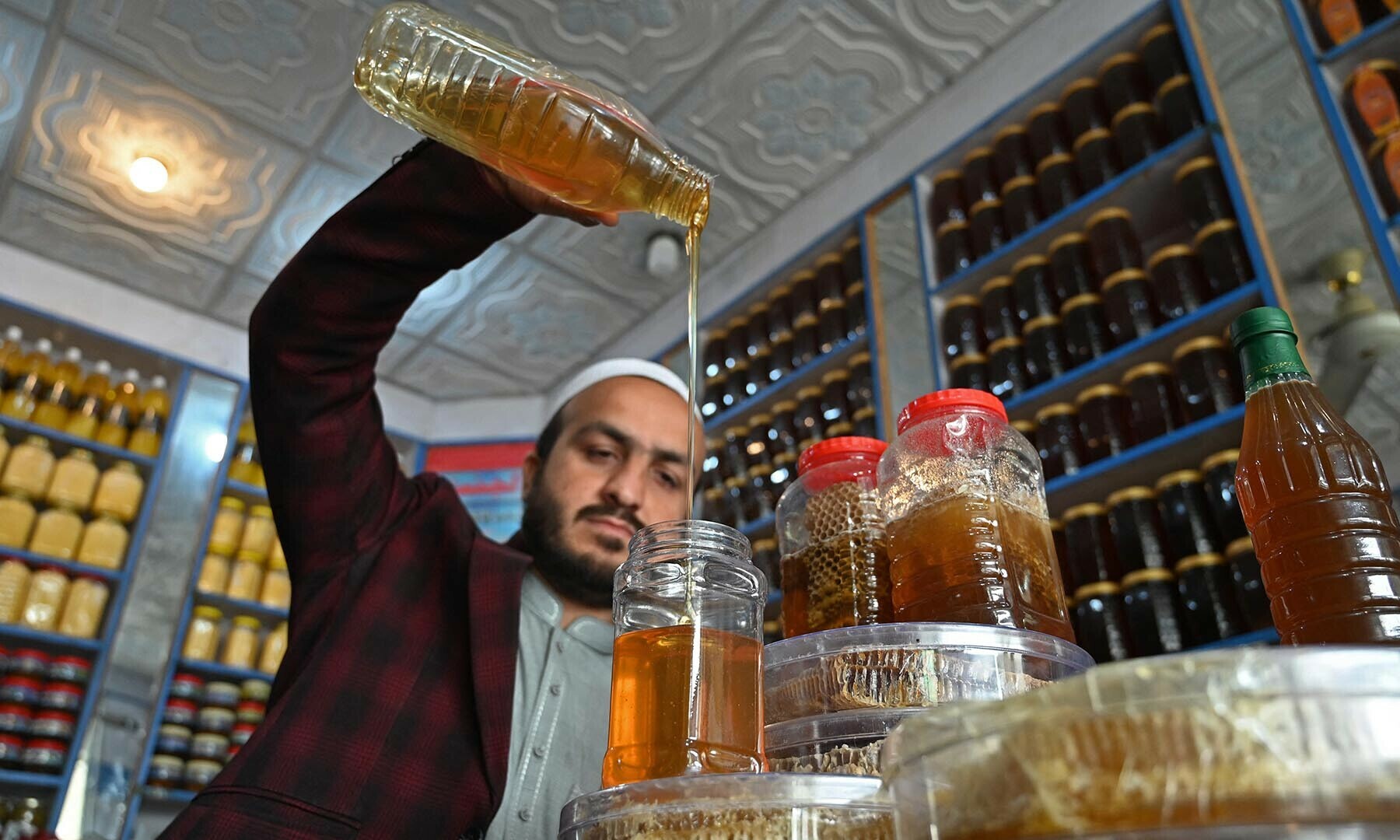
This photograph taken on Feb 4, 2025 shows a vendor filling a bottle with honey at his shop in Chamkanni on the outskirts of Peshawar in Khyber Pakhtunkhwa. — AFP


This photograph taken on Feb 4, 2025 shows a vendor filling a bottle with honey at his shop in Chamkanni on the outskirts of Peshawar in Khyber Pakhtunkhwa. — AFP

“Now, we go as far as Sindh for warmer temperatures and to escape extreme weather conditions,” Khan told AFP, referring to areas up to 1,000 kilometres (600 miles) away.

“Bees are like babies, they need a good environment, good surroundings, and proper food to survive.”

Moving the bees comes with its own risks.

“If the weather is very hot, or if the distance is too long, there is a chance that some bees could die. It has happened to my bees before,” Khan explained.

On long trips, they must also be fed artificial food because they cannot produce honey while travelling.


This photograph taken on Feb 4, 2025 shows a vendor waiting for customers at a key honey market in Chamkanni on the outskirts of Peshawar in Khyber Pakhtunkhwa. — AFP


This photograph taken on Feb 4, 2025 shows a vendor waiting for customers at a key honey market in Chamkanni on the outskirts of Peshawar in Khyber Pakhtunkhwa. — AFP


Moving so often is expensive for beekeepers in a country where fuel prices have risen dramatically in recent years.

And beekeepers seeking better weather can face harassment if they set up in areas without permission from landlords.

On barren land outside Chamkanni in Khyber Pakhtunkhwa, Gul Badshah watches helplessly as bees appear and disappear from dozens of boxes on a fruitless search for flowers.

“They fight and kill each other if the weather conditions do not suit them,” he told AFP.

Badshah, whose boxes were also washed away in floods in 2010, and again in 2022, has given up travelling long distances.

“There is nowhere to be found. We do not know where else to go.”
 

Cool bees​

Some hope is offered by new technology intended to keep bees cool, addressing the problem of how extreme temperatures affect the insects — if not their food source.

Abdullah Chaudry, a former beekeeper, developed new hives with improved ventilation based on inspiration from other honey-producing nations dealing with rising temperatures, including Turkiye and Australia.

Early signs suggest the boxes improve production by around 10pc.

“Extreme heat does not make bees comfortable and instead of making honey, they keep busy cooling themselves,” he told AFP at the capital’s beekeeping research centre.


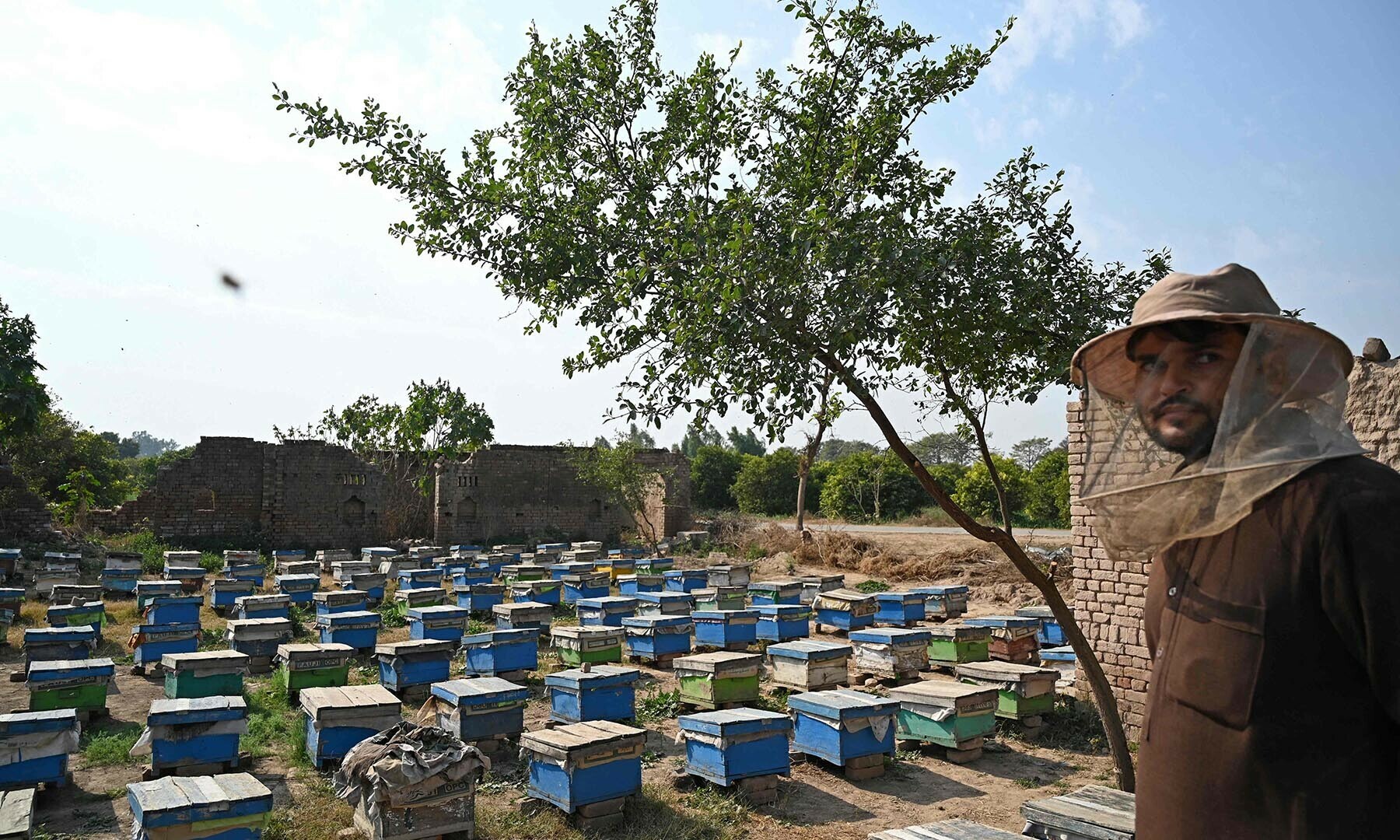
This photograph taken on Jan 30, 2025 shows a beekeeper standing in a honeybee farm at Lak Mor village in Sargodha district of Punjab. — AFP


This photograph taken on Jan 30, 2025 shows a beekeeper standing in a honeybee farm at Lak Mor village in Sargodha district of Punjab. — AFP

“These modern boxes are more spacious, and have different compartments giving more space to the bees.” The improved hives are just part of the adaptation puzzle though, he acknowledges.

“It is an ongoing battle,” Chaudry told AFP.
 
Cotton cultivation in Punjab hits 2.116M acres in Kharif 2025-26, up from 1.806M last year. 60% of the 3.5M-acre target achieved so far, says Ministry of National Food Security

1747516913757.png
 
To view this content we will need your consent to set third party cookies.
For more detailed information, see our cookies page.
 
To view this content we will need your consent to set third party cookies.
For more detailed information, see our cookies page.
 

Ginners to enforce moisture rules


The Newspaper's Staff Reporter
August 1, 2025

LAHORE: In response to higher-than-usual rainfall in the cotton-growing belt, the Pakistan Cotton Ginners Association (PCGA) has announced the immediate implementation of a new moisture policy, effective from Aug 1.

According to a letter issued by PCGA General Secretary Zikrullah Khalidi on Thursday, ginners will pay the full rate for cotton containing up to 10pc moisture, without any deduction in weight.

However, deductions will apply for higher moisture levels, and produce with more than 40pc moisture will be rejected outright.

As per the new policy, a deduction of 1kg will be applied for cotton with 10-20pc moisture, 2kg for 21-30pc and 3kg for 31-40pc.

If the moisture falls between 11pc and 40pc but doesn’t fit within these specific bands, a standard allowance of 100 grams will be deducted.

Cotton exceeding 40pc moisture content will be refused, though growers may resubmit the dried produce within 24 to 48 hours.

Published in Dawn, Aug 1st, 2025
 

Users who are viewing this thread

Latest Posts

Back
Top