Pakistan Air Force | News & Discussions

I would be surprised if they can afford more than 2 squadrons.

My guess is whatever PFX is may take over the Mirage sqds and J-35 is relegated to the F-16 squadrons. Kaan may eventually augment or replace 5 sq and then maybe older thunder airframes.
Just a controversial thought, but from a long-term standpoint, would it be better to 're-set' the fighter development track entirely? I'm just not sure how viable it is to keep the JF-17 program alive when (1) AVIC is likely losing interest in maintaining the overhead for just a few dozen units at a time and (2) it is unclear if China would release the necessary tech inputs for Pakistan to manufacture the JF-17 entirely in-house.

The JF-17 was borne from the need of a multirole fighter that can fill most needs, even an offensive role if necessary (via SOW). However, if the PAF is inducting twin-engine NGFAs and, in all likelihood, UCAVs to complement them, then there will be sufficient assets for strike and any long-range/endurance operation.

Therefore, the mainstay crewed fighter need could be 'scaled back' to a shorter-range, point-defence platform. I'm not saying we'd have to scale all the way back to a small jet, but does the PAF need to think along the lines of the Tejas Mk2 or Gripen E for PFX?

My thought is... Is there value in taking an industry-focused approach and build around what we can secure? For example, the Turks are actively developing a 42 kN afterburning engine for use on their drones. However, in theory, one can use 2 of these engines to also develop a crewed lightweight fighter, ala the Taiwnese F-CK-1 and T-5.

Granted, you have size and weight restrictions. In an earlier age, that would've limited the capabilities of the fighter by cutting its range, payload capacity, etc. However, today, one can work around them via greater composite use, using efficient sensor tech (e.g., GaN AESA radars and GaN-based ECM), and smaller munitions (e.g., AZB-81LR).

Again, the point isn't to have a jack-of-all-trades. We would have some highly capable strike fighters via the J-35, for example. The point is to rethink the role of the mainstay jet and, perhaps pursue an advanced lightweight fighter (with GaN AESA radar, GaN AESA-based ECM, HMD/S, IRST) strictly for area-denial.

My logic is that we can, theoretically, invest into Turkiye's engine program (the 42 kN one under development right now) so we can co-produce it in Pakistan. We can also look at designing the necessary tooling, composites production sites, etc., elements ourselves and, ideally, elevate our industrial capacity as a whole.
 
Just a controversial thought, but from a long-term standpoint, would it be better to 're-set' the fighter development track entirely? I'm just not sure how viable it is to keep the JF-17 program alive when (1) AVIC is likely losing interest in maintaining the overhead for just a few dozen units at a time and (2) it is unclear if China would release the necessary tech inputs for Pakistan to manufacture the JF-17 entirely in-house.

The JF-17 was borne from the need of a multirole fighter that can fill most needs, even an offensive role if necessary (via SOW). However, if the PAF is inducting twin-engine NGFAs and, in all likelihood, UCAVs to complement them, then there will be sufficient assets for strike and any long-range/endurance operation.

Therefore, the mainstay crewed fighter need could be 'scaled back' to a shorter-range, point-defence platform. I'm not saying we'd have to scale all the way back to a small jet, but does the PAF need to think along the lines of the Tejas Mk2 or Gripen E for PFX?

My thought is... Is there value in taking an industry-focused approach and build around what we can secure? For example, the Turks are actively developing a 42 kN afterburning engine for use on their drones. However, in theory, one can use 2 of these engines to also develop a crewed lightweight fighter, ala the Taiwnese F-CK-1 and T-5.

Granted, you have size and weight restrictions. In an earlier age, that would've limited the capabilities of the fighter by cutting its range, payload capacity, etc. However, today, one can work around them via greater composite use, using efficient sensor tech (e.g., GaN AESA radars and GaN-based ECM), and smaller munitions (e.g., AZB-81LR).

Again, the point isn't to have a jack-of-all-trades. We would have some highly capable strike fighters via the J-35, for example. The point is to rethink the role of the mainstay jet and, perhaps pursue an advanced lightweight fighter (with GaN AESA radar, GaN AESA-based ECM, HMD/S, IRST) strictly for area-denial.

My logic is that we can, theoretically, invest into Turkiye's engine program (the 42 kN one under development right now) so we can co-produce it in Pakistan. We can also look at designing the necessary tooling, composites production sites, etc., elements ourselves and, ideally, elevate our industrial capacity as a whole.
Is it necessary to take that route manned?
The Kizelema fits perfectly into the point defense narrative with the ability to do BVR and interdiction attacks as needed.

The Jf-17 will be scaled back eventually but what’s interesting is where PAC is moving to be more a subdivision of TAI having gained experience with CAC.

TAI products are in demand and PAC can exploit that area to provide a facility at lower labor costs while providing a readily available “live testing” ground.

Eventually - Kaan can come in greater numbers mid to late 2030s as more JF-17s and F-16s go out .
 
Just speaking hypothetically...

This isn't news. This isn't real information.

I'm just saying...

IF the PAF has a few squadrons in mind to phase over to the J-31/J-35, it would likely a couple among these ones:
  • No.7 (Mirage)
  • No.25 (Mirage)
  • No.27 (Mirage)
  • No.9 (F-16A/B)
  • No.11 (F-16A/B)
Basically, the non-amalgamated tactical attack and top-end multirole units.

It'd be interesting to see how they approach it. Being their largest and most capable fighter to-date, I wonder if they'll reduce squadron sizes down to 12~14 aircraft a unit. Or, maybe, shift to a composite model where they maintain a mix of ~12 crewed fighters plus ~12 UCAVs (mix of ~2-ton and ~5-ton designs).

Or, the PAF goes a whole other direction by maintaining full-sized crewed squadrons (20~24 jets) and starts shifting legacy squadrons onto new-gen UCAVs entirely.

@Oscar @arslank01
Just a rumor I heard, maybe you could make sense of it: The ex-Jordanians will be the last to retire. Any idea why?
 
Just a rumor I heard, maybe you could make sense of it: The ex-Jordanians will be the last to retire. Any idea why?
Likely because they're the OCU unit for the whole F-16 fleet. I think as the J-35AEs enter the picture, the remaining airworthy No.9 and No.11 F-16s will be sent to No.19, and No.19 would eventually become a big squadron for F-16A/Bs (the way No.50 is for the Mirage III/5s).
 
Likely because they're the OCU unit for the whole F-16 fleet. I think as the J-35AEs enter the picture, the remaining airworthy No.9 and No.11 F-16s will be sent to No.19, and No.19 would eventually become a big squadron for F-16A/Bs (the way No.50 is for the Mirage III/5s).
Well that makes sense. Appreciate your feedback.
Thank You
 
Is it necessary to take that route manned?
The Kizelema fits perfectly into the point defense narrative with the ability to do BVR and interdiction attacks as needed.

The Jf-17 will be scaled back eventually but what’s interesting is where PAC is moving to be more a subdivision of TAI having gained experience with CAC.

TAI products are in demand and PAC can exploit that area to provide a facility at lower labor costs while providing a readily available “live testing” ground.

Eventually - Kaan can come in greater numbers mid to late 2030s as more JF-17s and F-16s go out .
That's the alternative, i.e., fully lean on autonomous operations for point-defence.

It'd be an interesting thing to see how automation can manage the interoperability between the interceptor-UCAVs, SAMs, EW/ECM, and anti-air DEWs. There are just so many factors at play, e.g., passive stoppers (EW/ECM) to kinetic stoppers (SAMs) to a fighter element.

IMO, even if Pakistan enters Turkiye's supply chain with the Kizilelma, the automation -- i.e., software -- side will need a lot of work. But the benefit for Pakistan is that this is largely expertise and research driven, it doesn't require nearly as many physical inputs as the manufacturing side.

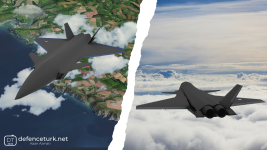
BTW, there seems to be a plan to develop a twin-engine Kizilelma-C (with a pair of 42 kN afterburning engines). This is the basic size I was thinking for a new point-defence jet -- but I still think a crewed variant, even as an OPV, ought to be considered. We just don't know when Pakistan will master autonomous air operations enough to rely strictly on a UCAV for point-defence roles.

1743121301156.png
 
Just speaking hypothetically...

This isn't news. This isn't real information.

I'm just saying...

IF the PAF has a few squadrons in mind to phase over to the J-31/J-35, it would likely a couple among these ones:
  • No.7 (Mirage)
  • No.25 (Mirage)
  • No.27 (Mirage)
  • No.9 (F-16A/B)
  • No.11 (F-16A/B)
Basically, the non-amalgamated tactical attack and top-end multirole units.

It'd be interesting to see how they approach it. Being their largest and most capable fighter to-date, I wonder if they'll reduce squadron sizes down to 12~14 aircraft a unit. Or, maybe, shift to a composite model where they maintain a mix of ~12 crewed fighters plus ~12 UCAVs (mix of ~2-ton and ~5-ton designs).

Or, the PAF goes a whole other direction by maintaining full-sized crewed squadrons (20~24 jets) and starts shifting legacy squadrons onto new-gen UCAVs entirely.

@Oscar @arslank01
When do you think China will start wrapping up J-10C production? PAF would want to get their hands on two three more squadrons before the line closes I am guessing.

Its hard to believe China will hand over any J-35 before they've come to a level close to USN. Their airforce has come to a point to challenge the USAF on paper atleast, but when you throw in the USN and Marines air arm, that's a whole extra airforce. Even if China starts churning out 100 airframes a year of J-35 and assuming they get the production to scale in another two years, then it will be atleast another 8 years before they find spare capacity to service foreign demand. They have got to place those J-35 on the air bases on the reefs, fill their current aircraft carriers and upcoming ones in the coming decade.

So 2035 seems reasonable for PAF to get its hand on 5th gen, which will likely go to the last couple of strike Mirage squadrons. I am highly sceptical the PFX will bear fruit to actually replace squadrons, maybe upgrade yes, but not replace. Closer to 2040 is when PAF will be evaluating best way to start replacing the F-16s squadrons. With an organisation like PAF, that rates tradition highly, I expect no.9 to receive the first 'western' 5th gen KAANs around that time frame.
 
Another decade is not too long; by then, these mirages of the IAF will be 50 years old. I doubt they will carry them that long.

The current plans call for the oldest Jaguars to be retired first, followed by MiG-29UPGs. Mirages were upgraded to Mirage-2000I standard less than a decade ago and that included structural fixes to increase their airframe life. They'll easily last till 2035.
 
Just speaking hypothetically...

This isn't news. This isn't real information.

I'm just saying...

IF the PAF has a few squadrons in mind to phase over to the J-31/J-35, it would likely a couple among these ones:
  • No.7 (Mirage)
  • No.25 (Mirage)
  • No.27 (Mirage)
  • No.9 (F-16A/B)
  • No.11 (F-16A/B)
Basically, the non-amalgamated tactical attack and top-end multirole units.

It'd be interesting to see how they approach it. Being their largest and most capable fighter to-date, I wonder if they'll reduce squadron sizes down to 12~14 aircraft a unit. Or, maybe, shift to a composite model where they maintain a mix of ~12 crewed fighters plus ~12 UCAVs (mix of ~2-ton and ~5-ton designs).

Or, the PAF goes a whole other direction by maintaining full-sized crewed squadrons (20~24 jets) and starts shifting legacy squadrons onto new-gen UCAVs entirely.

@Oscar @arslank01
Also, the trouble with retiring no.7 assets is you are simultaneously forced to retire the entire Ra'ad 1 stockpile. So those Rose 1 aircraft will be kept flying till their last breadth, perhaps even when the first 5th gen arrive.
 
Also, the trouble with retiring no.7 assets is you are simultaneously forced to retire the entire Ra'ad 1 stockpile. So those Rose 1 aircraft will be kept flying till their last breadth, perhaps even when the first 5th gen arrive.

Can JF-17 not fire RAAD?
 
Can JF-17 not fire RAAD?
Modified Ra'ad can be carried as per what is seen in public, not sure if that means new build Ra'ad 2s or the old ones can be retrofitted. Most likely retrofitting will not work since its a major change involving form factor and control surfaces.

So yes, I believe the Ra'ad 1s are intrinsically tied to the Rose 1 fleet, a mission set more valuable that the no.25 and no.27's terrain hugging penetrating night strike which is fast becoming obsolete as India saturates its low and medium tier AD with modern SAM systems.

To view this content we will need your consent to set third party cookies.
For more detailed information, see our cookies page.


edit: actually there is some evidence that it may just be the same old Raad in those pictures. So now I am not sure. More smoke and mirrors from PAF. Kudos.
 
Last edited:
Mirage squadrons phase-out timeline:
2022: no. 15 Cobras - legacy mirage (common knowledge vis-vis J-10CE induction)
2023: no. 8 - legacy mirage (common knowledge vis-vis block-3 induction)
2024: CCS Skynots - Mirage Rose 1 (tweets from the more trusted accounts)
2025: no. 7 Bandits - Mirage Rose 1 (possible ? awaiting 2nd tranche of J-10s?)

To view this content we will need your consent to set third party cookies.
For more detailed information, see our cookies page.
 
Also, the trouble with retiring no.7 assets is you are simultaneously forced to retire the entire Ra'ad 1 stockpile. So those Rose 1 aircraft will be kept flying till their last breadth, perhaps even when the first 5th gen arrive.

Potentially at some point J-10s could carry raad underwing?

Though, i think gradually, older ra'ads will be relegated to storage, being swapped out for more modern solutions like Rasoob, and god willing, derivatives of- or take lessons learnt from it and apply to a modernised raad variant.
 
Potentially at some point J-10s could carry raad underwing?

Though, i think gradually, older ra'ads will be relegated to storage, being swapped out for more modern solutions like Rasoob, and god willing, derivatives of- or take lessons learnt from it and apply to a modernised raad variant.
Actually, I am inclined to retract that earlier statement of mine given close look at the picture of block-2 carrying Ra'ad (it really looks like the old Ra'ad), and the mounting evidence that Rose-1s will be the first to go from all the Roses.

If the PAF hadn't found a viable alternative to carry its existing Ra'ad stockpile, the mission of Rose-1s would have been the most irreplaceable from amongst all the Mirages. Retiring CCS Rose-1s and moving no.7 from the vastness of Central/ South India facing Sindh to Mushaf, certainly means your premier strategic munition is carried by some other platform down south.

Regarding the J-10s, we will first need to see some Pakistan source 'easier to integrate' munitions under the wings of J-10s. That will tell us the degree to which our friends are willing to open up the J-10 to us.
 
Actually, I am inclined to retract that earlier statement of mine given close look at the picture of block-2 carrying Ra'ad (it really looks like the old Ra'ad), and the mounting evidence that Rose-1s will be the first to go from all the Roses.

If the PAF hadn't found a viable alternative to carry its existing Ra'ad stockpile, the mission of Rose-1s would have been the most irreplaceable from amongst all the Mirages. Retiring CCS Rose-1s and moving no.7 from the vastness of Central/ South India facing Sindh to Mushaf, certainly means your premier strategic munition is carried by some other platform down south.

Regarding the J-10s, we will first need to see some Pakistan source 'easier to integrate' munitions under the wings of J-10s. That will tell us the degree to which our friends are willing to open up the J-10 to us.
IMO... It'll depend more on the PAF than China.

For AVIC, it's a comparatively limited use-case (i.e., enabling the PAF to integrate its own munitions). So, they'll want the PAF to pay up for the whole process of integration, testing, and qualification, which can get costly if we start thinking beyond Ra'ad.

For the PAF, it's a question of how badly they want the J-10CE to deploy the Ra'ad. Since PAC can now integrate domestic munitions to the JF-17, the PAF technically already has a platform. Sure, it lacks the range of a larger fighter, but the whole point of the Ra'ad ALCM is about launching from within Pakistan, which the JF-17 achieves.

IMO, I suspect the PAF's current vision for the J-10CE is to be more air-to-air-oriented. Yes, it's a multirole fighter and the PAF's configuration is capable of air-to-surface ops. But the JF-17 largely solves the latter re: Ra'ad/-2, Taimur, AZB, and later AZB-81LR, Rasoob, etc. In fact, the bigger issue is addressing the Rafale and Tejas Mk1A threat across the border -- which is where J-10CE with PL-15/E and PL-10E matters the most.

OTOH, I do think the J-35AE would get AZB-81LR and Rasoob 250 compatibility out-of-the-box or early on. They're likely designed for internal weapon bays in mind. It wouldn't even surprise me if Pakistan supplies some AZB-81LR and Rasoob 250s to the PLAAF as part of an offset package (GIDS officials said at IDEAS 2024 that they were speaking to Chinese officials about both programs - @arslank01 ).
 

Users who are viewing this thread

Country Watch Latest

Back
Top