Find out where and how the children of these officers are living today and how much wealth they have inherited and earned on top of it!
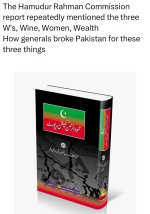
According to the BBC, the Hamudur Rehman Commission had recommended that the following officers be tried in an open court, but this did not happen:
Yahya Khan
At the time of the fall of East Pakistan, he was the President, Chief Martial Law Administrator, Defense Minister and Foreign Minister.
General Abdul Hameed Khan
General Abdul Hameed Khan was Yahya Khan's Deputy Commander-in-Chief and Deputy Martial Law Administrator. He was sacked by the Bhutto government on 20 December 1971. He died anonymously in a house in Lahore Cantt.
Lt. Gen. MM Pirzada
He was the president's principal staff officer and nosebleed. He was considered the alleged bridge of communication between Bhutto and Yahya. On December 20, he was also dismissed from the post. Later, till death, he remained in the corner.
Lt. Gen. Gul Hasan Khan
He was the Chief of General Staff at the time of the fall of Dhaka. However, instead of dismissing him, the Bhutto government promoted him to the rank of lieutenant general and appointed him as the commander-in-chief of the army.
About two-and-a-half months later, he was sacked along with Air Force Chief Air Marshal Rahim Khan and Navy Chief Muzaffar Hasan.
Although the commission recommended Gul Hasan to be tried in an open court, the Bhutto government appointed him ambassador to Austria after dismissing him from service and withdrawing all privileges and medals.
Major General Ghulam Umar
He was Yahya Khan's deputy in the National Security Council. He is said to have collected funds from Pakistani industrialists to influence the election results.
According to Brigadier AR Siddiqui, head of the army's public relations department, around two crore rupees were collected during that time. But according to an article by Altaf Gohar, Rs 28 lakh was given to be distributed among friendly political forces. The money was to be used through ISI chief Major General Akbar Khan and Rao Farman Ali.
But what happened, no one has the final details. Ghulam Umar was also dismissed by the Bhutto government on December 20 and detained for some time. He was the Chairman of Pakistan Institute of International Affairs during the Zia-ul-Haq era.
Major General Abubakar Usman Matha
General Matha was the quartermaster general of the army when he was dismissed on December 20 on the recommendation of General Gul Hasan. He is said to have participated in the technical planning of the March 25 Operation Searchlight in East Pakistan.
He died in December 1999 in London. Later his friend from London wrote these words to Indu Matha, widow of General Matha: 'All he wanted in the last days of his glorious life was a room where he could eat, drink, write, sleep and walk. There should also be a place for them from where they can see the green plains in front of them and the mountains in the distance.'
It was General Matha who founded the Army's SSG commando unit. SSG commandos also gave him the last condolence salute. General Matha left behind a book 'In Likely Beginnings. A Soldier's Life, From Bombay to GHQ'.
Lieutenant General Irshad Ahmad Khan
In the 1971 war, he was the commander of One Corps. whose command area included the defense from the Line of Control to Sialkot. During the hearing of the commission, it was alleged that he handed over 500 villages of Shakargarh to the enemy without resistance. Became anonymous after retirement.
Major General Abid Ali Zahid
He had the responsibility of defending the Sialkot sector. Allegedly, they left 98 villages in Phaklia area of Sialkot sector unopposed and when the ceasefire was declared, the Indian troops were within 1500 yards of Marala headworks. But Major General Abid Zahid could dare to bring this secret to the knowledge of GHQ only after the ceasefire.
Major General BM Mustafa
Their target area was Rajasthan sector. He alleged that the decision to advance hastily without planning towards Ramgarh caused heavy losses.