Pakistan Automobile Industries

Automobile sales hit 18-month high

The Newspaper's
July 11, 2024

KARACHI: The country’s auto sales — cars, jeeps, sport utility vehicles and pickups — touched an 18-month high to 13,284 units during June 2024, showing a growth of 21 per cent month-on-month (MoM) and 120pc year-on-year.

In volumetric terms, the MoM jump in car sales is primarily due to an increase in the sales of Indus Motors Company, which rose by 44pc to 2,957 units and Pak Suzuki Motor Company Ltd, which went up by 15pc to 6,885 units in June this year.

Hyundai Nishat Motor recorded sales of 1,059 units (up 55pc MoM) while Sazgar Engineering Works (SAZEW) sales were 871 units, up by 12pc. Only Honda Atlas Cars Limited (HACL) recorded sales of 1,095 units, down by 8pc MoM in June 2024.

On a year-on-year (YoY) basis, the significant jump of 120pc in total car sales is attributed to a low base from last year amid plant shutdowns, Myesha Sohail of TopLine Securities said.

Total sales of cars, jeeps, vans and pickups during FY24 were down by 18pc to 103,827 units YoY which is the lowest sales after 15 years due to escalating car prices, expensive auto financing, and the low purchasing power of consumers, she said.
 

Auto sales increase 15% YoY in August amid mixed segment performance

Bilal Hussain
September 10, 2024

10225231d3aa36c.jpg


Auto sales in Pakistan increased 15% year-on-year (YoY) in August 2024, as the total number of units sold in the said month stood 8,699, compared to 7,579 units in the same month of the previous year.

On month-on-month (MoM) basis, auto sales (cars, LCVs, vans, jeeps) rose 1% in August against 8,589 units sold in July 2024, according to the latest data released by the Pakistan Automotive Manufacturers Association on Tuesday.

“The YoY jump in overall auto sales can be attributed to a low base effect, as the industry faced significant challenges in the previous year,” Muhammad Abrar Polani, research analyst at AHL Research, said.

“These challenges included restrictions on opening LCs [letters of credit] and subdued auto demand, leading to widespread plant shutdowns,” Polani added.

The 1,300cc and above category recorded a strong MoM growth of 35%, with sales reaching 3,330 units in August.

The 1,000cc segment also performed well, showing a 37% MoM increase with 321 units sold.

However, the below-1,000cc category experienced a 12% decline, with sales dropping to 2,766 units, indicating consumer preference shifting towards higher-capacity vehicles.

Industry experts suggest future growth in the automotive sector will depend on a combination of policy support and macroeconomic stability.

“Potential monetary easing, along with stable car prices bolstered by a strong currency, could enhance auto financing and drive growth in the automotive sector,” said Osama Naeem, auto sector analyst at AKD Research.

However, seasoned analyst Mashood Khan emphasised that a significant recovery would not be possible without interest rates dropping to single digits.

“The auto sector cannot be fully revived unless interest rates drop to single digits, which is challenging under the current economic conditions,” he said.

In July, the central bank’s Monetary Policy Committee (MPC) reduced the key policy rate by 100bps, taking it to 19.5%.

The next MPC meeting is due on September 12 as analysts expect the State Bank to continue with its easing stance as slower inflation and improved macroeconomic indicators boost sentiment of a third-successive reduction.

Khan also pointed to a shift in consumer preference toward two-wheelers as a sign of the industry’s struggle.

“The government needs to support the four-wheeler segment with positive policies. Even if the policy rate drops to 17%, down by two percentage points from 19%, it won’t be enough to boost four-wheeler sales,” he said.

In the two-wheeler segment, sales rose 23% MoM, with Atlas Honda (ATLH) leading the charge, selling 90,483 units—a 29% increase from July.

Among the automakers, Indus Motors Company Ltd (INDU) stood out with a 28% MoM increase in its sales, totaling 2,129 units in August.

This growth was fueled by a 42% MoM increase in sales of its popular models like the Corolla, Yaris, and Corolla Cross. Sales of the Fortuner and Hilux models also rose by 1%.
 

Dewan Farooque Motors (DFML) starts EV production after EDB’s approval

BR Web Desk
September 10, 2024

1017010726fcc79.png


Dewan Farooque Motors Limited (DFML) said on Tuesday that it has commenced production of electric vehicle (EVs) at its assembly plant after receiving approval from the Engineering Development Board (EDB).

The listed company shared the development in its notice to the Pakistan Stock Exchange (PSX) on Tuesday.

“In continuation of our earlier letter dated July 23, 2024 regarding the physical verification of manufacturing facilities of Eco-Green Motors Limited (EGML) at the company’s assembly plant by the Engineering Development Board’s (EDB), the approval of which has been received and accordingly the production of electric vehicles has now been started at our assembly plant under the toll manufacturing agreement with our associated company EGML,” read the notice.

Following the development, DFML’s share price jumped to Rs52.3, a gain of Re0.91 or 1.8% at the time of this report.

Incorporated in Pakistan on December 28, 1998 as a public limited company, DFML is engaged in assembling, progressive manufacturing and sale of vehicles in Pakistan.

Back in June, DFML said it entered into a toll manufacturing agreement with ECO-Green Motors Limited (EGML) for manufacturing EGML’s Honri-VE.

The production of the vehicle was expected to commence in August, DFML shared in its notice back then.

“By the grace of Almighty Allah, we hereby announce that DFML has entered into a toll manufacturing agreement with ECO-Green Motors Limited (EGML) for manufacturing of EGML’s Honri-VE (200km and 300km range), thereby becoming the leading manufacturer of electric vehicles in Pakistan,” read the notice.

Under the toll manufacturing agreement between two companies, one company owns a design or idea for a product and supplies materials to the other to manufacture the product or parts of it.

In 2022, DFML said it entered into a Technology License Agreement (TLA) with Korea’s KIA Corporation to produce and assemble its vehicles in Pakistan.
 
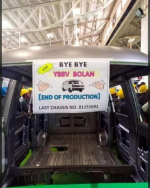
Goodbye, Suzuki Bolan:
A legacy ends. 1988-2024

Suzuki Pakistan has discontinued the production of Bolan, also known as Carry Dabba, after a 36-year dominance in the Pakistani market. The company is slated to introduce Suzuki Every in the second week of October 2024, targeting the van segment.

1727363982271.png
 

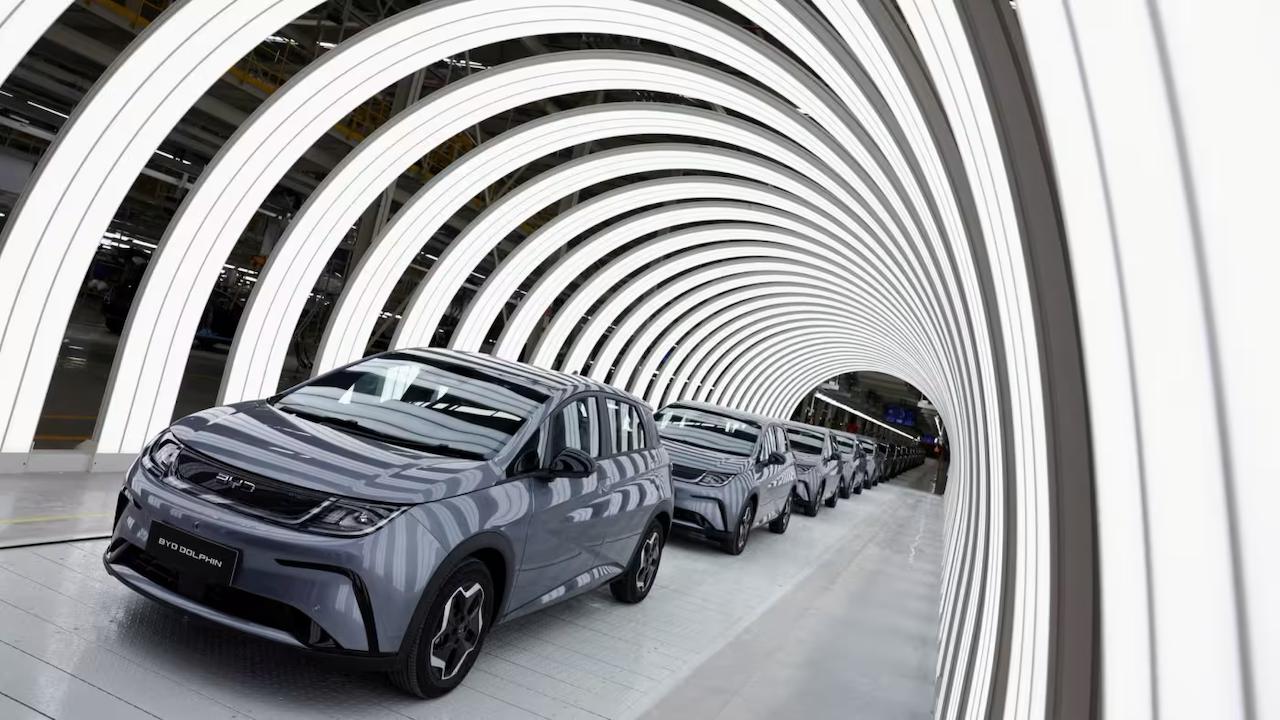
BYD and Hubco Partner to Launch Pakistan’s First Electric Vehicle Assembly Plant​

September 22, 2024


Chinese electric vehicle (EV) giant BYD, backed by Warren Buffett, is set to expand into Pakistan through a partnership with Hub Power’s subsidiary, Mega Motor.

This collaboration aims to establish Pakistan’s first electric vehicle assembly plant by 2026, located near Karachi’s Port Qasim. Hubco CEO Kamran Kamal highlighted ambitions for Pakistan to become a key car exporter, with a focus on markets in Africa and South Asia. This marks BYD’s first foray into South Asia, following investment restrictions in India.

Pakistan’s Finance Minister, Muhammad Aurangzeb, emphasized the government’s push to transform the country into an export hub, targeting automotive exports. The BYD expansion is part of the China-Pakistan Economic Corridor (CPEC) initiative, further solidifying the growing Pak-China economic cooperation.

Chinese electric-car maker BYD’s expected expansion into Pakistan has raised hopes in the country that the Warren Buffett-backed company can help jump-start exports in the automotive manufacturing sector.

Pakistan’s biggest private electricity producer Hub Power (Hubco) said last month that its subsidiary Mega Motor was entering a partnership with the Tesla rival to set up the country’s first electric vehicle assembly plant by 2026.

BYD’s Pakistan plan would mark the company’s first venture into south Asia after being blocked in India by Prime Minister Narendra Modi’s government, which has restricted Chinese investment.

Hubco’s chief executive Kamran Kamal said in an interview with the Financial Times that the ultimate goal was for Pakistan to start exporting vehicles from the plant near Karachi’s Port Qasim.

“We have big ambitions to be the leading carmaker in this country by the end of the decade,” said Kamal. “For any industry in Pakistan to be competitive, they should be focused on the export market.”

Pakistan’s finance minister Muhammad Aurangzeb said the government was encouraging BYD to export to markets in Africa and south Asia, including Bangladesh and Sri Lanka. Trade between India and Pakistan has been reduced since 2019 after a security crisis between the two countries.

“We want that Pakistan becomes an export hub, period,” Aurangzeb said in a separate interview with the FT. “Korean brands are here, the Japanese brands have been here . . . but the reality is we haven’t been exporting.”

BYD said details of its Pakistan plans had yet to be formally announced and declined to comment further.

The company’s expansion into south Asia comes as it is also establishing factories in Turkey, Hungary, Thailand and Brazil. BYD has also been scouting locations for a new factory in Mexico.

The carmaker is expanding its manufacturing footprint beyond China as countries impose increasing tariffs on Chinese exports, including on EVs, solar panels and wind turbines.

Tu Le, founder of consultancy Sino Auto Insights, said the aggressive international expansion plans would help BYD export to fast-growing markets despite tariffs in the US and Europe.

But he warned that BYD should not expect the same “unfettered growth” the company has enjoyed in China as it learns to manage factories in different countries.

“Chinese companies are used to having a lot of control. What they are going to find is that due to labour laws, different work ethics, different cultures, they’re going to have a lot less control than they normally would,” he said.

Hubco is a joint venture partner for a number of Chinese power projects established under the China-Pakistan Economic Corridor, a $60bn infrastructure network that is part of Beijing’s Belt and Road Initiative.

The company has no prior experience manufacturing vehicles but it aims to use its extensive power generation network to set up EV charging infrastructure throughout the country of 240mn people, Kamal said.

The exact size of the investment and the types of models that will be assembled in the Karachi plant “are being discussed”, he said.

Hubco said it expected to sell 100,000 BYD plug-in hybrid and fully electric cars in Pakistan a year by 2030, representing about a quarter of total cars sold in Pakistan, according to the company’s estimates.
 

BYD and Hubco Partner to Launch Pakistan’s First Electric Vehicle Assembly Plant​

September 22, 2024


Chinese electric vehicle (EV) giant BYD, backed by Warren Buffett, is set to expand into Pakistan through a partnership with Hub Power’s subsidiary, Mega Motor.

This collaboration aims to establish Pakistan’s first electric vehicle assembly plant by 2026, located near Karachi’s Port Qasim. Hubco CEO Kamran Kamal highlighted ambitions for Pakistan to become a key car exporter, with a focus on markets in Africa and South Asia. This marks BYD’s first foray into South Asia, following investment restrictions in India.

Pakistan’s Finance Minister, Muhammad Aurangzeb, emphasized the government’s push to transform the country into an export hub, targeting automotive exports. The BYD expansion is part of the China-Pakistan Economic Corridor (CPEC) initiative, further solidifying the growing Pak-China economic cooperation.

Chinese electric-car maker BYD’s expected expansion into Pakistan has raised hopes in the country that the Warren Buffett-backed company can help jump-start exports in the automotive manufacturing sector.

Pakistan’s biggest private electricity producer Hub Power (Hubco) said last month that its subsidiary Mega Motor was entering a partnership with the Tesla rival to set up the country’s first electric vehicle assembly plant by 2026.

BYD’s Pakistan plan would mark the company’s first venture into south Asia after being blocked in India by Prime Minister Narendra Modi’s government, which has restricted Chinese investment.

Hubco’s chief executive Kamran Kamal said in an interview with the Financial Times that the ultimate goal was for Pakistan to start exporting vehicles from the plant near Karachi’s Port Qasim.

“We have big ambitions to be the leading carmaker in this country by the end of the decade,” said Kamal. “For any industry in Pakistan to be competitive, they should be focused on the export market.”

Pakistan’s finance minister Muhammad Aurangzeb said the government was encouraging BYD to export to markets in Africa and south Asia, including Bangladesh and Sri Lanka. Trade between India and Pakistan has been reduced since 2019 after a security crisis between the two countries.

“We want that Pakistan becomes an export hub, period,” Aurangzeb said in a separate interview with the FT. “Korean brands are here, the Japanese brands have been here . . . but the reality is we haven’t been exporting.”

BYD said details of its Pakistan plans had yet to be formally announced and declined to comment further.

The company’s expansion into south Asia comes as it is also establishing factories in Turkey, Hungary, Thailand and Brazil. BYD has also been scouting locations for a new factory in Mexico.

The carmaker is expanding its manufacturing footprint beyond China as countries impose increasing tariffs on Chinese exports, including on EVs, solar panels and wind turbines.

Tu Le, founder of consultancy Sino Auto Insights, said the aggressive international expansion plans would help BYD export to fast-growing markets despite tariffs in the US and Europe.

But he warned that BYD should not expect the same “unfettered growth” the company has enjoyed in China as it learns to manage factories in different countries.

“Chinese companies are used to having a lot of control. What they are going to find is that due to labour laws, different work ethics, different cultures, they’re going to have a lot less control than they normally would,” he said.

Hubco is a joint venture partner for a number of Chinese power projects established under the China-Pakistan Economic Corridor, a $60bn infrastructure network that is part of Beijing’s Belt and Road Initiative.

The company has no prior experience manufacturing vehicles but it aims to use its extensive power generation network to set up EV charging infrastructure throughout the country of 240mn people, Kamal said.

The exact size of the investment and the types of models that will be assembled in the Karachi plant “are being discussed”, he said.

Hubco said it expected to sell 100,000 BYD plug-in hybrid and fully electric cars in Pakistan a year by 2030, representing about a quarter of total cars sold in Pakistan, according to the company’s estimates.
 

Pak Suzuki to discontinue its Bolan, launch ‘Every’ in Pakistan

Bilal Hussain
October 11, 2024

111439337a41c67.jpg


Pak Suzuki Motor Company has formally announced the launch of its new model ‘Every’, ending decades-long production of its Bolan that remained popular among the masses for several reasons.

In a statement to the media, Head of Corporate Affairs Pak Suzuki Motor Co. Ltd Shafiq Shaikh said the company will display ‘Every’ at authorised showrooms across Pakistan on October 13, 2024.

“Prospective buyers can also take the vehicle for a test drive the same day,” the statement added.

“This launch reinforces our commitment to providing customers with innovative, reliable, and affordable mobility solutions.”

Pak Suzuki Motor Company has been a leading automobile manufacturer in Pakistan, known for its brands such as Suzuki Alto, Swift, and Cultus. It is the biggest passenger car assembler/manufacturer in terms of volume in the country.

Auto sector expert and former PAAPAM chairman Mashood Khan said that he sees a gap in the segment that Suzuki Every could cater.

“I think it will perform,” he told Business Recorder.

Every is a vehicle that can be used commercially as a school van as well as a loading vehicle similar to its predecessor Bolan.

Meanwhile, auto experts lauded the entry of a new economical vehicle into the Pakistani market.

“The entry of Suzuki Every into the local market is a good decision,” Usman Ansari, an auto sector analyst and founder of website carspirit.pk, told Business Recorder.

“Customers criticised discontinuation of the Mehran earlier, saying that Pakistan may not have economical cars anymore. But Alto did better, with better sales. I also expect Every to do better than Bolan, which lacked features and comfort,” he maintained.

Suzuki Every is projected to be priced in the range of around Rs2.6- Rs2.7 million.

“However, the only concern is Suzuki not introducing an automatic version of Every, which is now considered an important feature.”

On the other hand, Abrar Polani, auto sector analyst at Arif Habib Limited (AHL), also put the expected price at around Rs2.6 million.

“It will be a price point where financing is also easier,” said Polani.

He added the car will have better safety features.

The analyst informed that auto sales numbers are improving especially for vehicles below 1000cc category. “Expectations are Every will also be able to perform well.”
 

Assemblers plan rolling out EVs, plug-in hybrids

Aamir Shafaat Khan
October 13, 2024

KARACHI: In contrast to the introduction of the eagerly awaited locally assembled petrol-driven 660cc Suzuki Every Saturday after the discontinuation of the iconic Bolan, several new and existing players gear up to launch locally assembled plug-in hybrid and pure electric vehicles, including motorcycles.

MG Pakistan is all set to launch MG HS Plug-in Hybrid Vehicle (PHEV) in Q42024. This vehicle runs on a pure electric motor and a petrol engine. The battery can be charged on idle as well, unlike conventional hybrid vehicles where no external charging is required.

MG has been leading the introduction of innovation and specification in the otherwise conservative Pakistani market.

“MG HS PHEV will be the first completely knocked down (CKD) PHEV in Pakistan and its unveiling is planned in Pakistan Auto Parts Show 2024 to be held in Lahore in the last week of this month,” MG Pakistan General Manager Marketing Asif Ahmed told Dawn.

Suzuki launches much-anticipated successor of Bolan
He said that the MG HS, with 50 kilometres per litre mileage, is further expected to increase the market share of New Energy Vehicle (NEV), which currently stands at approximately 50 per cent in the Mid SUV segment.

MG HS has taken Pakistan by storm in 2021. The iconic British brand started producing CKD from its plant in Lahore in December 2022. MG claims to be the second-highest EV brand on Pakistani roads. The most battery-powered electric vehicle (BEV) in Pakistan is the Audi eTron.

Chief Executive Officer of eTurbo Motors, Sheikh Osama Nadeem, said the company is launching an electric motorcycle next week in Karachi.

“Our total investment in the project is Rs500 million at a six-acre land purchased for future plant expansion,” he said.

He said the company has strategically partnered with a foreign joint venture to bring advanced technology and expertise to our project without mentioning any details on foreign partners.

“We will share details shortly.”

The plant in the Site area is rolling out 300-400 e-motorcycles per month, and it can be expanded to 1,500-2,000 units per month by next year, he said, adding that more models in the production line have also been planned this year.

The new electric bike project carries 20-30pc localisation and “we plan to fully localise the product in coming years,” he said.

He claimed to have obtained a licence from the Engineering Development Board (EDB) for the local assembly and the operation meets all regulatory standard requirements for assembling electric bikes.

“Currently, we have over 50 employees working in our plant, and our production is increasing. We are also opening new positions, with plans to create over 150 jobs in the coming year,” Osama said.

On EV bike market saturation in the next one to three years, as around 30 companies are marketing e-bikes, he believed that the E-turbo EV motorcycle market still has significant growth potential despite the number of new entrants. “We focus on innovation, quality, and customer satisfaction, which we think will set us apart and sustain demand even as the market evolves,” he added.

He said charging infrastructure and public awareness are critical factors for EV adoption. “We are seeing progress with more stations being developed and increased awareness campaigns. With continued investment and government support, these barriers will significantly reduce in the next couple of years, accelerating EV motorcycle sales,” he added.

Dewan Farooque Motors Ltd (DFML) informed the Pakistan Stock Exchange on Friday that it has successfully assembled Honri EV under toll manufacturing. The first lot of EVs has been dispatched to Eco Green Motors Ltd.

Regal Automobiles will soon start assembling the country’s first electric SUV (Seres vehicles) at its Lahore plant after recently getting a license from the EDB. The formal production launch is expected by the end of this month.

Every’s launch

Pak Suzuki Motor Company Ltd (PSMCL) has launched locally assembled Every 660cc. The price of VX and VXR models is Rs2.749m and Rs2.799m, respectively, an official of PSMCL said.

A display of Every along with a test drive will be available on Sunday at authorised showrooms across the country.

It is not clear whether the company has introduced the latest version available in the world or an old model has been launched. However, as per an old practice, local assemblers usually roll out old models.

Published in Dawn, October 13th, 2024
 

NLC enhances logistics fleet for efficient cross border transportaion


Press Release
October 17, 2024

17181442e89ce53.jpg


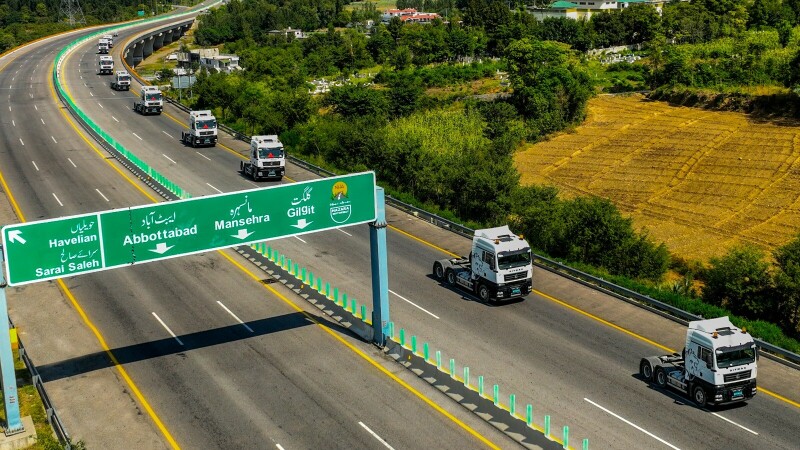
In response to the increasing trade with regional countries, the National Logistics Corporation (NLC) has enhanced its fleet with the procurement of 500 modern, high-powered trucks, according to a press release.

As per the details, the advanced vehicles are designed for long-haul operations.

Prime Movers brought in Pakistan by road through Khunjerab Pass by saving lot of time and expenditure as compared to sea transportation.

The introduction of the trucks is a strategic move to strengthen “Regional Connectivity” under the TIR (The International Road Transport).

The initiative was taken by the NLC with the launch of first commercial operation in 2021.

Since then, NLC has progressively extended land-based transportation operation to Central Asian Republics, China, Russia, Turkiye, Azerbaijan and beyond while plans are afoot to expand NLC’s outreach to other countries in Eastern Europe, the press release read.

Powered by advanced technology and delivering 390 horsepower, the trucks are equipped to handle the demanding requirements of long-distance transportation and will be utilised for the transportation of goods via road to various destinations.

The addition of the trucks to NLC’s fleet is expected to enhance its cross-border logistics capabilities, contributing to the growth of regional trade and connectivity.


Pakistan auto factory rolled out a milestone 10,000th vehicle​

By Mariam Raheem | Gwadar Pro
Oct 23, 2024

LAHORE - A milestone was achieved on 12 October as the 10,000th HAVAL vehicle rolled off the production line at SAZGAR Engineering Works Ltd’ KD factory in Pakistan. This occasion marks a collaboration between SAZGAR and Chinese auto brand Great Wall Motor (GWM), which has flourished since its inception.

Since commencing operations in September 2022, the KD factory has witnessed robust growth and has manufactured two globally renowned models: HAVAL H6 and HAVAL JOLION. HAVAL H6 HEV, the first locally assembled New Energy Vehicle (NEV) in the country, has garnered immense popularity since its launch, swiftly becoming the region’s best-selling SUV.

Pakistan auto factory rolled out a milestone 10,000th vehicle


10,000th HAVAL vehicle rolled off the production line in Pakistan, photo provided by GWM

This success highlights the growing demand for eco-friendly and technologically advanced vehicles in Pakistan. These energy products have helped increase the penetration rate of NEVs in the Pakistani passenger car market from less than 1% in 2022 to nearly 11% in 2024.

Attending the roll-out ceremony, Rana Tanveer Hussain, Federal Minister for Industries and Production of Pakistan, emphasized the positive and crucial impact that the collaboration between Pakistan and China has had on the local automotive landscape.

“The collaboration has provided Pakistani consumers with access to new models that meet global standards,” he said. “This has greatly enhanced our travel quality and accelerated the transition towards more sustainable and eco-friendly transportation options.”

In addition to the two assembled SUV models, SAZGAR plans to launch three new energy vehicles—OAR 03, ORA 07, and TANK 500 HEV—this year. Looking ahead, it plans to launch more NEV products, including plug-in hybrid electric vehicles (PHEVs) and battery electric vehicles (BEVs).
 
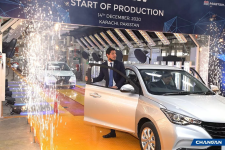
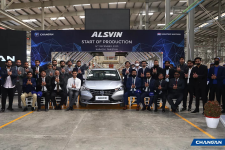
Pakistan's First Euro 5 Smart Sedan – Changan Alsvin production has officially commenced with the line-off ceremony held at the state-of-the-art plant on 14th December 2020.

1730048246041.png


1730048262362.png
 
Why they build such low class cars? In Russia they already make electric models from Chinese brands.
Import duties are insanely high where purchasing a land cruiser (in pakistan) is the equivalent of purchasing a lambo (uk price). Local alternatives are terrible and ugly. The car market in Pakistan is a complete mess.
 

Users who are viewing this thread

Country Watch Latest

Latest Posts

Back
Top