Pakistan Border Trade

Nov 7, 2021
ISLAMABAD (APP): Pakistan and Iran has decided to increase bilateral trade volume to US$5 billion in next five years at high level meeting during the visit of Adviser to Commerce and Investment, Abdul Razak Dawood along with the senior business leaders.

Advisor Commerce said that it was important to make the trade and investment relations more broad based, said a press release issued here on Sunday.

Adviser Commerce, Abdul Razak Dawood met with Iran’s Minister for Industry, Mining and Trade, Syed Reza Fatimi Amin at Tehran, Iran before the meeting of the 9th Joint Trade Committee (JTC).

Minister of Industry, Mine and Trade of Iran Fatemi Amin and Adviser to the Prime Minister on Commerce and Investment of Pakistan, Abdul Razak Dawood, have co-chair the meeting to discuss all trade issues and progress made after the 8th meeting held in 2019 in Islamabad.

They discussed matters relating to trade and investment between the two countries and resolved to translate the decisions of 9th JTC into positive and tangible outcomes. The Iranian Minister invited Pakistani companies to invest in Iran.

Earlier last Friday the Adviser Commerce left for Iran on a two day visit to negotiate on bilateral trade and investment with Iranian government.

Pakistan and Iran have agreed to start initial talks on the FTA and other important issues of trade for increasing the bilateral trade volume and investment opportunities.

Both of the neighboring countries have discussed barter trade, cooperation in transportation, Free Trade Agreement, construction of border markets and other issues affecting bilateral trade. The 9th Joint Trade Committee (JTC) meeting between Islamic Republic of Iran and Islamic Republic of Pakistan was held on November 6-7 2021-at Tehran.

An MOU on exhibition cooperation has also been signed between the two countries.

Officials from the Ministry of Commerce, Pakistan Customs (FBR), Govt of Balochistan and Presidents of Federation of Pakistan Chambers of Commerce and Industry and Quetta Chamber of Commerce and Industry were accompanied by the Adviser for the meeting.
 
Pak-Afghan border officials agree to enhance trade via Torkham

The Newspaper's Correspondent
November 10, 2021


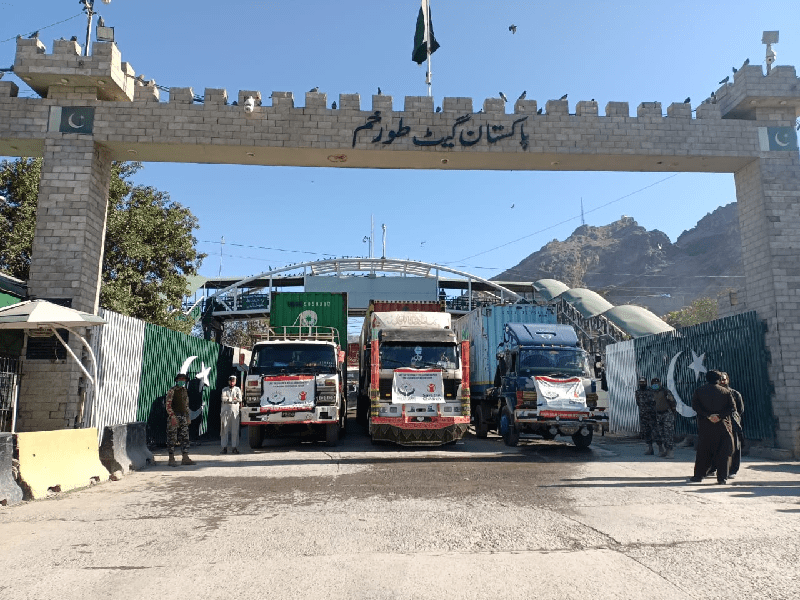
This file photo shows a general view of the border post in Torkham, Pakistan. — Reuters/File


This file photo shows a general view of the border post in Torkham, Pakistan. — Reuters/File

KHYBER: Pakistan and Afghan border officials agreed on Tuesday to devise a mechanism to enhance bilateral trade via the Torkham border.

A meeting to this effect was held at the customs compound attended by officials of Frontier Corps, National Logistics Cell, Federal Investigation Agency, State Bank of Pakistan, Khyber and Sarhad chambers, local traders and customs clearing agents.

From Afghanistan side, their border officials — Maulvi Mustafa, Maulvi Ubaidullah and head of Afghan customs Abdul Hameed participated in the meeting.

The participants discussed all the issues confronted by the local traders and transporters in clearance of goods at the border, and also shared suggestions for prompt removal of bottlenecks in goods clearance.

The meeting agreed on increasing the number of electronic scanners in order to expedite the scanning process of loaded trucks and reducing chances of delay in customs clearance in order to overcome traffic congestion at the border crossing.

Representatives of Khyber and Sarhad chambers told the meeting that delay in issuance of export forms by the private banks to the local exporters was causing reduction in export of Pakistani goods to Afghanistan despite an extension in the ‘cash-on-counter’ facility by the State Bank of Pakistan.

The meeting agreed on formation of a coordination committee comprising government officials and representatives of local traders, customs clearing agents and transporters to pinpoint difficulties in goods clearance.

It was for the first time that Taliban officials participated in such a meeting on the Pakistan side of the border after they took control of Afghanistan in mid August.
 
International trade corridors: Pakistan begins installing RMPs to secure borders

Muhammad Ali
05 Jan 2022


61d4c298018d4.jpg


KARACHI: Pakistan has begun installing Radiation Monitoring Portals (RMPs) at all international trade corridors to avert the smuggling of nuclear materials. This information was disclosed by Dr Rehmatullah, the first Director of the newly-established National Nuclear Detection Architecture (NNDA).


“The decision to establish NNDA at all international trade corridors was made after the recent Indian propaganda regarding the seizure of a potentially radioactive consignment from a vessel that originated from Pakistan,” Dr Rehmatullah said.

“The government is very serious about securing its borders from smuggling of nuclear materials, especially after opening the Central Asia trade corridor. Therefore, the installation of radiation detection equipment is being made to avert all possibilities of nuclear material smuggling, he added."

The RMPs will monitor the movement of nuclear material and detect any radioactive traces left behind by smugglers who try to circumvent them.

Earlier, the MoU signing ceremony between the Directorate of Transit Trade and the representatives of all terminals for scanners’ installation was held at the Customs House, Karachi.

Dr Rehmatullah, who is also serving as the director in Directorate of Transit Trade, said the MoU aimed to install single view scanners at the ports and airports of Karachi, Lahore, and Islamabad.

The project cost is $31 million, funded by the World Bank. He said that in the first phase, scanners would be installed at South Asia Port Terminal (SAPT) and the Karachi airport by October this year, and it would be run as a pilot project for three months. After that, the scanners would be rolled out to QICT, PICT, KICT, Islamabad, and Lahore dry and airports.

He said that after installing these scanners, the clearance time would be reduced from five days to hours as these advanced scanners could scan 120 to 150 containers per hour.

Replying to a question, he ruled out the possibilities of human interaction and misuse of the scanners, saying that the department had evolved a mechanism where no scanning officer would have access to any relevant information to ensure transparency in the clearance process through scanners. Furthermore, he said that new appointments would be made for this project, and these officers would be given incentives and special training to operate the scanners.
 
The Pakistan-Uzbekistan Transit Trade Agreement (AUPTT) has been operationalised & history made on 3rd March 2022 by clearance of the first-ever transit trade consignment to Uzbekistan. The maiden transit shipment is being moved by Pyramid Logistics of Pakistan, from the SAPT Terminal at Karachi Port to Termez in Uzbekistan.

With this, a new era of trade has started between Pakistan & Central Asia whereby goods would move to and from Pakistan’s ports to their respective destinations..


1646399578211.png


..
1646399609850.png
 

Halal meat export to Tashkent begins​

Containers carrying meat from Pakistan return with cotton

Our Correspondent
March 10, 2022

photo file


KARACHI: Pakistan’s accession to the International Transport of Goods (TIR) Convention has opened up new avenues of regional trade and as a result bilateral exchanges between Pakistan and Central Asian states are growing.

Taking advantage of the potential for trade with the Central Asian states, Pakistani exporters have kick-started export of Halal meat to Uzbekistan through the land route.

The first shipment, containing 18 tons of meat, was exported to Tashkent on Wednesday. Parliamentary Secretary for Economic Affairs Sheikh Yaqub was present at the time of shipment.

Shaheen Group Chief Executive Officer Malik Sher Khan told The Express Tribune that there was a huge market for Halal food in Central Asia and TIR had turned it easier for Pakistan to access the region.

“In one month, 900 tons of meat will be shipped to Tashkent via Torkham in 50 consignments of 18 tons each,” he said. “A consignment takes eight days to reach Tashkent from Pakistan.”

He revealed that talks were underway with Uzbekistan for export of meat to Tajikistan.

Citing that all routes from Pakistan to Tashkent had been surveyed, he added that Torkham was completely safe and all Central Asian states were connected to it.

“Increase in bilateral trade with Central Asian states will facilitate freight services and push down fares,” he said. “Containers carrying meat from Pakistan return to the country with cotton.”

He noted that the containers were able to reach Central Asia due to strict adherence to the axle load standards in Pakistan. “This system is being improved further at the government level, which will benefit exports.”
 
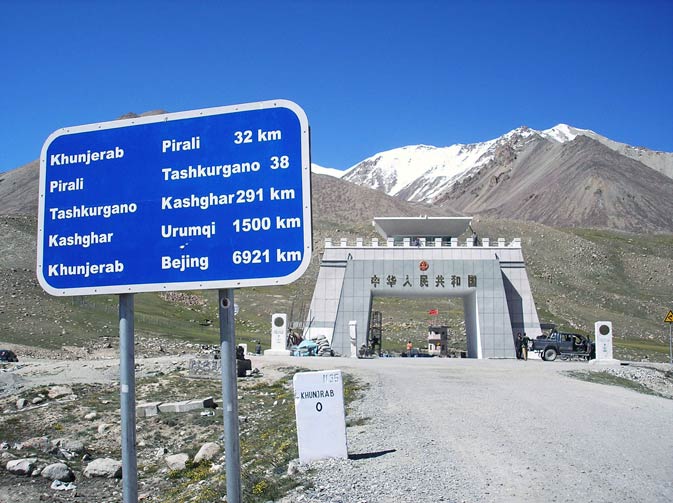
After keeping the land route between Pakistan and China closed for over two years following the outbreak of Covid-19 pandemic, China has finally announced to open the Khunjerab border from April 1, 2022 for trade activities.

1648471086974.png
 
Pakistan Afghanistan border at Khyber Pass in August 1934..

1650999711452.png
 
NHA to link CPEC M-14 with Pak-Afghan border

The federal government has decided to connect Ghulam Khan in North Waziristan with Motorway 14 (M-14), a project of the western alignment route of China-Pakistan Economic Corridor (CPEC) via a 184km-long Motorway.

According to Gwadar Pro on Tuesday, the National Highway Authority (NHA) on Monday issued a request for proposal (RFP) of consultancy services for the Feasibility Study and Detailed Design for the Construction of the Motorway from Ghulam Khan to Esa Khel Interchange (184km approx).

The project will be financed by the Federal Government through PSDP 2022-23 through separate head/allocation.
In this regard, a pre-proposal conference on the project will be held on July 19, 2022, at NHA headquarters in Islamabad while procurement will be carried out by adopting the “Single Stage Two Envelops” procedure.

The proposals complete in all respects in accordance with the instructions provided in the RFP document in sealed envelopes, which should reach on or before August 10, 2022.

Esa Khel Interchange is located over M-14 in Mianwali district of Punjab, which is in proximity to the Lakki Marwat district of Khyber Pakhtunkhwa (KP). Between Mianwali and Ghulam Khan falls Bannu district of KP. After Torkham and Chaman, Ghulam Khan is the third most important crossing between Pakistan and Afghanistan.

Afghanistan has already started benefiting from Gwadar Port and the country received the first consignment of bulk cargo from the United Arab Emirates in July 2020. Ghulam Khan crossing, at the Pak-Afghan border point, is the shortest route connecting CPEC’s western route with Afghanistan, Central Asian States and beyond.

Route Map:


1669659270385.png


Feasibility Study Completed on Sept 9th: Tender issued for Feasibility Study - July 8th, 2022
Evaluation Report Completed on Nov 24th: Announcement Of Evaluation Report - Sept 9th, 2022
Current Status: TBD
 

Thousands of trucks stuck at Torkham border crossing​

Up to 6,000 trucks loaded with goods had been stuck on both sides since Sunday, says Sarhadi

REUTERS
February 21, 2023

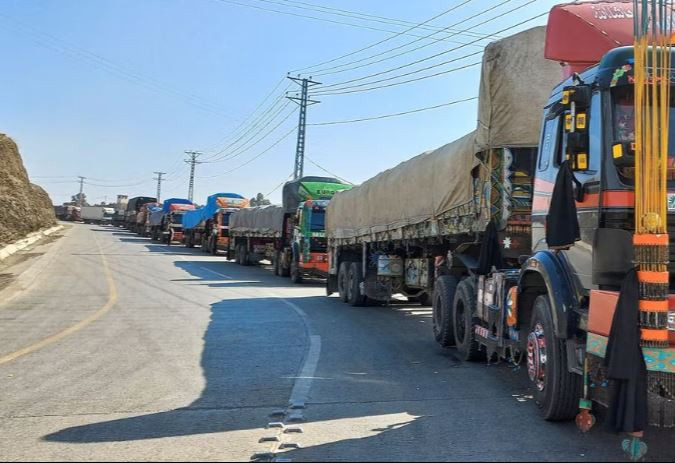
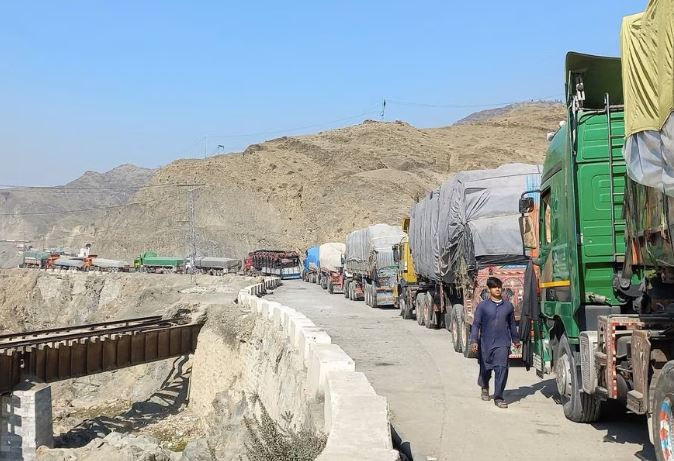
A key border crossing between Pakistan and Afghanistan remained closed for a third day, with thousands of goods vehicles stuck and businesses facing losses as officials from both sides try to broker a solution.

Taliban authorities on Sunday closed Torkham, the main point of transit for travellers and goods between Pakistan and landlocked Afghanistan.

"The closure of the border crossing between Pakistan and Afghanistan has been causing losses to traders of the two countries. There are long queues of heavy trucks stranded on both sides of the border," said Zia-ul-Haq Sarhadi, director of the Pakistan-Afghanistan Joint Chamber of Commerce and Industry.

He said up to 6,000 trucks loaded with goods had been stuck on both sides since Sunday.

The reason for the closure was not entirely clear, though officials on both sides have said they were in discussions to resolve the issue. A provincial Taliban official told Reuters on Monday Pakistan had not lived up to its commitments to allow transit, travellers and sick people seeking treatment to cross.

TORKHAM-21676985276-1.jpg


Trucks loaded with supplies to leave for Afghanistan, are seen stranded after Taliban authorities have closed the main border crossing in Torkham, Pakistan February 21, 2023. PHOTO: REUTERS

However, the incumbent government has not commented publicly on the matter. According to sources, the government had not been told the reason ahead of the closure.

Sarhadi said Afghanistan relied on goods from Pakistan for much of its needs and many trucks were also destined for Central Asia using Afghanistan as a transit point.

"The traders and particularly those supplying fresh food items such as fruits, vegetables, are facing losses as trucks are stranded on the way for the past three days," he said.

TORKHAM-31676985276-2.jpg


A man walks past trucks, loaded with supplies to leave for Afghanistan, aer seen stranded after Taliban authorities have closed the main border crossing in Torkham, Pakistan February 21, 2023. PHOTO: REUTERS

He added some trucks had been diverted to another, smaller border crossing, but traders were worried about the security of truck drivers travelling to that region.

Residents had reported heavy gunfire on Monday morning near the Torkham border crossing, but the Taliban official had denied any clashes and said the situation was under control.

Disputes linked to the 2,600 km (1,615 mile) border have been a bone of contention between the neighbours for decades.
 
Pakistan Afghanistan border crossing

FpdvtJnaEAAzlcM
 

Barter Trade: Benefits For Pakistan & Afghanistan​

Admin PSF

b1.png


Large scale Barter trade is an centuries old concept of commence that has traditionally thrived within the South Asian region since the very start of recorded civilizations. It comes with various advantages that many people across the border (Both Pakistan/Afghanistan) continue to rely upon well within the 21st century.

It is exactly due to these advantages and circumstances linked with barter trading that the Government of Pakistan has been making various efforts to formalize the concept and implement trade barter mechanisms. This article will dive briefly into the need for and importance of barter trading between Pakistan and Afghanistan.

First of let’s start with small introductions, barter is an act of trading goods or services between two or more involved traders without the use of money or any financial currency (Goods are exchanged for different Goods). Hence international barter trade between Pakistan and Afghanistan is an occurrence of exchange in which people from both countries directly exchange goods or services for other goods or services without using currency such as intentionally standard US dollar as a medium.

For example, due to current ongoing war in Ukraine fuel prices have soured internationally, as a result Pakistan has started to source coal from Afghanistan instead of previous South African suppliers, in exchange for exporting coal Afghan traders import meat and wheat from Pakistan due to food shortage and ongoing humanitarian crisis in Afghanistan (Exchange of goods).

This system is particularly important due to the ease of trading it provides for locals, promotion of commercial activities across borders and most importantly absence of using US Dollars to trade of which both Pakistan and Afghanistan currently are in shortage (Pakistan facing economic crisis and Afghanistan facing western sanctions). These advantages are listed in more detail below:

Circumnavigating International banking and Dollars

Typically, international trade involves usage of international banking processes and exchange of currency (US dollars) for goods or services, however this is not a good option in the situation that US dollars are in short supply, international sanctions limit the use of banking resources or banking infrastructure being inadequate.

For trade between Pakistan and Afghanistan, the situation is bad on multiple spectrums as western sanctions on IEA / lack of adequate banking infrastructure within Afghanistan limits its access to international banking and resulting economic restrictions reduced dollar supply,

Pakistan is also facing its own dollar shortage due to economic shortcomings. This means Barter trade between Pakistan and Afghanistan where goods are exchanged for other goods has become a good method of circumnavigating international banking restrictions and reducing dependency upon US dollars.

Using Barter trade, people on both sides of the border can easily access various products and services which are in short supply locally but available in abundance across the border without the need for relying upon complex international banking. Western banking restrictions upon trading with IEA government and inability of Afghans to pay in dollars can be countered by simple barter trade. Here the threat of money going to “Regimes” as west terms it is also reduces as in barter the main beneficiaries are local people trading need-based goods rather than weapons.

Resolving the humanitarian crisis and securing Peace

Currently Afghanistan is still in facing a humanitarian crisis partially caused by sanctions placed on the country which limit its options in importing necessary food, medicine, and other essentials. By making use of Barter trade with Pakistan has the pressure been reduced upon Afghans as they were able to trade various local products sitting in surplus such as coal in exchange for various necessary items such as wheat.

Furthermore, as Afghans continue to reopen various lost local industries its options for barter exports to Pakistan increase in exchange for which Afghanistan can continue to import essentials until the crisis gets resolved.

The government of Pakistan has listed assisting Afghanistan within the crisis as one of main motivating factors behind formalization of barter trade. This is because Pakistan understands that peace within Afghanistan is long overdue and a necessary step towards establishing economic development framework in Pakistan’s western frontier.

Increasing economic cooperation and development

As things stand, both Pakistan and Afghanistan have economic issues now. Both issues differ from one another in circumstance and intensity, regardless it is the long-term goals of both to countries to establish an environment where economic cooperation and development can be achieved. Barter trading in this context is a great start as in its nature it requires both parties to cooperate, whereas development is a natural byproduct of increased local commercial activities.

As Barter trading is relatively simpler than international banking, more and more local traders within Afghanistan and Pakistan have access to this trade network and can benefit directly. As the government fully implements a fully comprehensive barter trading system, the cooperation level of both countries will increase dramatically where long term economic planning will become possible.

Furthermore, as traders start taking advantage of surplus products from each side while making up for shortages at home, economic development rate is expected to rise. Such is the power of barter trading between two culturally close nations.
 

Khunjerab Pass opened for Pakistan-China trade after three years​

PM Shehbaz hails the development, hopes it will boost trade between two countries

APP
April 02, 2023


pakistan china border khunjerab pass


Pakistan-China border, Khunjerab pass
The Khunjerab Pass, a major trade route between Pakistan and China, has been reopened after a closure of almost three years due to the Covid-19 pandemic.

The pass connects Gilgit-Baltistan with China’s Xinjiang Uyghur Autonomous region and was closed in 2020 following the outbreak of Covid-19.

According to official sources, Chinese authorities have shared a letter with Pakistani officials regarding the reopening of the pass for trade, and port authorities on the Chinese side have been instructed to take all necessary measures to contain Covid-19 before the arrival of goods from Pakistan.

Similarly, Pakistani border authorities have also been instructed to take all measures regarding Covid-19, ensuring the containment of the disease.

Khunjerab Pass generally opens from April 1 to November 30 every year, and remains closed from December 1 to March 31 due to cold weather and lack of oxygen in the high altitude.

But to ensure the smooth customs clearance of Pakistan’s urgently-needed and other supplies, the port was temporarily opened twice early this year.

Despite difficulties including extremely cold weather, heavy snow and lack of oxygen, the local customs have worked round the clock to ensure the transportation of cargo.

This year, the last temporary opening lasted for 12 days between January 30 and February 10 while the first port opening was between January 19 and 20.

The two temporary openings facilitated 128 cross-border personnel visits, 328 transportation vehicles’ passes, and more than 6,000 tonnes of goods exported.

The reopening of the border crossing is expected to boost economic activities between the two countries.

Meanwhile, Prime Minister Shehbaz Sharif has expressed his pleasure over the reopening of the Khunjerab Pass, saying it would help increase bilateral trade between Pakistan and China.

The reopening of the pass removes a hurdle that would further expedite the pace of work on the China-Pakistan Economic Corridor (CPEC), he said.

The prime minister termed the occasion a welcome one for boosting trade with 'Iron brother China' and expressed his resolve to move ahead on CPEC with dual speed.

He added that CPEC was a gift of progress and prosperity given by former prime minister Muhammad Nawaz Sharif and the Chinese leadership for the region and the people.

The premier also appreciated the relevant authorities of the two countries and team members over the restoration of trade and travel facility.
 
CARGO trucks pass through the Torkham area where a customs terminal is under construction.

6429f28548b2e.jpg


The salient features of the terminal, under the procedure, customs clearance of loaded vehicles would be done under a one-window system while goods declaration procedure could be performed through internet under the WebBasedOne Custom system by the importers and exporters from any part of the country or abroad.

The terminal, which will be of an international standard and will provide all the basic facilities to traders, transporters and customs officials, would be completed and fully operational by the end of 2023.

The new terminal will have a cumulative parking facility for at least 500 vehicles which will hugely minimise traffic mess on the main Peshawar-Torkham highway.

The terminal is also designed to offer rapid passenger immigration process, efficient cargo checking and handling alongside e-lanes for even faster clearance and a sufficiently large parking space for at least 500 trucks awaiting clearance.
 

Officials promise removal of hurdles to Pak-Afghan trade

Bureau Report
April 9, 2023

PESHAWAR: Authorities have assured Pakistani and Afghan traders of measures to remove hurdles to trade between the two countries.

Newly-appointed chief collector (customs) in Khyber Pakhtunkhwa Fayyaz Anwar chaired a meeting at the Torkham border on Saturday to discuss issues related to Pak-Afghan trade.

The participants, including Pakistani and Afghan traders and relevant officials, held a “thorough discussion on the performance of relevant public sector institutions along with the problems of Pak-Afghan businessmen,” according to a news release.

The traders highlighted their issues and proposed ways to resolve them.

Traders complain of slow goods clearance at border points

The participants included collector customs (operations) in Peshawar Mohammad Ashfaq, additional collector customs at Torkham Mohammad Rizwan, additional collector customs in Peshawar Rizwan Mehmood, deputy collector (operations) at Torkham Asma Javed, assistant collectors at Torkham Imad Mohib, superintendent Siddique Akbar, PAJCCI coordinator and director Ziaul Haq Sarhadi, KCCI president Syed Jawad Hussain Kazmi, and members of the Torkham Customs Agents Association.

The representatives of NLC, FC, police and other security departments, who were also in attendance, made several suggestions to remove obstacles to Pak-Afghan trade.

Customs officials from Torkham briefed Mr Anwar about their visit to the newly-constructed NLC terminal.

Ziaul Haq Sarhadi, who is also the president of Frontier Customs Agents Association (FCAA) and former senior vice-president of the Sarhad Chamber of Commerce and Industry (SCCI), called for steps to ensure smooth Pak-Afghan trade as well as transit trade.

He said traders had no issues with the customs department at Torkham, Ghulam Khan and Kharlachi border points.

Mr Sarhadi, however, said officials of border management and other institutions took a lot of time for goods checking causing difficulties for traders.

He said while containers of Afghan transit trade were cleared in 10-12 days at Karachi Port, the demurrage charges were imposed on them due to the slow process of their clearance.

The FCCA president also complained that official orders for cross-stuffing hadn’t been implemented causing the levying of heavy charges on containers.

He suggested that goods of Afghan transit trade should be moved from Karachi to Torkham by the Pakistan Railways along with a bonded carrier service.

Mr Sarhadi urged authorities to allow the filing of goods documents at Azakhel dry port for trouble-free functioning of the customs clearing agents in the province.

Chief Collector (customs) Fayaz Anwar told traders that all possible measures would be taken to facilitate cross-border trade.

He said the customs department knew the problems facing the business community and would strive to resolve them on a priority basis.
 
Pakistan - Iran Border Market Inaugurated ..

APP | Radio Pakistan
May 18, 2023

Prime Minister Shehbaz Sharif on Thursday announced that Iran will supply 100 megawatts of electricity daily to Balochistan’s Gwadar once the Polan-Gabd electricity transmission line project becomes functional.

The prime minister made the announcement at a media briefing after he and Iranian President Seyed Ebrahim Raisi inaugurated the transmission line project and a marketplace at the Mand-Pishin border crossing point.

State-run APP reported that the line will play a pivotal role in meeting the energy needs of the region — including households and businesses — by bringing in an additional 100MW of electricity from Iran.

Separately, in an interview with Iran’s official news agency IRNA, the premier stressed the importance of enhanced cooperation with Iran, saying the energy projects and border markets were emblematic of the vitality of Pakistan-Iran friendship.

The prime minister said Pakistan and Iran were brotherly countries bound by deep-rooted religious, cultural, and linguistic ties. “Both our governments are collaborating closely for the betterment and socio-economic uplift of our peoples.”

PM Shehbaz said the Mand-Pishin border marketplace and the Polan-Gabd electricity project were tangible manifestations of this resolve. They would also serve as a stepping stone for greater cooperation between our two countries, especially in the economic domain, he added.

Border marketplace​

The Mand-Pishin border sustenance market will provide a thriving platform for increasing cross-border trade, fostering economic growth, and opening up new avenues of opportunity for local businesses.

The premier was of the view that border markets would enhance trade and contribute to the development of the two nations.

This is one of the six border markets which will be constructed along the Pak-Iran common border.

PM Shehbaz and President Raisi also planted a sapling on the premises of the border market as a gesture to stride forward in the bilateral relationship between the two countries.
 

Users who are viewing this thread

Country Watch Latest

Latest Posts

Back
Top