Pakistan Budget for FY 2026-27

The social weight on the new budget

Afshan Subohi
June 1, 2026

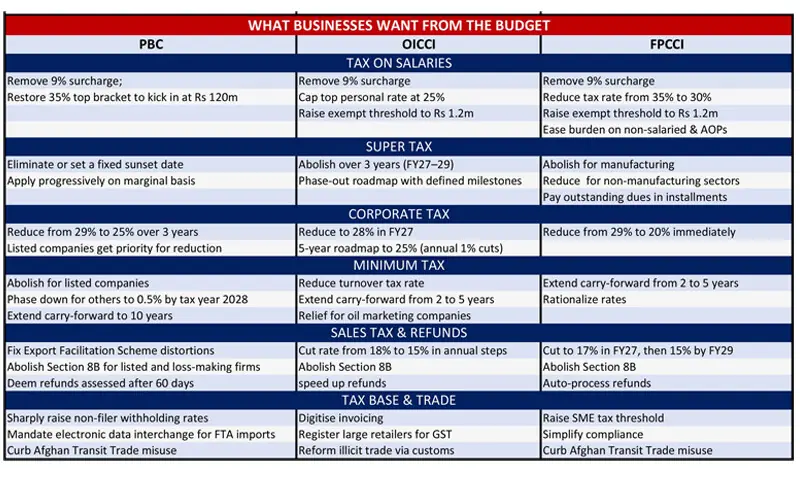
The government must stop shifting the cost of weak revenue mobilisation onto households and the corporate sector and instead offer targeted tax relief to offset the burden imposed in recent years, including a reduction in the petroleum levy. While support for the most vulnerable remains necessary given high poverty levels, sustained job-creating growth is vital.

It is unreasonable to tax a monthly income of Rs50,000, which falls below the amount required for a family’s subsistence. To make the tax regime more logical and equitable, the income tax threshold should be raised to Rs1.5 million per annum (Rs125,000 per month) from the current Rs600,000. The tax slabs and rates should then be recalibrated accordingly to preserve progressivity while providing meaningful relief to low-income earners.

At the same time, there is little justification for imposing a super tax on the already compliant corporate sector while large segments of the economy — including many services, retail and wholesale trade, real estate, and farm landowners — continue to remain undertaxed or effectively enjoy a tax holiday.

With inflation once again edging upward, the persistently high petroleum levy is adding to the cost pressures across the economy. The levy needs to be rationalised and gradually reduced to levels comparable with regional averages to provide much-needed relief to consumers and businesses alike.

‘Attempting to extract more taxes from an already stressed private sector is likely to generate frustration and resentment rather than meaningful additional revenues’

Measures to broaden the tax base by effectively bringing big property owners and traders into the federal tax net, while ensuring that provinces adequately tax agricultural income and other undertaxed service providers, could not only offset the revenue loss from providing relief to overburdened taxpayers but also generate substantial additional revenues.
 

The upcoming budget must deliver relief, not more burdens on taxpayers


Attempting to extract more taxes from an already stressed private sector is likely to generate frustration and resentment rather than meaningful additional revenues.

“A wider and more equitable tax base would improve compliance, reduce distortions, and strengthen fiscal sustainability without placing further pressure on already heavily taxed segments of society,” said a retired Federal Board of Revenue officer.

Meanwhile, revenue targets should be set realistically, considering the near-stagnant state of the economy, where economic growth is barely keeping pace with population growth. Under these circumstances, greater emphasis should be placed on reducing wasteful administrative spending and rationalising the costs of an oversized and inefficient state apparatus.

“Sizeable increase in tax revenues is rarely achieved in a low-growth environment,” observed a tax expert who requested anonymity. “Attempting to extract more taxes from an already stressed private sector is likely to generate frustration and resentment rather than meaningful additional revenues. It could further undermine business confidence, discourage investment, and deepen the economic slowdown at a time when the country can least afford it.”
 

Budget 2027 & fiscal illusion​


Tax potential is Rs30tr if informal economy, real estate & others are documented

Dr Ikramul Haq
June 01, 2026

budget 2027 fiscal illusion


Budget 2027 & fiscal illusion

ISLAMABAD: The principal reason for low revenue collection in Pakistan is weak fiscal management and a policy framework designed to appease tax evaders while burdening the already documented sectors. In 2026, while the numbers have become astronomical, the underlying disease remains unchanged.

The Federal Board of Revenue (FBR) is still missing targets, relying excessively on withholding taxes, manipulating figures through indirect levies, blocking refunds, coercing compliant sectors, and shifting the entire burden of fiscal failure onto salaried classes, consumers, withholding agents and documented businesses.

The latest figures expose the gravity of the crisis. During July-April of fiscal year 2025-26, the FBR reportedly collected around Rs10.25 trillion against a target of Rs10.90 trillion, leaving a shortfall of nearly Rs683 billion.

Income tax alone missed the target by around Rs210 billion, sales tax by Rs382 billion, customs duty by Rs79 billion and federal excise duty by Rs14 billion. In May 2026, the situation has not improved much, and the gap is now well over Rs750 billion.
 
Despite this alarming situation, the IMF-supported framework for Budget 2026-27 envisages an unprecedented FBR target of nearly Rs15.3 trillion coupled with a petroleum levy target of Rs1.73 trillion. This is nothing but another exercise in fiscal engineering.

What makes the situation more painful is the fact that the government continues to celebrate percentage growth figures while concealing structural failure. Inflation, currency depreciation and higher petroleum prices automatically increase nominal revenues, but this does not represent genuine tax reform or broadening of the tax base.

The real test is sustainable collection through proper assessment, voluntary compliance and documentation of untaxed sectors. On this count, the FBR continues to fail miserably.
 
The same old methods are being employed again. Advance taxes are collected prematurely, refunds are unlawfully withheld, arbitrary assessments are raised to create artificial "demand", and indirect levies are enhanced to bridge gaps.

Petroleum levy has now become the favourite instrument of fiscal manipulation because it does not form part of the divisible pool under Article 160 of the Constitution.

Provinces are deprived of their rightful share in general sales tax (made zero since March 1, 2022) while citizens suffer unprecedented fuel inflation. This is constitutional evasion masquerading as fiscal prudence.

The federal government has virtually substituted divisible-pool taxation with non-divisible levies, especially petroleum levy, thereby undermining fiscal federalism guaranteed under the Constitution and National Finance Commission (NFC) Awards.

The irony is painful. Even before parliament debates the Finance Bill, negotiations with the IMF have already concluded around how much additional burden could be imposed on citizens through indirect taxation and petroleum levy.

This is precisely why Budget 2027 increasingly appears less a sovereign fiscal exercise and more a compliance document prepared under external supervision.
 
The most disturbing aspect, however, remains the structure of tax collection itself. According to official data, nearly 90% of income tax collection now comes through withholding and advance taxes. Salaried persons, contractors, electricity consumers, telecom users, importers, exporters, bank account holders and corporate entities continue to finance the state through forced deduction regimes.

FBR's own contribution through audit, enforcement and recovery remains negligible.

The latest Revenue Division Year Book itself demonstrates this failure. Withholding taxes alone contributed over Rs3.38 trillion during FY2024-25. Salaried individuals paid over Rs605 billion, registering more than 55% increase compared to the previous year.

Retailers, wholesalers, speculative traders, real estate tycoons, absentee landlords and large segments of the undocumented economy continue to remain either undertaxed or entirely outside the effective tax net. T

he burden is, thus, concentrated on those already visible to the system.
 
To view this content we will need your consent to set third party cookies.
For more detailed information, see our cookies page.
 

Budget 2026-27: freelancers call for continued tax relief on foreign earnings

  • Extending 0.25% tax regime could boost freelancing, encourage local savings while supporting students, youth, and women, says PAFLA chairman
June 1, 2026
Gohar Ali Khan
B Recorder

Pakistan’s freelancers and digital workers have called on the government to preserve the reduced 0.25% tax rate on foreign exchange earnings for the next ten years, arguing that sustained policy support is essential for the sector’s growth.

While giving proposals for the Federal Budget 2026-27, freelancers urged the government to allocate funds for extensive capacity-building and training programmes, establish freelancing hubs in multiple cities, and provide subsidies for internationally recognised certifications.

“Extending the 0.25% tax regime for the next decade would encourage freelancers to retain their earnings in local banks and motivate students, young professionals, and women to adopt freelancing as a sustainable source of income,” Pakistan Freelancers Association (PAFLA) chairman Ibrahim Amin said.


He pointed out that freelancers registered with the Pakistan Software Export Board (PSEB) pay a tax rate of 0.25% on every foreign remittance received in their bank accounts, whereas a significant majority of freelancers are currently paying 1% tax on their earnings.
 
According to the State Bank of Pakistan (SBP), export receipts generated through freelancing in computer and information services surged to $959 million during July-April FY2025-26, compared to $642 million during the same period of the previous fiscal year, reflecting a year-on-year increase of 49%, or $317 million.

Govt urged not to impose additional taxes on content creators

Dr Imran Batada, President and CEO of PAFLA, said the government should also refrain from imposing additional taxes on content creators producing knowledge-based content, including skills training, news and analysis, educational content, and infotainment.

“PAFLA supports all digital workers contributing to the national economy, including YouTubers and influencers who uphold Pakistan’s cultural values and comply with relevant laws and regulations,” he said.
 
According to estimates, Pakistan is home to nearly three million full-time and part-time freelancers. Given the country’s large youth population, this number can grow significantly if an enabling environment and adequate support mechanisms are provided.

Said emphasised that freelancers must continuously upskill themselves in emerging fields such as artificial intelligence (AI) and cybersecurity to remain competitive and relevant in the global marketplace.

“In this regard, the government should design and implement a series of mentorship, training, and capacity-building programmes to guide both existing and aspiring freelancers,” he said.
 

What does IMF want from Pakistan's upcoming budget?


June 1, 2026
BR Web Desk

Pakistan’s ongoing engagement with the International Monetary Fund (IMF) is shaping many of the economic policies expected to feature in the upcoming federal budget and broader reform agenda.

Discussions between Pakistani authorities and the IMF have focused on fiscal consolidation, tax reforms, energy-sector restructuring, governance measures, and steps aimed at maintaining macroeconomic stability.

One of the IMF’s primary objectives is fiscal consolidation. Under the current programme, Pakistan has committed to maintaining a primary budget surplus, which measures government revenues against expenditures excluding interest payments on debt.The purpose of this target is to improve public finances and support debt sustainability.

A key component of this effort is increasing tax revenue. The IMF has urged Pakistan to strengthen revenue collection through a combination of administrative reforms and tax-policy measures.

Discussions have focused on broadening the tax base, reducing revenue leakages, improving compliance, and bringing more economic activity into the documented economy. The Federal Board of Revenue (FBR) has been working on measures aimed at increasing collections and improving enforcement mechanisms.
 

Users who are viewing this thread

Pakistan Defence Latest

Country Watch Latest

Back
Top