Pakistan Budget for FY 2026-27

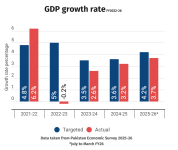
The minister said growth was on its way to the target at the start of the year, when only trade uncertainty was in the field, but two subsequent floods in August-September and the regional war in March tested Pakistan’s resilience. Still, Pakistan kept its journey from stability to growth on track, he said.

However, he said the reality was that Pakistan still had a long way to go and must stay the course of reforms and fiscal discipline.

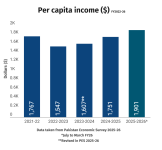
He said the size of the economy increased by 11pc to a record Rs126.87 trillion from Rs114.04tr last year, while per capita income improved to $1,901 in the outgoing fiscal year from $1,751 in FY25, reflecting improved economic activity and income growth.

The finance minister said the current account deficit dropped to just $252m in the first 10 months of the year, down from $17.4bn in FY22, as remittances reached $4.25bn a month in May — the highest in the country’s history — and were well on their way to reaching $41bn to $42bn by year-end against a target of $39bn.
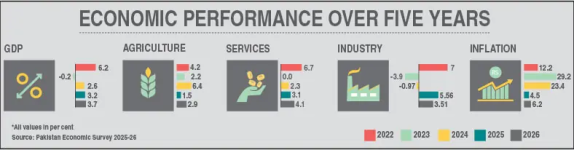
 
Exports faced challenges and were down by 5pc, mainly because of a $1.5bn decline in rice and sugar exports. Foreign exchange reserves held by the State Bank had already crossed $17.1bn and would touch $18bn to provide three months of import cover, a respectable level recognised globally, he said.

He said the fiscal deficit at 0.7pc of GDP in the first nine months was the best performance in decades and had come down from a peak of 8.4pc in FY22. This helped the primary balance reach 3.2pc of GDP in nine months, down from a 3.1pc primary deficit in FY22.

The minister said the debt-to-GDP ratio had fallen to 68.5pc this year, down from 75.2pc in FY23 and 70.7pc in FY24, meaning that debt sustainability was also improving.

The minister said FBR revenue collection increased by more than 10pc this year, adding that the revenue agency recovered Rs60bn in additional revenue from the cement and sugar sectors through digitisation and another Rs34bn through artificial intelligence-based audits of 800 high-risk cases. This would be expanded to other sectors in the next budget.

He said he welcomed criticism over a new scheme for traders but noted that 3m to 4m small traders were outside the tax net and a start had to be made somewhere.

Responding to a question on why the success stories he cited had not benefited the common man or led to higher growth, the minister said growth could be achieved in three months by pumping liquidity into the system, but that would not be sustainable, as past experience had shown.
 

Budget for FY2026-27 set to be presented in NA today

News Desk
June 12, 2026

The federal budget for the upcoming fiscal year (FY26-27) is set to be presented in the upper and lower houses of the Parliament today.

Finance Minister Muhammad Aurangzeb was expected to present the financial plan in the National Assembly at 3pm, but the session has yet to begin.

A meeting of the federal cabinet, chaired by Prime Minister Shehbaz Sharif, is in progress to approve the federal budget 2026-27 before its laid before the parliament.

In a post on X ahead of the NA session, PM Shehbaz said the budget has been prepared with “a lot of hard work and sincerity”.

He added that the “welfare and prosperity of Pakistan’s great nation has been given utmost priority”.
 

ECONOMIC SURVEY 2025-26: Pakistan trails South Asia region in most health benchmarks


Ikram Junaidi
June 12, 2026

ISLAMABAD: While Pakistan continues to spend less than 1pc of GDP [Gross Domestic Product] on health, its economic indicators are one of the worst in South Asia (SA).

According to Pakistan Economic Survey 2025-26, released by the government on Thursday, the Public Sector Development Programme (PSDP) allocation for health was just Rs19.37 billion. It claimed that the life expectancy at birth increased from 66.5 years in 2018 to 67.8 years in 2024, but the same for South Asia was 72.6 years.

While maternal mortality ratio (per 100,000 births) is 155 in Pakistan, the same ratio in SA is 120. Birth rate (crude) per 1,000 people, which means the number of live births occurring in a population of 1,000 people over one year, is 27.4 compared to 16.4 in SA. The infant mortality rate (per 1,000 live births) is 47 against 23.2 in South Asia.

The document further shows that even prevalence of HIV (total percentage of population 15-49 years of age) is slightly higher in Pakistan (0.20pc) compared to SA (0.19pc).

Pakistan has better numbers in prevalence of overweight (percentage of children under 5) -- 2.1 -- compared to 3.4 in SA. However, in terms of people using at least basic sanitation facilities, 82pc of the population get the facility in SA compared to 71.9pc in Pakistan. In SA, 95.9pc people using at least basic drinking facilities, while in Pakistan the ratio is 90.7pc.

As many as 11.7pc of the population in South Asia are undernourished compared to 16.5pc in Pakistan. Similarly, 31.5pc children (under age of 5) in South Asia are facing stunting while the percentage in Pakistan is 33.6.
 
Year on year indicators

According to the Economic Survey, year-on-year indicators have improved, as there were 319,572 doctors in 2024 and the number increased to 336,582 in 2025. Similarly, the number of dentists has also increased from 39,088 in 2024 to 42,118 in 2025. The number of nurses did not increase and their number remained at 138,391. Similar is the case with midwives and lady health workers with their numbers remaining at 46,801 and 29,163, respectively.

As per Pakistan Social Living Standard Measurement Surveys (PSLM), progress was also observed in child health as the immunisation coverage rose from 68 per cent in 2018–19 to 73 per cent in 2024–25 alongside reductions in neonatal mortality from 41 to 35 per 1,000 live births and infant mortality from 60 to 47 per 1,000 live births.

Pakistan has also made progress toward achieving SDG 3 — good health and well being — despite facing challenges. As per the Sustainable Development Report 2025, Pakistan ranked 140th among 167 countries.
 

Pakistan's young population could power its economy. The Economic Survey shows why it won't


Reading Pakistan's demographic question through the Economic Survey 2025-26.

Durre Nayab
June 12, 2026

Twenty years ago, I asked whether Pakistan’s swelling working-age population would prove a demographic dividend or a demographic threat. The answer, I argued then, depended entirely on what governments chose to do, in education, health, and labour market policy, while the window remained open. That window ran from 1990 to roughly 2045 at that time. We are now 35 years into it.

The Economic Survey 2025-26, released on Thursday, offers the most current evidence on how the choice has been made. The government’s foreword celebrates GDP growth of 3.7 per cent, a historic primary surplus, and multi-year-high foreign exchange reserves.

Fine. But macroeconomic stabilisation and the realisation of a demographic dividend are not the same thing, and a country that has been “stabilising” for 30 years without resolving its human capital deficit must at some point ask: stabilising for what exactly, and for whom?

The demographic dividend lives or dies in Chapters 10 through 12 of this Survey, i.e., the chapters on education, health, population and labour force. Read them carefully, and the celebration in the foreword becomes harder to sustain.
 

Our population

Pakistan’s population stands at 252 million, growing at 2.07pc annually. Some 56.9pc falls in the working-age group; 26.6pc is the youth cohort of 15–29 years. These are the proportions that define dividend potential. They are real, and, by a perverse irony, the window to capitalise on them has actually extended.

Earlier estimates placed the close of the demographic dividend around 2045; the slow pace of fertility decline has pushed that to roughly 2055, adding a decade to the opportunity. But this is not good news.

A slower fertility transition means a larger, longer-sustained dependent population, more pressure on already strained services, and a dividend that can only be realised if investment in human capital accelerates, not defers, to match the extended timeline.

Health and education, the two sectors most essential to human capital development, command 1.6pc of national income from the state

Population growth is routinely treated as the problem to be solved, with family planning presented as the primary lever. That framing is too narrow, and the evidence does not support it.

Population, education, health, and employment do not operate in a one-way causal chain; they are mutually constitutive. Better education, especially for girls, delays marriage and lowers fertility. Better health reduces child mortality and, with it, the precautionary demand for large families.
 

Education investment

Every year of deferred investment in this cohort (or group of people of this shared demographic) compounds backward. The fertility transition continues on a “slow decline” scenario, the Survey’s own framing, which means the base of the population pyramid remains heavily loaded at 39.5pc under 15 years. The window is not yet closed. But it is not widening, and the investment to match it is not arriving.

Looking at education, we see the same gap. Pakistan’s Human Development Index rank is 168. Expected years of schooling, 7.9 years, is the lowest in the South Asian comparison table the Survey itself provides. Below Nepal. Below Bangladesh. Below Afghanistan. Mean years of schooling stand at a low 4.3 years.

Literacy stands at 63pc for those aged 10 years and above, going down to 54pc for women. In Balochistan, female literacy is 25 per cent in rural areas. These are populations the Survey simultaneously describes as the beneficiaries of the demographic dividend opportunity.
 

Health investment

Moving to health, we see some progress, but it has not closed the gap. Life expectancy improved from 66.5 to 67.8 years. Infant mortality fell from 60 to 47 per 1,000 live births.

These are gains and should be acknowledged, but Pakistan’s infant mortality rate is double the South Asian average of 23.2 per 1,000 live births. Life expectancy trails the regional average by nearly five years.

Public health expenditure is 0.8pc of GDP, precisely what education also receives, meaning together the two sectors most essential to human capital development command 1.6pc of national income from the state.

The nutrition data is where the macro stabilisation story meets its starkest counternarrative. Stunting in children under five is 33.6pc, above the South Asian average of 31.5pc.
 

Not the right jobs to save

Labour earning constitutes the basis of the whole notion of demographic dividend. The Economic Survey’s labour market data present a paradox that deserves to be read slowly.

Between 2020–21 and 2024–25, the employed labour force grew from 67.25 million to 77.2 million, i.e., ten million additional employed persons. This is real. But in the same period, the unemployed grew from 4.51 million to 5.9 million, and the unemployment rate rose from 6.3pc to 7.1pc. Both are growing. Unemployment is growing faster.

Manufacturing’s share of employment declined from 14.9pc to 14.8pc, effectively zero net industrial absorption of a dramatically larger workforce. The growth sectors are community and social services, and wholesale and retail trade: large, informal, low-productivity, low-wage.

The demographic dividend’s promise is not jobs of any kind; it is productive employment that generates savings, taxation, and the intergenerational transfers that compound growth.

The Survey reports 762,499 workers registered for overseas employment in 2025, with 69.5pc going to Saudi Arabia. Remittances are valuable. But the Survey also presents a Saudi-Pakistan Human Resource Deployment Plan targeting 1.51 million annual Pakistani worker deployments by 2039.

At what point does organised labour export at this scale stop being a bridge to domestic development and become a permanent substitute for it? The Survey does not ask. It should.
 

ECONOMIC SURVEY 2026-27:

Poverty surges 7pc, pushing 27m people into financial distress

Bakhtawar Mian
June 12, 2026

ISLAMABAD: National poverty rate has surged by seven per cent, pushing approximately 27 million additional people into financial distress over the last six years and bringing the total number of the impoverished population of the country to 70m, according to the Economic Survey 2025-26.

The survey figures show that poverty was 21.9pc in 2018-19 which increased to 28.9pc in 2024-25. Poverty remained significantly higher in rural areas. Rural poverty increased from 28.2pc to 36.2pc, while urban poverty increased from 11pc to 17.4pc over the same period.

At the provincial level, poverty increased across all major provinces. In 2024-25, poverty was estimated at 23.3pc in Punjab, 32.6pc in Sindh, 35.3pc in Khyber Pakhtunkhwa, and 47pc in Balochistan. In 2018-19, the corresponding rates were 16.5pc, 24.5pc, 28.7pc, and 41.8pc, respectively. Balochistan continued to record the highest poverty incidence, while Punjab remained the lowest among the four provinces, the survey says.

The surge in poverty is attributed to prolonged economic shocks, including record-high inflation, currency depreciation, IMF stabilisation measures, catastrophic climate events like floods and the Middle East conflict. The adverse situation has weakened people purchasing power, raised food insecurity and strained remittance-receiving families, the survey says.
 

ECONOMIC SURVEY 2025-26: Digital economy grows as IT sector posts gains

Kalbe Ali
June 12, 2026

5G spectrum auction rakes in $510m; broadband penetration surges to 64.2pc; telecom revenues reached Rs837bn; IT & telecom sector’s export remittances climb to $3.38bn
• 161.6m mobile handsets locally manufactured due to heavy import duties


ISLAMABAD: Pakistan’s information technology and telecommunication sector marked significant expansion during the fiscal year 2025-26, driven by a $509.6 million 5G spectrum auction and a surge in broadband penetration to 64.2pc.

According to the Economic Survey 2025-26, the outgoing fiscal year saw sweeping improvements in accessibility and connectivity.

Cellular mobile services now cover 92pc of the population, with 3G and 4G signals reaching over 81pc of the country’s area. Broadband penetration has nearly doubled from 32.6pc in 2019.

Telecom revenues reached Rs837bn in 9MFY26, bolstered by $567 million in sector investments. The industry contributed Rs285bn to the national exchequer through taxes and duties. Total telecom subscriptions, encompassing both mobile and fixed-line services, hit 207.22m in March.

To further expand internet access, the National Assembly on Thursday approved the Pakistan Telecommunication (Reorganisation) (Amendment) Act, 2026.
 

Users who are viewing this thread

Pakistan Defence Latest

Country Watch Latest

Back
Top