Pakistan Budget for FY 2026-27

Allocation under this category is set to rise by 39.62pc to Rs925.83bn from Rs663.08bn in the current fiscal year, accounting for almost 31pc of the defence budget.

The sizeable increase suggests renewed emphasis on force modernisation and equipment acquisition following a period in which personnel and operational costs had absorbed a growing share of military expenditure.

Major military imports and acquisitions are usually in addition to the allocation made under this head and are not disclosed.

Spending on civil works, which includes maintenance of military infrastructure and construction of new facilities, is projected to increase by 7.92pc to Rs363.16bn from Rs336.49bn.

Military pensions are budgeted separately and are not included in the defence services allocation. The government has earmarked Rs822bn for pensions of retired military personnel under the federal pension head.

An additional Rs10.9bn has been allocated for defence administration compared to an original allocation of Rs7.9bn in the outgoing fiscal year, which was later revised upward to Rs11.75bn.

As in previous years, the published budget does not disclose expenditure on Pakistan’s nuclear weapons programme, which is believed to be financed through separate classified allocations.
 
According to the latest estimates by the International Campaign to Abolish Nuclear Weapons, Pakistan spent about $1.5bn on its nuclear programme in 2025, equivalent to roughly Rs418bn at current exchange rates, although no official figure is publicly available.

The increase in defence spending comes despite continuing fiscal pressures.

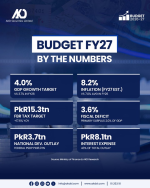
Inflation averaged 7.5pc during the outgoing fiscal year and is projected at 8.2pc in 2026-27, while the government remains engaged in efforts to maintain fiscal discipline under its economic stabilisation programme.

Therefore, the proposed allocation reflects the difficult choice the government faced while balancing economic constraints with security imperatives. Even as pressure persisted for greater spending on development and social sectors, the government appears to have concluded that the prevailing security environment warrants continued growth in defence expenditure.

By comparison, Rs1tr has been allocated for development projects, including Rs25.1bn for healthcare under federal government-run institutions and Rs46bn for higher education.
 

BUDGET 2026-27: Rs5.29bn set aside for training of 120,000 youth in IT, digital skills

Bakhtawar Mian
June 13, 2026

ISLAMABAD: The federal government has allocated Rs5,290.49 million to train 120,000 youth in IT and digital skills under the Prime Minister’s Youth Skills Development Programme.

Finance Minister Muhammad Aurangzeb, in his budget speech, highlighted the importance of the country’s youth population, describing it as Pakistan’s biggest asset. He said 67 per cent of the country’s population is below the age of 30.

“Our youth possess a strong spirit for acquiring skills and utilising them for the development of the country,” he said, adding that Prime Minister Shehbaz Sharif has resolved that every Pakistani youth should have access to modern skills and training in various trades, enabling them to actively contribute to the country’s progress and development.

However, despite these claims and the rising unemployment rate, the budget contains no specific allocation for employment generation or any dedicated jobs programme, apart from the Rs5,290.49m earmarked for training 120,000 youth under the existing PM’s programme.

Moreover, the government has recently merged and shut down several departments, resulting in the layoff of thousands of workers. Some departments and organisations have also been privatised.
 

BUDGET 2026-27:

Business leaders see no vision for manufacturing, export sectors

Aamir Shafaat Khan
June 13, 2026

• Trade associations see relief ‘selective’ as costly energy to continue hindering economic growth
• Term omission of Final Tax Regime a setback for industry


KARACHI: Business leaders offered a cautious welcome to the Rs18.7 trillion federal budget, describing it as a mix of relief measures and missed opportunities.

While acknowledging steps aimed at easing the tax burden on businesses and salaried individuals, they argued that the budget falls short of presenting a coherent strategy for export growth, industrial revival and long-term economic expansion.

Federation of Pakistan Chambers of Commerce and Industry (FPCCI) President Atif Ikram Sheikh said the economy had shown signs of stabilisation, citing GDP growth of 3.7pc, a fiscal deficit of 0.7pc of GDP, and a 23pc decline in public debt-servicing costs.

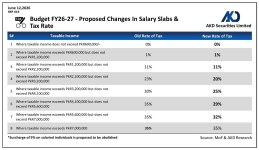
He welcomed several measures incorporated from FPCCI proposals, describing them as a partial shift towards a growth-oriented model. These include the abolition of Capital Value Tax on foreign assets, the removal of the Federal Excise Duty on international business-class travel, the elimination of super tax on income slabs up to Rs500 million, and a reduction in the rate from 10pc to 8pc for higher incomes. Exporters have been exempted from super tax, while tax rates for salaried individuals have also been reduced.
 

Subsidies cut by 8pc to Rs1.09tr

Kalbe Ali
June 13, 2026

• New housing scheme gets Rs71bn
• Subsidy for electricity consumers reduced from Rs1.036tr to Rs830bn


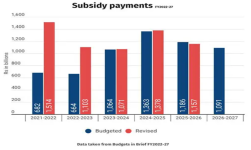
ISLAMABAD: The federal government has slashed subsidies by eight per cent to Rs1,091 billion for 2026-27 against Rs1,186bn allocated for the outgoing fiscal year.

Incidentally, out of the Rs1,186bn allocated for FY26, actual spending remained at Rs1,157bn, mainly due to a decline in electricity-related subsidies. A new head, PM Apna Ghar Programme, has been created for FY27 with an allocation of Rs71bn.

However, an additional Rs127bn was spent in FY26 under the PM’s austerity measures outside the budget, amid the situation in the Middle East following the US-Israeli war on Iran.

The government was unable to utilise the total allocation earmarked for electricity consumers. Subsidies to the power sector were budgeted at Rs1,036.13bn in FY26, but actual spending remained at Rs893.136bn.

The government has now reduced the subsidy for electricity consumers from Rs1,036bn to Rs830bn for FY27.

The subsidy for tariff differential on agricultural tube wells in Balochistan was allocated at Rs4bn in FY26 and has been reduced to Rs3bn for FY27.

The allocation for inter-Disco tariff differential subsidy stood at Rs249.13bn in FY26 and has been reduced to Rs248bn in FY27.
 
There is nothing in this budget for the poor. Infact, the poor will become more poor.

New taxes hve been announced on milk, milk, milk based products, cooking Oil, crockery, plastic ware, sanitary, bathroom fittings, shoes and bags etc.
Pesticides and detailed packed insecticides get taxed which will affect small growers and farmers.

On the flip side, revenue from petrol levy which massively affects inflation remains, the power sector taxes remain, no benefits or checks on pharmaceuticals, schools, colleges an universities, transportation has no benefits, no incentives on garments and hosiery and no incentive for pulses and oil that is imported.

Incentives have been given on EV, Cigarette manufacturer, industrialists, and property sector .... while no incentives in sight for chemical, industrial gases and petroleum by product industries.

Now lets see the givernmwnt praise this as growth oriented and pro poor budget
 
To view this content we will need your consent to set third party cookies.
For more detailed information, see our cookies page.
 
To view this content we will need your consent to set third party cookies.
For more detailed information, see our cookies page.
 
To view this content we will need your consent to set third party cookies.
For more detailed information, see our cookies page.
 
To view this content we will need your consent to set third party cookies.
For more detailed information, see our cookies page.
 
I hate this guy but for those who can read Urdu sobering and eye opening :

Same thing he is saying what I hav even warning about …. Fudging numbers and fency graphics cannot hide the fact that we are heading towards a catastrophe


We are in a catastrophe, not heading towards it
 

Users who are viewing this thread

  • Country Watch Latest

    Back
    Top