Pakistan Budget for FY 2026-27

If 6% GDP growth rate after 2 years of COVID triggers you, I am not sure if I have any solution fot you.
Brother it was fake growth which caused greater issues afterwards. It's been repeated to death on this forum multiple times by multiple members so I don't wanna go through it again but it wasn't a sign of success in anyways. But let's just agree to disagree IG cause I don't want to derail the thread.
 
I would argue despite facing COVID, Pakistan’s growth was better than the growth experienced in the last 4-5 years under the current government.

The current government has enjoyed an extended period of low oil prices, steady growth in world economy, and a one-page hybrid rule (one can argue its a martial law facade).

Despite all this, why is Pakistan’s growth stuttering? Is Pakistan not attractive enough to potential investors? Is there a flaw in Pakistan’s government machinery that the investors look elsewhere? Is the Pakistani workforce not smart enough? Some deep introspection required.
 

Pakistan’s outstanding sovereign guarantee exposure projected to cross Rs5 trillion by June 2027​

Government plans Rs907 billion in guarantees for Reko Diq, ML-3, C-5 power project and other projects; power sector accounts for 56% of current exposure


Pakistan’s outstanding sovereign guarantees and other contingent liabilities reached Rs4.32 trillion by the end of March 2026 and are projected to exceed Rs5 trillion by June 2027 as the government plans additional support for major energy, mining and infrastructure projects.

The government plans to issue guarantees worth Rs907 billion during fiscal year 2026-27, including the final quarter of FY26.

The proposed commitments include Rs223 billion for the Reko Diq mining project, Rs221 billion for the Nuclear C-5 1200MW power project and Rs113 billion for the ML-3 railway project.

Another Rs90 billion has been set aside for public-private partnership projects, while Rs80 billion is planned for credit guarantee schemes.

The proposed guarantee envelope also includes Rs50 billion each for the Water and Power Development Authority, Pakistan State Oil and miscellaneous or contingency requirements.

The National Grid Company of Pakistan may receive guarantees worth Rs19 billion, while Rs10 billion has been proposed for the Export-Import Bank of Pakistan.

The guarantees are primarily issued on behalf of state-owned enterprises to help them secure financing at lower costs, access concessional loans and fund infrastructure and operational requirements.


Although sovereign guarantees are not counted as direct public debt, they could become government liabilities if the borrowing entities fail to meet their repayment obligations.

Net guarantees projected at Rs683 billion

During the first nine months of FY26, the government issued or rolled over guarantees worth Rs769 billion, equivalent to 0.61% of gross domestic product.

The amount remained below the statutory annual ceiling of 2% of GDP prescribed under the Fiscal Responsibility and Debt Limitation framework.


After adjusting for an estimated Rs224 billion in repayments against existing guaranteed loans, net guarantee issuance is projected at Rs683 billion.

This would increase the outstanding stock from Rs4.32 trillion to around Rs5.005 trillion by the end of June 2027.

Power sector dominates exposure

The power sector accounts for Rs2.43 trillion, or 56%, of the government’s existing guarantee portfolio. The concentration reflects continued sovereign-backed borrowing by power-sector entities, including the Central Power Purchasing Agency-Guaranteed.


Circular debt, payment delays and liquidity constraints across the electricity supply chain have kept the power sector the largest source of contingent fiscal exposure.

Commodity operations represent the second-largest category, accounting for Rs895 billion, or 21%, of outstanding guarantees.

These guarantees support procurement and storage operations undertaken by the Trading Corporation of Pakistan and the Pakistan Agricultural Storage and Services Corporation.

Major state-owned entities


At the institutional level, the Pakistan Atomic Energy Commission has the largest exposure, followed by the Central Power Purchasing Agency-Guaranteed and PASSCO.

Pakistan State Oil and the Water and Power Development Authority are also among the principal recipients of sovereign guarantees because of their roles in energy and infrastructure financing.

Guarantees linked to the aviation sector stand at Rs269 billion, while financial-sector exposure amounts to Rs166 billion. Other categories account for another Rs567 billion.

Interest rate and maturity risks


Around 51% of guaranteed obligations carry floating interest rates, while the remaining 49% are based on fixed rates. Most of the underlying loans have maturities of around five years, creating continuing refinancing and rollover requirements.

The planned guarantees for FY27 are expected to expand the government’s contingent exposure further, with energy, mining, railways and state-owned enterprises remaining the main sources of risk.
 
IMG-20260614-WA0062.jpg
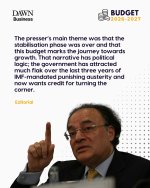
EDITORIAL:Official post-budget media briefings in Pakistan are carefully choreographed affairs, full of reassuring phrases like ‘moving in the right direction’, ‘resilience’, and ‘enabling business and investment environment’ delivered by the keepers of the public exchequer.

After the briefings end, journalists walk away with little they did not already know. The post-budget presser by Finance Minister Muhammad Aurangzeb was no different.

While talking with the characteristic confidence of a bank executive, he could not quite paper over the tension at the heart of the new budget: a document trying to be a relief budget, a growth budget and a consolidation budget all at once — and only partially succeeding at each.

Read more: https://www.dawn.com/news/2007731
 
Brother it was fake growth which caused greater issues afterwards. It's been repeated to death on this forum multiple times by multiple members so I don't wanna go through it again but it wasn't a sign of success in anyways. But let's just agree to disagree IG cause I don't want to derail the thread.

Fake growth ? The numbers were not even PTIs.. but let's leave it.

I am not here to change minds or to further the cause
 
Pension has become a big problem and will become unsustainable in near future. Without pension reform we are looking at yet another abyss.
 
@RocketLaw

The Government of Pakistan has announced a increase of 39.62% in funding for defense physical assets,


Well, Pakistan lives in a tough neighbourhood and has no choice but to raise defense spending.

Regards


Taking "we will eat grass" to a whole new level.

It seems we have developed appetite for it and now finding reasons to continue eating grass.
 

Textile sees budget ‘balanced’; poultry, plastic sectors, trade unions raise concerns

Dawn Report
June 14, 2026

LAHORE: Business and industry associations delivered mixed verdicts on the federal budget, with textile exporters hailing a number of tax and financing measures as supportive of investment and export whereas poultry and plastic manufacturers voiced concerns over burdensome taxation and policy inconsistencies.

The Pakistan Textile Exporters Association (PTEA) termed the budget balanced and growth-oriented, saying it reflected the country’s economic realities and contained measures that could stimulate industrial activity and support sustainable growth.

Chairman Sohail Pasha appreciated the government’s efforts to support economic recovery, industrial expansion and ease of doing business. He said the budgetary measures would strengthen investor confidence, encourage business expansion and generate employment, while ultimately benefiting lower-income segments of society.

He said improving macroeconomic indicators, stable remittances inflows and rising economic confidence were expected to support stronger GDP growth in the coming years.

Welcoming the abolition of super tax for entities with income up to Rs500 million and the reduction in tax collection on export proceeds from 2 per cent to 1.25pc, he said the measures would provide much-needed relief to exporters, improve liquidity, encourage investment and support export-led growth.
 

18pc sales tax abolished on shipping sector


Kalbe Ali
June 14, 2026

1781434267261.png

ISLAMABAD: To boost the maritime and logistics sectors, the federal government has abolished the 18 per cent sales tax on the shipping industry for 2026-27.

On Saturday, Maritime Affairs Minister Muhammad Junaid Anwar Chaudhry said the decision was taken to fulfil a long-standing industry demand to improve the shipping sector’s competitiveness.

“The abolition of the 18pc sales tax will facilitate trade by lowering transportation and logistics costs,” the minister said in a statement, adding that the measure will encourage investment in the maritime sector and support the growth of local shipping services.
 

BUDGET 2026-27: Govt shifts focus to tax enforcement

Mubarak Zeb Khan
June 13, 2026

• Plans raising Rs500bn through administrative steps, Rs150bn from new measures
• Officials say IMF has been briefed on enforcement strategy ahead of upcoming review


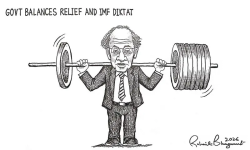
ISLAMABAD: In what appears to be an unusual budget in recent years, the government has placed greater emphasis on enforcement measures rather than introducing new taxes to meet its revenue targets, a strategy that is expected to be tested over the next three to six months ahead of the International Monetary Fund (IMF) review.

Policymakers have sought a policy space from the IMF to assess this approach, aiming to avoid placing additional burden on existing taxpayers while lowering certain rates to stimulate growth and improve tax collection.

“We have convinced the IMF of this strategy,” an official involved in the budget process said, adding that alternative measures remain available if the approach fails to deliver the desired results.

The tax proposals aim to generate approximately Rs150 billion through new measures, while a significantly larger amount of around Rs500 billion is expected to come from enhanced enforcement. The government set the FBR target at Rs15.3 trillion for FY27.

In addition, the federal government has already asked the provinces to contribute between Rs1.3tr and Rs1.7tr to help bridge the shortfall in Federal Board of Revenue collections. The centre also plans to raise a further Rs1.7tr through the petroleum development levy.
 
Sales tax revenue measures

The government has expanded sales tax at the retail stage by placing 19 food and non-food items in the Third Schedule of the Sales Tax Act to collect 18 per cent sales tax at the consumer price. These include sugar confectionery, pasta, sauces, jams and fermented beverages, as well as footwear, bathroom accessories, crockery, automobile parts, milk products, hair and shaving preparations, tissues and sanitary paper, household utensils, ceramic sanitary ware, petroleum jelly and waxes.

The list also covers insecticides, plastics, tableware, kitchenware, furniture and other household articles, bringing everyday consumer goods under retail price taxation.

It has been proposed that toll manufacturers will withhold sales tax from unregistered buyers. The association of persons and individuals will also withhold sales tax at the rate of 5pc from unregistered suppliers.

Similarly, the government proposed recovering 3pc value-added tax from manufacturers if the imported raw material is sold in the same state.
 
Income tax revenue measures

The government has proposed a tax on sham life insurance policies in order to discourage their misuse. A withholding tax regime has been introduced on revenues received by digital content creators and social media influencers from platforms such as YouTube, Facebook, Instagram and TikTok. Banking and financial institutions will deduct tax on such receipts.

The withholding tax regime on services has been revised, with rates increased from 6pc to 7pc for services such as courier, logistics, hotel, transport, air cargo, car rental, human resource outsourcing and oil drilling. The withholding tax rate has also been set at 14pc for other services, 12pc for terminal and port services, and 15pc for independent professional services.

The reduced minimum tax rate for distributors, dealers, sub-dealers and wholesalers of specified sectors has been increased from 0.25pc to 0.5pc.
 
FED revenue measures

The government has expanded the scope of excise taxation, raising the duty on e-liquid for electronic cigarettes to Rs16,500 per kilogram from Rs10,000 while scrapping the earlier 65pc tariff on retail price.

Federal excise duty (FED) has been imposed on naphtha, solvent oil and turpentine, while rates on luxury electric and other high-end vehicles have been revised upward. Vehicles with an import value of Rs20m to Rs30m will be subject to a 30pc FED, while those valued above Rs30m will face a 40pc duty.

FED on luxury internal combustion engine vehicles has also been increased, with a 70pc rate proposed for vehicles with engine capacities between 2,000cc and 3,000cc and 81pc for those above 3,000cc
 
Fixed tax for small shopkeepers

The new scheme applies to single-shop retailers with annual sales of up to Rs200 million and covers only the income earned from that shop. To prevent misuse, clear exclusions have been set: businesses with sales above Rs200m, owners of more than one shop, sellers of jewellery or branded clothing, professional service providers such as doctors, engineers and lawyers, as well as carts, kiosks and small street stalls, will not qualify.

National faceless centre

In the Finance Bill, the government introduced a plan for a centralised digital tax operating model, under which audits and assessments would be handled by “faceless” wings in Islamabad to reduce official discretion and direct contact between tax officials and taxpayers.

Pakistan’s new tax operating model is scheduled for a three-phase rollout beginning in October this year. The new model introduces separate audit and assessment wings, both operating virtually and facelessly from a centralised hub in Islamabad.

Under the proposed plan, Inland Revenue operations will be restructured into three functionally separate wings, each operating with a defined mandate, distinct statutory powers and non-overlapping responsibilities.
 

Users who are viewing this thread

Country Watch Latest

Back
Top