Pakistan Budget for FY 2026-27

To view this content we will need your consent to set third party cookies.
For more detailed information, see our cookies page.

4 black holes that are and will keep sinking us till fixed:

1/ Unwillingness to tax the untaxed sectors and documentation of the economy.

2/Pension reforms. We are now at around 1.2 trillion mark and rising fast.

3/ NFC rationalization and enforcement of PFC.

4/ Privatization. SOEs are leaking 1 trillion plus
 
Ok, can you explain the reasoning for bringing down the education spending? And also the government says it wants a "export" economy but we don't see investment into those sectors, why is that? I also read through these reforms and none of them are substantially beneficial to the country at large.(the link u sent)
I tried to compare Pakistani federal system. Got this response from AI .

" Unlike India, Education is no longer a concurrent list subject in Pakistan. Following the passage of the 18th Constitutional Amendment in 2010, the Concurrent Legislative List was abolished, and the responsibility for education was fully devolved to the provincial governments. [1, 2]"
 
4 black holes that are and will keep sinking us till fixed:

1/ Unwillingness to tax the untaxed sectors and documentation of the economy.

2/Pension reforms. We are now at around 1.2 trillion mark and rising fast.

3/ NFC rationalization and enforcement of PFC.

4/ Privatization. SOEs are leaking 1 trillion plus
You missed a 5th - babus factor
 

KP to unveil Rs2.15tr tax-free budget today

Manzoor Ali
June 19, 2026

• ADP allocation pitched at over Rs235bn; own-source revenue target set at Rs182bn
• Govt workers to get 7pc raise
• No new taxes to be introduced
• Official says federal grant approval subject to Imran’s assent


PESHAWAR: The Khyber Pakhtunkhwa government will unveil its over Rs2.15 trillion tax-free budget for fiscal year 2026-27 on Friday.

Sources told Dawn that the provincial government has allocated over Rs235 billion for the Annual Development Programme (ADP) in the budget, while its own-source revenue has been pitched at Rs182bn.

“We have based our budgetary estimates on the Federal Board of Revenue tax target of Rs15.2tr,” an official told Dawn. He said the provincial government had also decided to give a seven per cent pay raise to government employees, along with an increase in conveyance allowance.

Besides, he said no new taxes would be introduced in the budget and the government had decided to reduce the infrastructure development cess to 0.75pc from the existing 2pc.

The official said tax on five-marla houses would also be reduced, benefiting over 200,000 households. He said the budget would also include loans for students as well as Pakistanis going overseas. He said it would be a pro-growth budget.

However, the official added, the approval of the federal grant would be subject to the assent of incarcerated Pakistan Tehreek-i-Insaf founder Imran Khan.

The finance department, in its budget strategy paper released in May, had pitched the budget outlay at Rs2.3tr for the next fiscal year, with federal tax assignment estimated at Rs1.6tr.

In addition, the province’s own-source revenue was pitched at Rs150bn, merged areas funds at Rs321bn and foreign project assistance at Rs160bn.
 
The budget strategy paper had pitched the settled areas’ current budget at Rs1.5tr and ADP at Rs426bn. Besides, current expenditure for merged areas was estimated at Rs181bn, while their ADP was pitched at Rs153bn.

The paper stated that in the current fiscal year, development spending faced challenges in meeting targets, with actual expenditure reaching only Rs169bn against a budget estimate of Rs547bn, reflecting a 30pc achievement rate.

“This has resulted in a downward revision of the total expected development outlay to Rs444bn, though this still represents a 31pc increase over the previous year’s actual spending. Overall, the grand total of expenditures as of March stands at Rs988bn, 50pc of the budget, leading to a rationalised annual growth projection of 19pc as the government balances fiscal restraint with protected obligations,” it said.

Meanwhile, a notification issued by the assembly secretariat stated that in pursuance of sub-rule (1) of Rule 33 of the Khyber Pakhtunkhwa Government Rules of Business, 1985, the annual budget for financial year 2026-27 would be presented before the Khyber Pakhtunkhwa Assembly on June 19 (today) at 2pm.
 
Excellent analysis by moeed pirzada on india vs pak budget comparisons. Jaag punjab jaag .

To view this content we will need your consent to set third party cookies.
For more detailed information, see our cookies page.
 

FinMin says govt focused on broadening tax base, not burdening salaried class in budget​


Rejects concerns over GDP calculations and economic data, says govt has presented balanced and growth-oriented budget

Waqas Ahmad/APP
June 20, 2026

finance minister muhammad aurangzeb photo file


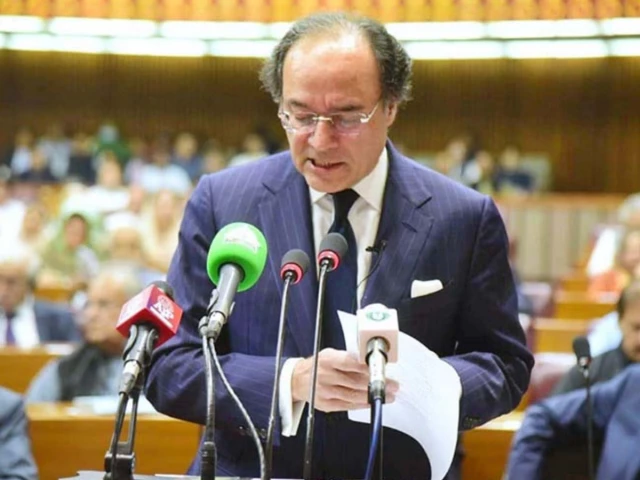
Finance Minister Muhammad Aurangzeb.

ISLAMABAD: Finance Minister Muhammad Aurangzeb on Saturday said that Pakistan’s macroeconomic indicators remained stable and the government was focused on expanding the tax base rather than increasing the burden on salaried individuals.

"In this budget, we have taken additional and strong steps in this regard, and keeping in mind the principles of equity and fairness, we have reduced the burden of tax on the existing taxpayers, especially the salaried class, small businesses, industries, exporters and construction industries, whereas the provision of property loans has been ensured for the export sector and agriculture", The finance minister said, “ said Aurangzeb while winding up budget debate in the National Assembly.

“To expand the tax net, retailers have been made part of the system through an easy scheme, and comprehensive steps have been taken to further improve compliance and enforcement,” he added.
 
FinMin said the government had presented a “balanced, growth-oriented and stability-focused budget,” under the leadership of Prime Minister Muhammad Shehbaz Sharif, with key macroeconomic indicators showing significant improvement over the past year.

He said the Pakistan Bureau of Statistics (PBS) continues to compile national accounts under the United Nations System of National Accounts (SNA 2008), using 2015–16 as the base year. He added that GDP growth of 3.7 percent reflects real economic activity measured at constant prices in line with international practice.

Aurangzeb said national accounts are approved by the National Accounts Committee, which includes representatives from federal and provincial governments, the State Bank of Pakistan, academia and other relevant institutions.

He said that nominal GDP was calculated at current market prices and converted into US dollars using average exchange rates, with Pakistan’s economy estimated at around $452 billion in FY2025–26. He added that per capita income was based on gross national income and population estimates derived from the 2023 census.
 
Federal Minister for Finance and Revenue, Senator Muhammad Aurangzeb, while concluding the general debate on the budget, commended the substantial saving of 5 billion rupees under the Prime Minister of Pakistan's austerity campaign from the budget allocated for the National Assembly for the fiscal year 2025-26, and expressed gratitude to the Speaker of the National Assembly, Sardar Ayaz Sadiq.

To view this content we will need your consent to set third party cookies.
For more detailed information, see our cookies page.
 
On economic targets, Aurangzeb said remittances had reached $4.25 billion last month and expressed confidence that the annual target of $41 billion would be achieved.

He added that IT exports had increased by 20 per cent and were expected to exceed $4.5 billion, while freelancers had recorded earnings of $1.6 billion.

He said the Federal Board of Revenue’s (FBR) performance had improved, noting that the government collected an additional $14 billion in revenue over the past two years. He compared this with earlier periods, saying similar increases took 23 years (1988–2011) and 13 years (2011–2024), respectively.

The finance minister said ongoing reforms were focused on bringing retailers into the tax net and strengthening the revenue system.
 
The finance minister announced agriculture-related relief measures, describing the sector as the backbone of the economy. These include collateral-free loans worth up to Rs300 billion for small farmers, expected to benefit around 750,000 farmers.

He said Rs4.2 billion had been allocated for agriculture and livestock projects, while nearly Rs2 billion in import duty relief had been provided for agricultural machinery. Duties on high-horsepower tractors, combine harvesters, irrigation pumps and spare parts had been removed.


Aurangzeb said Rs 7.1 billion would be spent on building agricultural cold storage with private sector participation. He said construction and housing remained key economic multipliers and that taxes in the sector had been made “reasonable and balanced”, while the Prime Minister’s housing programme aimed to provide low-cost housing.
 
Aurangzeb said large-scale manufacturing had grown by around 6.5 per cent, marking a four-year high, while the external account remained stable and the current account surplus had continued for the first 11 months of the financial year.

He also announced reforms in pension facilitation, including easier Proof of Life certification for retired employees using facial recognition to address biometric verification challenges.

The minister said taxes had been reduced on contraceptives and life-saving medicines. He added that a tenured track system had been introduced in higher education, with a 35 per cent salary increase for professors and other academic staff.
 

Users who are viewing this thread

Country Watch Latest

Latest Posts

Back
Top