Pakistan China News : Relationships

ghazi52

THINK TANK: CONSULTANT
Joined
Mar 21, 2007
Messages
156,845
Reaction score
206,679
Reputation
8,682.8
Country of Origin
Country of Residence

New Delhi signals ‘discomfort’ with trilateral meeting in China


Our Correspondent
June 28, 2025

NEW DELHI: India is vigilant of developments in its neighbourhood that “have a bearing” on its “interest and security”, the external affairs ministry said of a recent trilateral meeting between Pakistan, Bangladesh and China, adding that it factors in the “evolving context” in its bilateral relations with these countries.

According to The Wire, during a trilateral meeting in Kunming, China, on June 19 involving Chinese vice foreign minister Sun Weidong, Bangladesh’s acting foreign secretary Ruhul Siddique and Pakistan’s additional foreign secretary Imran Siddiqui, the three sides agreed to explore cooperation in a number of sectors including trade, ‘maritime affairs’, health and the environment.

Asked for comment on the meeting during the ministry’s weekly press briefing on Thursday, spokesperson Randhir Jaiswal said that “we maintain a constant watch on the developments in our neighbourhood that have a bearing on our interest and our security”.

“Our relations with individual countries, while they stand on their own footing, take into account the evolving context as well,” he added.

According to The Wire, New Delhi’s remarks suggest a degree of discomfort with the trilateral meeting, comprising countries with whom it either has hostile or uneasy relations, and come as it has otherwise publicly espoused the view that it does not see bilateral relations through the lens of third countries.

Incidentally, the Chinese readout of the trilateral meeting had noted that cooperation among the three sides was “not directed at any third party”.

Dhaka echoed this view on Thursday, with its interim foreign adviser Touhid Hossain telling reporters that the meeting was “certainly” not “targeting any third party”.

He also acknowledged that Dhaka’s relationship with New Delhi was undergoing “readjustment” during the tenure of Muhammad Yunus’s interim government as compared to warmer relations earlier under deposed prime minister Sheikh Hasina, who has remained in India since she took refuge here immediately after her violent ouster in August last year.

Bilateral relations have soured after Yunus took office, with India insisting that religious minorities in Bangladesh have been vulnerable to being attacked under his watch.

Published in Dawn, June 28th, 2025
 
Last edited:
Dar heads to China for seventh foreign ministers’ strategic dialogue​


Deputy PM/FM is first international dignitary to visit Beijing in 2026 at invitation of Chinese counterpart

Web Desk
January 03, 2026


dar departs for beijing to co chair seventh foreign ministers strategic dialogue with china


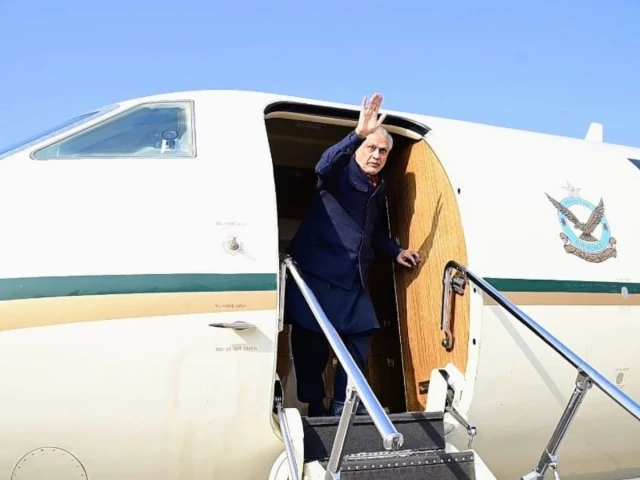
Dar departs for Beijing to co-chair seventh foreign ministers' strategic dialogue with China

Deputy Prime Minister and Foreign Minister Senator Mohammad Ishaq Dar departed for Beijing to co-chair, with Chinese Foreign Minister Wang Yi, the seventh Pakistan-China Foreign Ministers’ Strategic Dialogue. The event is to be held on January 4.

The Ministry of Foreign Affairs, in a post on X (formerly Twitter), stated that Dar is the first foreign dignitary to visit China in 2026, at Yi’s invitation.
 
To view this content we will need your consent to set third party cookies.
For more detailed information, see our cookies page.


The two nations, or the "iron brothers", established diplomatic relations in 1951, making Pakistan one of the first countries to recognise the People's Republic of China. The neighbours now prepare to mark 75 years of relations amid shifting dynamics on the regional and global stages.

Ties between the two have evolved over the years into a comprehensive strategic partnership underpinned by political trust, defence cooperation, and economic engagement.
 
To view this content we will need your consent to set third party cookies.
For more detailed information, see our cookies page.
 

What will the dialogue cover?​

Apart from the Pakistan-China Foreign Ministers’ Strategic Dialogue, he will also attend events marking the beginning of the 75th year of Pakistan-China diplomatic ties, with both countries planning initiatives and commemorative activities throughout 2026, the FO previously said.

The dialogue, meanwhile, will review the full spectrum of bilateral cooperation, identify new areas of partnership, and further advance the all-weather strategic cooperative partnership between Pakistan and China, the FO said.

It was the “highest consultative mechanism between Pakistan and China, providing a structured platform to review the entire spectrum of bilateral cooperation, as well as regional and international developments of mutual interest”.

The FO said that during the dialogue, the two foreign ministers will also announce a series of initiatives and commemorative activities to mark the 75th anniversary of the establishment of diplomatic relations between the two countries.

It had added that the visit formed an important part of the regular high-level exchanges between the two countries and reflected their shared determination to broaden and deepen their cooperative partnership, while reaffirming their mutual commitment to regional peace, stability, and sustainable development.

The sixth round of the strategic dialogue was held in Islamabad in August, with Yi visiting the capital and meeting Dar, Prime Minister Shehbaz Sharif and President Asif Ali Zardari.

At the time, China had affirmed its commitment to working with Pakistan on promoting regional peace, development and stability.
 
Deputy Prime Minister and Foreign Minister Ishaq Dar held meetings with Chinese dignitaries in Beijing on Sunday, with exchanges mainly focusing on bilateral ties, according to statements issued by the Foreign Office (FO).

Dar reached Beijing on Saturday, primarily to co-chair the seventh round of the Pakistan-China Foreign Ministers’ Strategic Dialogue, which is scheduled for today, with Chinese Foreign Minister Wang Yi.

The FO said in a statement on social media platform X today that the foreign minister also met Chinese Executive Vice Premier Ding Xuexiang today.
 
China and Pakistan will hold a crucial "strategic dialogue" on Sunday, as Deputy Prime Minister and Foreign Minister Ishaq Dar arrived in the Chinese capital on Saturday, becoming the first top foreign diplomat to travel to Beijing in 2026.

He will co-chair the seventh round of the Pakistan-China Foreign Ministers' Strategic Dialogue with Chinese Foreign Minister Wang Yi, against the backdrop of several regional and international developments.

A senior Foreign Office official said the last strategic dialogue was held in August and the convening of the next in a short span highlights the close cooperation and consultations between the two "iron clad brothers."

The forum is essentially to discuss broader regional and international issues and work towards aligning positions. Amid the ongoing developments starting from South Asia to the Middle East and from other global hotspots make the upcoming strategic dialogue between the two countries even more significant.
 
Since the establishment of diplomatic relations in May 1951, Pakistan has been among the first countries to recognise the People's Republic of China. Over the decades, the ties have evolved into a multifaceted partnership characterised by strong political trust, close defence cooperation, and expanding economic engagement. The relationship has survived multiple regional upheavals and global power shifts, with both countries often describing each other as "iron brothers."

Beijing has consistently supported Islamabad on core issues, including the Kashmir dispute, while Pakistan has reaffirmed China's sovereignty and territorial integrity on the international stage. Defence collaboration and security coordination have remained integral elements of the bilateral partnership, bolstering both countries' strategic stability in the region.


Economic cooperation, particularly through the China-Pakistan Economic Corridor (CPEC), has become a central pillar of bilateral engagement over the past decade. Despite challenges such as global economic volatility and domestic constraints, both governments have reiterated their commitment to high-quality development of CPEC projects.

The upcoming dialogue is expected to focus on strengthening industrial collaboration, promoting agricultural innovation, expanding information technology initiatives, and pursuing green development projects in line with sustainable development goals.

The dialogue comes amid a rapidly changing regional security environment. Key issues likely to feature on the agenda include the situation in Afghanistan following the political transition, ongoing tensions in the Middle East, and the evolving strategic competition among major powers.

Analysts suggest that both Islamabad and Beijing may discuss coordinated approaches to regional stability, multilateral diplomacy, and security challenges in South and Central Asia.

In addition, the strategic dialogue provides an avenue for both countries to exchange assessments on global developments, including economic recovery trends post-pandemic, energy security concerns, and emerging trade and technology partnerships.

Observers note that Beijing's increasing global economic and strategic outreach aligns with Islamabad's objectives of stabilising its economy while leveraging Chinese support for sustainable development.
 

Pakistan, China call for more ‘visible, verifiable’ actions to eliminate terrorist groups based in Afghanistan


News Desk
January 5, 2026

1767618765887.png

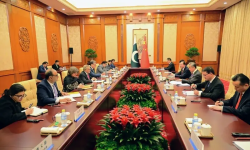
Deputy Prime Minister Ishaq Dar and Chinese Foreign Minister Wang Yi co-chair the 7th round of the Pakistan-China Foreign Ministers’ Strategic Dialogue on January 4. — Photo courtesy FO

Pakistan and China issued a joint communique on Monday calling for more “visible and verifiable” actions to dismantle and eliminate all terrorist organisations based in Afghanistan, and prevent them from using Kabul’s territory for militancy against any other country.

The joint statement came after the conclusion of the 7th round of the Pakistan-China Foreign Ministers’ Strategic Dialogue, for which Deputy Prime Minister Ishaq Dar travelled to Beijing.
 
“The two sides called for more visible and verifiable actions to dismantle and eliminate all terrorist organisations based in Afghanistan which continue to pose serious threats to regional and global security, and prevent terrorist organisations from using the Afghan territory for terrorism against any other country and to endanger any other country,” the statement said.

“The two sides agreed to keep in close communication and coordination on the Afghan issue, work with the international community to encourage the Afghan government to build an inclusive political framework, adopt moderate policies, focus on development, pursue good-neighbourliness, and play a constructive role in helping Afghanistan achieve stable development and integrate into the international community,” it added.


The statement also said that China commended the measures taken by Islamabad to combat terrorism and protect the safety of Chinese personnel, projects and institutions in Pakistan.

“China fully recognised the significant contributions and huge sacrifices that Pakistan made in combating terrorism over the years,” it said.

“The two sides reiterated their commitment to combating terrorism in all its forms and manifestations with zero tolerance, and agreed to further deepen all-round cooperation on counter-terrorism and security, and make concerted efforts to ensure that the China-Pakistan Belt and Road cooperation advances in a secure and smooth manner,” it said.
 

Pak-China agree to enhance communication​

According to the communique, during the dialogue in Beijing, the two sides engaged in a “thorough exchange of views on bilateral relations and cooperation in wide-ranging areas, including strategic and political cooperation, as well as cooperation on defence and security, economy, trade, investment, and cultural and people-to-people exchanges”.

Pakistan and China “agreed to enhance strategic communication, deepen strategic mutual trust, jointly safeguard their common interests, promote the economic and social development of the two countries,” it said.

They also called for the safeguarding and advancing “peace, development and prosperity of the region and beyond”.

Pakistan and China also marked the 75th anniversary of the establishment of diplomatic relations, with the launch of commemorative activities, the communique said.

It added that the anniversary was an “opportunity to consolidate China-Pakistan friendship and expand new areas of cooperation”.
 

‘Upgraded version of CPEC’​

The communique further said that the two sides also reached an agreement to “build an upgraded version 2.0” of the China-Pakistan Economic Corridor (CPEC).

They agreed to “further align their development plans and priorities”, the statement said.

According to the communique, the two nations outlined three key sectors: industry, agriculture, and mining.

They also called for pushing for the “building and operation of the Gwadar Port, smooth passage of the Karakoram Highway, and enhancing Pakistan’s capacity for sustainable development”.

The two nations pledged to “deepen cooperation in areas such as trade and investment, information technology, science and technology, cybersecurity, technical and vocational training and education, and people-to-people and cultural exchanges”.

During the course of the dialogue, it was also decided that the two countries will “take the year-round opening of the Khunjerab Pass as an opportunity to deepen two-way trade and people-to-people exchanges”.

They also agreed to “welcome third-party participation in CPEC cooperation that conforms with the modalities set by China and Pakistan”, the statement said.

The two countries also agreed to strengthen bilateral cooperation in the financial and banking sectors, including extending mutual support at regional and international multilateral financial forums, the communique added.
 

Agree to uphold UN Charter, oppose unilateral actions​

The two sides also reaffirmed their commitment towards upholding UN principles and international law, vowing to “oppose the plotted resurgence of fascism and militarism”.

They expressed “support for the postwar international order underpinned by international legal documents such as the Cairo Declaration and the Potsdam Proclamation and other principles of international law for the maintenance of world peace and security, and protect historical truth and international justice”.

They also underscored the significance of a South Asian “regional order underpinned by the UN Charter, international law, and the basic norms governing international relations”.

Pakistan and China also reiterated their “opposition to any unilateral actions, and reaffirmed the significance of maintaining peace and stability in South Asia and the necessity of resolving all outstanding disputes through dialogue and consultation”.

During the dialogue, Pakistan informed China of the latest developments in occupied Kashmir, with the latter reiterating that the dispute should be resolved “properly and peacefully in accordance with the UN Charter, relevant UN Security Council resolutions and bilateral agreements”.
 

Pakistan, China reaffirm bond amid regional tensions


Dawn Report
January 5, 2026

1767619072994.png

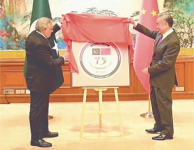
DAR and Wang Yi unveil the logo marking the 75th anniversary of diplomatic ties between their countries.—X/@ForeignOfficePk

• Foreign Minister Dar, his Chinese counterpart co-chair 7th Strategic Dialogue in Beijing
• Both sides agree to mark 75 years of diplomatic ties with year-long celebrations
• Vice Premier hails Islamabad’s consistent support for Beijing on issues of core interest

ISLAMABAD: As tensions simmer in the region and further afield, Foreign Minister Ishaq Dar and his Chinese counterpart Wang Yi on Sunday termed the Pakistan-China friendship “vital” for regional peace and stability as they co-chaired the 7th round of the Pakistan-China Foreign Ministers’ Strategic Dialogue in Beijing.
 
According to information from the Pakistani Embassy in China:

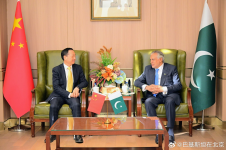
Deputy Prime Minister / Foreign Minister Senator Mohammad Ishaq Dar met a delegation from China Minmetals Corporation (MCC) led by Vice President Mr. Xu Jiqing.

They held productive discussions on MCC’s ongoing and upcoming projects in Pakistan.

DPM/FM reaffirmed the Government of Pakistan’s strong support for MCC in advancing mining investment and promoting value-added industrial development.
1767685320614.png

Link
 

Users who are viewing this thread

Latest Posts

Back
Top