Pakistan Constitutional Amendments:

The court that replaced the Constitution​

Syed Jalal Hussain
November 14, 2025

The writer is a lawyer and development consultant. Email: [email protected]

Constitutions in Pakistan rarely die in flames. They survive the heat, only to be quietly rewritten by those who once swore to protect them. The 27th constitutional amendment keeps the book unburned, yet edits the chapters that shaped the Republic's balance of power. It builds a Federal Constitutional Court, a polished institution born of reform's promise. Beneath that veneer lies a redesign of power itself. The Supreme Court, once the last refuge of dissent, is reduced to an appellate archive, while the new court decides what is constitutional, what is lawful, and what may no longer be questioned.

It is the most sophisticated capture of the Constitution in our history, a coup written in calligraphy.

The harder question though is what the judiciary has done to the state as much as what the state has done to the judiciary. For many, this moment stirs resentment more than sympathy. The citizen asks, almost bitterly: what claim do these judges have on our defence? What light were they shining before it was snuffed out, that we should now grieve its absence? They brought down elected leaders, sanctified unconstitutional power, and hesitated when history demanded resolve. In their conviction lay a moral absolutism that mistook authority for virtue. It is difficult to summon outrage for their loss when the echo of their own overreach still lingers.
 
When one looks back honestly, the slow death of judicial independence was not inflicted overnight. It was assisted by a political class that found it convenient to use judges as weapons rather than walls. Each time a government sought validation through the bench, it taught the court that power lay not in justice but in judgment. Each time a judge sought applause rather than restraint, the institution lost a fragment of credibility. So when the executive now moves to redesign the judiciary entirely, there are few left willing to defend it.

Yet that is precisely what makes this amendment more dangerous than any before it. For the first time, the dismantling of judicial independence arrives in an age when the judiciary has already exhausted its moral capital. There will be no street protests, no lawyers' movement, no black flags fluttering on the Mall. The Constitution will be altered without resistance because those who once held its torch dimmed it themselves.

History has seen this pattern before. Every age of authoritarianism begins with an "institutional correction". In 1958, martial law promised "guided democracy". In 1977, the Constitution was "held in abeyance" to cleanse the system. In 1999, the coup arrived wrapped in the language of accountability. Each time, power avoided calling itself by its real name. It claimed to reform the state while redesigning obedience.

Elsewhere too, this method has matured. In Viktor Orbán's Hungary, the Constitutional Court was reconstituted, not abolished; its judges replaced gradually, its jurisdiction narrowed. In Turkey, after 2016, the judiciary was reshaped under emergency decrees until independence became indistinguishable from insubordination. In Chile, Pinochet amended the constitution to give permanence to temporary emergency powers. The line between reform and subjugation is always written in the language of procedure.
 
This amendment carries the same genetic code. It transforms judicial appointment into a political act. A judge who declines a transfer will now face proceedings before the Supreme Judicial Council within thirty days and must step aside from duty while the inquiry unfolds. The Constitution, which once guaranteed tenure to shield judges from fear, now turns that protection into a tool of discipline. In this new order, refusal becomes defiance, and compliance the only form of survival.

The repercussions are profound. It collapses the security of tenure that is the moral backbone of an independent judiciary. It creates two apex courts, dividing constitutional interpretation from ordinary justice, ensuring that the most sensitive cases, those involving state power, are decided by a forum born of executive design. And it eliminates the spontaneous judicial conscience, the ability of a court to take notice of rights violations on its own. That power, which once gave voice to the voiceless, is erased with legislative precision.

Over time, this architecture will move from controlling judges to reshaping the nature of judgment itself. Courts will learn that to remain safe is to remain silent. Ambitious lawyers will aim for appointment rather than justice. The very idea of judicial courage, once a real phenomenon, will turn into an administrative risk.

When Ayub Khan's "Doctrine of Necessity" emerged from the Dosso judgment, the judiciary survived, though only as a domesticated institution. This amendment does something subtler but more final. It ensures that the question "What is constitutional?" will no longer be answered by independent minds but by designed majorities. Once that shift occurs, there is no need for coups. Power becomes legal; legality becomes obedience.
 
The Constitution's framers imagined that certain rights would remain inviolable, that an independent court would always stand between citizen and state. This amendment quietly removes that final line of defence. Future governments will not need to coerce judges; they will simply appoint new ones under rules already tilted in their favour. The next time someone speaks of fundamental rights, it will be before a court that owes its creation to the very authority those rights were meant to restrain.

There will be no proclamation of emergency, the new order will arrive through clauses and provisos, the legal poetry of control. The Constitution will still exist, beautifully printed, ceremonially cited, publicly praised, but privately hollow. Its heartbeat will have moved to another institution, one more compliant and less troublesome.

When those entrusted to guard the Constitution begin to rewrite its limits, it transforms from a social contract into a manual for authority. The state stops fearing its citizens; citizens begin to fear procedure. Dissent turns into a disciplinary issue.

The world will call it reform. History will call it design. And when the next crisis comes, as it always does in Pakistan, the court that replaced the Constitution will do what it was built to do: interpret power, not restrain it.
 

International jurists body calls 27th Amendment an attack on judiciary​


ICJ criticises FCC’s formation, judicial appointment criteria, and sweeping immunities under Articles 248, 243

Web Desk
November 14, 2025

The International Commission of Jurists (ICJ) has raised serious concerns over Pakistan’s 27th Constitutional Amendment, describing it as a “flagrant attack on the independence of the judiciary and the rule of law,” as it became law with the signature of President Asif Ali Zardari on Thursday.

The amendment, passed a day earlier by Parliament and signed into law by the president, has now become part of the Constitution. “The changes made to the judicial system in the 27th amendment are alarming,” said Santiago Canton, ICJ Secretary-General. “They will significantly impair the judiciary’s ability to hold the executive accountable and protect the fundamental human rights of the people of Pakistan.”

The ICJ said it was particularly concerned about the changes introduced under the 27th Amendment, noting that—alongside the 26th Amendment passed in October 2024—it fundamentally alters the structure of the judiciary and undermines its independent function in multiple ways.
 
Taking aim at the establishment of the Federal Constitutional Court (FCC) and the criteria for judicial appointments, the ICJ pointed out that the amendment fails to define the basis for appointments or require reasons for selections, beyond general qualifications for serving as an FCC judge.

It added that international standards require the appointing body to be independent of the executive, a principle that is “clearly not met” in the appointment of the FCC chief justice and the first batch of FCC judges. The commission stressed that clear procedures and objective criteria are essential under international norms for judicial appointments.

The ICJ also raised objections to the provision that the FCC chief justice and senior-most FCC judge will serve as members of both the Judicial Commission of Pakistan (JCP)—responsible for judicial appointments—and the Supreme Judicial Council, which oversees judicial accountability. The body termed this arrangement inconsistent with the principle of judicial independence.
 
Referring to the 26th Amendment, the ICJ voiced concern over the method of appointing the Chief Justice of the Supreme Court and the FCC, noting that the new amendment adopts the same opaque procedure for the selection of the FCC chief justice after the first incumbent retires.

It further observed that the provision sets no criteria or grounds on which the Supreme Parliamentary Committee (SPC) will nominate the Chief Justice of the Supreme Court or FCC, while mandating that its meetings be held in camera.

The ICJ also decried the new composition of the JCP, which now includes the chief justices of both the FCC and the Supreme Court, the next senior-most judges of each court, and one judge jointly nominated by both chief justices. The remaining members are unchanged.
 
Before the 26th Amendment, the JCP was composed predominantly of judges. However, its revised structure now includes two members of the National Assembly, two senators, and one woman or non-Muslim representative nominated by the National Assembly speaker. The law minister, attorney general, and a representative of the bar continue to serve as members.

Calling the revised composition “a cause for concern,” the ICJ warned that the inclusion of executive appointees and political figures in the JCP allows for “direct political influence” over judicial appointments, as judicial members now form a minority. For appointments to the Supreme Court and FCC, only five out of thirteen members of the JCP are judges.

The ICJ secretary general also raised alarm over amendments to Article 200 of the Constitution, which governs the transfer of High Court judges. He noted that the amendment fails to specify criteria or establish a transparent mechanism to guide transfer decisions, leaving room for arbitrary or punitive transfers rather than moves made in the public interest.
 
Referring to international standards on judicial independence, the ICJ questioned the rationale for allowing the removal of judges who refuse transfers, asking how such refusal could amount to “serious misconduct.” It reiterated that under international norms, judges should only be removed on “serious grounds of misconduct or incompetence.”

The commission also expressed grave concern over the sweeping immunities granted under Articles 248 and 243 through the 27th Amendment. The amendment grants the president lifetime immunity from criminal proceedings and arrest, as well as protections from civil suits. It also extends similar immunities to the ranks of Field Marshal, Admiral of the Fleet, and Marshal of the Air Force — ranks currently held by the Chief of the Armed Forces.

Calling these immunities “contrary to core rule of law principles,” the ICJ said they violate the tenets of accountability, access to justice, and equality before the law. “No public official should ever be entirely unaccountable,” it said, warning that such provisions open the door to unlawful or arbitrary exercise of power without consequence.

facebook twitter whatsup linkded email
 
Why it was necessary to mention FM Asim Muneer name specifically in the amendments whenever Five Star Military officers are mentioned???

Is he not sure that he a Five Star Officer????

This man has degraded uniform so much, insulted by sitting like a chaprasi on a far away chair during a recent foreign visit by PM.

This is our FM for God sake have some self respect, some honor.

You got your Immunity and Rank for life, now please focus on your primary job, instead of extra curriculum activities.
 
Now there would be 3 four star army generals. CDF will have VCOAS and CNSC working under him!
To view this content we will need your consent to set third party cookies.
For more detailed information, see our cookies page.
 

Supreme Court judges Mansoor Ali Shah, Athar Minallah resign after passage of 27th Amendment​

In his resignation, Justice Shah terms 27th Amendment 'grave assault' on Constitution


Hasnaat MalikNovember 13, 20253 min read
facebook twitter whatsup linkded email

justice mansoor ali shah l and justice athar minallah r photo files

Justice Mansoor Ali Shah (L) and Justice Athar Minallah (R). Photo: Files


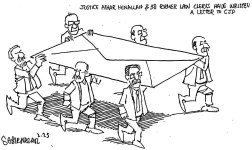
The senior-most judges of the Supreme Court, Justices Mansoor Ali Shah and Athar Minallah, have tendered their resignations following the approval of the 27th Constitutional Amendment by Parliament.

In his 13-page resignation letter, Supreme Court Justice Mansoor Ali Shah stated that the 27th Constitutional Amendment is a serious attack on the Constitution of Pakistan. He further remarked that the amendment has fragmented the Supreme Court of Pakistan.

"The Twenty-Seventh Constitutional Amendment stands as a grave assault on the Constitution of Pakistan. It dismantles the Supreme Court of Pakistan, subjugates the judiciary to executive control, and strikes at the very heart of our constitutional democracy- making justice more distant, more fragile, and more vulnerable to power," Justice Mansoor stated in his resignation.

"I am unable to uphold my oath sitting inside a court that has been deprived of its constitutional role; resignation therefore becomes the only honest and effective expression of honouring my oath. Continuing in such a version of the Supreme Court of Pakistan, would only suggest that I bartered my oath for titles, salaries, or privileges," reads Justice Mansoor's resignation letter.

He further mentioned, "Accordingly, for the reasons set out hereunder, and in terms of Article 206(1) of the Constitution of the Islamic Republic of Pakistan, I hereby resign from the office of Judge of the Supreme Court of Pakistan, with immediate effect."


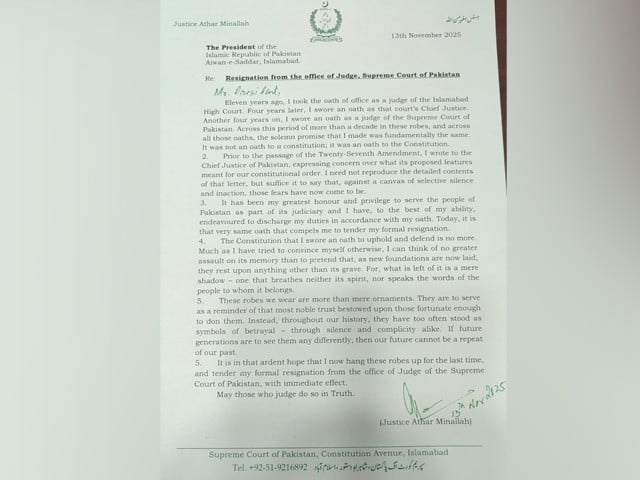
Meanwhile, Justice Athar Minallah in his resignation letter stated that, "It has been my greatest honor and privilege to serve the people of Pakistan as part of its judiciary, and I have, to the best of my ability, endeavored to discharge my duties in accordance with my oath. Today, it is that very same oath that compels me to tender my formal resignation," reads the Athar Minallah resignation.

"The Constitution that I swore an oath to uphold and defend is no more. Much as I have tried to convince myself otherwise, I can think of no greater assault on its memory than to pretend that, as new foundations are now laid, they rest upon anything other than its grave. For, what is left of it is a mere shadow – one that breathes neither its spirit, nor speaks the words of the people to whom it belongs," it adds.


res1763046691-0.jpg


"It is in that ardent hope that I now hang these robes up for the last time and tender my formal resignation from the office of Judge of the Supreme Court of Pakistan, with immediate effect," it concludes.

Chief Justice of Pakistan Yahya Afridi has also convened a full court session on Friday (tomorrow) to deliberate on the 27th Constitutional Amendment, the session is scheduled for tomorrow, before Friday prayers, sources told The Express Tribune.

The decision follows multiple letters from Supreme Court justices, bar associations, and senior lawyers requesting deliberation on the amendment.

Earlier, President Asif Ali Zardari has signed the 27th Constitutional Amendment Bill, which had already been approved by both houses of Parliament. With this signature, the bill has now become part of the Constitution.

The Senate approved the 27th Constitutional Amendment bill after a second round of voting on Thursday, despite protests from the opposition. The clauses of the amendment had already been approved with a two-thirds majority.

The bill, previously passed by the National Assembly on Wednesday, comprises 56 clauses and was presented in the Senate in the same form.

Under the new legislation, the government has established a Federal Constitutional Court (FCC)—a body that now holds authority over constitutional matters, effectively making the Supreme Court subordinate to it. Justice Yahya Afridi has been granted the title of Chief Justice of Pakistan.

The new amendment has sparked widespread concern among the judiciary and legal community, with critics arguing that it undermines the independence of the Supreme Court. The controversy has prompted letters from sitting judges, petitions from senior lawyers, and coordinated protests by bar associations, highlighting the deep apprehension over the potential shift in the balance of power between the judiciary and the executive.

Justice Syed Mansoor had urged CJP Afridi to engage the executive regarding the proposed 27th amendment. Likewise, Justice Athar Minallah also suggested CJP Afridi to convene a judicial convention. Retired judges and lawyers are requested him the same. It is learnt that no formal full court meeting was convened by him on the issue.


Users who are viewing this thread

Pakistan Defence Latest

Back
Top