Pakistan Constitutional Amendments:

There is much more than that, including preventing the misuse of power by the higher Judiciary which has caused huge damage to Pakistan's politics and economy over the last two decades. There is also a focus on stabilizing Pakistan's politics because the dramas since Zia's death in 1988 hasn't worked for Pakistan--you know, the definition of 'madness' per Einstein.
Since Zia’s death, who has been the longest ruler in Pakistan? The PA itself.
Why blame others for all these failures?

you are wrong that all the previous military power grabs
Yeah. That’s true.
But there was always a dire situation quoted to justify the power grab. Dire situation was either an external one or internal one. There was always a justification dished out.

I remember when Musharraf had done it the last time. The general sentiment in Pakistan was of relief and hope for betterment. But we all know how it panned out. It all starts with good intentions and then degrades into something else.
Munir has shown those colours within a few months. If past performance is any indication, then this power grab seems headed only one way.
I do see hope and positivity in your assessment.
Good luck.
May your wishes get fulfilled and this indeed turns out to be a new leaf.
 
I do see hope and positivity in your assessment.
Good luck.
May your wishes get fulfilled and this indeed turns out to be a new leaf.

Thank you.
Yes, I cautiously welcome the new changes. I have seen Einstein's definition of 'madness' played out in Pakistan since 1988 and major changes were needed.
And you'd be very wrong to think there is not much political input in all these changes: Please, on the Pakistani media, follow how much discussion, wheeling and dealing, dissent, experience from the past has been factored in. Just because a Mr. 30% voted is opposing these doesn't make it like some El Sissi Egypt legislation.
 

President gives assent to bill resetting army chief’s tenure after appointment as CDF


Nadir Guramani | News Desk
November 15, 2025
https://whatsapp.com/channel/0029VaMc238IiRov8okfYy3n
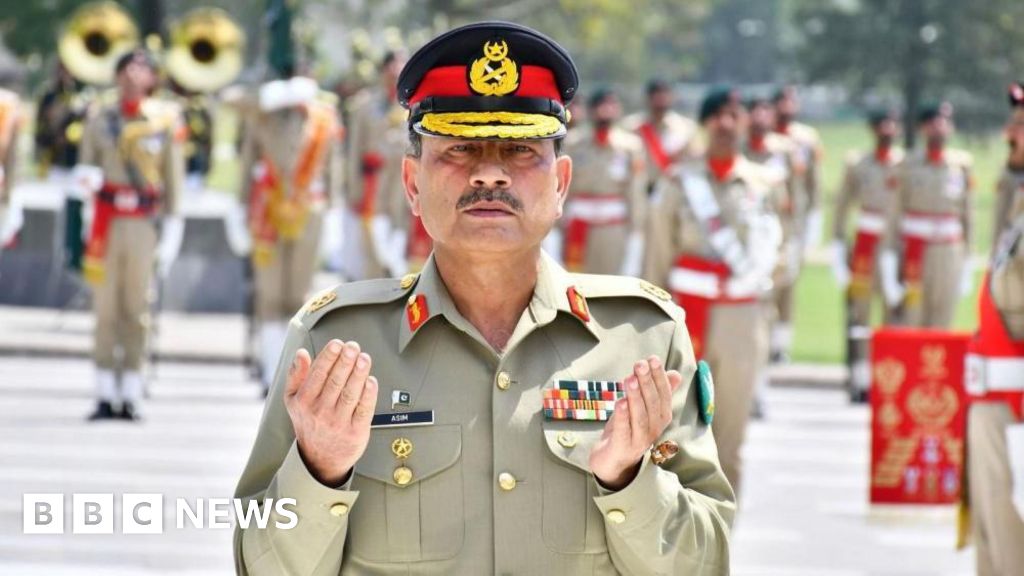
President Asif Ali Zardari on Saturday gave his assent to three bills, including one for resetting the tenure of Chief of the Army Staff (COAS) Field Marshal Asim Munir after his appointment as the chief of the defence forces (CDF).

The president gave his assent to the Pakistan Army (Amendment) Bill 2025, the Pakistan Air Force (Amendment) Bill 2025, and the Pakistan Navy (Amendment) Bill 2025. Notifications of the same were also shared by the PPP on social media platform X.

With his assent, the bills have now become part of the Constitution.
 
As explained by Law Minister Azam Nazeer Tarar in the National Assembly (NA) earlier this week, it now means that the five-year tenure of the CDF will commence from the date of his notification of the appointment.

All three pieces of legislation, which were hurriedly passed by Parliament without any debate earlier this week, pertain to the contentious 27th Amendment.

The amendment, which has paved the way for the establishment of a Federal Constitutional Court (FCC) and changes to the military leadership structure, has been heavily criticised by the opposition.

Under the new changes made to the Army Act, the expression “chief of the army staff” will be replaced with “chief of the defence forces” as per the 27th Amendment. Similarly, the expression “Chairman Joint Chiefs of Staff Committee” (CJCSC) will be replaced with the “commander of the National Strategic Command”.

Further, changes have been made to Section 8A of the Pakistan Army Act 1952, saying that “provided that for the first appointment of the chief of the army staff concurrently the chief of the defence forces under paragraph (a) of Clause 4 of the Article 243 of the Constitution of the Islamic Republic of Pakistan, the tenure under this section shall commence from the date of notification of the said office”.
 
Another change pertains to the appointment of commander of the National Strategic Command says, “The prime minister may, on the recommendation of the chief of the army staff concurrently the chief of the defence forces, appoint the commander of the National Strategic Command, from amongst generals in the Pakistan Army, for a tenure of three years.” The proposed amendment also authorises the prime minister to “reappoint the commander…for additional tenure of three years and/or extend the tenure(s)…up to three years” on the recommendations of the CDF.

Under the changes, the appointment, reappointment or extension of the commander of the National Strategic Command, or the “exercise of discretion by the appointing authority in this regard, shall not be called into question before any court on any ground whatsoever”.
 
Further, the federal government may, on the recommendation of the army chief and concurrently the CDF and by order in writing, “authorise the officer appointed as vice chief of the army staff or deputy chief of the army staff to exercise and perform such of the powers and functions vested in the chief of the army staff under any law, rules, regulations, orders or instructions for the time being in force as may be so specified”.

Meanwhile, the changes to the air force and navy laws include the elimination of the post of CJCSC from their documents.
 

Justice Shams Mehmood Mirza resigns from LHC following 27th Amendment

Wajih Ahmed Sheikh
November 15, 2025

1763206559369.png


This photo shows Lahore High Court’s Justice Shams Mehmood Mirza. — LHC/website

Justice Shams Mehmood Mirza on Saturday tendered his resignation as a judge of the Lahore High Court (LHC), becoming the first judge to resign from any high court after the contentious 27th Constitutional Amendment was enacted into law.

According to family sources, his resignation letter stated that in light of the latest amendment to the Constitution, he could not continue in good conscience.

Justice Mirza was appointed as an additional judge of the LHC in March 2014, and his superannuation was due on March 6, 2028.

He is the son of late Justice Zia Mehmood Mirza, a former Supreme Court judge who delivered the famous and only dissenting opinion among seven judges in the case pertaining to the dismissal of Benazir Bhutto’s government by then-president Farooq Ahmad Khan Laghari in 1996.

The judge had held that Laghari’s move was unjustified and there was no evidence suggesting there was a breakdown of constitutional order to justify exercising his powers under Article 58(2)(b), which allowed the president to dismiss the elected government and which was ultimately removed in the 18th Amendment.

Justice Mirza’s resignation comes two days after the passage of the contentious 27th Amendment, which has been assailed as a “flagrant attack” on judicial independence by the International Commission of Jurists (ICJ).

The move also follows the resignations of the Supreme Court’s senior puisne judge, Justice Mansoor Ali Shah, and Justice Athar Minallah, both of whom wrote strongly worded resignation letters censuring the 27th Amendment.

Amid speculation about possible transfers of high court judges, Justices Mohsin Akhtar Kayani and Saman Rafat Imtiaz of the Islamabad High Court (IHC) have hinted they might not be available to hear cases in the federal capital from next month.
 
27th Amendment and its impact on judiciary

The 27th Amendment, besides bringing changes in other domains, alters the judiciary’s functioning in two areas — constitutional matters and the transfer of judges.

The legislation empowers the Judicial Commission of Pakistan to transfer high court judges without their consent — a provision that has raised concerns within sections of the judiciary.

The most notable decision made by the ruling coalition is the formation of the Federal Constitutional Court (FCC), which experts say has dethroned the Supreme Court as the country’s highest judicial forum.

The reason for those concerns is that the FCC will now deal with crucial constitutional matters and its decisions would be binding on all courts, including the SC itself. Under the new Article 189, the SC would be downgraded to the apex court for civil.
 

No 'independent space to operate'​

The second controversial area of change are the courts and judiciary.

Under the amendment a new Federal Constitutional Court (FCC) will be created which will determine constitutional questions. The FCC's first chief justice and the judges that serve in it will be appointed by the president.

"It forever changes the shape and the nature of the right to a fair trial," says Ms Jahangir.

"The influence of the executive has increased not just in appointing judges but also constitutional benches. When the state is dictating the constitution of those benches then what hope do I have as a litigant of getting a fair trial?"

Arifa Noor, journalist and commentator, says: "The judiciary is now quite subservient to the executive.

"The general consensus seems to be that the judiciary is now going to not really have any independent space to operate for the moment."

Before this amendment was passed, the Supreme Court would hear and decide on constitutional cases. Some said this created a backlog of criminal and civil cases waiting to be heard as judges had to listen to constitutional arguments as well, arguing that separating the two has helped smooth the court process.​


That has some traction with some lawyers, although Salahuddin Ahmed, a Karachi-based lawyer in the Supreme Court, sees that argument as disingenuous. He points out that the majority of cases pending in Pakistan are not in the Supreme Court.

"Statistically, if you were genuinely worried about making litigation quicker, you would focus on reforms for those cases."

In the hours after the amendment was signed into law, two Supreme Court justices handed in their resignations.

"The constitution that I swore an oath to uphold and defend is no more," said Justice Athar Minallah in his resignation letter.

Justice Mansoor Ali Shah said that the judiciary had been brought under the control of the government and that the 27th amendment had "torn the Supreme Court to pieces".

Khawaja Asif, the defence minister, said of the resignations "their conscience has awakened because their monopoly on the Supreme Court has been curbed and Parliament has tried to prove the supremacy of the Constitution".

Judges can also now be transferred to different courts without their consent. If they don't agree to the transfer, judges can appeal to the judicial commission and if their reasons for not moving are found invalid the judge would have to retire.

Those in favour argue that this will ensure that courts in all areas of the country can be staffed, but some are worried it will be used as a threat.

"To pick a judge up from the province where he's been serving and take him to a different high court is something that will place them under further pressure to toe the government's line," says Mr Ahmed. He worries that the change will upset the balance in Pakistan.

"[Our judiciary] has collaborated with dictators in the past, but they've also sometimes nudged the executive. I think if you completely rob people of that hope, then that sends them into other, much uglier directions."

Mr Kugelman agrees: "Bottled-up grievances don't bode well for social stability."

"It does indicate a slide towards authoritarianism," says Ms Noor, adding that she sees the latest amendment as building on the 26th amendment, made last year, which gave lawmakers the power to pick Pakistan's top judge. There is already speculation of a 28th.

"It indicates that the balance of power is tilted in favour, heavily tilted in favour, of the establishment."

 
This could be a great thread if all the amendments in the Constitution of Pakistan are mentioned chronologically.
 
IMG-20251116-WA0012.jpg

Editorial: It comes as no surprise but is nevertheless cause for embarrassment. Pakistan has been placed close to the bottom in Freedom House’s Freedom on the Net index, scoring only 27 out of 100. Ranked ‘not free’, the country accompanies China, Iran and Russia on the list known for internet curbs.

Regional peers, meanwhile, performed better with India at 51, Sri Lanka at 53 and Bangladesh at 45. All three were declared ‘partly free’. The assessment comes at a time when Pakistan is experiencing major democratic curtailments such as the passage of the 27th Amendment, besides repeated internet shutdowns, including the recent weeklong outage in Balochistan.

Read the full editorial here: https://www.dawn.com/news/1955400
 

Users who are viewing this thread

Country Watch Latest

Back
Top