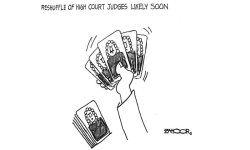
Pakistan Constitutional Amendments:

AI Overview


A hybrid system of government blends democratic elements (like elections) with authoritarian traits (like restricted rights or strong military influence), often called "hybrid regimes," "illiberal democracies," or "partial democracies"
. These systems feature regular but often manipulated elections, controlled political participation, and compromised rule of law, with powerful entities (like the military or elites) wielding significant power behind a democratic facade, exemplified by countries like Pakistan. Another concept of a "hybrid government" describes a state also acting as a market participant, engaging with the private sector for complex issues, but the political science term is more common.

Key Characteristics of Hybrid Regimes (Political Science)
  • Elections: Regular elections occur, but are often flawed, controlled by security apparatus, or engineered to favor incumbents.
  • Authoritarian Influence: Strong military, intelligence, or powerful civilian elites significantly influence or control political outcomes, limiting true democratic processes.
  • Limited Freedoms: Civil liberties and political rights exist but are often restricted, with political repression common.
  • Illiberalism: Combines democratic structures with autocratic tendencies, creating a "facade of democracy".
  • Examples: Often seen in developing nations, with Pakistan frequently cited as a classic case of alternating civilian-military rule.

Other Interpretations
  • Hybrid Government (Economic/Governance): A government that also functions as a market player, collaborating with private entities to manage complex societal challenges, beyond traditional regulatory roles.
In essence, a hybrid political system exists in the grey area between full democracy and full autocracy, adopting just enough democratic features to maintain legitimacy while retaining authoritarian control.
 
An Islamabad anti-terrorism court on Friday handed out double life sentences to YouTuber Adil Farooq Raja, journalists Wajahat Saeed Khan, Sabir Shakir and Shaheen Sehbai, anchorperson Haider Raza Mehdi and analyst Moeed Peerzada in a case related to riots in the country on May 9, 2023.
I am 100 percent sure due process of law was followed in this case - @VCheng
IMG_1119.jpeg
 
In essence, a hybrid political system exists in the grey area between full democracy and full autocracy, adopting just enough democratic features to maintain legitimacy while retaining authoritarian control.

Well, that system is what Pakistan has worked hard to create for governing itself over the last 50 years or so, and it seems to be working as designed.
 
The Federal Constitutional Court (FCC) upheld on Tuesday the Super Tax under Sections 4b and 4c of the Income Tax Ordinance (ITO), 2001 intra vires to the Constitution.

A three-judge FCC bench, headed by Chief Justice Amin-ud-Din Khan and comprising Justice Syed Hasan Azhar Rizvi and Justice Arshad Hussain Shah after hearing the arguments of the counsel of taxpayers from Karachi Makhdoom Ali Khan, reserved the judgment and at 2 o’clock passed the short order.

Key points:

  • Parliament has exclusive authority to determine taxation
  • Courts cannot re-determine tax slabs, rates, thresholds, or fiscal policy
The Parliament has exclusive authority to determine taxation under Sections 4(b) and 4(c); courts’ role is limited to interpretation, the FCC declared.

It set aside the High Courts’ judgments striking down or reading down Section 4C. It held that courts cannot re-determine tax slabs, rates, thresholds, or fiscal policy, and that the High Courts committed judicial overreach, violating the doctrine of separation of powers.

Read more: Lawyer submits before FCC: Super tax falls under parliament’s exclusive taxing authority

All appeals filed by the Secretary, the Federal Board of Revenue (FBR), and Commissioner Inland Revenue were confirmed as maintainable.

According to the FBR, the decision would help fetch revenue to the tune of Rs300 billion to the public exchequer through super tax.

The court rejected the appeals filed by taxpayers against the judgments of High Courts relating to Section 4b. It held that Section 4b would applicable from 2015 and Section 4c from 2022 when they were respectively enacted.

Section 4B was inserted in the Income Tax Ordinance, 2001 through the Finance Act, 2015 during the Pakistan Muslim League Nawaz (PML-N) government had introduced Super Tax on rich individuals, association of persons and companies earning income above Rs500 million in the tax year 2015 at rate of 4% of income of banking companies and 3% on other categories for rehabilitation of temporarily displaced persons through Finance Bill (2015-16).

The government inserted Section 4C in the Income Tax Ordinance through Finance Act 2022 to charge the super tax from 13 specific sectors that according to it made windfall gains, taking their total income tax rate to 39%.

The government had imposed the super tax on banks; cement; iron and steel; sugar; oil and gas; fertilisers; LNG terminals; textile; automobile; cigarettes; beverages; chemicals; and airlines.

The super tax under Section 4C was imposed on profits of wealthy corporations whose earnings exceeded Rs150 million, to ease the impact of the rising inflation on the poor.

Several companies then approached all the provincial High Courts and the Islamabad High Court, challenging the super tax.
 
The Federal Constitutional Court (FCC) upheld on Tuesday the Super Tax under Sections 4b and 4c of the Income Tax Ordinance (ITO), 2001 intra vires to the Constitution.

A three-judge FCC bench, headed by Chief Justice Amin-ud-Din Khan and comprising Justice Syed Hasan Azhar Rizvi and Justice Arshad Hussain Shah after hearing the arguments of the counsel of taxpayers from Karachi Makhdoom Ali Khan, reserved the judgment and at 2 o’clock passed the short order.

Key points:

  • Parliament has exclusive authority to determine taxation
  • Courts cannot re-determine tax slabs, rates, thresholds, or fiscal policy
The Parliament has exclusive authority to determine taxation under Sections 4(b) and 4(c); courts’ role is limited to interpretation, the FCC declared.

It set aside the High Courts’ judgments striking down or reading down Section 4C. It held that courts cannot re-determine tax slabs, rates, thresholds, or fiscal policy, and that the High Courts committed judicial overreach, violating the doctrine of separation of powers.

Read more: Lawyer submits before FCC: Super tax falls under parliament’s exclusive taxing authority

All appeals filed by the Secretary, the Federal Board of Revenue (FBR), and Commissioner Inland Revenue were confirmed as maintainable.

According to the FBR, the decision would help fetch revenue to the tune of Rs300 billion to the public exchequer through super tax.

The court rejected the appeals filed by taxpayers against the judgments of High Courts relating to Section 4b. It held that Section 4b would applicable from 2015 and Section 4c from 2022 when they were respectively enacted.

Section 4B was inserted in the Income Tax Ordinance, 2001 through the Finance Act, 2015 during the Pakistan Muslim League Nawaz (PML-N) government had introduced Super Tax on rich individuals, association of persons and companies earning income above Rs500 million in the tax year 2015 at rate of 4% of income of banking companies and 3% on other categories for rehabilitation of temporarily displaced persons through Finance Bill (2015-16).

The government inserted Section 4C in the Income Tax Ordinance through Finance Act 2022 to charge the super tax from 13 specific sectors that according to it made windfall gains, taking their total income tax rate to 39%.

The government had imposed the super tax on banks; cement; iron and steel; sugar; oil and gas; fertilisers; LNG terminals; textile; automobile; cigarettes; beverages; chemicals; and airlines.

The super tax under Section 4C was imposed on profits of wealthy corporations whose earnings exceeded Rs150 million, to ease the impact of the rising inflation on the poor.

Several companies then approached all the provincial High Courts and the Islamabad High Court, challenging the super tax.
Now all the companies can shut down. Good job by the kangaroo court
 

Users who are viewing this thread

Pakistan Defence Latest

Latest Posts

Back
Top