Not as much a push but a confirmation of being a banana republic…Another push towards becoming a banana republic.
Navigation
Install the app
How to install the app on iOS
Follow along with the video below to see how to install our site as a web app on your home screen.
Note: This feature may not be available in some browsers.
More options
Style variation
You are using an out of date browser. It may not display this or other websites correctly.
You should upgrade or use an alternative browser.
You should upgrade or use an alternative browser.
Pakistan Constitutional Amendments:
- Thread starter ghazi52
- Start date
More options
Who Replied?mythbuster
Trusted Member

I agree with you at higher level of philosophical construct but neglecting ground realities and sitting on higher ground ( it's cozy up there ) is not a wise thing to do .Comparing Pakistan's judicial system to that of the United States is akin to comparing apples to oranges. Pakistan's legal and parliamentary systems, unlike the presidential system of the U.S., are based on the UK model. If we are to make meaningful comparisons, they should be drawn with countries such as the UK or India, which share more similarities with Pakistan in terms of governance and legal structure.
In the UK, an independent selection commission is responsible for appointing Supreme Court justices. This commission primarily consists of senior judges from other courts, alongside the most senior judges of the Supreme Court. The Chief Justice, or President of the Supreme Court, is selected through the same process.
In India, a comparable system known as the Collegium is in place, where the appointment process is managed by the five senior-most judges of the Supreme Court. When the position of Chief Justice becomes vacant, the most senior judge is appointed to this role.
In contrast, Pakistan has introduced a process where the government and executive wield all the control over the selection, promotion, and removal of judges, including CJ. This arrangement kills the independence of the judiciary. This scenario can jeopardize the rule of law and the impartiality essential for a functioning democracy, making it a recipe for disaster.
Though PTI may be on the losing end at present, those who herald this debacle as a triumph will soon find themselves facing the fallout. This is not merely a setback for one political party; it is a profound defeat for the people of Pakistan and their fundamental rights, a reality that will resonate far beyond the political arena.
mythbuster
Trusted Member
Sometimes you have to leave the comforts of those higher moral grounds and get dirty and slug it out .I agree with you at higher level of philosophical construct but neglecting ground realities and sitting on higher ground ( it's cozy up there ) is not a wise thing to do .

M. Sarmad
THINK TANK: CONSULTANT
I agree with you at higher level of philosophical construct but neglecting ground realities and sitting on higher ground ( it's cozy up there ) is not a wise thing to do .
Sometimes you have to leave the comforts of those higher moral grounds and get dirty and slug it out .
No state/Army can ever win by turning on its own people.... any victory won that way is fleeting at best, a ticking time bomb at worst.
The current "collaborators" may find themselves on the receiving end tomorrow, just as past collaborators do today. But the current/PDM collaborators are far more destructive than their predecessors, actively undermining the very fabric of the state, mutilating the constitution, and trampling on the rule of law—all in a frantic attempt to cling to power despite the wide spread odium they have incurred. They seem oblivious to the steep price the nation and they themselves will inevitably pay for their reckless actions.
Ultimately, it is the establishment that has prevailed by dividing the people and maintaining its stranglehold.... But this time around, they have managed to unite the overwhelming majority of Awam against them—an unprecedented development since 1971, and one that could eventually prove fatal for (what remains of) the state.....And this isn’t some philosophical construct..... These are cold, hard facts, grounded in reality
Last edited:

Jango
THINK TANK: CONSULTANT

Though PTI may be on the losing end at present, those who herald this debacle as a triumph will soon find themselves facing the fallout. This is not merely a setback for one political party; it is a profound defeat for the people of Pakistan and their fundamental rights, a reality that will resonate far beyond the political arena.
There is only one winner here, and that isn't Justice Afridi, but the establishment.
Jango
THINK TANK: CONSULTANT
but neglecting ground realities
Just curious, what are the ground realities?
mythbuster
Trusted Member
1 ) economy , IK was not willing to take the unpopular but necessary measures to avoid default .........2 ) geopolitics ...Ik wanted to go all hog into the Chinese camp , he believed China will open up the vault for him and there won't be any need to go to IMF ..... military wants to keep a balance in relationship between China and US .Just curious, what are the ground realities?
Olympus81
Trusted Member

The establishment has been acting like a bull in a Chinese shop.
Every step, they have taken entails self preservation rather than serving the national interest. From RCO, rigging elections, abducting civilians, blackmailing judges and now the 26th ammendment.
Any sane country and the establishment players would be hanged for treason multiple times.
This is Pakistan, not some family owned enterprise that operates on the whims of a fickle boss.
This here is a root cause of Pakistan’s ills.
Every step, they have taken entails self preservation rather than serving the national interest. From RCO, rigging elections, abducting civilians, blackmailing judges and now the 26th ammendment.
Any sane country and the establishment players would be hanged for treason multiple times.
This is Pakistan, not some family owned enterprise that operates on the whims of a fickle boss.
This here is a root cause of Pakistan’s ills.

ghazi52
THINK TANK: CONSULTANT
- Thread starter
- #219
Editorial:
It is hoped under Justice Afridi, SC can heal fractures that developed under CJP Isa’s watch
Curtain call
EditorialOctober 24, 2024
THE controversy surrounding the full-court verdict, where a majority of eight Supreme Court judges favoured restoring PTI as a parliamentary party and granting it reserved seats, continues to simmer.
Chief Justice Qazi Faez Isa, part of the minority in the case, has raised concerns about the legality of the majority’s decision to issue clarifications on queries from the ECP. In his dissenting note, the CJP makes a valid point: once the full court had issued its verdict, the eight judges had no authority to act independently and issue clarifications to queries put forth to the court. He rightly contends that the responses should have been routed through official channels in line with protocol.
And yet, while his critique of the judges’ overreach is valid, his leadership has faced criticism for failing to enforce the full court’s decision. As chief justice, he had a responsibility to ensure that the ruling was implemented, even if he disagreed with it. His inability to push for its implementation gives one the impression he may have been quietly aligned with the view that the ruling should not be enforced. This failure to act raises concerns about his leadership during a critical period for the judiciary.
The CJP’s note marks the end of a tumultuous tenure marred by decisions that some saw as unnecessarily divisive. His handling of cases like the ones pertaining to PTI’s bat symbol and Article 63-A are examples where his rulings appeared more focused on technicalities and less on justice. In the bat case, he was clear in upholding the ECP’s stance against the PTI, refusing the party its election symbol due to legal technicalities. Yet, this decision appeared to be more of a punitive gesture towards the PTI.
Similarly, the timing of the Article 63-A ruling — which dealt with toeing party lines — stirred significant debate. The forces that hunger for influence over the political and judicial landscape were firmly against the man at the start but appear sated now.
On the other hand, the chief justice, who was once viewed as a crusader for judicial integrity has left many of his initial supporters disillusioned. Once lauded as one of the finest jurists, he will now leave a complex legacy, with his dissent symbolising the divisions within the apex court.
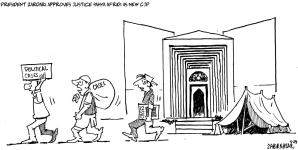
Adding to this quagmire is the appointment of Justice Yahya Afridi as the new CJP, passing over Justice Mansoor Ali Shah, who was a strong contender being the next most senior judge.
There is, however, hope that under Justice Afridi, the court can move beyond the discord and heal the fractures that developed under CJP Isa’s watch. The nation needs a judiciary that upholds justice without descending into internecine strife — a hope that rests on Justice Afridi’s shoulders as he dons the robe.
Published in Dawn, October 24th, 2024
ghazi52
THINK TANK: CONSULTANT
- Thread starter
- #220
What exactly did the independent judiciary do with expanded power post-lawyers’ movement?
All cases related to economy had a long-term fallout whose costs could easily be tallied in trillions of rupees. Yet there was no learning curve.Economy under the gavel
Khurram Husain
October 24, 2024
MAYBE this is a good time to recall the Reko Diq judgment delivered by one of the most exalted and hailed chief justices of the Supreme Court. Or should we recall the Dam Fund instead, along with threats to charge with treason those who dared to criticise the effort?
Remember that fiasco, run by a chief justice who probably relished the limelight more than any of his predecessors? Or maybe an article detailing a blow-by-blow account of how yet another chief justice became obsessed with tearing down a residential building on Sharea Faisal in Karachi, leaving the families who lived in it homeless and fighting to this day for compensation? How many remember how the same CJ who promised us that he would build a mega dam with funds donated by the public also became obsessed with shutting down the Punjab Kidney Liver Institute?
How many of us know what it takes to bring in mega investment in a mining project, or erect a large hospital providing specialised care for free, or how infrastructure financing actually works, or the process of compensating displaced affectees of government decisions is actually structured? How many of us realise how long this list of the follies and silliness of the post-lawyers’ movement judges actually gets?
I have lawyer friends who shrug this history off as if it is all par for the course, or nothing but a series of isolated moments during which some judges temporarily showed bad judgment. But I have a different reading. These are moments when the truth about the so-called ‘independent judiciary’ that emerged following the lawyers’ movement was revealed.
And what we saw was a judicial leadership more interested in interfering in executive decisions, second-guessing policymaking, disqualifying prime ministers on minute technicalities, arbitrarily setting the price of sugar or demanding that subsidies for natural gas be increased, running campaigns in favour of major dams even when there were strong apprehensions in at least two provinces about the negative effects of these structures, and so on in an endless train of ignorant decisions whose negative effects are still with us even if those who made these decisions have gone into comfortable retirement.
Consider the fallout from the Reko Diq judgment. No private foreign investor has been willing to acquire large stakes in Pakistan ever since, without first negotiating protections for themselves from Pakistan’s own laws, courts, tax authorities and payment constraints.
Since Pakistan, like many other Third World countries, cannot afford the costs of its own infrastructure requirements, and no foreign investor was willing to take exposure to such high-cost, long-term risk, the country had little choice but to fund its infrastructure from the Chinese in the mid-2010s. The Chinese first asked for the same protections for themselves before committing to anything. Not all of this can be laid at the doorstep of the Reko Diq judgment, but a significant amount most certainly can.
We got an independent judiciary after the lawyers’ movement. But what exactly did the judges do with this expanded power?
Of course, we all remember the protracted arbitration that cost Pakistan tens of millions of dollars, the consequent arbitral award of $6 billion, the scramble to renegotiate with Barrick Gold and re-enter into an agreement with them, only this time the deal would be placed beyond the reach of the Supreme Court altogether.
Olympus81
Trusted Member
One of the reasons for barging along with the ill conceived amendment was to install their own Justice as Chief Justice.
Please go ahead and perform mental gymnastics to your best of abilities while Pakistan goes down the rabbit hole.
Please go ahead and perform mental gymnastics to your best of abilities while Pakistan goes down the rabbit hole.

Nilgiri
INT'L MOD


Oscar
Moderator
The question isn’t so much whether the establishment is using its old playbook from the British Raj - or whether eventually it will be the end of Pakistan - but whether those making these moves have secured themselves enough to not worry their heads on eventual judgement days.No state/Army can ever win by turning on its own people.... any victory won that way is fleeting at best, a ticking time bomb at worst.
The current "collaborators" may find themselves on the receiving end tomorrow, just as past collaborators do today. But the current/PDM collaborators are far more destructive than their predecessors, actively undermining the very fabric of the state, mutilating the constitution, and trampling on the rule of law—all in a frantic attempt to cling to power despite the wide spread odium they have incurred. They seem oblivious to the steep price the nation and they themselves will inevitably pay for their reckless actions.
Ultimately, it is the establishment that has prevailed by dividing the people and maintaining its stranglehold.... But this time around, they have managed to unite the overwhelming majority of Awam against them—an unprecedented development since 1971, and one that could eventually prove fatal for (what remains of) the state.....And this isn’t some philosophical construct..... These are cold, hard facts, grounded in reality
Afterall, Enron destroyed itself and the lives of its employees but most of its C suite and larger shareholders made out relatively unscathed.
At the end(and I wish I had that recorded on how they asked for “ہمِین امریکن فوج میں بھارتی کرا دیں) - even the foot soldiers now realize the end game but don’t want to think beyond their 4 walls.
This is a turn of events being completely missed by this cabal on top or willfully ignored when everyone is so disenfranchised that the majority other than the token percentage of PTI protesters and the other louder parties is simply waiting for someone to change something or something to go beyond a certain threshold which they can take an afternoon to go break things and then return home.
But ask any more of them and a shrug of shoulders or the proverbial “کدو” is the best you will get
Users who are viewing this thread
Total: 3 (members: 0, guests: 3)
Pakistan Defence Latest
-
Federal cabinet gives nod to imposition of emergency in KP; summary sent to president (63 Viewers)
- Latest: White Privilege
-

-
After uneasy questions, Bangladesh Army chief broke into Nazrul geeti during Oct 1 darbar (9 Viewers)
- Latest: RealNapster
-

-
Country Watch Latest


Latest Posts
-
-
-
Federal cabinet gives nod to imposition of emergency in KP; summary sent to president (63 Viewers)
- Latest: White Privilege
-
-