Pakistan Constitutional Amendments:

The question isn’t so much whether the establishment is using its old playbook from the British Raj - or whether eventually it will be the end of Pakistan - but whether those making these moves have secured themselves enough to not worry their heads on eventual judgement days.

Afterall, Enron destroyed itself and the lives of its employees but most of its C suite and larger shareholders made out relatively unscathed.

At the end(and I wish I had that recorded on how they asked for “ہمِین امریکن فوج میں بھارتی کرا دیں) - even the foot soldiers now realize the end game but don’t want to think beyond their 4 walls.

This is a turn of events being completely missed by this cabal on top or willfully ignored when everyone is so disenfranchised that the majority other than the token percentage of PTI protesters and the other louder parties is simply waiting for someone to change something or something to go beyond a certain threshold which they can take an afternoon to go break things and then return home.

But ask any more of them and a shrug of shoulders or the proverbial “کدو” is the best you will get
To understand the irrational logic operating in jamedars' collective brain trust you'd have to go all the way back to Mir Jaffer and his rationale to betray his ruler in favor of a foreign master despite the obvious adverse implications. Mir Jaffer and his progeny made it out fine in the new dynamic and the jamedar wager they'll do the same even if the masses are condemned to extreme poverty and disenfranchisement.
 
To understand the irrational logic operating in jamedars' collective brain trust you'd have to go all the way back to Mir Jaffer and his rationale to betray his ruler in favor of a foreign master despite the obvious adverse implications. Mir Jaffer and his progeny made it out fine in the new dynamic and the jamedar wager they'll do the same even if the masses are condemned to extreme poverty and disenfranchisement.
The logic is simple - nothing to do with your obsession with Jamedar(which btw the British made into an insult - used to be an honorific) but simple cultural rot from centuries. The people of this area made good mercenaries - pre-Islam, with Islam and they will do it even if they convert back.

It’s cultural - comes from a deep rooted wish for martial prowess but eventual loyalty to kith and kin not a state or ruler.
 
The logic is simple - nothing to do with your obsession with Jamedar(which btw the British made into an insult - used to be an honorific) but simple cultural rot from centuries. The people of this area made good mercenaries - pre-Islam, with Islam and they will do it even if they convert back.

It’s cultural - comes from a deep rooted wish for martial prowess but eventual loyalty to kith and kin not a state or ruler.

I've always said the dirty was of poor quality in South Asia.
 
The question isn’t so much whether the establishment is using its old playbook from the British Raj - or whether eventually it will be the end of Pakistan - but whether those making these moves have secured themselves enough to not worry their heads on eventual judgement days.

Afterall, Enron destroyed itself and the lives of its employees but most of its C suite and larger shareholders made out relatively unscathed.

At the end(and I wish I had that recorded on how they asked for “ہمِین امریکن فوج میں بھارتی کرا دیں) - even the foot soldiers now realize the end game but don’t want to think beyond their 4 walls.

This is a turn of events being completely missed by this cabal on top or willfully ignored when everyone is so disenfranchised that the majority other than the token percentage of PTI protesters and the other louder parties is simply waiting for someone to change something or something to go beyond a certain threshold which they can take an afternoon to go break things and then return home.

But ask any more of them and a shrug of shoulders or the proverbial “کدو” is the best you will get

That's basically the summary.

There are even more disjointed regimes in the world (from the population) than Pakistan's case....so Pakistan unfortunately has a long road ahead to traverse if its establishment doubles down knowing overall apathy and coercion dynamic at play with larger population.

I wont mention which other countries these are (past and current), it would go off-topic, but establishments can get away with a whole lot as long as they remain the central power with all the guns and organisational vantage points and inertias that matter and terms dictated by that as default.

It is not an unknown phenomenon in Pakistan, just its unique form of it within its context.
 

Unpacking the amendment

Ahmed Bilal Mehboob
October 27, 2024

SUCCESSIVE governments and parliaments in Pakistan have appeared obsessed with constitutional amendments related to the judiciary, especially the superior judiciary. Our parliament has so far passed 23 constitutional amendments.

Formally these are counted as 26 despite the fact that three (the ninth constitutional amendment of 1985, the 11th of 1989 and the 15th of 1998) were introduced but never passed. Out of these 23 amendments, a majority of 13 or 56 per cent have to do entirely or partly with the judiciary.

Eight amendments almost exclusively deal with the judiciary, while the remaining five are a mixed bag with a number of subjects including the judiciary. In stark contrast, India’s parliament has passed 106 constitutional amendments so far and only 11 or a little over 10pc deal with the judiciary.

These amendments passed in Pakistan can be viewed in the context of the ever-present power tussle between the executive and the judiciary. Since the executive is a subset of parliament in a parliamentary democracy practised in Pakistan, and a majority of parliamentarians are associated with the executive, parliament and its committees do not exercise any real oversight of the executive.

The majority ruling party or parties expect their parliamentarians to go soft on their government during the proceedings of the plenary and standing committees; almost always, the members seem to oblige. In such a scenario, the only other institution which can and should independently hold the federal and provincial governments to account is the judiciary, especially the high courts and the Supreme Court.

Most governments are, therefore, keen on finding a way to blunt the judicial weapon of accountability — hence, such a large percentage of judiciary-related constitutional amendments in Pakistan.

To be fair, however, it has not always been the judiciary on the receiving end; there are times when the judiciary also apparently ‘encroaches’ on the turfs of parliament and the executive. This description was used by Asif Saeed Khosa, a former chief justice of Pakistan, who repeatedly pleaded for a ‘grand dialogue’ to check encroachment by the judiciary, parliament, the executive, the military and intelligence agencies in each other’s domain.

It was the Supreme Court which endorsed the death sentence of former prime minister Zulfikar Ali Bhutto in 1979. It was also the same apex court, of course comprising different judges, which declared in 2024 that Mr Bhutto was not given a fair trial by the Lahore High Court and the Supreme Court.

The Supreme Court also sacked two elected prime ministers of Pakistan; Syed Yousuf Raza Gilani in 2011 and Nawaz Sharif in 2017 on grounds largely believed to be less than legitimate. Chief justice Saqib Nisar’s Supreme Court went on to disqualify Nawaz Sharif for life and to hold him ineligible to head his party the PML-N, although there was no such provision in the Constitution. Justice Umar Ata Bandial’s Supreme Court grossly misinterpreted the constitutional provision of Article 63-A about the defection of parliamentarians. All such judgments had to be later reversed. The Supreme Court is also criticised for upholding four grossly unconstitutional acts of dismissal of elected governments and military takeover.

Most governments want to find a way to blunt the judicial weapon of accountability.

This is the background against which the 26th Amendment was proposed and eventually passed by parliament. The bill was first introduced in the Senate on Sunday, Oct 20, and the hectic process of going through the first, second and third readings continued till a little before midnight. The process concluded in the National Assembly in the early hours of Monday, Oct 21. The president assented to the law and the Act of Parliament was notified in the Gazette of Pakistan the same day.

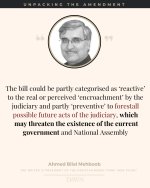
The bill could be partly categorised as ‘reactive’ to the real or perceived ‘encroachment’ by the judiciary and partly ‘preventive’ to forestall possible future acts of the judiciary, which may threaten the existence of the current government and National Assembly, with some ministers saying on media that they expected such action by a section of the judiciary after the retirement of chief justice Qazi Faez Isa on Oct 25, 2024. This explains the indecent haste with which the package of constitutional amendments was rushed through the two houses of parliament.

The 26th Amendment has either amended, substituted, or added 25 articles and one schedule of the Constitution out of which only nine articles deal with subjects other than the judiciary. Three of the amended articles deal with religious provisions and may be categorised as ‘riders’ using the American slang for amendments incorporated to win the support of more legislators and political parties for the package. These three amendments were proposed by Maulana Fazalur Rehman’s JUI-F.

The most important changes introduced in the Constitution through the amendment include the appointment of the Supreme Court chief justice through a 12-member parliamentary committee, instead of the senior-most judge of the court automatically becoming the top judge; the retirement of the chief justice at the age of 65 or on completing a three-year term, whichever occurs first; the introduction of constitutional benches in the apex court to be constituted by the Judicial Commission from time to time and in the high courts, subject to the approval of the respective provincial assemblies; reconstitution of the 13-member Judicial Commission after merging the erstwhile parliamentary committee in it; an annual performance evaluation of high court judges by the Judicial Commission; provision for a secretariat headed by a secretary for the commission; and lowering the minimum age to qualify for becoming a high court judge from 45 to 40 years.

These amendments, no doubt, increase the influence of the legislature and the executive in key aspects of the judiciary. Will the legislative and executive branches use the newly acquired powers maturely and strictly on the basis of merit, or allow personal and political considerations to colour their judgments? The jury is out on this question.

The writer is president of the Pakistan-based think tank Pildat.

X: @ABMPildat
 

26th Amendment, new CJP and reforms


Huzaima Bukhari | Dr Ikramul Haq | Abdul Rauf Shakoori
October 25, 2024


671af9935ec3a.jpg


The Constitution (Twenty-sixth Amend-ment) Act, 2024 [26th Amendment], passed in utmost haste by the Parliament on October 21, 2024 receiving the assent of President of Pakistan on the same day, claims to bring “much-needed reforms in country’s legal framework, enhancing judicial transparency, and promoting the welfare of its citizens”, is being severely criticized by proponents of an independent judiciary.

The 26th Amendment has introduced several provisions that purport to fix the judicial system, ensuring it operates within democratic principles, reinforcing the integrity of Pakistan’s state institutions.

One of the most noteworthy aspects of the 26th Amendment is the inclusion of Article 9A, which enshrines the right to a clean and healthy environment as a constitutional guarantee.

This addition reflects Pakistan’s commitment to global environmental standards and acknowledges the importance of safeguarding natural resources for future generations. By embedding this right within the 1973 Constitution, the government has set a praiseworthy precedent for prioritizing environmental protection, ensuring that future policies align with the nation’s duty to provide a healthy environment for all.

The 26th Amendment has devised a new procedure of judicial appointments by amending Article 175A of the Constitution—changing the composition of Judicial Commission of Pakistan by including members of Parliament having majority in any decision making process.

By allowing both government and opposition members to have a voice in this process, the amendment ensures that parliament has supremacy over judiciary that earlier had absolute say in selection process of judges of higher judiciary. This inclusion, one hopes, will bring transparency and accountability, making the judicial system more representative and reducing chances of bias or undue influence.

Another significant aspect of the 26th Amendment is the introduction of new guidelines regarding the appointment of the Chief Justice of Pakistan (CJP). Under the revised framework, instead of the senior-most judge automatically assuming the role, a parliamentary committee will select one of three nominees.

This change aims at strengthening reliability of the appointment process by allowing a broader range of candidates to be considered for this crucial position. The main idea behind this change is to avoid sole reliance on seniority, ignoring merit, experience, etc. and selecting the individual best-suited for the highest judicial position.

Subsequent to the approval of 26th Amendment, Justice Yahya Afridi was nominated as Pakistan’s next CJP on October 22, 2024 and notified by President the next day —creating hope for stability at a critical time for the nation. With his extensive experience, demonstrated commitment to upholding rule of law, an unblemished legal career, praised by all for his integrity, fairness, and unshakable dedication to the principles enshrined in the Constitution, makes Justice Yahya Afridi an ideal candidate to lead the judiciary.

As the newly appointed CJP, Afridi carries the important responsibility of addressing some of the key challenges facing Pakistan’s judiciary. One of his foremost tasks would be to ensure the effective enforcement of the 26th Amendment.

This includes overseeing the reformed judicial appointment process, ensuring that it functions in a transparent and accountable manner, and upholding the principles of merit and integrity in judicial appointments. His leadership in this area will be critical in enhancing public trust in the judiciary and independent operation of the courts, without political interference.

Another essential task for Justice Afridi would be addressing the significant backlog of cases that have long plagued the country’s courts.

By introducing structural reforms like constitutional benches and streamlining judicial processes, Justice Afridi can make organized efforts to clear the backlog and to see that litigants receive timely justice. His commitment to upholding efficiency within the judiciary will be key to reducing the long-standing issue of delayed justice, which has often eroded public confidence in the legal system.

The 26th Amendment also introduces a more structured approach to judicial performance evaluations, ensuring accountability and continuous improvement within the judiciary. With these reforms, the underperforming judges will be given the opportunity to enhance their work before any disciplinary measures are considered.

As CJP, Justice Afridi can play a vital role in implementing these performance evaluations and ensuring that the judiciary maintains high standards of professionalism and dedication to the law. This will contribute to a more efficient and respected judicial system, with judges held to clear and consistent standards.

The 26th Amendment further emphasizes judicial restraint, particularly with respect to the exercise of Suo Motu powers. Introduction of a three-member judicial committee to approve such notices promotes the idea that the judiciary must act collectively and thoughtfully when intervening in political or administrative matters.

Justice Afridi’s leadership will be crucial in ensuring that these powers are used judiciously, maintaining the balance between judicial intervention and respect for separation of powers. His three-year tenure will likely see the judiciary exercise greater care in its decisions, and in protecting the country’s democratic structure.

The new CJP will also have an important role to play in making Pakistan’s judiciary a model for efficiency and transparency, regardless of regional disparities. With the 26th Amendment introducing provisions for case transfers between high courts, Justice Afridi’s oversight would enable this mechanism to operate smoothly and fairly.

This would guarantee that cases are heard in a timely manner, and that justice is accessible to all citizens.

Beyond these immediate responsibilities, Justice Afridi’s appointment comes at a critical juncture in Pakistan’s judicial history. With the nation passing through legal and political transformations, the judiciary will be instrumental in ensuring that these changes are implemented smoothly.
 
The 26th Amendment’s focus on timely justice, accountability, and judicial independence aligns perfectly with Justice Afridi’s career-long dedication to these principles. His track record as a fair and principled judge suggests that he will approach his new role with the urgency and diligence that the office demands.

The introduction of constitutional rights such as the right to a clean environment, coupled with reforms in the judicial appointment process and case management, provides the judiciary with a more robust framework for delivering justice. Justice Afridi’s tenure is expected to strengthen these reforms in the years to come.

Criticism aside of interference in independence of judiciary that has much weight to the extent of appointing constitutional benches from outside, by amending the Constitution, Pakistan’s legislature has made an effort to enhance transparency, accountability, and fairness in higher judiciary.

Inclusion of key provisions aimed at improving judicial efficiency and promoting environmental protection reflects the amendment’s comprehensive nature and its alignment with the country’s broader goals of social and legal progress.

However, only time will tell whether 26th Amendment proves to be beneficial for masses and democratization of institutions or is set to serve those who allegedly trigged it as they want no resistance from any quarters to their absolute control over the entire state apparatus—the legislators, no matter affiliated with which party, are always willing to oblige without any hesitation!

Copyright Business Recorder, 2024
 

Context and intentions

Umair Javed
October 28, 2024

MOST critiques of the 26th Constitutional Amendment focus on its impact on judicial independence.

Thankfully, some clauses related to the supposed sanctity of national security under Article 199 and the creation of a separate constitutional court did not make it to the final draft.

Nevertheless, by changing appointment methods, creating new constitutional benches through a political committee, assigning performance evaluations to parliament, and parliamentary control in the chief justice’s appointment, judges are more likely to be ‘politicised’.

Whereas previously factionalism and groupings were confined to internal bench and bar politics, one can argue that the amendment will enhance the role that political parties and party leaders play in judicial careers.

These concerns have been raised by opposition politicians from the PTI, civil society, and significant segments of the legal community. Those invested in the independence of the judiciary as a constitutional and political ideal are within their right to argue against the amendment.

An amendment being justified through the rhetoric of parliamentary supremacy had little to do with actual parliamentary functioning.

In my view, a different type of critique can be based on the political situation in which these drastic changes have taken place. In other words, one needs to look past what has happened ‘on paper’ and place it in the context of hybrid regime dynamics that began in 2018 and have accelerated to an unprecedented degree in the last two years. Here, four context-specific issues are worth mentioning.

The first issue is the urgency with which this was passed through. It is clear this was because the seniority principle needed to be set aside because it worked in the favour of someone who wasn’t favoured by the state. So this amendment carries the element of being person-specific, at least in the current moment.

The second issue is the nature and political importance of cases that will now be heard by a constitutional bench. These include litigation on the status of election tribunals and the functioning of the ECP, both of which have a direct bearing on the viability of the ruling coalition.

Some judges in various high courts and the Supreme Court had shown a degree of scepticism regarding how the election was carried out and the way in which election-related trials were being conducted. There was a reasonable chance that some results would have been overturned, after recounting or repolling. This can still happen but the amendment offers a temporary insurance policy through increased intervention in bench composition.

Similarly, favourable bench compositions may also help secure the status of military courts and the trials of those accused of ‘fomenting mutiny’ in line with the regime’s preferences. Resultantly, the sanctity of a free trial and of civil and political rights, while never in great shape in Pakistan, are now even more vulnerable.

A third issue is the absence of deliberation that went into the amendment. In the first attempt, no one, save a few, had actually seen the draft. There was no transparent consultation, nor any engagement on the legal and political reasoning behind it.

Things improved marginally in the second round, with drafts at least being shared among the parliamentary committee and party leaders, but again with an alarming level of secrecy and opaqueness. So much so that just a few days before the actual vote, a member of the Senate declared he had no response to anyone who asked what the amendment actually entailed. Ultimately it was passed through both Houses in a combined total of six hours.

It is a bit strange that an amendment being justified through the rhetoric of parliamentary supremacy had little to do with actual parliamentary functioning. Drafted elsewhere, deliberated by a select few, and passed in supreme haste.

Fourth, and perhaps most egregiously, the ways in which votes were shepherded showed a violation of democratic norms, even if they were strictly legal thanks to a favourable 63-A judgment. The reliance on floor-crossing of at least three MNAs along with the ‘disappearance’ of two BNP-M senators who emerged in the parking lot on the night of the vote places significant question marks on the entire act.

Some will inevitably respond by saying that the amendment should be evaluated on the basis of what it proposes, rather than the manner in which it was passed, the intentions behind it, or the context that marked its birth. While intentions and tactics can be suspect, they argue, the life of an amendment extends beyond the present and it may achieve the desirable goal of parliamentary supremacy in the long run.

One can concede that parliamentary oversight on judicial affairs is not necessarily a bad thing. Many countries provide for input in some form, and on the basis of various forms of judicial ingress and overreach since 2007, one can make a case for using a constitutional amendment to recalibrate the relationship between parliament and judiciary in Pakistan.

However, to this line of reasoning, there exists a relatively simple response: democracy’s survival is not just dependent on the existence of laws, but on the degree to which the polity actually believe in it as a form of government. It is that belief which provides legitimacy to the state and its institutions, including parliament.

A parliament that serves the interests of the executive through murky interventions can very well do so by formally jumping through all legal hoops. It can put forward the rhetoric of accountability and correcting past wrongs. It may even justify its actions on account of parliamentary strengthening and reconfiguring an imbalance between the elected and the unelected.

But in the backdrop of compromised intentions and context, it may very well end up delegitimising itself, undermining the very goal that it claims to achieve.

The writer teaches politics and sociology at Lums.

X: @umairjav
 
Topi Drama..

Amendment for extension , he voted. and shield for the seminary bill. Now that bill is gone, he took the pie and enjoy with his family. :mad: :mad:

Fazl rejects govt's proposals on seminary bill​


Fazl said if president could sign other bills into law, there should be no reason to return the madrassa bill

News Desk
December 09, 2024

jamiat ulema e islam fazl jui f chief maulana fazlur rehman photo file


Jamiat Ulema-e-Islam-Fazl (JUI-F) chief Maulana Fazlur Rehman.

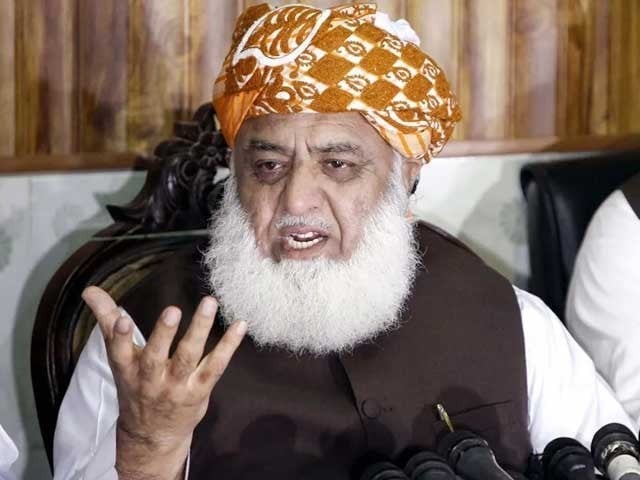
Jamiat Ulema-e-Islam (F) chief Maulana Fazlur Rehman on Monday rejected any proposed amendments to the madrassa bill by the government, stating that his party is unwilling to accept any of their suggestions.

Speaking at a press conference in Charsadda district of Khyber Pakhtunkhwa (K-P), Fazlur Rehman said that if the government were to present any amendments, they [JUI-F] would not even consider them. He asserted that the government’s proposals would be rejected outright.

Fazlur Rehman also questioned why the President returned the madrassa bill, which had already been approved by the National Assembly and the Senate, with objections.

He noted that if the President could sign other bills into law, there should be no reason to send the madrassa bill back with objections.

Addressing the government's claims regarding the affiliation of madrasahs with the Ministry of Education, Fazlur Rehman clarified that the bill provides madrasahs with complete autonomy to affiliate with any federal institution, whether under the 1860 Act or the Ministry of Education.

The JUI-F chief also expressed concerns about attempts to create divisions among religious scholars and madrasas over the bill. He stressed that there was consensus among all scholars and madrasahs regarding the bill.

He mentioned that a significant meeting, called by Mufti Taqi Usmani and the president of the Federation of Madrassahs, is scheduled for December 17, where a unified decision on the bill will be made.
 
To view this content we will need your consent to set third party cookies.
For more detailed information, see our cookies page.
 

Users who are viewing this thread

Back
Top