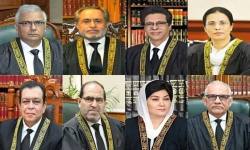
Pakistan Constitutional Amendments:

In yet another letter highlighting the rift within the judiciary, four Supreme Court (SC) judges expressed their reservations on Monday regarding a the process being adopted for the review and approval for Supreme Court Rules 2025.

They dubbed the full court meeting called for this purpose today a mere “stamp of approval” for the rules, which they said were already decided and unilaterally approved.

Read more: https://www.dawn.com/news/1940498
 
They dubbed the full court meeting called for this purpose today a mere “stamp of approval” for the rules, which they said were already decided and unilaterally approved.
Parliament = rubber stamp
Judiciary = rubber stamp
Government = rubber stamp
Army & ISI = the sole decision maker in occupied Pakistan
 
Editorial: The judiciary, once regarded as a source of clarity in times of political and institutional uncertainty, now appears increasingly consumed by internal discord.

Where judgements once prompted debates about their implications for citizens, the focus today has shifted to the courts’ own crises. Instead of guiding the public, the judiciary seems locked in a cycle of controversy that has steadily eroded all confidence in its ability to dispense justice.

Read full editorial here: https://www.dawn.com/news/1945402/justice-in-retreat
 
Editorial: The judiciary, once regarded as a source of clarity in times of political and institutional uncertainty, now appears increasingly consumed by internal discord.
There is NO internal discord. The power of judiciary comes from the people, just like other pillars of state such as parliament and government. In Pakistan, however, its power also comes from the Fauj. When Fauj wants judiciary to tighten its noose around the parliament or govt, they empower it so much that it can even rewrite the constitution. When Fauj wants judiciary to not even touch parliament or govt, they disempower it to the point it cannot even dispense justice to a single individual such as Imran Khan. Fauj roams supreme in the land of the lawless jungle...
 

Mustafa Khokhar files appeal after SC registrar returns plea seeking full court hearing against 26th Amendment


Umer Mehtab
October 2, 2025

Tehreek-i-Tahaffuz Ayeen-i-Pakistan (TTAP) Vice Chairman Mustafa Nawaz Khokhar on Thursday filed an appeal against the Supreme Court (SC) registrar’s decision to return his petition seeking a full court hearing of challenges against the 26th Constitutional Amendment.

The 26th Amendment, passed on Oct 21, 2024, took away the SC’s suo motu powers and empowered a Special Parliamentary Committee to nominate the next chief justice of Pakistan (CJP) from among the three most senior SC judges instead of the senior-most one.

The SC is currently seized with multiple petitions urging the constitution of a full court to hear the matter rather than the Constitutional Bench (CB) formed under the 26th Amendment. The CB is set to resume proceedings on the original appeals on October 7 (Tuesday).

“I’ve filed an appeal against the registrar’s decision to return my petition, seeking justice once again. My petition argues that the majority decision of the Practice & Procedure Committee remains valid in law and cases related to the 26th should only be heard by a full court,” Khokhar said on X.

The appeal, filed through Advocate Shahid Jamil Khan, requested the SC to set aside the September 19 decision and “register and entertain the said petition in accordance with law”.

The plea was filed under Rule 3 of the Supreme Court Rules and named the apex court’s registrar office as a respondent.

The appeal contended that the registrar had “no jurisdiction to determine the maintainability or entertainability of a petition under Article 184(3), as such questions can only be decided by this Hon’ble Court in exercise of its judicial authority”.
 
It argued that even if a petition appeared non-maintainable under the Constitution, law or the SC Rules, the “issue must be placed before the court for adjudication on the judicial side”.

“The registrar, acting on the administrative side, cannot assume or exercise judicial powers, nor can he refuse to receive or register a petition or appeal on the ground of perceived non-maintainability,” the former senator contended.

CJP Yahya Afridi had ignored a decision made in October 2024 by a committee to bring challenges to the 26th Amendment before the full court, according to minutes of the communication exchange between CJP and two senior SC judges.

The committee, which met on Oct 31, 2024 under the Practice and Procedure Act (PPA) 2023, was convened by senior puisne judge Justice Syed Mansoor Ali Shah and Justice Munib Akhtar. In response, CJP Afridi, who chairs the committee, said he did not find it appropriate to call for a full court hearing.

In separate minutes dated May 20, 2025, Justice Shah stressed the need for meaningful consultation, which he stated was the core purpose of the PPA. Justice Shah noted that delegating powers to the SC’s registrar was not covered by the act.

Since October 2024, multiple petitions have been filed with the SC challenging the amendment, contending that it “abrogates, repeals, alters and destroys the basic features of the Constitution” and “violates” fundamental rights.

An eight-member CB, headed by Justice Aminuddin Khan, will resume hearing a set of petitions against the 26th Amendment on Tuesday.

The bench also includes Justices Jamal Khan Mandokhail, Muhammad Ali Mazhar, Ayesha A. Malik, Syed Hasan Azhar Rizvi, Musarrat Hilali, Naeem Akhtar Afghan and Shahid Bilal Hassan.
 

SC Constitutional Bench to take up challenges to 26th Amendment from Oct 7

Nasir Iqbal
September 24, 2025

• Petitioners argue amendment passed without full parliament, relied on defectors’ votes
• Want case to be heard by full court

ISLAMABAD: Against the backdrop of growing calls for an early hearing, an eight-judge Constitutional Bench (CB) of the Supreme Court will resume on Oct 7 proceedings on a set of petitions challenging the 26th Constitution Amendment.

Headed by Justice Aminuddin Khan, the bench also includes Justices Jamal Khan Mandokhail, Muhammad Ali Mazhar, Ayesha A. Malik, Syed Hasan Azhar Rizvi, Musarrat Hilali, Naeem Akhtar Afghan and Shahid Bilal Hassan.

On Aug 20, senior puisne judge Justice Syed Mansoor Ali Shah and Justice Munib Akhtar had written a joint letter following the SC decision to make public the Oct 31, 2024 committee’s minutes that called for a full court meeting to determine the vires of the 26th Amendment.

Two responses from Chief Justice of Pakistan (CJP) Yahya Afridi were uploaded on the court’s website on Aug 14, explaining why he had disregarded the committee’s decision. The CJP had argued that such a move would undermine the much-needed spirit of collegiality among judges and expose the apex court to public comment, which, he noted, had regrettably been the case in the recent past.

In their joint letter, Justice Shah and Justice Akhtar observed: “The challenges to the 26th Amendment continue to remain pending and a golden opportunity to decide them at the earliest instance before the institution as a whole — i.e. the full court as it then stood — has been lost, perhaps irretrievably.”

The last hearing on the challenges was held on Jan 27, when the Constitutional Bench had asked different petitioners to consider the existing eight-judge bench as the full court. At that hearing, Justice Mazhar noted: “This is not the domain of the CB to constitute the Full Court or refer the matter to the Chief Justice of Pakistan after Article 191A of the Constitution.” He explained that a Full Court cannot be formed merely on the wishes of lawyers.

Justice Aminuddin Khan, however, issued notices to the respondents on points raised by counsel regarding reference of the matter to the Full Court, the amendment’s impact on judicial independence, and arrangements for live streaming of proceedings.

The Supreme Court is currently seized with multiple petitions filed by the PTI, individuals and various high court bar associations, urging the constitution of a Full Court to hear the matter rather than the Constitutional Bench formed under the 26th Amendment.

The petitions had argued that the process through which the amendment was passed contravened Articles 63A, 238 and 239 of the Constitution, pointing to the absence of a fully constituted parliament, the inclusion of defecting members’ votes and other procedural irregularities that allegedly rendered its passage unconstitutional and of no legal effect.

The petitioners also sought to have Sections 7, 9, 10, 12, 14, 17, 21 and 27 of the 26th Amendment declared unconstitutional, ultra vires and in direct conflict with the Constitution’s salient features and, therefore, void ab initio.
 

26th Amendment case: SC Constitutional Bench approves live streaming of proceedings


Dawn.com | Umer Mehtab
October 7, 2025

An eight-judge Constitutional Bench (CB) of the Supreme Court (SC) approved on Tuesday a set of requests seeking the live streaming of proceedings on pleas challenging the 26th Amendment.

The Amendment, which was approved by both houses of parliament in October last year, altered judicial authority and tenure, and has been a lightning rod for debate with both opposition parties and legal experts questioning its impact on the judiciary’s autonomy.

It took away the SC’s suo motu powers, set the chief justice of Pakistan’s (CJP) term at three years and empowered the prime minister to appoint the next CJP from among the three most senior SC judges. It also paved the way for the formation of the CB, which is now hearing petitions against the very legislation that led to its establishment.

It has been challenged by various high court bar associations, the PTI and others.

A CB headed by Justice Aminuddin Khan and comprises Justices Jamal Khan Mandokhail, Muhammad Ali Mazhar, Ayesha Malik, Syed Hasan Azhar Rizvi, Musarrat Hilali, Naeem Akhtar Afghan and Shahid Bilal Hassan resumed hearing the set of pleas today, which were last taken up on January 27.

During today’s hearing, three matters were primarily discussed — the constitution of a full court to hear the pleas against the 26th Amendment, objections to the CB and live streaming of the proceedings.

At the outset of the hearing, Justice Aminuddin Khan said the bench would first hear arguments on requests for a full court hearing on the pleas and objections to CB. “We will decide on the matter of live streaming (of court proceedings) later,” he added.

At that, lawyer Khawaja Ahmad Hassan argued that arguments on pleas seeking a full court hearing should be live-streamed so that the public was also made aware of the grounds on which the request was being made. He then urged the court to first hear arguments on requests for streaming the proceedings live.

Justice Aminuddin Khan remarked that matters of the bench were of relevance to the court, not the public. He asserted that the court would first take up the matter regarding the constitution of a full court.

At one point during the hearing, he said, “Things have to be managed. All of us are serving the public, we are all fulfilling our responsibilities. This is a big case, we will proceed on this in an orderly manner.”

The counsel for Tehreek-i-Tahaffuz Ayeen-i-Pakistan Vice Chairperson Mustafa Khokhar, Shahid Jameel, informed the court that the SC registrar had raised objections over his client’s plea for a full court hearing.

“We filed an appeal against the objections,” he said, requesting the court to first decide Khokhar’s appeal. He further said that his client had also raised objections over the CB and urged the court to hear it along with the other petitions.

After consultation among the judges, Khokhar’s petition was allotted a number.

The lawyer representing the Khyber Pakhtunkhwa government also presented arguments for a full court hearing of pleas.

He clarified that they did not have any objection regarding any of the members of the existing eight-judge CB but wanted a full court to hear the pleas.

During his arguments, Barrister Salahuddin Ahmed contended that every citizen had the right to information. However, neither was the draft of the 26th Amendment made public nor was there a public debate on it, he argued.

He then argued that at least proceedings should be live-streamed for public viewing.

He recalled that the 26th Amendment was approved by parliament “in the darkness of the night”, adding that previously court proceedings had also been streamed live, including those in Zulfikar Bhutto case and the case pertaining to the Supreme Court (Practice and Procedure) Act.

He said senior advocate of the SC Makhdoom Ali Khan had declared the 26th Amendment case the “constitutional case of the century”, arguing that a full court or a full CB should hear the case.

Following his arguments, Justice Afghan enquired, “So you want that apart from the proceedings taking place in broad daylight, they should also be live-streamed?”

To that, Barrister Ahmed said, “The Amendment was passed in the darkness of the night. That is why facts must be revealed to the public.”

Following that, the bench reserved its decision on requests seeking live streaming of the proceedings.

During the hearing, Justice Malik also asked Additional Attorney General Amir Rehman about the government’s stance on the live streaming of court proceedings.

To that, Rehman said the matter was administrative.

“So you will agree with whatever the bench decides?” asked Justice Mazhar.

Eventually, the court approved the requests for live streaming the case’s proceedings and adjourned the hearing till 11.30am tomorrow (Wednesday).
 

The petitions​

The petitioners have requested the apex court to strike down the entire 26th Amendment on grounds of procedural impropriety if determined that the requisite two-thirds of the lawfully elected membership of each House did not freely exercise their right to vote in favour of the same as required under Article 239, which elaborates on bills and their passage to amend the Constitution.

In the alternative, the petitioners pleaded, the court should strike down certain provisions of the 26th Amendment since they substantively undermine the independence of the judiciary which is a salient feature of the Constitution: namely the provisions for annual performance evaluation of judges of the high court by the Judicial Commission of Pakistan being inserted in Article 175A(1) and Articles 175A(18) to (20); the provisions relating to the appointment of the chief justice of Pakistan being the substitution to Article 175A(3), and the provisions for constitutional benches of the apex court and high courts.

As a consequence, the court should declare that the original Article 175A(3) holds the field and direct the federal government to notify SC’s senior-most judge as CJP in accordance with the original Article 175A(3), the petitioners argued.
 
The petitioners also challenged the constitutionality of the constitutional benches, arguing that the SC should declare invalid all amendments for which votes of such members whose election disputes were pending were necessary to achieve the prescribed numerical threshold in Article 239.

They also called for the Supreme Court (Practice and Procedure) Act 2024 and the Supreme Court (Number of Judges) (Amendment) Act 2024 to be declared unconstitutional, void ab initio and of no legal effect, since they stem from an unconstitutional amendment and represent an attempt to achieve unconstitutional designs.

The petitioners also requested the SC for a full court hearing of the pleas instead of a hearing by the CB, which was established under the 26th Amendment.
 

‘Opportunity lost’​

Between January and now, there have been multiple calls for a full court hearing of these pleas.

On August 14, two responses from Chief Justice of Pakistan Yahya Afridi were uploaded on the court’s website, explaining why he had disregarded a decision made last year by a committee to bring challenges to the 26th Amendment before the full SC.

The committee, which met on Oct 31, 2024, under the Practice and Procedure Act (PPA) 2023, was convened by senior puisne judge Justice Syed Mansoor Ali Shah and Justice Munib Akhtar. In response, CJP Afridi, who chairs the committee, said he did not find it appropriate to call for a full court hearing.

The CJP had argued that such a move would undermine the much-needed spirit of collegiality among judges and expose the apex court to public comment, which, he noted, had regrettably been the case in the recent past.

On Aug 20, Justices Shah and Akhtar wrote a joint letter to the CJP, following the SC decision to make public the Oct 31 committee’s minutes.

In their joint letter, Justice Shah and Justice Akhtar observed: “The challenges to the 26th Amendment continue to remain pending and a golden opportunity to decide them at the earliest instance before the institution as a whole — i.e. the full court as it then stood — has been lost, perhaps irretrievably.”
 

Supreme Court rift: Justices Shah, Akhtar say judicial process undermined in 26th Amendment controversy


Dawn.com

A letter, penned by Supreme Court Justices Syed Mansoor Ali Shah and Munib Akhtar, has exposed another deepening rift within Pakistan’s apex court, this time over Chief Justice Yahya Afridi’s failure to implement what the two judges argue was a legally binding decision by a Supreme Court Committee to hear challenges to the controversial 26th Constitutional Amendment before a Full Court.

The letter, which has surfaced amid a brewing controversy, reveals a clash over judicial independence, transparency, and the handling of one of Pakistan’s most politically charged constitutional issues: the 26th Amendment, which alters judicial authority and tenure, and has been a lightning rod for debate, with opposition parties and legal experts questioning its impact on the judiciary’s autonomy.

The letter states that on October 31, 2024, Justices Shah and Akhtar, members of the Supreme Court Committee formed under the Practice and Procedure Act, 2023, had pushed for a Full Court hearing to address petitions challenging the amendment’s validity. They argued that only a collective adjudication by all judges could restore public faith in the institution, which was seen at the time to have been battered by political pressures.

However, CJP Afridi, citing informal, private consultations with other judges, insisted that the cases should be assigned to a Constitutional Bench — a body created under the very amendment that was under scrutiny.

In a dramatic turn, the two justices said they had convened a formal Practice and Procedures Committee meeting the same day, deciding by majority to schedule the petitions for November 4, 2024, before a Full Court. The decision was never complied with by the Registrar of the Supreme Court, even after a subsequent letter was issued to them.

The CJP, who skipped the meeting, later issued notes justifying his refusal to comply. The two notes from the CJP, recently uploaded to the Supreme Court’s website, suggest that he had declined to implement the committee’s decision because such a move could have dampened the “much-needed spirit of collegiality” among the judges and “further expose the court to public scrutiny”.
 
cant they just rename 26th to Asim law? since he is lord king of khakistan?
 

SC Constitutional Bench mulls formation of full court while hearing pleas against 26th Amendment


Umer Mehtab
October 8, 2025

1759923244801.png

An eight-judge Constitutional Bench (CB) of the Supreme Court (SC) on Wednesday began its deliberations on the petitioners’ request to form a full court to hear a set of pleas challenging the 26th Amendment.

The Amendment, which was approved by both houses of parliament in October last year, altered judicial authority and tenure, and has been a lightning rod for debate with both opposition parties and legal experts questioning its impact on the judiciary’s autonomy.

It took away the SC’s suo motu powers, set the chief justice of Pakistan’s (CJP) term at three years and empowered a Special Parliamentary Committee for the appointment of the CJP from among the three most senior SC judges. It also paved the way for the formation of the CB, which is now hearing petitions against the very legislation that enabled its establishment.


The legislation had been challenged by various bar associations, bar councils, lawyers, the PTI, and some politicians. The SC is also seized with separate petitions seeking the formation of a full court to hear the matter, rather than the CB.

The CB is headed by Justice Aminuddin Khan and also includes Justices Jamal Khan Mandokhail, Muhammad Ali Mazhar, Ayesha Malik, Syed Hasan Azhar Rizvi, Musarrat Hilali, Naeem Akhtar Afghan and Shahid Bilal Hassan. It resumed proceedings yesterday after over eight months, and unanimously allowed live-streaming of the case upon some petitioners’ request.

The pleas taken up also seek the formation of a full court to hear the matter. Hence, before proceeding further, the court will first determine whether the challenges should be heard by a full court comprising all available SC judges or by the same eight-judge CB.

During today’s hearing, Lahore High Court Bar Association (LHCBA) lawyer Hamid Khan requested the formation of a 16-member bench to hear the pleas, as per the number of SC judges at the time of the 26th Amendment.

Several judges, including Justice Aminuddin, observed that the 26th Amendment was currently part of the Constitution. Some judges questioned whether the CB had the power to form a full court, while Justice Malik noted there was no restriction on issuing a judicial order for that.

The hearing was then adjourned till 11:30am tomorrow.

Requests to form a full court bench and to live stream the case dominated yesterday’s hearing, with the state lawyer expressing no objection to live stream the proceedings.
 

The hearing​

At the outset of the hearing, Advocate Hamid came to the rostrum and said the 26th Amendment was introduced in an “unusual” manner and passed by the parliament at night.

Hamid recalled that there were 17 judges present in the SC at the time the legislation was passed, including then-CJP Qazi Faez Isa, who later retired. Therefore, he contended, a 16-judge “full court” bench as of then should hear the pleas and pointed out that all eight judges in the current CB would be part of that bench as they were already serving as SC judges in October last year.

As per the SC’s website, there are currently a total of 24 judges in the SC, including CJP Yahya Afridi, after six new judges were appointed in February.

“This Amendment is against the very basic features of the Constitution,” he asserted, at which Justice Mandokhail said that the matter will be deliberated upon later and asked him whether the Amendment was currently a part of the Constitution.

In response to Hamid’s arguments, Justice Aminuddin remarked, “We depend on the Constitution. Lawyers also depend on the Constitution. Unless the Constitution is [further] amended, we will have to depend on the current Constitution.”

Justice Hilali also observed that whether the 26th Amendment was “right or wrong”, the court had not suspended it yet. “You consider the 26th Amendment a part of the Constitution, which is why you have challenged it.”
 

Users who are viewing this thread

Back
Top