Pakistan Exports / Imports - Updates

Pakistan’s tyre manufacturer secures US certification, clears way for exports​

Ghandhara Tyre and Rubber Company says its locally manufactured tyres meet US Federal Motor Vehicle Safety Standards as it targets new overseas markets

Ghandhara Tyre and Rubber Company Limited has obtained certification from the United States Department of Transportation, allowing it to export tyres to the US market.

The company said its manufactured tyres comply with applicable US Federal Motor Vehicle Safety Standards.

In a notice submitted to the Pakistan Stock Exchange on July 15, 2026, Ghandhara Tyre said the certification supports its plan to expand exports and enter new international markets.

The company did not disclose the expected volume, value or timing of tyre exports to the United States.

 

Pakistan’s Big Bird secures major export contract, eyes to dominate global halal market


July 16, 2026
BR Web Desk

Big Bird Foods Limited (BBFL), a Pakistani poultry processing unit, has secured a major contract to export poultry products to a Gulf-based halal food company.

The listed company shared the development in a notice to the Pakistan Stock Exchange (PSX) on Thursday.

“BBFL is pleased to announce that the company has secured a significant export order from a Gulf-based halal food company for the supply of raw chicken and further processed poultry products,” read the notice.


The company said that the order is expected to approximately double its current export volumes, with additional upside potential as production capacity expands and additional product categories are introduced.

“Based on current projections, the contract is expected to add further Rs1.2 billion in annual revenues,” it said.

The company shared that the global halal food market is currently estimated to exceed $900 billion annually and is projected to grow to over $1.4 trillion by 2034, presenting significant long-term opportunities for established halal producers with internationally compliant processing facilities.

Whereas, Pakistan’s annual meat exports are expected to exceed $500 million in FY26.
 
@Owaiz sb

One of the problems seems to be that Pakistan is exporting its best minds abroad which means domestic skill availability is stagnating. Remittances have become Pakistan's Dutch disease.

Regards
Absolutely sir. A country addicted to foreign inflows be they aid or loans or remittances does not feel the need to then focus on exports.
 
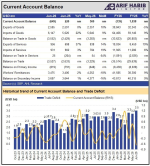
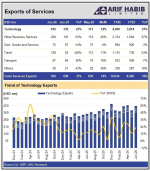
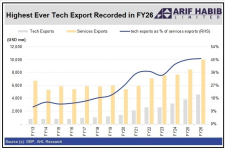
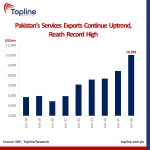
Pakistan services/IT exports have finally outpassed imports in recent months. So next FY Pakistan will have surplus in services trade for the first time ever in history. I think India passed this milestone long ago and since then services exports is what keep their growth going.

Meanwhile exports of goods decline by 5% in FY 2025-26. Overall its almost exact same as last year because of increase in services exports.

FY2025-26 exports $40.87bn
FY2024-25 exports $40.88bn

FY2025-26 imports $76.39bn
FY2024-25 imports $70.43bn


1784278628320.png

1784278678727.png
 
Last edited:
Pakistan services/IT exports have finally outpassed imports in recent months. So next FY Pakistan will have surplus in services trade for the first time ever in history. I think India passed this milestone long ago and since then services exports is what keep their growth going.

Meanwhile exports of goods decline by 5% in FY 2025-26.

View attachment 206670

View attachment 206671

"In the financial year 2025-26, India's services exports reached approximately $421.36 billion, while services imports stood at $204.42 billion. This generated a substantial services trade surplus of $216.94 billion."

That surplus in services exports is what keep India away from IMF.
 

Food import bill jumps to $9.1bn on higher sugar, edible oil purchases in FY 2026


Mubarak Zeb Khan
July 17, 2026

ISLAMABAD: Pakistan’s food import bill surged 11.66 per cent to $9.150 billion in the financial year 2025-26 from $8.195bn during the same period last year, largely led by higher purchases of sugar and edible oil.

The gap between food imports and exports widened during the year as exports of fruits and vegetables declined sharply, particularly to Afghanistan, following the suspension of bilateral trade in October 2025.

The trend has increased the country’s reliance on imported food items.

Meanwhile, exports of raw food products fell 29.49pc to $5.017bn in FY26 from $7.116bn in the preceding fiscal year, according to official data.


Raw food exports fall 29pc to $5bn, widening trade gap

The drop in exports was broad-based, with volumes declining across nearly all major food categories, except meat, which showed some resilience during the period.

The product-wise data showed that rice exports dropped 31pc to $2.291bn in FY26 from $3.353bn in FY25. Exports of basmati rice, however, edged up 1.5pc to $843.002 million from $830.570m over the same period last year. However, export volumes of basmati rice slipped 1.66pc year-on-year (YoY).
 
The Ministry of Commerce has extended the subsidy scheme for rice exports by another three months, until September 30, and raised the Duty Drawback of Local Taxes and Levies (DLTL) rate for non-basmati rice to support exporters facing weaker international demand.

The higher drawback rate and extension of the scheme are expected to provide temporary relief to exporters of coarse rice, which has been the hardest hit segment of Pakistan’s rice exports during the past year.


Similarly, the export of meat recorded a growth of 7.10pc during FY26 on a YoY basis. The exports of fish products recorded a 3.57pc growth. Most of other food products recorded a negative growth. Vegetables registered the steepest fall, plunging by 55.72pc and fruits 0.02pc. Tobacco exports recorded a negative growth of 14.41pc, and spice exports declined by 8.77pc during FY26.

On the import side, palm oil constituted the largest share among imported food items, followed by pulses, tea, soya bean oil and sugar.

Pakistan imported 309,545 tonnes of sugar in FY26, marking an unprecedented increase of 8,716.43pc compared to just 3,508 tonnes in the same period last year, according to official trade data.

In value terms, sugar imports jumped to $175.182m in FY26 from $3.508m a year earlier, reflecting a sharp rise of 4,893.80pc. The surge follows the government’s decision to allow large-scale imports to address domestic shortages and contain rising prices in local markets.
 

Users who are viewing this thread

Back
Top