Navigation
Install the app
How to install the app on iOS
Follow along with the video below to see how to install our site as a web app on your home screen.
Note: This feature may not be available in some browsers.
More options
Style variation
You are using an out of date browser. It may not display this or other websites correctly.
You should upgrade or use an alternative browser.
You should upgrade or use an alternative browser.
Pakistan Exports / Imports - Updates
- Thread starter ghazi52
- Start date
More options
Who Replied?


SoulSpokesman
Trusted Member

@hydrabadi_arab
Hydra bro
Pakistan services/IT exports have finally outpassed imports in recent months. I think India passed this milestone long ago and since then services exports is what keep their growth going.
You are right. We will never be competitive in goods exports, except in a few niche ones. Your taller than mountain friend has stitched that up. We are short on raw materials and energy, that will also hold back manufacturing. Services and skilled manpower exports are the way out for both PAK and IND.
Regards
Hydra bro
Pakistan services/IT exports have finally outpassed imports in recent months. I think India passed this milestone long ago and since then services exports is what keep their growth going.
You are right. We will never be competitive in goods exports, except in a few niche ones. Your taller than mountain friend has stitched that up. We are short on raw materials and energy, that will also hold back manufacturing. Services and skilled manpower exports are the way out for both PAK and IND.
Regards

hydrabadi_arab
Trusted Member


Distant_Observer
Trusted Member

@Owaiz sb
One of the problems seems to be that Pakistan is exporting its best minds abroad which means domestic skill availability is stagnating. Remittances have become Pakistan's Dutch disease.
Regards
Best minds will come back once Pakistan becomes livable and there is opportunity in R&D.
They need to focus on manufacturing at scale and take full advantage of their cheap labour.

ghazi52
THINK TANK: CONSULTANT
- Thread starter
- #307
Imports from US surge to $3.2bn in FY26
Mubarak Zeb KhanAugust 2, 2026
ISLAMABAD: Pakistan’s merchandise exports to North America grew 1.32 per cent to $6.503 billion in FY26 from $6.418bn the last year.
Imports from the region, however, rose 6.52pc to $3.822bn from $3.588bn.
Under the new agreement, Pakistan will import additional goods from the US to balance the trade deficit. As a result of this agreement, imports from the region, especially the US, grew sharply during the year.
However, exports to Canada declined. Imports under the agreement grew by nearly 39pc in FY26, while Pakistan’s exports to the US grew by a paltry 1.55pc.
Trump tariffs reshape trade landscape
The development comes amid policy shifts by US President Donald Trump, who has imposed additional tariffs while extending limited relief to Pakistan under a reciprocal arrangement.
Under the understanding, Pakistan is expected to increase imports of oil and other commodities from the US to narrow the bilateral trade gap.
The US remained the dominant market, accounting for nearly 94pc of Pakistan’s total exports to North America, with the remaining share going mainly to Canada and other countries.
In FY25, Pakistan’s merchandise exports to North America rose by 9.97pc to $6.415bn, up from $5.833bn in the corresponding period of the previous year, driven mainly by higher textile and clothing shipments to the US, according to data compiled by the State Bank of Pakistan.
ghazi52
THINK TANK: CONSULTANT
- Thread starter
- #308
Rice worth of $2.29b exported in FY2026
By Staff Reporter | The NationJul 25, 2026
ISLAMABAD: Rice exports from the country during the financial year ended on June 30, 2026 were recorded at $2.291 billion as compared to the exports of $3.353 billion of the corresponding period of the last year. During the period from July-June 2025-26, over 4.292 million metric tonnes of rice were exported as compared to the exports of 5.817 million tonnes of the same period of the last year.
Meanwhile, 794,638 metric tonnes of basmati rice valued at $843.002 million were also exported as compared to the exports of 808,069 metric tonnes worth of $830.570 million of the same period of the last year.
Food commodities worth $5.017 billion were exported during the financial year ended on June 30, 2026, as compared to the exports of $7.116 billion of the corresponding period of the last year, according to the data of the Pakistan Bureau of Statistics.
ghazi52
THINK TANK: CONSULTANT
- Thread starter
- #309
During the period from July-June, 2025-26, the food group exports from the country decreased by 29.49 percent as compared to the exports of the same period of the last year.
Over 215, 170 metric tonnes of fish and fish products worth of $482.017 million, 533,382 metric tonnes of fruit $308.130 million and 594,104 metric tonnes of vegetables worth of $162.770 million were exported during the period July-June, 2026 as compared to the exports of the same period of the last year.
The country also earned $142.527 million by exporting about 46,669 metric tonnes of tobacco, and $260.519 million by exporting about 243,019 metric tonnes of oilseeds and nuts, respectively.
Over 215, 170 metric tonnes of fish and fish products worth of $482.017 million, 533,382 metric tonnes of fruit $308.130 million and 594,104 metric tonnes of vegetables worth of $162.770 million were exported during the period July-June, 2026 as compared to the exports of the same period of the last year.
The country also earned $142.527 million by exporting about 46,669 metric tonnes of tobacco, and $260.519 million by exporting about 243,019 metric tonnes of oilseeds and nuts, respectively.
ghazi52
THINK TANK: CONSULTANT
- Thread starter
- #310
During the last financial year, about 114,046 metric tonnes of meat and meat preparations worth of $530.245 million were also exported, as against the exports of 114,157 metric tonnes valued at $495.109 million of the same period of the financial year 2024-25.
On the other hand, the food group imports into the country during the last financial year grew by 11.66 percent as different food commodities worth of $9.150 billion were imported as compared to the imports of $8.195 billion of the year 2024-25.
On the other hand, the food group imports into the country during the last financial year grew by 11.66 percent as different food commodities worth of $9.150 billion were imported as compared to the imports of $8.195 billion of the year 2024-25.
hydrabadi_arab
Trusted Member
MG Pakistan strikes deal to export vehicles to Bangladesh
ISLAMABAD: MG JW Automobile Pakistan on Thursday signed a Memorandum of Understanding (MoU) with Bangladesh’s RANCON Group to export Pakistan-made MG vehicles to Bangladesh.
The agreement marks a significant milestone for Pakistan’s automotive industry and reflects the growing international confidence in the country’s manufacturing capabilities. Under the agreement, MG JW Automobile Pakistan will export 100 locally assembled vehicles to Bangladesh during the current year, while total exports are projected to reach 5,800 vehicles over the next four years.
The MoU signing ceremony was witnessed by the Special Assistant to the Prime Minister (SAPM) on Industries and Production, Haroon Akhtar Khan. Talking to the media, SAPM said that the MoU reflects the government’s vision of transforming Pakistan into an export-oriented and industrially competitive economy.
READ MORE: MG Motor Pakistan conducts technical training for dealership teams
Khan said the agreement would generate millions of dollars in foreign exchange for Pakistan and represents another important step towards achieving the Government’s export-led industrial growth agenda.
He stated that, under the leadership of Prime Minister Muhammad Shehbaz Sharif, Pakistan is pursuing policies that promote exports, strengthen local manufacturing, attract investment, and create a business-friendly environment for industries. He added that the Government is finalising a comprehensive Auto Policy aimed at increasing vehicle exports, enhancing localisation, and strengthening the country’s automotive manufacturing base.
The SAPM emphasised that Pakistan’s automotive sector has made remarkable progress in quality, localisation, and production capacity, enabling locally manufactured vehicles to compete successfully in international markets. He said the Government will continue extending all possible support to industries that contribute to exports, employment generation, and technological advancement.
Copyright Business Recorder, 2026
ghazi52
THINK TANK: CONSULTANT
- Thread starter
- #312
Pakistan’s Ghandhara Tyre approved for exports to six Gulf countries
- Certification enables the company to export to countries, namely Bahrain, Kuwait, Oman, Qatar, Saudi Arabia and UAE
BR Web Desk
Ghandhara Tyre & Rubber Company Limited (GTYR) has received Gulf Standardisation Organisation (GSO) certification, enabling the company to export its tyre products to six Gulf Cooperation Council (GCC) countries.
The listed company disclosed the development in a notice to the Pakistan Stock Exchange (PSX) on Monday.
“We are pleased to inform our valued shareholders that GTR Tyres has been officially approved and certified by the Gulf Standardization Organization (GSO),” the notice read.
The tyre maker said that the achievement enables the company to export its tyre products to GSO member countries, namely Bahrain, Kuwait, Oman, Qatar, Saudi Arabia and the United Arab Emirates.
“This development marks an important milestone for the company and reflects its ongoing commitment to expanding its export portfolio, exploring new international markets, and strengthening its position in the global tyre industry,” it added.
The company said it remains focused on enhancing its international presence and delivering high-quality products in compliance with global standards.
Ghandhara Tyre & Rubber Company Limited (PSX: GTYR) was established as a private limited company in 1963 under the Companies Act of 1913, and later converted into a public limited company. It was formerly known as The General Tyre & Rubber Company.
hydrabadi_arab
Trusted Member
Pakistan's exports rise 10% to $2.96 billion in July 2026, textile sector leads growth
Textile exports up 9% to $1.83 billion, but PTEA flags 27% jump in consumer goods imports as concerning "consumption-led" trendPakistan's exports made a strong start to fiscal year 2026-27, rising 10% to $2.96 billion in July 2026 from $2.69 billion a year earlier, according to the Pakistan Textile Exporters Association (PTEA).
Sharing the figures on X, the PTEA described the performance as "a healthy start and one worth building on," noting that the textile industry remained the key driver of export growth.
Textile exports rose 9% to $1.83 billion in July 2026, compared to $1.68 billion in July 2025.
The association said the textile sector accounted for around 62% of the country's total exports. It called the performance encouraging while stressing there remains significant potential for further growth.
The PTEA urged the government to monitor the import side of the economy closely. It said imports of agricultural products rose more than 2% in July 2026, capital goods by over 43%, consumer goods by more than 27%, and raw materials by over 23%.
The 43% rise in capital goods imports reflects higher inflows of machinery and equipment, the association said, pointing to investment, capacity expansion and future production potential.
Similarly, it said the 23% rise in raw material imports is a positive sign if these inputs are being used for export-oriented manufacturing.
However, the association expressed concern over the more than 27% rise in consumer goods imports, describing it as consumption-led growth rather than productive import growth.
It warned that such imports widen the trade deficit without contributing to future export capacity.
The PTEA said Pakistan's export performance has remained episodic for decades, with periods of strong growth followed by declines.
It argued the underlying challenges are structural rather than cyclical, calling for a comprehensive overhaul of the country's export ecosystem.
The association stressed the need to address issues ranging from input costs and energy pricing to tax refunds, provincial taxation, logistics and certification, saying the export ecosystem must be restored rather than temporarily patched.
It further emphasised that policy consistency is needed, noting that exporters make investment decisions over years, not quarters.
Piecemeal measures, frequent policy reversals, delayed implementation and stop-go regimes undermine the predictability required for long-term investment, the association said.
hydrabadi_arab
Trusted Member
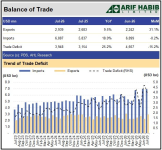
This is unsustainable, imports grow by 18% while exports just 9%.
SoulSpokesman
Trusted Member
@hydrabadi_arab
Hydra bro,
imports grow by 18% while exports just 9%.
Bit disappointed that a poster of your stature would make such a comment! Surely you are aware of what has happened to fuel and fuel derived commodity prices since March 2026.
Regards
Hydra bro,
imports grow by 18% while exports just 9%.
Bit disappointed that a poster of your stature would make such a comment! Surely you are aware of what has happened to fuel and fuel derived commodity prices since March 2026.
Regards
Users who are viewing this thread
Total: 1 (members: 0, guests: 1)
Pakistan Defence Latest
-

-

-
 Federal cabinet gives nod to imposition of emergency in KP; summary sent to president (28 Viewers)
- Latest: Meengla
-
-
Country Watch Latest

Latest Posts
-
-

-
-
 The Prime Minister of Singapore travels on official duty aboard a low-cost airline (17 Viewers)
- Latest: Hussain
-
