RescueRanger
Meme Lord

India–Pakistan Conflict Risk Brief (October 2025)
Prepared by: RescueRanger | Classification: Open (Open source Intelligence) *
1. Scope & Objective: to provide a succinct overview of the current threat dynamics of conflict between Pakistan & India
2. Methodology: Collation of information available in public domain using archive of newspaper articles, video interviews, opinion pieces, public tenders, examining previous conflagration points and triggers and reviewing propaganda on social, print and digital media.
3. Findings:
3.1 Current Situation
Tensions remain elevated but contained after the May 2025 crisis, which saw air and drone strikes across the Line of Control (LoC) and mass troop alerts.
No large-scale mobilization as of early October, but persistent rhetoric and localized ceasefire violations continue. Pakistan’s economic fragility and India’s electoral cycle raise the risk of politically driven escalation. Heightened chatter around Kashmir and increased drone activity are observed near border sectors.
3.2 Social Media Monitoring (October 2025)
Hashtag concurrence monitoring following alleged attack on Indian CRPF in Kandi, IOK. Refer to figure 1.
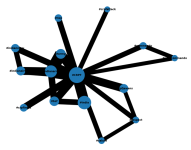
Figure 1: Hashtag concurrence monitoring following alleged attack on Indian CRPF in Kandi, IOK
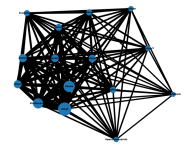
Figure 2: Hashtag concurrence monitoring using data-informed model. In less than 24 hours the hashtag #crpf was tweeted 176,403 times. The hashtag #crpfjawans was tweeted 16,494; #crpfindia was tweeted 9,020; and #crpfattack was tweeted 3,078 times respectively.
Event/incident tags like #crpfattack are present and connected (these often spike during incidents).
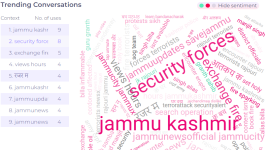
Figure 3: Multi-Platform hashtag monitoring along with moon-analysis. NB: the word map provides a colour coded heat-map: turquoise is positive, fuchsia is negative.
4. Likelihood Assessment
5. Potential Impact (If Conflict Erupts)
6 Early Warning Indicators
1. Major terror attack in India attributed to alleged Pakistan based group.
2. Mobilization of Indian armoured/air assets near the LoC.
3. Suspension of hotlines or diplomatic withdrawals.
4. Indian/Pakistani missile unit movements or nuclear rhetoric.
5. Social media spikes in nationalist or war preparatory messaging.
7. Mitigation & Response Options
8. Overall Assessment
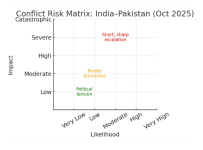
Probability of large-scale war remains low, but risk of short, sharp escalation is high and persistent. Rapid crisis communication and restraint messaging remain vital to avoid inadvertent nuclear signalling.
8.1 Risk Matrix
This work is protected under a creative-commons licence CC BY-SA
This license enables reusers to distribute, remix, adapt, and build upon the material in any medium or format, so long as attribution is given to the creator. The license allows for commercial use. If you remix, adapt, or build upon the material, you must license the modified material under identical terms. CC BY-SA includes the following elements:
BY: credit must be given to the creator.
SA: Adaptations must be shared under the same terms.
Prepared by: RescueRanger | Classification: Open (Open source Intelligence) *
1. Scope & Objective: to provide a succinct overview of the current threat dynamics of conflict between Pakistan & India
2. Methodology: Collation of information available in public domain using archive of newspaper articles, video interviews, opinion pieces, public tenders, examining previous conflagration points and triggers and reviewing propaganda on social, print and digital media.
- For Data analysis of social media conversation trends, the author used measured hashtag counts where available. Software used for hashtag network mapping: Python 3.9.
- Risk assessment modelling used: Belfast Centre Multi-Dimensional Escalation under the Nuclear Umbrella.
3. Findings:
3.1 Current Situation
Tensions remain elevated but contained after the May 2025 crisis, which saw air and drone strikes across the Line of Control (LoC) and mass troop alerts.
No large-scale mobilization as of early October, but persistent rhetoric and localized ceasefire violations continue. Pakistan’s economic fragility and India’s electoral cycle raise the risk of politically driven escalation. Heightened chatter around Kashmir and increased drone activity are observed near border sectors.
3.2 Social Media Monitoring (October 2025)
Hashtag concurrence monitoring following alleged attack on Indian CRPF in Kandi, IOK. Refer to figure 1.
Figure 1: Hashtag concurrence monitoring following alleged attack on Indian CRPF in Kandi, IOK
Figure 2: Hashtag concurrence monitoring using data-informed model. In less than 24 hours the hashtag #crpf was tweeted 176,403 times. The hashtag #crpfjawans was tweeted 16,494; #crpfindia was tweeted 9,020; and #crpfattack was tweeted 3,078 times respectively.
Event/incident tags like #crpfattack are present and connected (these often spike during incidents).
Figure 3: Multi-Platform hashtag monitoring along with moon-analysis. NB: the word map provides a colour coded heat-map: turquoise is positive, fuchsia is negative.
4. Likelihood Assessment
| Timeframe | Limited Escalation | Full Scale War | Key Triggers |
| Next 7–30 days | Moderate (20%) | Low (5%) | Terror attack, LoC provocation, political misstep |
| Next 6 months | Moderate / High (35%) | Low / Moderate (15%) | Sustained militant attacks, air/missile exchange |
| Next 2 years | Moderate (30–40%) | Low (10%) | Prolonged friction, major crisis trigger |
5. Potential Impact (If Conflict Erupts)
- Military: 100s–1000s of casualties in first week; destruction of bases and logistics hubs.
- Civilian/Economic: Airport closures, $5–10 B USD trade loss, energy and supply chain ripple effects.
- Regional/Global: Overflight bans, refugee pressure, heavy diplomatic engagement by US, China, Gulf states.
- Nuclear Risk: Low but not zero; tactical nuclear postures shorten escalation timelines
6 Early Warning Indicators
1. Major terror attack in India attributed to alleged Pakistan based group.
2. Mobilization of Indian armoured/air assets near the LoC.
3. Suspension of hotlines or diplomatic withdrawals.
4. Indian/Pakistani missile unit movements or nuclear rhetoric.
5. Social media spikes in nationalist or war preparatory messaging.
7. Mitigation & Response Options
- Diplomatic: Maintain hotlines and third-party mediation readiness (UAE, US, China).
- Military: Exercise notifications and air space coordination.
- Information: Counter disinformation and verify incident reporting.
- Humanitarian: Pre-position relief assets near potential refugee corridors.
8. Overall Assessment
Probability of large-scale war remains low, but risk of short, sharp escalation is high and persistent. Rapid crisis communication and restraint messaging remain vital to avoid inadvertent nuclear signalling.
8.1 Risk Matrix
This work is protected under a creative-commons licence CC BY-SA
This license enables reusers to distribute, remix, adapt, and build upon the material in any medium or format, so long as attribution is given to the creator. The license allows for commercial use. If you remix, adapt, or build upon the material, you must license the modified material under identical terms. CC BY-SA includes the following elements:
BY: credit must be given to the creator.
SA: Adaptations must be shared under the same terms.