Oscar
Moderator


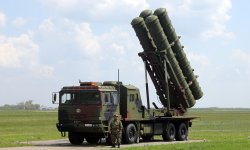
As I pointed out to the typical nationalist subjects from the Indian side - the 400km range is limited to the 40N6 missile.Theoretically, with 400 km range, S-400 coverage was in all bases. @side-winder am I right?
But the missile isnt the problem either:
At low/medium altitudes, engagement is usually sensor/line-of-sight limited, not missile-range limited. Radar horizon is commonly modeled with the 4/3 Earth radius assumption (standard refraction), giving the well-known radar horizon relationship.
If the S-400 battery radar is near ground level (say 10 m antenna height as an order-of-magnitude):A 10,000 ft target is only line-of-sight visible at roughly ~230–250 km for a ground-based radar at typical antenna heights.
To have pure geometric line-of-sight to a 10,000 ft target at 375 km, the radar would need to be about ~1.3 km (~4,200 ft) above the surrounding terrain (e.g., a high mountain site), or you’d need an elevated sensor (airborne/balloon/etc.) providing track/quality cueing.
@side-winder could confirm.
The 400 km figure commonly quoted for the S-400 (with long-range interceptors) assumes:
- High-altitude targets (tens of thousands of feet)
- Clear line-of-sight for most of the flight
- Ideal detection, tracking, and cueing conditions
Next:
Low altitude = late detection + compressed timeline
- Detection happens much later
- Engagement window shrinks dramatically
- Missile flies a shorter, steeper, more energy-wasting profile
Now interestingly - because of this pure physics limitation the HQ-9B which advertises 260-300km has a practical range against a 10kft target of 180-230km.. and the S-400 which advertises 400km has a practical range of 200-250km. So they actually become "equivalent" of sorts.
More interesting is that HQ-9B(by nature of later development and PLA Philosophy vs Russian) has greater emphasis on networked ground radars and overlapping sensors can feed into it better instead of relying on just it's own sensors which India has been trying to(but no news of success) in overcoming.
Then there are the missiles:
The S-400's theoretical missile range with thumping types bring (because they like copy pasting fast) is the 40N6 - but that system is focused more on high altitude targets like AEW systems and in turn needs cueing by a higher sensor(which even the Russians have struggled with getting the A-50 to work properly).
The missile itself is extremely sophisticated(with ML elements) and high ECCM and an active seeker. But is also expensive AF.
The primary weapon is the 48N6DM which is a Semi-Active seeker and good ECCM but is reliant on the Illumination radar from the S-400 complex.
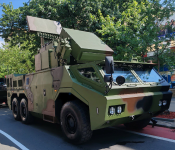
The HQ-9B on the other hand has one "jack of all trades" missile with an AESA seeker and generally good ECCM due to that seeker but missile motor and kinematics arent as good as S-400. But in all respects a "jack of all trades is a master of none but is better than a master of one".
So when it comes to actual performance against the most common of targets - the performance of HQ-9B and S-400 start narrowing down to a similar class.
So while I don't really want to get into a comparison, the point I make here is the S-400 is a great system but it was designed for a very particular mix of threat scenarios including ABM which Hq-9B isn't the best for - but then the brochure talks to the ABM use case as baseline when it is INFACT a NICHE use case.
So in realitiy, while the S-400 provides "coverage" out to 400km across India - it actually is not effective nor "covering" most of India when it comes to both typical fighter profiles, cruise missiles and in certain cases even hypersonic.
Which is why India now wants the S-500 for Hypersonics because that is what that system is optimized for - it is NOT a better system against the other majority of air threats versus the S-400 but a ABM component because surprise surprise - AAD and PAAD arent "perfect".
 . Here are some example of them referring to their own wreckage of S-125 missile as Fatah rockets.