Pakistan-India Conflict 2025: News Updates and Discussion

Punjab invoked ‘War Book’ protocols for maximum preparedness and took measures to ensure public safety.

By then, New Delhi had started its preparations for Pakistan’s expected retaliation. The Indian capital went dark when power was cut off for an emergency drill.

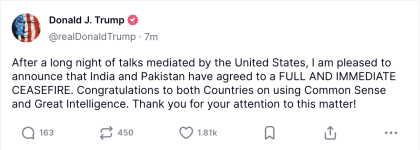
At 10pm, about 12 hours after his earlier press briefing, the DG ISPR provided an updated toll of casualties from the Indian strikes. Meanwhile, Trump offered his help in calming down tensions.

May 8​

The second day of active conflict, in the words of the DG ISPR, marked a “serious provocation” as India sent 25 Israeli-made Harop drones into Pakistan — all of which the military said it intercepted.

While Dar said at this point that the Pakistani and Indian NSAs had spoken to each other, a day later the DG ISPR said no direct communication had taken place. Regardless, firing across the LoC had continued overnight, while Indian cities witnessed blackouts as part of a nationwide civil defence drill.

The conflict’s impact extended to the country’s south, with an Indian drone falling on the outskirts of Karachi and in villages in Sindh near the border.

One drone crashed near the Rawalpindi Cricket Stadium, the venue of the then-underway Pakistan Super League’s 10th edition, resulting in the death of a vendor.

An Indian drone “managed to engage in a military target near Lahore”, injuring four army personnel, DG ISPR Chaudhry said.
 
With drones hovering in the skies, flights from major airports largely remained suspended. In India, around 27 airports were closed, with the Delhi airport alone seeing as many as 90 flight cancellations.

After India’s strikes the previous day accompanied by a barrage of drones, Indian Foreign Minister S. Jaishankar claimed it was not their “intention to escalate the situation”, and warned Pakistan against retaliating. Defence Minister Rajnath Singh claimed that New Delhi was willing to engage in dialogue.

In Islamabad, PM Shehbaz endorsed the NSC’s decisions made a day earlier.

Meanwhile, the NA witnessed a rare moment of the treasury and opposition benches being on the same page, as the PTI expressed its clear support for the armed forces.

Speaking on the NA floor, Information Minister Attaullah Tarar said Pakistani forces killed “40 to 50 Indian soldiers” across the LoC.

At this point, the US’ mediation efforts were publicly acknowledged by the defence minister, who said Washington was leading efforts to reduce tensions between Pakistan and India.

This was followed by US Secretary of State Marco Rubio’s separate phone calls to PM Shehbaz and Jaishankar, wherein he urged both sides to de-escalate. This was reiterated by the US State Department hours later, which said the US was “engaged with both governments at multiple levels”.
 

May 9​

The drone incursions continued on Friday. By 1pm, Pakistan’s defence systems had shot down another 49 drones sent by its eastern neighbour, taking the total tally to 77.

The LoC remained very active, with Indian shelling killing at least five civilians and Pakistan destroying three Indian posts in response. Amid a war-like situation, civil defence drills were conducted in Punjab.

In the afternoon, leaders across the political spectrum slammed India’s actions as they spoke on the NA floor. The defence minister contended that New Delhi planned to detect the locations of sensitive sites inside Pakistan through its drone flights.

The ongoing drone attacks prompted the Pakistan Cricket Board (PCB) to postpone the remaining eight PSL matches. New Delhi also suspended the Indian Premier League (IPL) for one week.

Meanwhile, DPM Dar was busy communicating Pakistan’s stance to other countries as he spoke on the phone with various counterparts, including the United Kingdom’s foreign secretary.

The Foreign Office, in its weekly press briefing, called out India’s “irresponsible, unlawful and belligerent conduct” that “brought the two nuclear-armed states closer to a major conflict”.

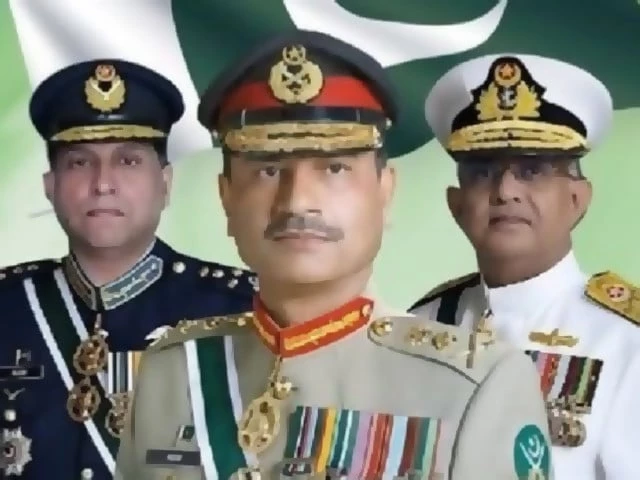
In the evening, the now-familiar trio of DG ISPR, Air Vice Marshal Aurangzeb Ahmed and Vice Admiral Raja Rab Nawaz held a joint press briefing. The number of civilian casualties from Indian attacks had now risen to 33, with 76 injured.

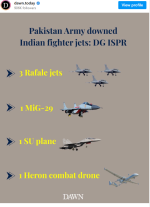
Lt Gen Chaudhry highlighted that India had still not given any evidence regarding its allegations against Pakistan on the Pahalgam attack, while AVM Aurangzeb provided a reconstruction of how the PAF shot down Indian jets on May 7.
 

May 10​

Saturday was busy for everyone — from the personnel on the defence frontlines to journalists sifting through the barrage of reports, and from top global leaders to those involved in relaying diplomatic messages.

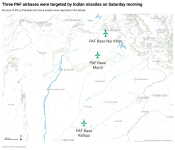
Things escalated pretty early on. Shortly after 3am, the DG ISPR confirmed that India targeted three PAF bases, located in Rawalpindi, Chakwal and Shorkot.

The majority of the missiles were intercepted and all PAF assets remained safe. But this did not mean that India’s “madness”, as per the military spokesperson, would go unanswered.

A map showing three Pakistan Air Force airbases that were targeted by Indian missiles on May 10, 2025. — Datawrapper

1778151599547.png

What followed was a thundering response from Pakistan, dubbed Operation Bunyanum Marsoos (concrete structure).

Over a span of about 12 hours, the armed forces targeted multiple strategic and military sites in India and occupied Kashmir, destroying the S-400 missile system in Adampur and a storage site of the Brahmos missiles in Beas, among other targets.

The retaliatory attacks targeted at least 26 locations, India acknowledged, adding that at least five airbases suffered damage to “equipment and personnel”.
 
To view this content we will need your consent to set third party cookies.
For more detailed information, see our cookies page.


You offer this menu in a shadi to anyone in karachi and they won't meet you ever again


Vietnamese president eating food from this menu

To view this content we will need your consent to set third party cookies.
For more detailed information, see our cookies page.
 

On Marka-e-Haq Day, forces signal firm resolve​


On Marka-e-Haq Day, forces signal firm resolve

Our Correspondent
May 07, 2026

tribune


RAWALPINDI: On the first anniversary of Marka-e-Haq, on night between 6 and 7 May, the armed forces, particularly Pakistan Air Force (PAF), commemorate a defining chapter in the nation's military history; one that strengthened national confidence, reaffirmed institutional resolve and validated PAF's relentless pursuit of modernisation and focused capability enhancement.

According to the Inter-Services Public Relations (ISPR), this historic milestone reflects PAF's steadfast journey towards becoming a future-ready air power through smart inductions of cutting-edge systems and swift operationalisation of niche and disruptive technologies, consolidating its operational reorientation.
 

Users who are viewing this thread

  • Pakistan Defence Latest

    Back
    Top