Navigation
Install the app
How to install the app on iOS
Follow along with the video below to see how to install our site as a web app on your home screen.
Note: This feature may not be available in some browsers.
More options
Style variation
You are using an out of date browser. It may not display this or other websites correctly.
You should upgrade or use an alternative browser.
You should upgrade or use an alternative browser.
Pakistan-India Conflict 2025: News Updates and Discussion
- Thread starter Ali_Baba
- Start date
More options
Who Replied?


ghazi52
THINK TANK: CONSULTANT

India-Pakistan ceasefire raises hopes that the worst fighting in decades is over.
Here’s what to know
By Christian Edwards, CNN
Sun May 11, 2025
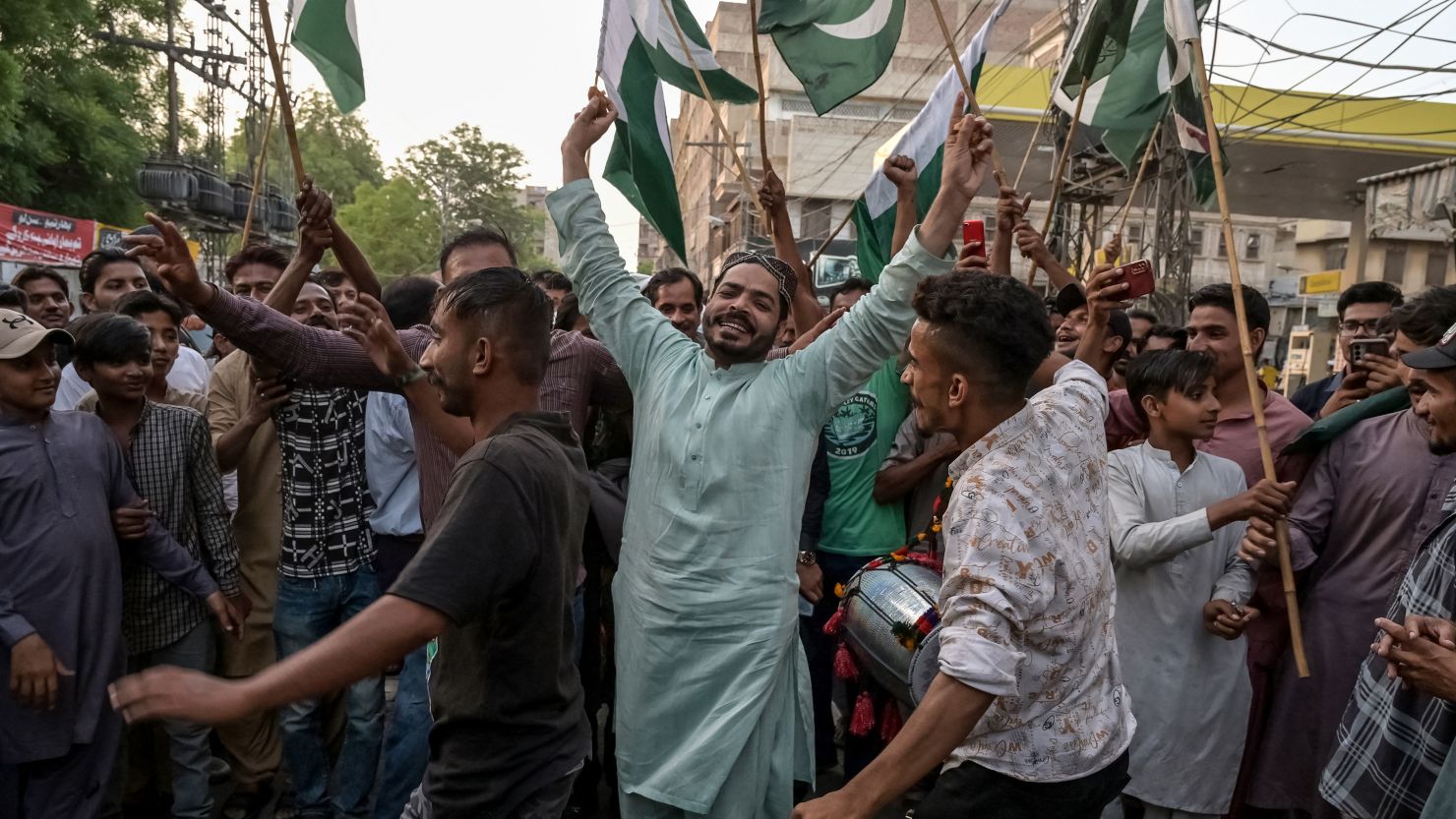
People in Hyderabad, Pakistan, celebrate after the ceasefire with India was announced on Saturday.
Akram Shahid/AFP via Getty Images
CNN —
A ceasefire agreed between India and Pakistan appears to be holding, with both sides stressing their commitment to the surprise truce which halted the worst fighting in decades between the nuclear-armed neighbors.
The flare-up was triggered by a massacre of tourists last month in Indian-administered Kashmir. Cross-border military strikes began on Wednesday and have left dozens of people dead.
There were reports of violations from both sides soon after the ceasefire was announced on Saturday, although CNN understands that since then it has been holding.
US President Donald Trump was the first to announce the ceasefire and claimed credit for Washington’s role in securing it, but contradictory accounts have emerged about the extent of US involvement.
Here’s what you need to know.
How did the truce come about?
Just before 8 a.m. ET on Saturday, about 5 p.m. in India and Pakistan, Trump announced the ceasefire in a post on Truth Social.“After a long night of talks mediated by the United States, I am pleased to announce that India and Pakistan have agreed to a FULL AND IMMEDIATE CEASEFIRE,” Trump said, congratulating the leaders of both countries for “using common sense and great intelligence.”
Soon after, Secretary of State Marco Rubio claimed that India and Pakistan had not only agreed to a ceasefire, but also “to start talks on a broad set of issues at a neutral site.” Rubio said that the ceasefire came after he and Vice President JD Vance spent the past two days speaking with senior officials from both countries.
Both sides confirmed the agreement soon after.
India’s Ministry of Information said the agreement was worked out “directly between the two countries,” downplaying US involvement and contradicting Trump’s claim. The ministry also said there was “no decision” to hold further talks.
But Pakistani officials have heaped praise on Washington.
“We thank President Trump for his leadership and proactive role for peace in the region,” said Prime Minister Shehbaz Sharif.
A Pakistani source familiar with the negotiations told CNN that the US – and Rubio in particular – was instrumental in striking the deal, painting a picture of talks that were in doubt right until the truce was confirmed.
The deal was all the more surprising given fighting continued Saturday, with both sides accusing each other of attacking military bases, raising fears of further escalation.
Why the differing accounts?
It should not be surprising that these bitter rivals have given contradictory accounts of how the ceasefire was reached.India, which views itself as a regional superpower, has long been resistant to international mediation, whereas Pakistan, which is heavily dependent on foreign aid, tends to welcome it, analysts say.
“India has never accepted mediation in any dispute, be it India-Pakistan or India-China, or any other,” said Dr. Aparna Pande, research fellow for India and South Asia at the Hudson Institute, a think-tank in Washington, DC.
“Pakistan, on the other hand, has always sought international mediation so they will praise it,” she added, saying it is “the only way it can put pressure on India to discuss and resolve the Kashmir dispute.”
The fighting before Saturday’s ceasefire was marked by claims, counterclaims and disinformation from both sides. Now that the conflict has paused, both sides are ramping up their efforts to shape perceptions of what the fighting achieved and how it ended.
On Sunday, India’s defense minister said New Delhi had sent a bold message to terrorists, while the country’s air force hailed its “precision and professionalism.”

A man walks past a house damaged by Pakistan's strikes on Jammu, a city in India-administered Kashmir, on Saturday.
Adnan Abidi/Reuters
What was the trigger for the crisis?
This round of fighting began in Kashmir, a disputed region that has been a flashpoint in India-Pakistan relations since both countries gained their independence from Britain in 1947.The two nations to emerge from the bloody partition of British India – Hindu-majority India and Muslim-majority Pakistan – both claim Kashmir in full, despite only controlling parts of it. Months after becoming independent, they fought the first of their three wars over the territory.
On April 26, gunmen opened fire on sightseers in a popular travel destination in the mountainous destination of Pahalgam in Indian-administered Kashmir. At least 25 Indian citizens and one Nepali were killed in the massacre.
New Delhi immediately blamed Islamabad, accusing it of supporting “cross-border terrorism.” Pakistan has denied all involvement in the attack.
Two weeks after the Pahalgam massacre, India on Wednesday launched a series of strikes on Pakistan and the parts of Kashmir it holds, calling the attack “Operation Sindoor.”
The theater of conflict since then has been far broader than in previous rounds of fighting, with both sides striking deep into the other’s territory.
Why did the US get involved?
Just two days ago, JD Vance downplayed the potential for US influence as the India-Pakistan conflict spiralled.“What we can do is try to encourage these folks to de-escalate a little bit, but we’re not going to get involved in the middle of a war that’s fundamentally none of our business and has nothing to do with America’s ability to control it,” Vance told Fox News on Thursday.
Vance’s about-face is a measure of how concerned the US – and the wider international community – became by the escalating conflict between the two nuclear powers.
Trump administration officials told CNN that, after receiving alarming intelligence on Friday about the extent to which the conflict could escalate, the State Department felt it had no choice but to play a greater role in talks between the two sides
Will the ceasefire hold?
While initially appearing fragile, both sides appear to be upholding the terms of the ceasefire into Sunday.India’s Foreign Secretary Vikram Misri accused Pakistan of repeatedly violating the ceasefire agreement on Saturday, after explosions were heard in both the India- and Pakistan-administered parts of Kashmir.
Pakistan also accused India of committing violations but stressed it “remains committed to a faithful implementation of the ceasefire.”
Since then, CNN understands there have been no fresh missile strikes or drone flights. However, an Indian defense source told CNN Sunday that the air force’s operational readiness is still high.
In the wake of the tourist massacre, the two announced a host of other reprisals: suspending visas, banning trade, while India suspended its participation in a crucial water-sharing pact. It is unclear yet whether such moves will be reversed.
CNN’s Rhea Mogul, Sophia Saifi, Esha Mitra, Aditi Sangal, Nic Robertson, Alayne Treene, Aishwarya S. Iyer, Kunal Seghal, Sophie Tanno and Mukhtar Ahmad contributed reporting.

Hakikat ve Hikmet
VIP Member

ghazi52
THINK TANK: CONSULTANT
Army engaged 26 Indian military targets linked to terrorism and attacks on Pakistanis: DG ISPR
DG ISPR says 26 military targets, along with facilities in India used to target Pakistani citizens and entities involved in fomenting terrorism in Pakistan, were engaged in both Occupied Jammu and Kashmir and mainland India.
“The targets included airforce and aviation bases at Suratgarh, Sirsa, Adampur, Bhooj, Nalia, Bathinda, Barnala, Halwara, Avantipura, Srinagar, Jammu, Mamoon, Ambala, Udampur and Pathankot — all of which sustained major damages.”
He added that Barhmos facilities, which had fired missiles in Pakistan and killed innocent civilians, were also destroyed.
ghazi52
THINK TANK: CONSULTANT
Terrorism has nothing to do with Islam, humanity, or Pakistan: DG ISPR
DG ISPR says Pakistan continues to suffer the scourge of terrorism, while the country’s leadership asserts that India is the one sponsoring and abetting it. He adds that India is conducting and prosecuting terrorism inside Pakistan through multiple proxies.
The military’s spokesperson stresses the need for national unity, stating that the country has always stood like a steel wall against this threat and must continue to do so.
“This steel wall will smash terrorism as well. The state of Pakistan, with the support of its people, is doing it. We have these 14 points of the National Action Plan, we have to implement [them] wholly,” Lt Gen Chaudhry said.
“Terrorism is not going to go away by talking with India. We don’t look outside, we don’t beg anyone to stop doing this. Our strategy is not hope. We are a proud nation and we will finish off this terrorism. There should be no doubt.”
In response to another question about terrorism, the DG ISPR says, “We will conquer terrorism. We are on the right path, their [terrorists’] ideology is perverted. It has nothing to do with Islam, or humanity or Pakistan. Killing the innocent, suicide bombings, blowing up mosques … how is this related to Islam or humanity?”
He adds that Pakistan had a battle-hardened army. “What we just need is to stand together as we have stood together, and this nation, for its survival and prosperity, is standing together,” he asserts.
He went on to say that despite efforts to reduce faith in the institutions, the nation came together during times of crisis. “The state is like a mother. We are all raised under her, some more, some less. There are differences, but they don’t make us … start fighting each other. Our unity and resolve have been strengthened.”
ghazi52
THINK TANK: CONSULTANT
‘No violation’ of ceasefire being made by Armed Forces: DG ISPR
In response to a question about the ceasefire with India, DG ISPR said that the Pakistan Armed Forces are not violating the ceasefire.
“Being the spokesperson of the Armed Forces, I can say with 200 per cent certainty that the Armed Forces are holding the LoC (Line of Control) ceasefire,” he emphasised. “We are a professional army and we strongly abide by the commitments we make and follow by letter and spirit the orders of the government.”
He added that currently Pakistanis are celebrating peace.
“Does it make any sense for Pakistan to start violating this commitment we made?” he asked. “We’re a peace-loving nation; peace within and without.
“But if there is any aggression, we will respond.”
ghazi52
THINK TANK: CONSULTANT
DG ISPR says Kashmir issue ‘central to the dispute between Pakistan and India’
DG ISPR has said that the issue of Kashmir remains central to the dispute between Pakistan and India, adding that unless the issue is resolved according to United Nations Security Council (UNSC) Resolutions and the will of the Kashmiri people, the region will not see lasting peace.
“This conflict has once again put Kashmir as a flashpoint and it needs to be resolved,” Lt Gen Chaudhry said.
“The problem that we’re seeing is that India continues to internalise this external problem. It’s an external problem with Pakistan, India and the people of Kashmir,” he added. “It’s an internationally recognised dispute and India is trying to internalise it by changing demography [and] the legal status, in violation of UNSC resolutions and international commitments India has made.”
“You are seeing what’s happening after Pahalgam,” DG ISPR said, addressing reporters. “People’s homes are being demolished, people are being taken into custody in the thousands.
Adressing India indirectly, he said “It’s an international issue, talk it out and find a solution which satisfies the will of the people.”
ghazi52
THINK TANK: CONSULTANT
‘The govt’s position on the Indus Waters Treaty is absolutely clear’: DG ISPR
Responding to whether the suspension of the Indus Waters Treaty will be discussed by both nations’ military operations chiefs tomorrow, DG ISPR has said, “The government’s position on the Indus Waters Treaty is absolutely clear and no further comment is needed on that.”
ghazi52
THINK TANK: CONSULTANT
Pakistan never requested for ceasefire: DG ISPR
In a press conference, DG ISPR has “put it on record” that Pakistan “never requested for a ceasefire”.
“On the night of May 6 and 7, after those dastardly and cowardly attacks were made, Indians requested and Pakistan gave a very clear response that we will communicate back only after we have given the response that this act deserves.
“So on May 10, after the response and retribution […] and on the request and intervention of international interlocutors, we responded to the already made request of the Indians,” he said.
The military spokesperson added that peace between India and Pakistan would always allude until the resolution of the Kashmir issue.
ghazi52
THINK TANK: CONSULTANT
‘Social media chatter’: Pakistan has no pilot in custody, clarifies DG ISPR
DG ISPR has clarified that Pakistan has no Indian pilot in custody, blaming it to “social media chatter”.
“This is all part of fake news and propaganda that has been generated from multiple sources,” he said.
ghazi52
THINK TANK: CONSULTANT
In reality, there is no space of war between India and Pakistan: DG ISPR
“In a conflict between two rival nuclear powers … such a conflict is actually an absurdity and it is inconceivable and sheer stupidity,” DG ISPR says.
“In the case of India and Pakistan, such a conflict can lead to peril of more than 1.6 billion people,” he replied to a question. “In reality, there is no space for war between India and Pakistan, and if anyone wants to carve out this space for war, he is actually carving out the space for mutual annihilation.”
“This is why you saw how in this conflict Pakistan acted in a very mature manner and through conventional forces, we maintained escalation control, through conventional forces we gave them a two notch up response while also ensuring that the Pakistan forces employed on the counterterrorism operations … no pull is also exerted on them.”

Distant_Observer
Trusted Member

ghazi52
THINK TANK: CONSULTANT
Pakistan’s anti-drone system rendered enemy systems unserviceable, says air vice marshal
“The PAF’s response has strengthened Pakistan’s national security and our enduring commitment for stability and peace. But I have no doubt that the real cerebrum behind the aim and design was the Chief of Air Staff Zaheer Ahmad Babar,” he said.
“He asked us to do three things: re-establish deterrence, neutralise key threats, retain control of air,” Aurangzeb recalled.
“During the befitting response we generated in our first episode, we attired the IAF’s pride, the Rafales, resulting in this entire fleet coming to a standstill at ground position. They did not fly after that, at least not close to their western border.”
“This reduced their liberty of action and curtailed their options,” he pointed out.
“They intiated unmanned aircraft operations targeting Pakistan’s civilian population and infrastructure. All these spots are drones and UAVs coming into our territory being picked up by radar even before entering. Anti-drone systems of PAF, Navy and Army rendered enemy drone attacks ineffective through jamming and spoofing and rendering systems unserviceable.”
All drones were detected and rendered useless through indigenous jamming systems, Aurangzeb added.
hyperman
INT'L MOD
The only way the situation with the IAE would be salvaged was the train project China planned from Pakistan through Afghanistan through to Central Europe. Frankly there is a massive trust deficit on both sides when it comes to dealing with the taliban.
China would be need to set up a carrots and sticks type of policy. Where there is investment offered that is contingent on their disarming the TTP and dissolving them as an organization. They aren't going to Turn them over, but then can be pressured to dismantle the organization.
Pakistan really wasted 20 years with how Afghanistan went, 20 years behind in development, 20 years behind in border infrastructure. Amercian money was flowing for 20 years and there still isn't a solid wall/barrier on the durand line, something the US would have gladly paid for as the taliban issue was a headache for them for 20 years. Just so much oversight in how things were managed.
Its still not too late, that border needs to be solidified if there is to ever be hope for security in Pakistan. Otherwise the insurgency will bleed Pakistan and its economy to death. Without dealing with the insurgency there can be no economic development.

pashtunkoum
Registered Member
China would be need to set up a carrots and sticks type of policy. Where there is investment offered that is contingent on their disarming the TTP and dissolving them as an organization. They aren't going to Turn them over, but then can be pressured to dismantle the organization.
Pakistan really wasted 20 years with how Afghanistan went, 20 years behind in development, 20 years behind in border infrastructure. Amercian money was flowing for 20 years and there still isn't a solid wall/barrier on the durand line, something the US would have gladly paid for as the taliban issue was a headache for them for 20 years. Just so much oversight in how things were managed.
Its still not too late, that border needs to be solidified if there is to ever be hope for security in Pakistan. Otherwise the insurgency will bleed Pakistan and its economy to death. Without dealing with the insurgency there can be no economic development.
Subject for another thread but it’s not a wall that will solve insurgency. We need to invest in positive and mutual beneficial relationship with Afghanistan.
20 years war on terror was a big disaster and we need to recover that.


