
RescueRanger
Meme Lord

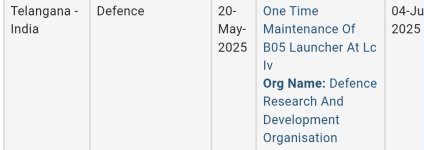

LC-IV (Launch Complex 4 Abdul Kalam).
Follow along with the video below to see how to install our site as a web app on your home screen.
Note: This feature may not be available in some browsers.

Their manned ones can’t seem to sneak around that well so I guess they want to take the man out of it?Another interesting tender from India View attachment 122488
LolTheir manned ones can’t seem to sneak around that well so I guess they want to take the man out of it?

Do you really need to enter Indian Air Space to target dams? Even if air bases are targeted, an air base can be repaired and restored far more quickly than a dam that takes years to build. Example: Ukrainian HIMARS attacks destroyed or heavily damaged several Russian held and operated air bases in Crimea and Kherson and even those bases in Rostov and Kursk; but the Russians destroyed the Nova Khakova dam ensuring that Crimea would have water, Crimea had been reduced to a desert with not even drinking water available , after Ukraine blocked all the water using diversion canals and a layered dam system. Russians ( at a price) have restored water to Crimea and agriculture is back to its original stateFrankly, if anyone remembers my posts from around 20 days ago, when some members from the Pakistani side were claiming that the PAF could bomb Indian dams
my first response was clear: India's immediate reply would be to target PAF airbases.
That’s exactly what happened, and that’s exactly what will continue to happen if such threats escalate. This time, it was a relatively small matter, but in the event of full-scale war, the stakes and scale will be far higher.
From what I understand about the IAF, we need to move faster toward advanced systems. Right now, we have limited AWACS aircraft, electronic warfare (EW) systems, and other tech that can not back large-scale operators like IAF. In modern warfare, integration of such technology isn’t optional — it’s critical.
Rafale or Su-30 MKI can’t win battles alone. If it turns into one-on-one dogfights, then pilot skill and aircraft capability matter more. But real wars today are fought with layered systems — radar coverage, jamming, networked assets, early warning — and IAF is currently lagging behind on that front.
With only 4–5 AWACS platforms, we’re below the bare minimum for a force of IAF’s size and scope. That needs to change, fast.
In my view, this isn’t an impossible challenge — it’s a matter of urgency and strategic clarity. We need to procure at least 12–16 more AWACS and 5–10 EW aircraft equipped with advanced jammers and communication disruption systems. That alone could transform the IAF’s operational capability and deterrence power.
India is steadily strengthening its air defense systems — and that's a smart move. As these systems grow in range and capability, they'll further limit PAF’s ability to operate in Indian airspace. That’s a key deterrent and a necessary step in modern defense planning.
India is strengthening air defenses smartly, but lagging in air force modernization—especially in AWACS, EW systems, and tech integration. That gap is a serious strategic concern.

i think they've got a small whiff of what Pakistan has, and didn't use yet. Hence they think the SAMs would be reasonable to help them to prevent Pakistan from using hidden tech they don't know about. DG ISPR and other retired military men have spoken on media that they dont even know what we have......Something has the Indians spooked to invest in so many SAM systems. That too for the MR (Marine) and KM(Short Range) variants.
I tend to agree generally on your analysis about what PAF lacks and where it excels.Well, i can not reply more here since i know that i'll get thread ban
But honestly, I have already given my opinion!
Two critical notable points in this conflict:
If a full-scale war begins, India will likely target PAF airbases first, grounding their fleet before takeoff — something India has shown it's capable of doing.
- IAF lacks sufficient AWACS, EW systems, and modern tech integration.
- PAK lacks strong air defence systems.
PAF operating over Indian skies will be extremely difficult, as India’s air defence network continues to grow stronger with new systems.
People here may hype PAF all day, but in a real war, its current capabilities are suited only for the most limited conflict — geographically, PAF has many disadvantages. Air bases are exposed, and even don't have similar Iranian underground bases. its does not have large geographically areas with safe distance
India’s priority now should be to accelerate technological upgrades for the IAF — that’s the missing piece. That's the most serious concern that should be for Indian planners.
I know I might get heat for saying this — maybe even fired from the thread — but facts are facts.
Today it's about supersonic; tomorrow it'll be hypersonic.
The game is moving fast, and only those who evolve with it will stay in play.
In the end, the side with stronger air defenses and a sharper, tech-driven strategy will have the upper hand. That’s the reality — whether people like it or not.

Masha Allah. May Allah SwT bless you.Hi,
I know that---. I am still kicking---.

I agree with many points.I tend to agree generally on your analysis about what PAF lacks and where it excels.
1. Geography, can't be changed. Though, there are spots in Baluchistan where some fallback bases can be built. Other than that, you are making the same mistake which many other Indian members have been making over the years. Thinking about IAF's modernization and thinking rest of the world specially PAF is frozen in time and will not reciprocate. India took decades deciding MRCA which is yet to be materialized under which IAF was suppose to get 114 4.5 gen fighters and what you actually got 36 Rafale and look at PAF in the same time span, operationalize not one but 2 4.5 gen fighters (J-10CE/JF-17Block III) and is on the cusp of getting 5th gen years ahead of IAF. Same goes for ADS system. Yes, there are gaps because PAF/PA started v late. 2018-2020 was the time when serious discussion on having LOMAD/HIMAD mix entered into anything meaningful and still we were able to integrate both systems very successfully. Yes, gaps are there and system is not very dense ... what you think after current round PAF will just leave those gaps as it is. No, they will be filled on priority basis and I am certain that right now attack vectors of Brahmos are being discussed to overcome shortcomings. Pakistan's real problem is strike capability specially air launched, long range, high-supersonic weapons like ALCM/ALBM. Pakistan has the option to go for CH-9 that can carry 1500 KM range ALBM or pick a supersonic ALCM from China and integrate on J-10 and JF-17 like HD-1 etc. You will certainly see some action in that regard as well. As for as play the fast changing game is concern it is not about supersonic or hypersonic only. The magic word here is INTEGRATION ... of any weapon or platform in your operational doctrine this is where IAF needs to work on along with EW capabilities because it is clear now that CHINA will be a factor in any large scale conflict. PAF has moved to single vendor situation so integration is not even a trouble let alone being a challenge while IAF is a zoo of various systems developed with different design philosophies for different needs, good luck making them talk to each other.
If we can beat the crap out of them for the first time, we will in-sha-Allah do that or even worse to them again a weeks or months later. Why people are worried? Have solid faith in Allah Almighty and trust His slaves, i.e. our military. The members of our forces are waiting for the orders/permission to get inside enemy and break its backbone once for all. Allahu Akbar.@Developereo seems my hunch was correct
They are spending big.
The upper limit of the emergency procurement cost is ₹24,000 crore.

Their manned ones can’t seem to sneak around that well so I guess they want to take the man out of it?
Insha'Allah.If we can beat the crap out of them for the first time, we will in-sha-Allah do that or even worse to them again a weeks or months later. Why people are worried? Have faith trust in Allah Almighty and trust His slaves, i.e. our military. The members of our forces are waiting for the orders/permission to get inside enemy and break its backbone once for all. Allahu Akbar.
Of course S-400 did not prove to be the god they thought. They want a denser AD to cover their next misadventure.Something has the Indians spooked to invest in so many SAM systems. That too for the MR (Marine) and KM(Short Range) variants.
Lol.Bhai apko kese pata. You share space with him?


