Navigation
Install the app
How to install the app on iOS
Follow along with the video below to see how to install our site as a web app on your home screen.
Note: This feature may not be available in some browsers.
More options
Style variation
You are using an out of date browser. It may not display this or other websites correctly.
You should upgrade or use an alternative browser.
You should upgrade or use an alternative browser.
Pakistan Industries News / Updates
- Thread starter ghazi52
- Start date
More options
Who Replied?


hydrabadi_arab
Trusted Member
Challenge SEZ secures financing for Phase-I development
- Closing paves the way for the commencement of large-scale development activities
Challenge Special Economic Zone (SEZ) in Lahore has achieved financial close for its first phase after signing financing agreements with a consortium of banks and financial institutions, clearing the way for large-scale development of the export-oriented industrial project.
The Special Investment Facilitation Council (SIFC) facilitated the successful signing of financing agreements for the first phase of the Challenge SEZ in Lahore, at a ceremony held at the Prime Minister’s Office, Islamabad, on Wednesday.
Secretary SIFC, Jamil Ahmad Qureshi, commenced the ceremony by highlighting the significance of SEZ development in Pakistan and assured continued support from SIFC, read a statement.
Federal Minister for Planning, Development and Reforms Ahsan Iqbal and Special Assistant to the Prime Minister Haroon Akhter witnessed the signing ceremony.
The signing ceremony celebrated the successful completion of the financing arrangements for Phase-I of the Challenge SEZ Lahore project, developed by Challenge Fashion (Pvt.) Limited (CFL). With the financing documentation finalised and executed by the participating financial institutions, the project has achieved financial close, paving the way for the commencement of large-scale development activities.
The ceremony brought together senior representatives of Challenge Group and leading financial institutions, including The Bank of Punjab, Pak China Investment Company Limited, Habib Metropolitan Bank Limited, Bank of Khyber, BankIslami Pakistan Limited, and Pak Libya Holding Company Limited.
The Challenge SEZ is a significant industrial project located on the Lahore-Kasur Road in Punjab. It is being developed by Challenge Fashion (Private) Limited (CFPL), a wholly Chinese-owned subsidiary of Shanghai Yuanyi Industry Co Limited.
The SEZ, spanning 99.45 acres and purposed for the textile and allied industry, was granted official status by the Board of Administrators of the Board of Investment (BoI) in December 2022, following an application received in July 2022.
The first phase of the zone is expected to be completed next year, generating approximately 8,000 jobs.
The SEZ is envisioned as a modern industrial hub that will promote export-oriented manufacturing, attract domestic and foreign investment, generate substantial employment opportunities, and strengthen industrial value chains.
As per the statement, the project is expected to contribute significantly to Pakistan’s economic growth by enhancing industrial productivity, encouraging technology transfer, and expanding the country’s manufacturing base.
“The successful execution of the financing agreements demonstrates the growing confidence of Pakistan’s banking and financial sector in strategically important development projects being facilitated through SIFC.
“It also reinforces the government’s commitment to creating a transparent, predictable, and investment-friendly business environment that supports sustainable economic growth,” it added.
hydrabadi_arab
Trusted Member
Challenge SEZ secures financing for Phase-I development
https://www.google.com/preferences/source?q=brecorder.com
- Closing paves the way for the commencement of large-scale development activities
Challenge Special Economic Zone (SEZ) in Lahore has achieved financial close for its first phase after signing financing agreements with a consortium of banks and financial institutions, clearing the way for large-scale development of the export-oriented industrial project.
The Special Investment Facilitation Council (SIFC) facilitated the successful signing of financing agreements for the first phase of the Challenge SEZ in Lahore, at a ceremony held at the Prime Minister’s Office, Islamabad, on Wednesday.
Secretary SIFC, Jamil Ahmad Qureshi, commenced the ceremony by highlighting the significance of SEZ development in Pakistan and assured continued support from SIFC, read a statement.
Federal Minister for Planning, Development and Reforms Ahsan Iqbal and Special Assistant to the Prime Minister Haroon Akhter witnessed the signing ceremony.
The signing ceremony celebrated the successful completion of the financing arrangements for Phase-I of the Challenge SEZ Lahore project, developed by Challenge Fashion (Pvt.) Limited (CFL). With the financing documentation finalised and executed by the participating financial institutions, the project has achieved financial close, paving the way for the commencement of large-scale development activities.
The ceremony brought together senior representatives of Challenge Group and leading financial institutions, including The Bank of Punjab, Pak China Investment Company Limited, Habib Metropolitan Bank Limited, Bank of Khyber, BankIslami Pakistan Limited, and Pak Libya Holding Company Limited.
The Challenge SEZ is a significant industrial project located on the Lahore-Kasur Road in Punjab. It is being developed by Challenge Fashion (Private) Limited (CFPL), a wholly Chinese-owned subsidiary of Shanghai Yuanyi Industry Co Limited.
The SEZ, spanning 99.45 acres and purposed for the textile and allied industry, was granted official status by the Board of Administrators of the Board of Investment (BoI) in December 2022, following an application received in July 2022.
The first phase of the zone is expected to be completed next year, generating approximately 8,000 jobs.
The SEZ is envisioned as a modern industrial hub that will promote export-oriented manufacturing, attract domestic and foreign investment, generate substantial employment opportunities, and strengthen industrial value chains.
As per the statement, the project is expected to contribute significantly to Pakistan’s economic growth by enhancing industrial productivity, encouraging technology transfer, and expanding the country’s manufacturing base.
“The successful execution of the financing agreements demonstrates the growing confidence of Pakistan’s banking and financial sector in strategically important development projects being facilitated through SIFC.
“It also reinforces the government’s commitment to creating a transparent, predictable, and investment-friendly business environment that supports sustainable economic growth,” it added.
Pakistan need 20 of these to double the textile exports.

ACE OF HEARTS
Registered Member
1. Labour board,
2. environmental certification,
3. chemical / acid handling / storage certification
should be all computerised without any government or relevant agency personnel coming into contact with the industrialist.
2. environmental certification,
3. chemical / acid handling / storage certification
should be all computerised without any government or relevant agency personnel coming into contact with the industrialist.

ghazi52
THINK TANK: CONSULTANT
- Thread starter
- #125
Cement FY26: Domestic demand takes the lead
July 31, 2026BR Research
Pakistan’s cement industry closed FY26 on a firmer footing. Total dispatches reached 50.58 million tons, up 7.6 percent from 47 million tons in FY25. This was the strongest volume performance in several years and the second consecutive year of growth. More importantly, the recovery came from where producers would prefer it to come: the domestic market.
Local dispatches rose 10 percent to 41.57 million tons, adding nearly 3.8 million tons during the year. Exports, which had kept plants running while domestic construction remained in the trenches, declined 2.1 percent to 9.01 million tons. Their share in total dispatches consequently fell to around 18 percent from nearly 20 percent last year.
This marks an important shift in the sector’s sales mix. Between FY22 and FY25, high interest rates, inflation, weak household purchasing power and cuts in development spending brought construction activity to a standstill.
Producers increasingly turned abroad, even though exports generally offer weaker prices and carry higher freight and handling costs. In FY26, the local buyer finally returned.
ghazi52
THINK TANK: CONSULTANT
- Thread starter
- #126
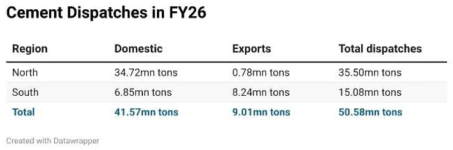
The regional numbers show where the recovery came from. North-based dispatches increased 7.5 percent to 35.5 million tons, driven by an 11 percent increase in domestic sales.
Northern exports, however, more than halved to 0.78 million tons as the closure of the Afghanistan border disrupted cross-border shipments. South-based dispatches grew 7.8 percent to 15.08 million tons.
Domestic sales in the south increased 6 percent, while exports rose 9 percent to 8.24 million tons, supported by access to seaborne markets.
June provided a strong finish, although the numbers come with a low-base caveat because Eid holidays had fallen in June last year.
hydrabadi_arab
Trusted Member
Pakistan's FIFA World Cup football maker teams up with Chinese co for sports footwear production
- Agreement expected to support technology transfer
The agreement was signed under the facilitation of the Special Investment Facilitation Council (SIFC), in a bid to strengthen the country’s manufacturing base and enhance footwear exports, read a statement released on Thursday.
Forward Sports is a Sialkot-based company in Pakistan known for manufacturing sports goods, particularly footballs. In addition to producing high-quality footballs for the FIFA World Cup, the company also manufactures sports bags, apparel, and lifestyle footwear.
Zhongzi Huaxin Group is a diversified Chinese investment and asset management group with expertise in industrial development, footwear and apparel parks, and regional economic cooperation.
The signing ceremony, organised at SIFC, was attended by the Minister for Defence, Director General SIFC, Chairman of the Pakistan Regional Economic Forum, Chief Executive Officer of Zhongzi Huaxin Group, and Chief Executive Officer of Forward Sports.
“By combining Pakistan’s manufacturing excellence with Chinese investment and expertise, this agreement is expected to support technology transfer, industrial development, employment generation, and export diversification, while enabling Pakistan to capture a greater share of the growing global footwear market,” read the statement.
hydrabadi_arab
Trusted Member
What FAST Cables’ BASEC Certification Really Means for Pakistani Manufacturing
Every so often, an announcement comes along that looks small on the surface but points to something much larger underneath. FAST Cables becoming Pakistan’s first cable manufacturer to earn BASEC certification is one of those moments. It’s easy to read it as a single company’s win. Look closer, though, and it’s really a case study in what it takes for Pakistani industry to compete on global terms — and a challenge to the rest of the sector to catch up.
Certification Is a Process, Not a Sticker
For a product like electrical cable, quality isn’t something you can eyeball. It has to be proven through testing, documentation, and repeatable manufacturing controls. That’s the real value of independent certification: it replaces “trust us” with an external, verifiable benchmark. Buyers no longer have to take a manufacturer’s word for it — they can point to a recognized standard that was actually assessed by a third party.This matters enormously for a product category that disappears the moment it’s installed. Nobody sees the cable running through the walls of a building or beneath an industrial facility, but everyone depends on it working exactly as specified, for decades, without failure. When something is this invisible yet this critical, the case for external validation becomes obvious.
Buying Reliability, Not Just Product
When a contractor, developer, or utility purchases cable, they aren’t just buying meters of copper and insulation. They’re buying confidence — confidence that today’s batch performs the same as last year’s, and next year’s, under real-world conditions. Certification is one of the clearest ways a manufacturer can signal that this consistency isn’t accidental. It’s built into how raw materials are sourced, how suppliers are managed, how production is controlled, and how testing happens at every stage — not just at the final inspection point.That distinction is important. A company that only tests the finished product is checking a box. A company that embeds quality into sourcing, production, and delivery is building a culture. The latter is what sustains certification standards over time rather than treating them as a one-off achievement.
Why This Matters More for Pakistan Specifically
Pakistani manufacturing has real capability with skilled engineers, technical talent, and industrial capacity. But the sector has often had to compete primarily on price, which is a difficult and ultimately limiting strategy. Sustainable competitiveness comes from somewhere else: quality, reliability, innovation, and operational discipline.International certifications offer a practical way to make that shift. They give local manufacturers credibility with consultants, developers, and institutional buyers who are used to evaluating suppliers against global benchmarks. They also matter for companies eyeing export markets, where technical and safety requirements can be demanding and where an unproven local supplier faces real skepticism. Certification won’t open every door on its own, but it removes a lot of the uncertainty that keeps those doors closed in the first place.
There’s also a perception dimension worth naming directly. Pakistani products are sometimes judged by where they were made rather than how well they perform. Certification changes the terms of that conversation. Instead of “is this local or imported,” the question becomes “what standard does this meet, and what evidence backs it up”, a far more useful and fairer basis for trust.
The Real Test Comes After
Here’s the part that’s easy to overlook in the celebration of a new certification: earning it is the easy half. Maintaining it is the hard half. Standards evolve, customer expectations shift, and technology moves forward. A company that treats certification as a finish line rather than a floor will eventually fall behind the very standard it once met.That means the harder, less visible work continues indefinitely; asking whether processes can be tightened, whether testing can be more rigorous, whether waste can be reduced, whether new technology can raise the quality bar further. These aren’t one-time questions. They’re the ongoing discipline that separates a company that got certified from a company that stays worthy of certification.
A Ripple Effect Worth Encouraging
Perhaps the most valuable outcome of an achievement like this isn’t the certification itself, it’s what it might trigger elsewhere. When one manufacturer raises the bar, competitors tend to notice. Ideally, that shifts industry competition away from a race to the bottom on price and toward a race to the top on quality, reliability, and innovation. That’s the kind of competitive pressure that strengthens an entire sector rather than eroding it.For Pakistan’s manufacturing base to grow into something genuinely globally competitive, more companies need to make this same investment — in testing capability, in trained people, in documented processes, in the unglamorous infrastructure of quality assurance. The goal isn’t simply producing more. It’s producing better, more consistently, at a standard that holds up anywhere in the world.
FAST Cables’ BASEC certification is one data point. Whether it becomes a trend is up to how many other Pakistani manufacturers decide to follow the same path.
hydrabadi_arab
Trusted Member
Govt to set up Construction Industry Development Board, dedicated bank in sweeping reform push
Cheema weighs CDB alongside three-year defect liability period as CAP backs bringing consultants under legal accountabilityPakistan is preparing to launch a Construction Industry Development Board (CIDB) tasked with setting standards, ensuring quality and providing strategic direction for the country's construction sector, as authorities weigh a wider reform package that includes exploring a dedicated Construction Development Bank (CDB).
The plan surfaced from a high-level session led by Federal Minister for Economic Affairs and Establishment Division Ahad Cheema, convened to review major regulatory, operational and financial changes needed in the sector.
A statement issued Saturday said the meeting drew Minister of State for Finance Bilal Azhar Kayani, Federal Secretary for Housing and Works Captain (R) Mahmood, the managing director of the Public Procurement Regulatory Authority (PPRA), and senior representatives of the Construction Association of Pakistan (CAP), among other officials.
Beyond the CIDB and the proposed CDB, the broader reform package being considered includes streamlining import and export rules and rolling out targeted tax measures for the sector.
Cheema described the CIDB as serving two functions at once — driving the sector's overall growth while also regulating standards for contractors and consultants. Drawing members from both government and industry, the board is meant to act as a single platform for raising the bar on national construction practices.
He said the federal government and CAP were in full agreement on the necessity of setting up such a body, and that the proposed structure would soon be sent to the prime minister for sign-off.
The minister added that the wider package aims to resolve financial and regulatory obstacles through customised tax breaks and better-aligned trade policy, with the goal of encouraging modern technology use and strengthening domestic construction capabilities.
On infrastructure durability, Cheema announced the government's intention to nearly triple the standard Defect Liability Period (DLP) for public projects, from one year to three, with plans to eventually push it to five years.
He argued that public infrastructure should not degrade soon after being built, and that a longer liability window would push contractors and implementing agencies to maintain higher standards and avoid early deterioration.
The minister also flagged a gap in the current accountability structure: while contractors already face penalties for defaults or subpar work, no similar mechanism exists to hold consultants responsible. Under the CIDB's proposed framework, consultants would be brought under direct regulatory oversight and made legally and financially answerable for flawed designs or technical mistakes, a step CAP representatives said they fully supported, calling it necessary to safeguard design accuracy and protect public spending.
Addressing separate concerns CAP had raised about difficulties in obtaining financial and performance guarantees from banks, along with its push for a specialised CDB, Cheema instructed Kayani to open formal talks with the State Bank of Pakistan and the Pakistan Banks Association. He said any move toward establishing the bank would hinge on the feedback and feasibility assessment provided by those institutions.
Cheema concluded that an independent board combining development and regulatory functions would strengthen accountability, simplify dispute resolution, and help bring Pakistan's construction standards in line with international benchmarks.
hydrabadi_arab
Trusted Member
Artistic Milliners to invest $18 million in Port Qasim Garment City, first phase to create over 130,000 jobs
250-acre first phase projected to generate $2.2 billion in annual exports, with 64 MW power, 13 million gallons/day water and 750,000 pounds/day industrial gas capacityISLAMABAD: Federal Minister for Maritime Affairs Muhammad Junaid Anwar Chaudhry has announced that Pakistani textile and denim manufacturer Artistic Milliners will establish a manufacturing unit with an investment of more than $18 million at the proposed 400-acre garment city at Port Qasim.
The first phase of the export-oriented project is projected to create 138,125 jobs and generate annual exports of around $2.2 billion.
Chairing a meeting on the proposed garment city project, the minister said the export-oriented manufacturing cluster would focus on high-value apparel production and attract private-sector investment.
According to the project plan, the first phase will cover 250 acres, with 35% allocated for internal roads, utilities and green areas. The project is envisaged as a public-private partnership.
The proposed commercial structure comprises 32 industrial plots of five acres each. However, the plot size could be reduced to two or three acres to accommodate more investors and manufacturing units.
The Port Qasim Authority (PQA) would provide infrastructure and utilities. Each industrial unit would have access to up to 400,000 gallons of water per day, two megawatts of on-grid electricity and 23,100 pounds of industrial gas per day at 8 pounds per square inch (PSI), sufficient to support requirements for 10 tonnes of steam.
For the overall project, the planned utility capacity includes 13 million gallons of water per day, 64MW of on-grid electricity and 750,000 pounds of industrial gas per day.
Junaid Chaudhry said private-sector participation would be a key component of the project. Under the plan, Artistic Milliners would establish a manufacturing unit with an investment of more than $18 million, incorporating vertical integration and green technologies.
The project would also feature a one-window mechanism for exporters, including streamlined export processing, specialised customs desks and dedicated transport corridors.
Projections presented at the meeting put first-phase employment at 138,125 jobs and annual exports at $2.2 billion. The project also aims to raise the average export value of garments to around $8 per piece.
The minister said the initiative was part of efforts to expand Pakistan’s industrial base and export capacity by integrating port infrastructure, utilities, customs facilities and private investment into the proposed apparel zone.
hydrabadi_arab
Trusted Member
Artistic Milliners to invest $18 million in Port Qasim Garment City, first phase to create over 130,000 jobs
250-acre first phase projected to generate $2.2 billion in annual exports, with 64 MW power, 13 million gallons/day water and 750,000 pounds/day industrial gas capacity
ISLAMABAD: Federal Minister for Maritime Affairs Muhammad Junaid Anwar Chaudhry has announced that Pakistani textile and denim manufacturer Artistic Milliners will establish a manufacturing unit with an investment of more than $18 million at the proposed 400-acre garment city at Port Qasim.
The first phase of the export-oriented project is projected to create 138,125 jobs and generate annual exports of around $2.2 billion.
Chairing a meeting on the proposed garment city project, the minister said the export-oriented manufacturing cluster would focus on high-value apparel production and attract private-sector investment.
According to the project plan, the first phase will cover 250 acres, with 35% allocated for internal roads, utilities and green areas. The project is envisaged as a public-private partnership.
The proposed commercial structure comprises 32 industrial plots of five acres each. However, the plot size could be reduced to two or three acres to accommodate more investors and manufacturing units.
The Port Qasim Authority (PQA) would provide infrastructure and utilities. Each industrial unit would have access to up to 400,000 gallons of water per day, two megawatts of on-grid electricity and 23,100 pounds of industrial gas per day at 8 pounds per square inch (PSI), sufficient to support requirements for 10 tonnes of steam.
For the overall project, the planned utility capacity includes 13 million gallons of water per day, 64MW of on-grid electricity and 750,000 pounds of industrial gas per day.
Junaid Chaudhry said private-sector participation would be a key component of the project. Under the plan, Artistic Milliners would establish a manufacturing unit with an investment of more than $18 million, incorporating vertical integration and green technologies.
The project would also feature a one-window mechanism for exporters, including streamlined export processing, specialised customs desks and dedicated transport corridors.
Projections presented at the meeting put first-phase employment at 138,125 jobs and annual exports at $2.2 billion. The project also aims to raise the average export value of garments to around $8 per piece.
The minister said the initiative was part of efforts to expand Pakistan’s industrial base and export capacity by integrating port infrastructure, utilities, customs facilities and private investment into the proposed apparel zone.
Breakdown of the Port Qasim Garment City Project
- Total Project Scope: A 400-acre apparel and garment zone designed as a public-private partnership to boost Pakistan's high-value textile exports.
- First Phase Layout (250 Acres):
- 35% of the land is dedicated to internal roads, green areas, and utility infrastructure.
- Initially structured into 32 industrial plots of 5 acres each, though plans allow downsizing plots to 2 or 3 acres to accommodate a larger number of individual investors.
- Total Phase 1 Projections (Across All Units):
- Jobs: 138,125 projected positions.
- Exports: Around $2.2 billion in annual exports.
- Value Target: Aiming to push the average export value of garments to roughly $8 per piece.
- Infrastructure & Utilities Provided by Port Qasim Authority (PQA):
- Water: 13 million gallons per day total capacity (up to 400,000 gallons daily per individual unit).
- Electricity: 64 MW on-grid total capacity (2 MW allocated per unit).
- Industrial Gas: 750,000 pounds per day total capacity (23,100 pounds daily per unit at 8 PSI to support 10 tonnes of steam).
- Facilitation Features: The zone will feature a one-window operation for exporters, including streamlined customs processing, dedicated transport corridors, and on-site specialized desks to minimize bureaucratic delays.
hydrabadi_arab
Trusted Member
Pakistan to establish bulletproof glass manufacturing factory in Karachi

In this connection, a delegation of leading business group Vanguard International held an important meeting with SIFC officials.
The project will be launched with an investment of about fifty million dollars at the Bin Qasim Industrial Park.
The bulletproof glass produced under the project will help meet the requirements of Pakistan Army and security institutions.
The modern facility will facilitate technology transfer, save foreign exchange and create employment opportunities for around four hundred skilled workers.
In this connection, a delegation of leading business group Vanguard International held an important meeting with SIFC officials.
The project will be launched with an investment of about fifty million dollars at the Bin Qasim Industrial Park.
The bulletproof glass produced under the project will help meet the requirements of Pakistan Army and security institutions.
The modern facility will facilitate technology transfer, save foreign exchange and create employment opportunities for around four hundred skilled workers.
Pakistan to establish bulletproof glass manufacturing factory in Karachi
Pakistan to establish bulletproof glass manufacturing factory in Karachi
 www.radio.gov.pk
Pakistan to establish bulletproof glass manufacturing factory in Karachi
Pakistan to establish bulletproof glass manufacturing factory in Karachi
www.radio.gov.pk
hydrabadi_arab
Trusted Member
Pak Suzuki Begins Alto and Every Exports to Brunei
Pak Suzuki Motor Company has formally commenced regular exports of the locally manufactured Suzuki Alto and Suzuki Every to Brunei Darussalam, marking another step towards placing Pakistan-built vehicles in overseas markets.
Haroon Akhtar Khan, Adviser to the Prime Minister on Industries and Production, inaugurated the regular export programme during the Pakistan Auto Show 2026 in Lahore.
The development is particularly significant for the Alto, Pakistan’s highest-volume locally assembled passenger car, as Pak Suzuki says more than 65% of its components are produced locally. The company has presented the export programme as evidence that Pakistan’s automotive manufacturing and vendor base can meet requirements beyond the domestic market.
Alto and Every Already Introduced in Brunei
The Brunei programme itself is not entirely new. Suzuki Motor Corporation announced on August 28, 2026, that the Pakistan-built Alto and Every had been introduced in Brunei through its local distributor, Boustead Sdn. Bhd.According to Suzuki Motor Corporation’s official announcement, the vehicles use the same body size and 660cc engine displacement specifications associated with Japanese mini-vehicles.
Suzuki described the move as the first time it has exported mini-vehicle-sized models from an overseas production base, making Pak Suzuki’s role more significant than a small one-off shipment.
The latest announcement at PAPS therefore represents the formal commencement of the regular export programme, rather than the first disclosure that Pakistan-made Suzukis would be sold in Brunei.
Why This Matters for Pakistan’s Auto Industry
Pakistan’s auto industry has historically been built primarily around supplying the domestic market. Export programmes remain relatively limited, particularly for completely assembled passenger vehicles.That makes sustained exports more important than the number of cars in an initial shipment.
If Pak Suzuki can turn Brunei into a consistent export destination, it gives the company an opportunity to utilise its Pakistani manufacturing base beyond local demand while also giving domestic component suppliers exposure to international quality requirements.
Pak Suzuki Managing Director Hiroshi Kawamura said the exports represent international recognition of the quality and competitiveness of vehicles manufactured in Pakistan.
There is also a broader industrial point. High localisation matters more when locally produced parts become part of an export vehicle rather than merely replacing imports for domestic sales. In the Alto’s case, the company’s claim that more than 65% of components are produced locally means a successful export programme could potentially extend benefits further down Pakistan’s automotive supply chain.
Users who are viewing this thread
Total: 2 (members: 0, guests: 2)
Pakistan Defence Latest


Country Watch Latest
-

-
 Iran - Israel/US War: Israel-US declare war on Iran, Iran responds (57 Viewers)
- Latest: Professor Jiang
-
-

-

Latest Posts
-

-
-
-
Iran - Israel/US War: Israel-US declare war on Iran, Iran responds (57 Viewers)
- Latest: Professor Jiang
-