
Navigation
Install the app
How to install the app on iOS
Follow along with the video below to see how to install our site as a web app on your home screen.
Note: This feature may not be available in some browsers.
More options
Style variation
You are using an out of date browser. It may not display this or other websites correctly.
You should upgrade or use an alternative browser.
You should upgrade or use an alternative browser.
Pakistan Minerals and Mining Updates
- Thread starter ghazi52
- Start date
More options
Who Replied?

Hakikat ve Hikmet
VIP Member


[Al Khidhr said to Moses] “And as for the wall, it belonged to two orphan boys in the city, and under the wall was a treasure that belonged to them, and their father had been a righteous man. So your Lord willed that these children should come of age and retrieve their treasure, as a mercy from your Lord. I did not do it ˹all˺ on my own. This is the explanation of what you could not bear patiently.” (Sura Al Kahf, Ayet#82)
Looks like the Pak Deep Nation is getting matured to retrieve the "treasure" bestowed by HIM on the rightful (Sa'dik and Muhsin) Founding Fathers of Pakistan (Jinnah, Iqbal etc.)....
Looks like the Pak Deep Nation is getting matured to retrieve the "treasure" bestowed by HIM on the rightful (Sa'dik and Muhsin) Founding Fathers of Pakistan (Jinnah, Iqbal etc.)....
RajaBaja
Trusted Member
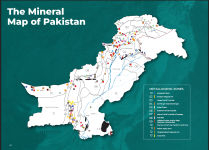
I didn't post this map because it's incomplete. I had notified Malik sb's team a while ago to update it. It has the zoning right. But it needs 2023-2024 geo testing updates on it. You'd have nearly 10-12 more sites, many in Punjab and a couple more in Sindh.
hydrabadi_arab
Trusted Member
I didn't post this map because it's incomplete. I had notified Malik sb's team a while ago to update it. It has the zoning right. But it needs 2023-2024 geo testing updates on it. You'd have nearly 10-12 more sites, many in Punjab and a couple more in Sindh.
Which is correct map then?
RajaBaja
Trusted Member
Which is correct map then?
I'll try to get it. But what I posted in black and white, even old, covers almost all the right minerals and host areas.
Samlee
Trusted Member
What are the "Pakistan's federal entities", exactly?
OGDCL PPL And GHPL.Three Blue Chip High Profit SOEs of Pakistan

ghazi52
THINK TANK: CONSULTANT
- Thread starter
- #98
Reko Diq wins $6b funding pledges
ADB, World Bank approve $1b; US, Japan, and others extend strong supportShahbaz Rana
August 23, 2025

Reko Diq wins $6b funding pledges. Photo: Express
ISLAMABAD: Reko Diq Mining Company is set to achieve financial close on the back of about $6 billion in indicative commitments, almost double the requirement. The package includes at least half a billion dollars in assurances by the United States.
Of the $6 billion in commitments, two multilateral lenders, the Asian Development Bank (ADB) and the World Bank Group, have already approved a little over $1 billion. The ADB approved $300 million for the Reko Diq Mining Company, which owns 100% of the world's fifth largest copper-gold mines in Balochistan, according to an announcement released by the Manila-based lender on Friday.
The ADB said the project will help meet rising global demand for critical minerals while unlocking economic development and poverty reduction in Pakistan.
The $300 million ADB financing indicates that Reko Diq will achieve financial close within months. It also signals to international private creditors to lend, according to people familiar with the matter.
Agreements with other lenders are expected soon to reach the $3.5 billion required for phase one of the $6.7 billion project, they added.
"Reko Diq will help the critical minerals supply chain, advance the clean energy transition and drive digital innovation across the region and beyond," said ADB President Masato Kanda after the board approved a $410 million package.
The ADB's contribution includes up to $300 million in loans to Reko Diq Mining Company Private Limited (RDMC) and a $110 million partial credit guarantee to cover the equity component of the Balochistan government, stated the ADB.
The project will mark the largest foreign direct investment in Pakistan's history, it added. Barrick Gold CEO Mark Bristow recently said the company was preparing a "G7 financing package" for the project. The mine is expected to begin production in 2028.
Earlier, Pakistan approved raising the first phase cost to nearly $6.7 billion, a 58% increase — by enhancing the scope of the strategically important scheme and accounting for inflationary impact and higher production needs.
As a result, the federal government's obligation for its 25% shareholding through three state-owned firms rose to $1.9 billion. The Balochistan government's obligation also increased to $1.1 billion.
Barrick Gold is responsible for arranging the remaining 50%.
Sources said the $6 billion in indicative commitments included $1.05 billion already approved by the World Bank Group and ADB. The US Export-Import (EXIM) Bank indicated a $500 million to $1 billion loan.
The US International Development Finance Corporation, Export Development Canada, and Germany's KfW have also promised loans. Guarantees have been offered by Euler Hermes, Finnvera Group, Swedish Export Credit Agency EKN, and Korean Exim Bank for $400 million.
Japan's Exim Bank has pledged $500 million while Australian Export Finance may extend up to $250 million, sources added.
However, final amounts will depend on the company's requirements. The mining firm now has the option to secure loans at highly competitive rates, they said.
"The ADB's support is also a game-changer for Pakistan, creating quality jobs and supporting the shift to a more resilient and diversified economy," said the ADB president.
hydrabadi_arab
Trusted Member
Reko Diq Mining Company is poised to finalise financing for its copper and gold project in Balochistan, with commitments totalling around $6 billion, nearly double the amount needed for phase one. The package includes at least $500 million in support from the United States, The Express Tribune reported.
Multilateral institutions have already approved over $1 billion, with the Asian Development Bank (ADB) providing $300 million in loans and a $110 million partial credit guarantee for the Balochistan government’s equity stake. The World Bank has also cleared its contribution, and additional funding is expected from the US Export-Import Bank, Japan’s EXIM, and other international agencies.
The financing will cover phase one of the $6.7 billion project, which had recently seen a 58% cost increase to account for inflation and expanded production plans. Under Pakistan’s 25% ownership through state firms, the federal government’s share rises to $1.9 billion while Balochistan’s contribution stands at $1.1 billion. Barrick Gold will provide the remaining 50% of funding.
ADB highlighted that the project will strengthen critical mineral supply chains, support energy transition, and contribute to regional digital infrastructure development. Officials expect the mine to generate thousands of jobs, stimulate local economies, and support education and healthcare initiatives, especially for women and nearby communities.
Construction began this year, including development of an open-pit mine and processing plant, with production expected to start in late 2028. The project will operate under strict environmental, social, and governance standards for at least 37 years. Initial output is projected at 800,000 tonnes of copper concentrate per year, addressing global supply shortfalls in a key material for renewable energy, electric vehicles, and digital technologies.
The feasibility study divides development into two phases: the first at 45 million tonnes of ore annually and the second doubling throughput to 90 million tonnes by 2034. With projected copper prices at $4.03 per pound and gold at $2,045 per ounce, the internal rate of return is estimated at 21.32%, with a payback period of six years and two months. Over the life of the mine, net cash flow could reach $70 billion.
The project has drawn interest from both the United States and China. It is also the first mining initiative supported by ADB under its new Critical Minerals to Manufacturing Value Chains framework, which aims to help Asia-Pacific countries capitalise on the growing demand for materials essential to clean energy and digital transformation.
Multilateral institutions have already approved over $1 billion, with the Asian Development Bank (ADB) providing $300 million in loans and a $110 million partial credit guarantee for the Balochistan government’s equity stake. The World Bank has also cleared its contribution, and additional funding is expected from the US Export-Import Bank, Japan’s EXIM, and other international agencies.
The financing will cover phase one of the $6.7 billion project, which had recently seen a 58% cost increase to account for inflation and expanded production plans. Under Pakistan’s 25% ownership through state firms, the federal government’s share rises to $1.9 billion while Balochistan’s contribution stands at $1.1 billion. Barrick Gold will provide the remaining 50% of funding.
ADB highlighted that the project will strengthen critical mineral supply chains, support energy transition, and contribute to regional digital infrastructure development. Officials expect the mine to generate thousands of jobs, stimulate local economies, and support education and healthcare initiatives, especially for women and nearby communities.
Construction began this year, including development of an open-pit mine and processing plant, with production expected to start in late 2028. The project will operate under strict environmental, social, and governance standards for at least 37 years. Initial output is projected at 800,000 tonnes of copper concentrate per year, addressing global supply shortfalls in a key material for renewable energy, electric vehicles, and digital technologies.
The feasibility study divides development into two phases: the first at 45 million tonnes of ore annually and the second doubling throughput to 90 million tonnes by 2034. With projected copper prices at $4.03 per pound and gold at $2,045 per ounce, the internal rate of return is estimated at 21.32%, with a payback period of six years and two months. Over the life of the mine, net cash flow could reach $70 billion.
The project has drawn interest from both the United States and China. It is also the first mining initiative supported by ADB under its new Critical Minerals to Manufacturing Value Chains framework, which aims to help Asia-Pacific countries capitalise on the growing demand for materials essential to clean energy and digital transformation.
Rationale
Registered Member

Which Chinese institution is involved in funding this or have they been frozen out in favour of the Americans ?Reko Diq Mining Company is poised to finalise financing for its copper and gold project in Balochistan, with commitments totalling around $6 billion, nearly double the amount needed for phase one. The package includes at least $500 million in support from the United States, The Express Tribune reported.
Multilateral institutions have already approved over $1 billion, with the Asian Development Bank (ADB) providing $300 million in loans and a $110 million partial credit guarantee for the Balochistan government’s equity stake. The World Bank has also cleared its contribution, and additional funding is expected from the US Export-Import Bank, Japan’s EXIM, and other international agencies.
The financing will cover phase one of the $6.7 billion project, which had recently seen a 58% cost increase to account for inflation and expanded production plans. Under Pakistan’s 25% ownership through state firms, the federal government’s share rises to $1.9 billion while Balochistan’s contribution stands at $1.1 billion. Barrick Gold will provide the remaining 50% of funding.
ADB highlighted that the project will strengthen critical mineral supply chains, support energy transition, and contribute to regional digital infrastructure development. Officials expect the mine to generate thousands of jobs, stimulate local economies, and support education and healthcare initiatives, especially for women and nearby communities.
Construction began this year, including development of an open-pit mine and processing plant, with production expected to start in late 2028. The project will operate under strict environmental, social, and governance standards for at least 37 years. Initial output is projected at 800,000 tonnes of copper concentrate per year, addressing global supply shortfalls in a key material for renewable energy, electric vehicles, and digital technologies.
The feasibility study divides development into two phases: the first at 45 million tonnes of ore annually and the second doubling throughput to 90 million tonnes by 2034. With projected copper prices at $4.03 per pound and gold at $2,045 per ounce, the internal rate of return is estimated at 21.32%, with a payback period of six years and two months. Over the life of the mine, net cash flow could reach $70 billion.
The project has drawn interest from both the United States and China. It is also the first mining initiative supported by ADB under its new Critical Minerals to Manufacturing Value Chains framework, which aims to help Asia-Pacific countries capitalise on the growing demand for materials essential to clean energy and digital transformation.
hydrabadi_arab
Trusted Member
Which Chinese institution is involved in funding this or have they been frozen out in favour of the Americans ?
No Chinese company is involved, only western investment in Reko Diq.
Rationale
Registered Member
Ok , the article said "The project has drawn interest from both the United States and China. ". So, I guess Pakistan chose United States over China for this one.No Chinese company is involved, only western investment in Reko Diq.


Distant_Observer
Trusted Member

8 trillion worth of minerals in Pakistan. This will become a very long thread over the years.
Samlee
Trusted Member
Potential of Cobalt Discovery in Gilgit-Baltistan
As a result of Regional Geochemical Survey conducted in the entire Gilgit-Balistan region by Pakistan Mineral Development Corporation Islamabad during 1991-2001, as much as 255Nos. of potential target areas (drainage catchment cells) have since been identified to contain anomalous amount of cobalt values. These values ranges up to 1458 grams/ton in association with copper, gold, silver other precious and base metals above the threshold value of 70 and 25 gm/ton already set for the pan concentrate and -80mesh fraction respectively for the entire Gilgit-Baltistan region by the Australian experts
Muhammad Yaqub Shah
Very rightly said by a renown investment advisor, Mr.Matt Bohlsen, “2016 was lithium’s year, 2017 might well be cobalt’s year”. Because the cobalt market has already gained a 20-years Compounded Annual Growth Rate of approximately 6% with a price of 55,500 USD/T in the international market as on 21st April 2017, whereas the production is also now greater than 100,000 metric tonnes per annum. This growth has been primarily due to the demand for cobalt in high performance rechargeable batteries which now accounts for more than 50% of consumption, up from 1% of a smaller market in the mid 1990’s. Cobalt delivers superior energy density for power, performance and charge life in lithium-ion batteries and is therefore a key ingredient in most cathode chemistries, including Lithium-Cobalt Oxide (“LCO”), Nickel-Cobalt-Aluminum (“NCA”) and Nickel-Manganese-Cobalt (“NMC”). Cobalt is also used in super alloys for aerospace applications, high strength alloys for cutting tools, cemented carbides, permanent magnets and surgical implants, pigments, catalysts, and additives in agricultural products.The cobalt market has switched into a supply deficit which is expected to continue as demand growth continues to overtake supply. Darton Commodities Limited is forecasting an approximately 11% Compounded Annual Growth Rate of battery demand for cobalt to 2022 – noting the impact of transformative automotive electrification. And whereas a typical smart phone battery contains between 5 and 20 grams of cobalt, EV batteries usually contain between 4,000 and 14,000 grams. Additionally, Tesla’s Giga factory in Nevada started commercial production earlier this year and will require more than 7000 tonnes of cobalt per annum when it reaches full production in 2018. Notably, more than 15 battery mega-factories have either been announced or are under construction globally to meet the future demand for Electric Vehicle’s and stationary storage cells.
In the light of the above explained situation, the Nucleus of Planners in Pakistan must give a priority to the exploration of cobalt as there are high potential target areas in the entire Country for exploration and development of this mineral commodity. All the ophiolite complexes in the Country stretching from North to South, including Waziristan Copper resource (containing 0.11% cobalt apart from copper, gold and silver in 35 million tons of ore) are the abodes of cobalt mineralization which are customarily found associated with other precious and base metals. Moreover, as a result of Regional Geochemical Survey conducted in the entire Gilgit-Balistan region by Pakistan Mineral Development Corporation Islamabad during 1991-2001, as much as 255Nos. of potential target areas (drainage catchment cells) have since been identified to contain anomalous amount of cobalt values. These values ranges up to 1458 grams/ton in association with copper, gold, silver other precious and base metals above the threshold value of 70 and 25 gm/ton already set for the pan concentrate and -80mesh fraction respectively for the entire Gilgit-Baltistan region by the Australian experts.
Amongst the aforementioned 255 nos. of target areas only in Gilgit-Baltistan region, the top most cobalt anomaly that needs distinction for its exploration at the outset is a specific catchment cell of about 4sq.km in Pakora valley of Gilgit-Baltistan as represented by a pan concentrate sample no. 50338 (Lat.36.3788280N & Long.73.8973090E) shown in the figure given below.

The chemical analysis of this sample (standardized to 100gms) contributes its results as under: –

The rock types observed within the catchment cell area are highly deformed, metamorphosed (up to green-schist facies) basalts, andesites and rhyolites intruded by quartz veins. Boulders, cobbles and pebbles of slates, conglomerates, sandstone, serpentinite, limestone, red shale and quartzite all representing melange zone rocks of the Northern Suture Zone (NSZ) have also been noticed in the float rocks of the catchment area’s small tributary. The prevalent geological environments within the area therefore augment its exploration for future mineral development in the entire region.
A possible accelerated approach in this context would be that Pakistan Council for Science and Technology (PCST) mandated to provide advice to the Government on policy issues regarding Science and Technology take initiative by recommending targeted exploration of this strategic mineral commodity along with other associated precious metals on fast track basis in the already known prospective areas of the Country. In this context it is worth mentioning here that PCST is already undertaking an exercise on technology foresight in the mineral sector. The purpose of this big idea initiated by PCST is to identify and respond to emerging opportunities in markets and technologies in the mineral industry of Pakistan. Therefore, being the highest Science & Technology policy forum, PCST must pay its role for bringing a breakthrough for the Nation.

PAMIR TIMES
As a result of Regional Geochemical Survey conducted in the entire Gilgit-Balistan region by Pakistan Mineral Development Corporation Islamabad during 1991-2001, as much as 255Nos. of potential tar…
 pamirtimes.net
Now That The World's Largest Producer DR Congo Has Extended Ban On Cobalt Exports This Mineral Will Become More Vital And Industrialized Countries Will Be Scrambling For It
DR Congo extends suspension of cobalt exports by three months
DR Congo extends suspension of cobalt exports by three months-
english.news.cn
Pakistan Has A Great Opportunity To Cash In On It
Users who are viewing this thread
Total: 3 (members: 0, guests: 3)
Pakistan Defence Latest
-
 PTI Murad Saeed in Afghanistan, was 'controlling KP govt' from there: Rana Sanaullah (1 Viewer)
- Latest: Meengla
-
-
-

-


