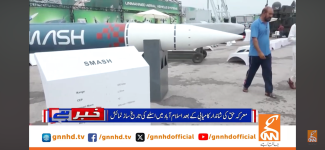
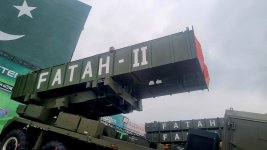
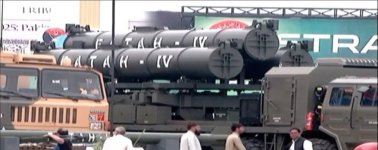
Pakistan Missiles - Updates, News & Discussion

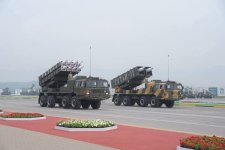
The critical issue is how many of these systems we can produce. Conflicts are decided upon intensity, achieving critical outcomes in the shortest time possible. The TELs are the key here, the more TELs we have, the more firepower per unit time, otherwise we'll need to spend time reloading, needing secure storage and support locations.
 
Key is to stop enemy incursion in the first place. Even then I'd say that 450,000 modernized & better trained army can better hold of and withstand and has better chances overall
Pakistan needs state-of-the-art ATGMs. There has to be a non-nuclear backup plan to "stop and push-back " if the enemy does break-through. In fact this has happened once before in the war in 1965 in the Battle of Dograi. Pakistan did have a civilian resistance force, but this was lightly armed with no capability to take on armored fighting vehicles , and suffered heavy casualties.
Ukraine showed how crews armed with advanced ATGMs ( Javelins , NLAWS) operating from strongpoints could stop an enemy armored offensive. The 40 km road to Kiev was littered with burning hulks of T-90 tanks and BMPs. The Russians were quick to learn the lesson, and used their Kornet and Schmel ATGMs from fixed defenses in the Suvorkin line blunting the Ukrainian armored offensive in the summer of 2023. Remarkably the Russian ATGM crews, destroyed " top-of-the-line" NATO standard heavy tanks ( M1A1 Abrams, Challenger, and Leopards) and also IFV such as Bradleys.
Pakistan's Baktar-Shikan is a wire guided ATGM which is unsuitable for combat in an urban environment.
Drones have taken over some of the jobs done by ATGMs but these are unsuitable for urban environments.
We are not sure if a Dograi like situation will happen again in the future. It is more than likely that MLRS systems and artillery would slow an enemy advance, but there should be a back-up plan.
 
The critical issue is how many of these systems we can produce. Conflicts are decided upon intensity, achieving critical outcomes in the shortest time possible. The TELs are the key here, the more TELs we have, the more firepower per unit time, otherwise we'll need to spend time reloading, needing secure storage and support locations.

Yeah, with cruise/supersonic missiles we may be falling into the trap of perfect being the enemy of good enough

Hypersonic is best no doubt, but even these can miss target and be intercepted (with greater difficulty obviously), but if we do not have mass we are screwed.

In a future war, as we have indicated, we may well "start East" and work our way slowly to the west of India. This is Gulf War 1 level stuff in terms of scale.

If not using fighters and artillery that far East you need to look at Indian assets and more importantly main air bases and HAS. 26 bases in Central and East India. Assume eaxch has on average 20 HAS, plus say radar and SAM installations. Approx we need 30 missiles per base. Now assume many get intercepted and some miss target, to take that into account we may need 50 missiles per base. so, 26 x 50 = 1,300 missiles just for Central and Eastern India. I have not ben started on Western India yet....
 
Yeah, with cruise/supersonic missiles we may be falling into the trap of perfect being the enemy of good enough

Hypersonic is best no doubt, but even these can miss target and be intercepted (with greater difficulty obviously), but if we do not have mass we are screwed.

In a future war, as we have indicated, we may well "start East" and work our way slowly to the west of India. This is Gulf War 1 level stuff in terms of scale.

If not using fighters and artillery that far East you need to look at Indian assets and more importantly main air bases and HAS. 26 bases in Central and East India. Assume eaxch has on average 20 HAS, plus say radar and SAM installations. Approx we need 30 missiles per base. Now assume many get intercepted and some miss target, to take that into account we may need 50 missiles per base. so, 26 x 50 = 1,300 missiles just for Central and Eastern India. I have not ben started on Western India yet....
1300 is a small number of missiles the force will compromise of Several divs, at minimum expect these missiles to be a few thousand to make any meaningful dent in indian defences and punish India in any meaningful way
 
1300 is a small number of missiles the force will compromise of Several divs, at minimum expect these missiles to be a few thousand to make any meaningful dent in indian defences and punish India in any meaningful way

Yeah, we literally needs thousands, possibly tens of thousands. Unsure how we afford that
 
Yeah, we literally needs thousands, possibly tens of thousands. Unsure how we afford that
Tens thousands is way out of our league and those aren't logical, missiles have life span of 10-15 yrs no need for that
A few thousand Capable CMs, BMs and HBM will do. Otherwise a separate command will lose its very purpose, no one can expect to punish an adversary like India with thousand or so missiles
 
Tens thousands is way out of our league and those aren't logical, missiles have life span of 10-15 yrs no need for that
A few thousand Capable CMs, BMs and HBM will do. Otherwise a separate command will lose its very purpose, no one can expect to punish an adversary like India with thousand or so missiles

Yeah, the only way we can really do this is such a massive and overwhelming wave within the first 24 hours to cripple the IAF.

Obviously the problem is in war the enemy also has a funny habit hitting back. That is why we need to combine a massive first wave missile strike with dispersal of PAF combat assets. If we are totally unleashed then so will be
 
Tens thousands is way out of our league and those aren't logical, missiles have life span of 10-15 yrs no need for that
A few thousand Capable CMs, BMs and HBM will do. Otherwise a separate command will lose its very purpose, no one can expect to punish an adversary like India with thousand or so missiles
Under the fear of nuclear strike from either side....the war will always be short lived ...max 4 days...your missile strike precision and selection of target is critical....
 
Yeah, with cruise/supersonic missiles we may be falling into the trap of perfect being the enemy of good enough

Hypersonic is best no doubt, but even these can miss target and be intercepted (with greater difficulty obviously), but if we do not have mass we are screwed.

In a future war, as we have indicated, we may well "start East" and work our way slowly to the west of India. This is Gulf War 1 level stuff in terms of scale.

If not using fighters and artillery that far East you need to look at Indian assets and more importantly main air bases and HAS. 26 bases in Central and East India. Assume eaxch has on average 20 HAS, plus say radar and SAM installations. Approx we need 30 missiles per base. Now assume many get intercepted and some miss target, to take that into account we may need 50 missiles per base. so, 26 x 50 = 1,300 missiles just for Central and Eastern India. I have not ben started on Western India yet....
Modern military science and technology are advancing rapidly. Many outdated concepts are gradually becoming blurred. Many of our traditional ideas are no longer applicable to current developments.
Regarding Pakistan's conventional missile development plan, my advice is:

Focus all technical resources on developing a universal missile technology platform.

1. Technology can be independently developed or purchased. The program does not allow for the procurement of any raw materials or components.
2. Don't pursue high performance figures. First, aim for 100% independent production, then gradually improve performance.

Common missile technology platform.
The various versions of missiles under this platform have a large number of common parts. By replacing different guidance heads and warheads, it can be transformed into a missile with different uses, and can be adapted to different launch vehicles such as air launch, land launch, and ship launch.

At the same time, Pakistan needs to invest more in basic research. For example:
1. Chemical industry (military high explosives and propellants).
2. Precision industry (ultra-small radar, guidance and control systems, etc.).
3. Composite materials.

Any country's technological capabilities in these disciplines are closely integrated between military and civilian applications. We can judge a country's military capabilities by its performance in the civilian sector.

Some countries claim their missiles are exceptionally powerful, developed and manufactured entirely independently. Yet, their civilian applications are utterly awful. In this case, they either have the backing of a mysterious superpower or are simply boasting......
 
Last edited:

Users who are viewing this thread

Country Watch Latest

Latest Posts

Back
Top