Pakistan-Saudi Arabia mutual defense pact: News & Discussion

Well that would depend on where you personally are living. 🙃

However, for the more serious folks on the call the simple fact is more smart people want to leave than stay and as they get success replacing lost skills becomes more and more difficult and scarce.
Everybody from the third world countries want to move into the first world, smart or not. Nobody is willing to wait for their third world country to become a first world country.

Parents who can, register their children in the "English schools" in the hope when they grow up, they could migrate to the first world with ease. That's how it is.

As of 2020-2021, there are 58 million children in various educational institutions in Pakistan. The country also has at least 220 universities. And, with 7.5 million babies born each year in Pakistan, I'm sure there isn't any shortage of new recruits, but there's definitely constant pressure for construction of more educational institutions year-after-year.
 
Although we're getting off track on this thread discussing brain drain and stuff, I'll point out one thing that a lot of people don't seem to understand. No one can deny that Pakistan's economy is stunted, and the country is suffering from mass poverty. The vast bulk of the 250 million population is living below the poverty line, if we consider poverty based on international standards.

If Pakistan's economy had grown at the same rate as China's between 1980 to 2025, Pakistan's economy would have been $3.88 TRILLION today, instead of $400 billion. Pakistan would have been a very prosperous country and, yes, the military budget would have been a lot larger. Given Pakistan's limitations I firmly believe that the economy would certainly have been $1.6 TRILLION, 4 times what it is now.

Instead of concentrating on economic growth, like China, Pakistan's rulers preferred to play international strategic games with USSR and USA.

So, instead of a $1.6 trillion economy we're sitting on a $400 billion economy. We're effectively losing $1.2 trillion is yearly productivity because of corruption and mismanagement.

People don't consider what Pakistan could have been. They think that patriotism requires them to say that everything is fine as it is.
A business person will tell you, when they invest in their product or in service, inventory they look to make a decent return. Some businesses find their niche and thrive. This is what could have happened with Pak, unfortunately the leaders invested in themselves and not the country. Had the investment been done properly the economy would have been much bigger.

Thing is the economy can be fixed, fundamentally its a people problem, bad policies, lack of proper investments and lack of security. Fix this and Pak has allot of potential. Goldman Sachs put Pak in 2075 as the 6th largest economy, this is because they see the potential if its realised.
 
Well, you can say whatever you feel about him.

But he is a popular vlogger and is considered well connected media person in Pakistan.
Not a personal attack on anyone, but when I hear the term "well connected" in the context of so called Pakistani Journalists/Vloggers, I think of human brain connected to the body, but then on the other hand asshole is also connected to the same body, does that make both the brain and the asshole the same intellectual level?
 
Not a personal attack on anyone, but when I hear the term "well connected" in the context of so called Pakistani Journalists/Vloggers, I think of human brain connected to the body, but then on the other hand asshole is also connected to the same body, does that make both the brain and the asshole the same intellectual level?
The vlogger is one of the very reputed ones in Pakistan. He doesn't just throw shit on others like many others sitting abroad after running from Pakistan.
 
Last edited:
I don't know about your own wiring/connections but the vlogger is one of the very reputed ones in Pakistan. He doesn't just throw shit on others like many others sitting abroad after running from Pakistan.
I genuinely did not mean to attack or insult you, but it seems to me that you have taken my post personally, and for that reason Let's agree to disagree.
 
West’s grip slips with Saudi–Pakistan security deal

Riyadh’s defense pact with Islamabad redraws alliances, weakens Indian leverage, and hints at a new Muslim deterrence framework beyond western control.

F.M. Shakil

SEP 23, 2025

a67c7978-9888-11f0-a2ee-00163e02c055.jpeg

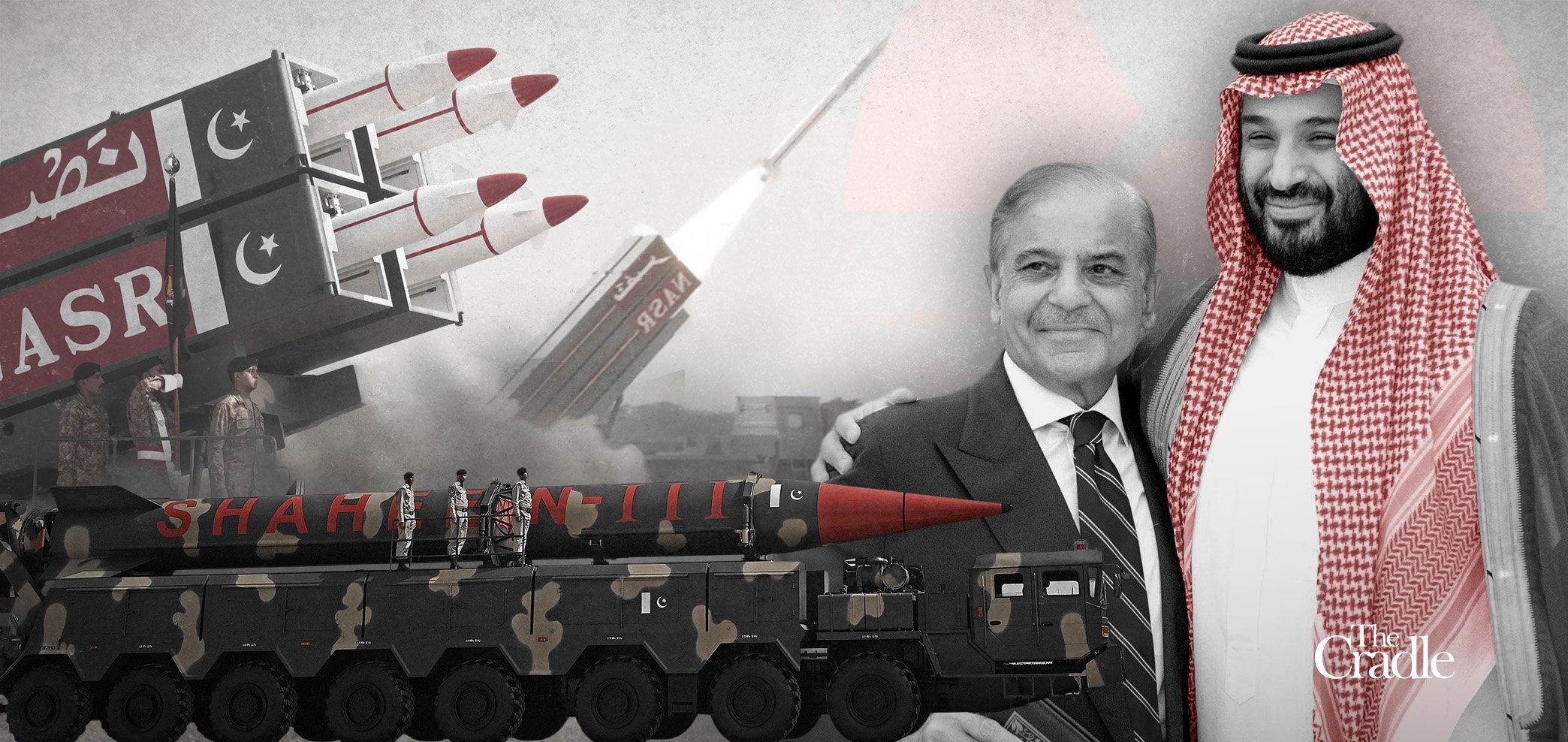
On 17 September, Riyadh rolled out the rare royal purple carpet for Pakistani Prime Minister Shehbaz Sharif – an honor previously reserved for global power players like US President Donald Trump.

Accompanying him on the trip was Pakistan’s Army Chief, Field Marshal Asim Munir. His presence highlighted that Riyadh values its defense pact with a nuclear power that, despite economic challenges, remains militarily strong.

Nuclear umbrella over Riyadh

The centerpiece of their visit was the signing of a “Strategic Mutual Defense Agreement” (SMDA), which declares that an attack on either country will be considered an attack on both.

Described by a senior Saudi official to Reuters as covering “all military means,” the pact has triggered speculation that it includes a nuclear umbrella, which would be a game-changing development in the military balance of West Asia.

With 81 percent of Pakistan's weapon imports coming from China, the agreement implicitly aligns Saudi Arabia with the Chinese military-industrial orbit, whether by design or default. The kingdom has long been reliant on US arms, training, and security guarantees.

The pact was signed just two days after an extraordinary joint session between the Arab League and the Organisation of Islamic Cooperation (OIC) was called, following the 9 September Israeli airstrikes on Qatar – a major non-NATO ally and Gulf neighbor – with no substantial response from Washington, reinforcing perceptions that western security commitments are both selective and expendable.

Mushahid Hussain Syed, a former information minister and chairman of Pakistan’s Senate Defense Committee, tells The Cradle that the US has pivoted away from Arab allies toward Tel Aviv, leaving the region disillusioned and increasingly leaning toward alternatives.

“The strategy of ‘Greater Israel,’ spearheaded by Netanyahu, has involved military actions against five more Muslim nations. Pakistan's recent triumph against India has demonstrated its capacity to contest Israel's significant ally, India, and establish itself as a strategic alternative for Gulf nations.”
Toward an Islamic NATO?

Iraqi Prime Minister Mohammed Shia al-Sudani recently called for an Islamic military alliance, akin to NATO, in response to Israel’s airstrike on Doha. His proposal echoed Egypt’s earlier attempt to revive a joint Arab defense force under the 1950 treaty – an initiative blocked by Qatar and the UAE, reportedly under US pressure.

A similar proposal has also come from Islamabad when Pakistan's Defense Minister, Khawaja Asif, urged Muslim countries to band together in a NATO-like military alliance in light of the Israeli aggression in Doha.

During an appearance on Geo TV last week, Asif drove home the point that a united Muslim military front is essential to tackle common security issues and fend off outside dangers. Asif invoked the wider role of the west in instigating instability in West Asia, emphasizing the intricate network of US support for Al-Qaeda and the CIA's covert actions that led to Osama bin Laden's relocation to Sudan or the regime change war in Syria.

Is nuclear deterrence a part of the Pact?

The nuclear dimension of the Riyadh–Islamabad pact remains opaque, but highly significant. While no official statement from either side confirms the presence of a nuclear component, Asif hinted that Pakistan's nuclear capabilities could be shared with Saudi Arabia as part of the agreement.

Syed, however, clarifies to The Cradle that Pakistan's nuclear doctrine is India-centric and that its deterrence posture is South Asia-specific and does not extend to the Persian Gulf.

“A novel security framework for the region appears to be taking shape, focusing on Global South nations such as Pakistan and Saudi Arabia, whereas the Indo-Israeli Axis, previously supported by the US, now finds itself significantly diminished.”
The defense agreement between Pakistan and Saudi Arabia, he says, represents a notable achievement for Pakistan, establishing it as a pivotal entity within the geopolitical framework of West Asia, particularly among Muslim countries.

“The agreement is shaped by three significant elements: the perceived neglect of Arab allies by the United States, Israel's proactive maneuvers in areas such as Iran, Qatar, Lebanon, Syria, and Yemen, and Pakistan's recent triumph over India in May.”
New Delhi, Tel Aviv on alert

Foreign media and analysts are already warning that the pact may have unintended consequences for India and Israel, despite claims that it targets neither. Others predict that this pact is really about Riyadh’s ambitions to counter Iran and Yemen's Ansarallah-led government in the region.

Dr Abdul Rauf Iqbal, a senior research scholar at the Institute for Strategic Studies, Research and Analysis (ISSRA) at Islamabad's National Defence University (NDU), tells The Cradle that New Delhi views the pact with unease as it formalizes Saudi–Pakistani security ties that could entangle Riyadh in South Asian rivalries, especially the India–Pakistan border tensions over Jammu and Kashmir:

“It represents a setback for Prime Minister Modi's foreign policy, potentially leading to Saudi involvement in a prospective Indo–Pak conflict. Furthermore, future Saudi investments in Pakistan's Gwadar port and economic corridors would challenge India's regional influence and initiatives such as the India-Middle East-Europe Corridor (IMEC).”
He adds that Saudi Arabia's pivot toward Pakistan reflects a broader alignment of Muslim powers and could push Tel Aviv to recalibrate its war on Gaza. It also pressures Tel Aviv by placing Pakistan – a vocal opponent of Israeli expansionism – into West Asian affairs.

“This agreement is not meant to counterbalance Iran's regional influence, but rather to promote the Saudi Iranian reconciliation, as Pakistan maintains friendly relations with both nations. By formalizing ties with nuclear-armed Pakistan, Riyadh secures a credible deterrent as US security guarantees weaken. While western think tanks view it as an effort to contain Iran, the Arab world emphasizes it as strengthening Gulf deterrence independently of Washington.”
Indian concerns also stem from fears that the pact’s NATO-style clause could complicate ongoing operations like Sindoor, which remains active in a limited capacity following the skirmish between the two nuclear powers in May, especially given that the Gulf states’ swift mediation to resolve the crisis reflects their own interests with India and makes any military action against it unlikely.

Secondly, India is strategically analyzing Pakistan's nuclear capability, which could see a boost if Saudi Arabia, having no such capacity, begins channeling funds to share Pakistan’s nuclear assets.

A post-western Gulf order?

While Tel Aviv and New Delhi remain publicly silent, both capitals are undoubtedly scrutinizing the fallout. Israel's failed assassination attempt on Hamas leaders in Qatar, and India’s pressure campaign along the Line of Control, suggest that the axis is nervous about the consequences of a Saudi–Pakistani alliance. Israeli media downplayed the Saudi–Pakistan defense deal, seeing it as a show of force after Riyadh failed to influence Trump or West Asian policy.

As Syed notes, “The traditional ‘Oil for Security’ framework, which once defined US relations with the Middle East [West Asia], now serves as a remnant of a bygone era. As Saudi economic power increasingly reinforces China's backing of Pakistan, India may feel vulnerable and isolated.”

Mark Kinra, an Indian geopolitical analyst with a focus on Pakistan and Balochistan, tells The Cradle that this development holds particular significance for India. New Delhi, he argues, has sustained robust economic and diplomatic ties with Saudi Arabia for many years, and the influx of Saudi investments in India continues to expand:

“India will be meticulously observing the progression of this agreement, particularly given that its specific terms are not publicly available. Any alteration in the regional security equilibrium may influence India's strategic assessments, energy security, and diplomatic relations.”
As Washington’s selective security guarantees falter and Israel escalates unchecked, Persian Gulf states like Saudi Arabia are looking eastward for credible deterrents and strategic autonomy.

By aligning with nuclear-armed Pakistan, Riyadh is asserting greater independence from the western military order. It also signals the emergence of a multipolar Persian Gulf security architecture –one increasingly shaped by Global South coordination, not western diktats.

 
West’s grip slips with Saudi–Pakistan security deal

Riyadh’s defense pact with Islamabad redraws alliances, weakens Indian leverage, and hints at a new Muslim deterrence framework beyond western control.

F.M. Shakil

SEP 23, 2025

View attachment 149010

On 17 September, Riyadh rolled out the rare royal purple carpet for Pakistani Prime Minister Shehbaz Sharif – an honor previously reserved for global power players like US President Donald Trump.

Accompanying him on the trip was Pakistan’s Army Chief, Field Marshal Asim Munir. His presence highlighted that Riyadh values its defense pact with a nuclear power that, despite economic challenges, remains militarily strong.

Nuclear umbrella over Riyadh

The centerpiece of their visit was the signing of a “Strategic Mutual Defense Agreement” (SMDA), which declares that an attack on either country will be considered an attack on both.

Described by a senior Saudi official to Reuters as covering “all military means,” the pact has triggered speculation that it includes a nuclear umbrella, which would be a game-changing development in the military balance of West Asia.

With 81 percent of Pakistan's weapon imports coming from China, the agreement implicitly aligns Saudi Arabia with the Chinese military-industrial orbit, whether by design or default. The kingdom has long been reliant on US arms, training, and security guarantees.

The pact was signed just two days after an extraordinary joint session between the Arab League and the Organisation of Islamic Cooperation (OIC) was called, following the 9 September Israeli airstrikes on Qatar – a major non-NATO ally and Gulf neighbor – with no substantial response from Washington, reinforcing perceptions that western security commitments are both selective and expendable.

Mushahid Hussain Syed, a former information minister and chairman of Pakistan’s Senate Defense Committee, tells The Cradle that the US has pivoted away from Arab allies toward Tel Aviv, leaving the region disillusioned and increasingly leaning toward alternatives.


Toward an Islamic NATO?

Iraqi Prime Minister Mohammed Shia al-Sudani recently called for an Islamic military alliance, akin to NATO, in response to Israel’s airstrike on Doha. His proposal echoed Egypt’s earlier attempt to revive a joint Arab defense force under the 1950 treaty – an initiative blocked by Qatar and the UAE, reportedly under US pressure.

A similar proposal has also come from Islamabad when Pakistan's Defense Minister, Khawaja Asif, urged Muslim countries to band together in a NATO-like military alliance in light of the Israeli aggression in Doha.

During an appearance on Geo TV last week, Asif drove home the point that a united Muslim military front is essential to tackle common security issues and fend off outside dangers. Asif invoked the wider role of the west in instigating instability in West Asia, emphasizing the intricate network of US support for Al-Qaeda and the CIA's covert actions that led to Osama bin Laden's relocation to Sudan or the regime change war in Syria.

Is nuclear deterrence a part of the Pact?

The nuclear dimension of the Riyadh–Islamabad pact remains opaque, but highly significant. While no official statement from either side confirms the presence of a nuclear component, Asif hinted that Pakistan's nuclear capabilities could be shared with Saudi Arabia as part of the agreement.

Syed, however, clarifies to The Cradle that Pakistan's nuclear doctrine is India-centric and that its deterrence posture is South Asia-specific and does not extend to the Persian Gulf.


The defense agreement between Pakistan and Saudi Arabia, he says, represents a notable achievement for Pakistan, establishing it as a pivotal entity within the geopolitical framework of West Asia, particularly among Muslim countries.


New Delhi, Tel Aviv on alert

Foreign media and analysts are already warning that the pact may have unintended consequences for India and Israel, despite claims that it targets neither. Others predict that this pact is really about Riyadh’s ambitions to counter Iran and Yemen's Ansarallah-led government in the region.

Dr Abdul Rauf Iqbal, a senior research scholar at the Institute for Strategic Studies, Research and Analysis (ISSRA) at Islamabad's National Defence University (NDU), tells The Cradle that New Delhi views the pact with unease as it formalizes Saudi–Pakistani security ties that could entangle Riyadh in South Asian rivalries, especially the India–Pakistan border tensions over Jammu and Kashmir:


He adds that Saudi Arabia's pivot toward Pakistan reflects a broader alignment of Muslim powers and could push Tel Aviv to recalibrate its war on Gaza. It also pressures Tel Aviv by placing Pakistan – a vocal opponent of Israeli expansionism – into West Asian affairs.


Indian concerns also stem from fears that the pact’s NATO-style clause could complicate ongoing operations like Sindoor, which remains active in a limited capacity following the skirmish between the two nuclear powers in May, especially given that the Gulf states’ swift mediation to resolve the crisis reflects their own interests with India and makes any military action against it unlikely.

Secondly, India is strategically analyzing Pakistan's nuclear capability, which could see a boost if Saudi Arabia, having no such capacity, begins channeling funds to share Pakistan’s nuclear assets.

A post-western Gulf order?

While Tel Aviv and New Delhi remain publicly silent, both capitals are undoubtedly scrutinizing the fallout. Israel's failed assassination attempt on Hamas leaders in Qatar, and India’s pressure campaign along the Line of Control, suggest that the axis is nervous about the consequences of a Saudi–Pakistani alliance. Israeli media downplayed the Saudi–Pakistan defense deal, seeing it as a show of force after Riyadh failed to influence Trump or West Asian policy.

As Syed notes, “The traditional ‘Oil for Security’ framework, which once defined US relations with the Middle East [West Asia], now serves as a remnant of a bygone era. As Saudi economic power increasingly reinforces China's backing of Pakistan, India may feel vulnerable and isolated.”

Mark Kinra, an Indian geopolitical analyst with a focus on Pakistan and Balochistan, tells The Cradle that this development holds particular significance for India. New Delhi, he argues, has sustained robust economic and diplomatic ties with Saudi Arabia for many years, and the influx of Saudi investments in India continues to expand:


As Washington’s selective security guarantees falter and Israel escalates unchecked, Persian Gulf states like Saudi Arabia are looking eastward for credible deterrents and strategic autonomy.

By aligning with nuclear-armed Pakistan, Riyadh is asserting greater independence from the western military order. It also signals the emergence of a multipolar Persian Gulf security architecture –one increasingly shaped by Global South coordination, not western diktats.

First Indian defeat and humiliation by Pakistan shook the global power equations and now Riyadh’s defense pact with Islamabad redraws alliances. MashaAllah. What's going on, people?
 
Irrelevant to what I was talking about but I will still bite

I was speaking of different camps in ME. Qatar and KSA aren't part of the same camp.

And by the same camp I don't mean those in the same camp will defend each other. For example, Qatar, Turkey and Syria are the same camp but Turkey defends neither Qatar nor the Israeli invasion of Syria. They don't have actually pacts.

Same in KSA camp. UAE abandoned them in Yemen midway and started backing the separatists while Saudis are attempting to keep the country together with "govt forces". This third pole in Yemen has made peace talks an impossible riddle.

It is in this background I was saying that it is very unlikely KSA will grant a veto to a country like Qatar it had blockaded few years ago, by letting it join Pak Saudi agreement with a veto power.

Would you complain if India invaded Pakistan and China did not do anything?
 
This will probably mark the begining of defanging Pakistan from its nukes. Prior to this accord, the Pak military went out of its way to emphasise that its nuke deterrent was solely aimed at India, not any other country, i.e. Israel. Now with the potential of placing nukes in Saudi aimed at Israel, the Zionists and Americans are already devising plans to defang Pakistan. There was an incident with Biden where they commented their concerns of Pak nukes and the Pak foreign office was up in arms...what do you think this move will do in the corridors of power in Washington? You can forget about Trump, he's just there for the clown show. The deep state in the US is probably in full swing running its strategies to come up with the best solution. You can effectively say bye bye to Pak nukes .
- Provision of Nuclear Umbrella does not mean nuclear warheads will stored at foreign soils.

- Nuclear weapons are not the weapons of first choice but the weapon of "last resort" which means Pakistan expect the to neutralize "any aggression" before any such situations arises either with conventional mean or by diplomacy or by use of both.

- This simply mean from now on Pakistan conventional war fighting capabilities would increased to such level where the need to use Nuclear weapons would not be required. This mean Pakistan's Nuclear Threshold would be increased to the maximum rather decreasing.

- This alone shows that Pakistan now will behave more as a "Normal State" in case if facing any aggression rather than desperate state with "nuclear suicidal tendencies"

- This development would not only bring stability at strategic level but would also bring "more stability in terms of Pakistan conventional war fighting capabilities in result this development would make region less pron for sub-conventional tactics against its rivals.

- Now Pakistan as an State would be more active Diplomatically for all the regional issues concern to its allies and to its own state, which would have preference over war fighting. Which further mean more stability and an additional stage before going militarily active.

- This also mean regional adversaries should also change their approach to deal with Pakistan, as it is changing itself for the stability of "both regions"
 
Last edited:
Iraq, Iran, Qatar, Syria, Jordan, Egypt all thought the same...the Zionists will never accept any state potentially aiming nukes at them, and big daddy Zionist is more than happy the make that happen.
But the question is what can they do ??? Now we have more pressing issues (economy, Political Stability and Social coherence) within the state boundaries then an enemy who could attempt to defang Pakistan.
 
Yasser mate maybe I'm being too 'doomsdayish' but you have to look at precedent, in our hubris we often make mistakes that become our undoing. One only has to look at what they did to Iraq, and let's face it, Iran turned out to be a paper tiger. Their plans run across generations and they play the long game.
Nothing wrong in your opinion infact your observations are genuine and need consideration. There is nothing doomsday type scenario in your post.
 
My take on reports of more Mutual Defense Agreements with other countries

To view this content we will need your consent to set third party cookies.
For more detailed information, see our cookies page.

wah wah wah wah koa kehne kia kehne dil ki bat ki ha .sir g
 
  • Like
Reactions: HRK
To view this content we will need your consent to set third party cookies.
For more detailed information, see our cookies page.


More sources coming in, Saudi rejected Indian meeting invitation at UNGA.


Update: Shebhaz Sharif had bilateral meeting w/Trump at UNGA. In addition, to the broader meeting with Muslim countries and Trump.


The Indians are very desperate.
 
- Provision of Nuclear Umbrella does not mean nuclear warheads will stored at foreign soils.

- Nuclear weapons are not the weapons of first choice but the weapon of "last resort" which means Pakistan expect the to neutralize "any aggression" before any such situations arises either with conventional mean or by diplomacy or by use of both.

- This simply mean from now on Pakistan conventional war fighting capabilities would increased to such level where the need to use Nuclear weapons would not be required. This mean Pakistan's Nuclear Threshold would be increased to the maximum rather decreasing.

- This alone shows that Pakistan now will behave more as a "Normal State" in case if facing any aggression rather than desperate state with "nuclear suicidal tendencies"

- This development would not only bring stability at strategic level but would also bring "more stability in terms of Pakistan conventional war fighting capabilities in result this development would make region less pron for sub-conventional tactics against its rivals.

- Now Pakistan as an State would be more active Diplomatically for all the regional issues concern to its allies and to its own state, which would have preference over war fighting. Which further mean more stability and an additional stage before going militarily active.

- This also mean regional adversaries should also change their approach to deal with Pakistan, as it is changing itself for the stability of "both regions"
Excellent post, but I would like to add something here, and its a bit far stretch but we do know that Israeli's and Pakistan has met behind the doors and even done some conversations, according some members that Israel even help Pakistan with some F-16's spare parts but even if its not the case but we do know that KSA/GCC were in talks of normalization ties with Israel, and maybe just maybe a draft was presented to Israeli's to create a Palestinian state with no Hamas and in return KSA/Pakistan will officially recognize Israel and that will mark the end of a 70 year old conflict until Israel got a crazy Puta back in Power.

Pakistan's pact with KSA although shows that Attack on Qatar really hurt Arab's Golden Egos, and rightly so because they were hoping that At least America will save them from the IDF, Netanyahu is a wild crazy card and sooner or later he will be gone from Power but I think the smart Israeli's already working on the After bibi Israel where a Defacto Palestinian state can be created with some Peace keeping force in Gaza, just like South Lebanon. In fact If Israel didn't have expansionist plans than giving Palestinian Statehood will secure Jewish state for centuries to come because if you think about it Israel & Palestinian have no enemies outside world, Palestine state will have All the Arabs and their money, they can develop the state, and Palestine can be a highly educated beautiful ME small country, while Israel enjoys the support of the entire West so once Palestine state is secure those 2 countries will probably be the most secure and prosper countries surround by indeed poor/unstable countries but I doubt that Lebanon, Syria or Cyprus has any plans to attack any of these 2 states.

Pakistan's in all this can provide a balancing power, its not just to protect the kingdom but also make sure that Iranian proxies remain in check, PA contingent in KSA or lets say in Gaza will ensure that no Iranian proxy ever take hold, and as much as our Jazbati awam wants to believe a few thousand small Contingent of Pakistan and some other country's Army is no threat to Israel because they will enjoy the un-match Air superiority even if PAF is stationed there, Israel AF is basically a Smaller American Air force. History we do have a precedent that PA did put down a Palestinian uprising in Jordan, Israel maybe uncomfortable with Egyptian or Turkish forces guarding Gaza due to their Main land close proximities, meaning any force belonging to Egypt/Turkish will get a quick back-up while PA soldiers will not have that luxury no matter how many soldiers we put in KSA or how many Sq's of fighter jets we stationed there, so PA soldiers if allowed in Gaza will only be there to work as protecting the Gaza's and keeping the order, making sure no other Khamas or Hamas types emerge again which will again be a checkmate from the Israeli's.

Lastly, I don't think that we will see a Arab NATO, the time for that is already came and gone, I mean attack on Qatar was the golden opportunity of a life time and Arabs wasted it, world would've no say or have ZERO concern if GCC signed a biding pact after the attack, EU and almost every country condemn Israel's reckless acts. There is not much we can say about things for sure except making calculated guesses but one thing for sure that the region is changing rapidly... if you just see the events unfold after Oct 7th Attack its crazy, Israel's vulnerability was out in the open, USA bullying was very apparent, Law/Order based world was dead, but now the world can see that even after the creation of UN, we still live with might is right system, GCC slowly but realizing that America is no friend, and will bomb and let others bomb them if they did not tow the line, ICC/ICJ and even UN is getting sanctioned now and Iran getting bombed, all that bravado of Iranian invincibility is gone, India getting the Arse handed to them, Chinese weapons made debut, Syria is basically gone as a united country, and worse of all now the world and Americans saw and realize how much their country/Politicians have been compromised by Israel/MOSSAD, from the liberal Democrats to hard core right wing Republicans, At this point it wont be wrong to say that Israel is running the USA foreign policy and I know some people say Israel runs US Foreign policy for just Middle East but I think they run it in its entirety.
 
  • Like
Reactions: HRK

Users who are viewing this thread

Pakistan Defence Latest

Latest Posts

Back
Top